
By David Hornung, Co-Founder & Principal Designer, D&J Concepts
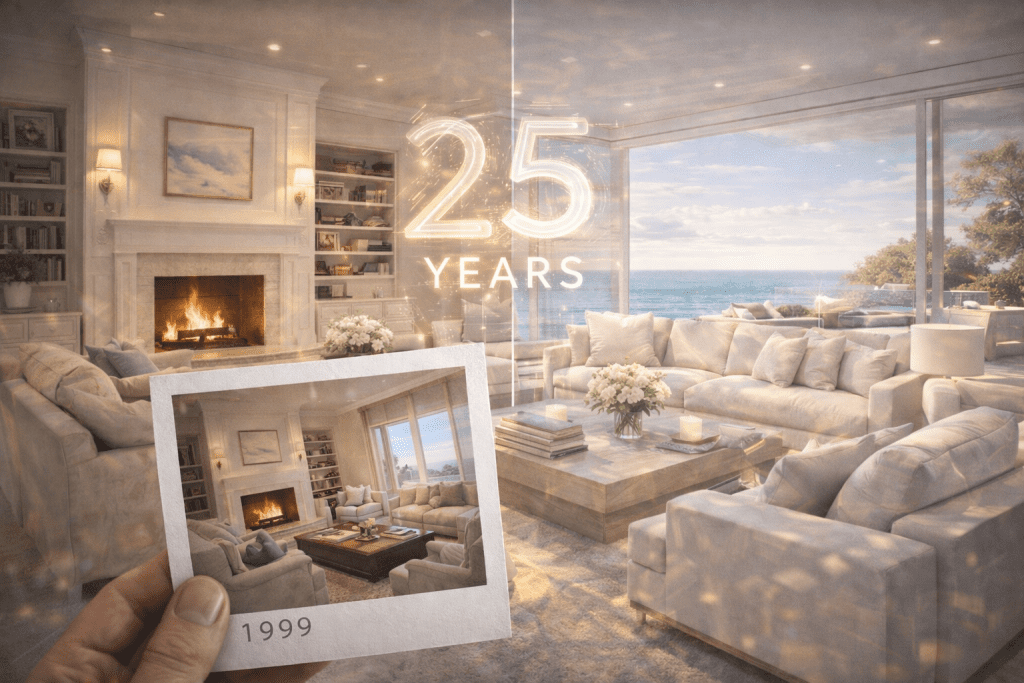
D&J Concepts was founded in 2001. Twenty-five years later, David Hornung can walk through his earliest projects and identify which rooms still work. Not which rooms look dated, because every room from 2001 reflects its era in some way. Which rooms still function beautifully, still satisfy their inhabitants, still feel correct despite two decades of shifting taste. Those rooms share five characteristics. Rooms that required renovation within ten years share five different characteristics. The pattern is consistent enough to constitute timeless design principles worth documenting.
Understanding what lasts is not nostalgia. It is investment intelligence. A client spending $5 million on a renovation deserves to know which decisions will still deliver satisfaction in 2041 and which will require replacement by 2033. After 25 years of building the evidence, Hornung can answer that question with specificity that most designers cannot match.
Principle One: Natural Materials Outlast Engineered Alternatives
Every project from D&J’s first decade that specified natural stone floors remains beautiful today. Not unchanged, but beautiful. Calacatta marble in a 2003 Southampton kitchen has developed a soft warmth that the homeowner describes as the room getting comfortable. Rift-cut oak floors from a 2005 East Hampton renovation have deepened to a honey tone that the original specification could not have predicted and the homeowner would not trade for new material.
In contrast, every project from the same era that specified engineered stone countertops has required replacement. Composite materials from that period yellowed under UV exposure within eight years. Engineered stone showed micro-scratches that revealed the substrate within a decade. These materials were specified for consistency and durability. They delivered consistency for approximately eight years, then failed. Natural stone, specified for beauty and accepted with its maintenance requirements, outperformed them by a factor of two.
Steve Chase knew this intuitively. His material selections in Palm Springs, made 40 years ago, remain relevant today because he chose surfaces that age honestly. Interior Design Magazine’s retrospectives on Chase’s work consistently highlight material longevity as a defining characteristic of his practice. D&J Concepts applies this timeless design principle to every specification: natural materials that develop character over time outperform engineered materials that resist change until they cannot.
Principle Two: Proportion Survives Fashion
Rooms with correct proportional relationships between ceiling height, room dimensions, and furniture scale remain comfortable regardless of decorative style. A living room with 10-foot ceilings, properly proportioned millwork, and furniture scaled to the room’s volume feels right whether furnished in mid-century modern, traditional, or contemporary style. Swap the furniture entirely, and the room still works.
Rooms with proportional errors never feel right regardless of investment. A 20-foot ceiling in a 16-foot-wide room creates vertical imbalance that no furniture arrangement resolves. An 8-foot ceiling in a 30-foot room produces horizontal compression that expensive finishes cannot overcome. Harvard Business Review’s environmental psychology research confirms that spatial proportion affects occupant comfort at subconscious levels that decorative choices cannot override.
D&J Concepts resolves proportional relationships during the architectural phase, before interior design begins. Adding height to a doorway, adjusting ceiling details, or modifying room dimensions by even 12 inches can transform a room’s fundamental character. These changes cost relatively little during design but are prohibitively expensive after construction.
Principle Three: Lighting Flexibility Outlasts Fixed Schemes
Every fixed lighting scheme from D&J’s early projects has been modified. Every flexible lighting system remains in service. The distinction is straightforward: fixed schemes optimize for one use scenario. Flexible systems accommodate the inevitable evolution in how inhabitants actually use their rooms.
Comprehensive dimming on independent circuits, multiple switching zones within each room, and provision for accent lighting additions are the three elements that define flexible lighting infrastructure. The fixtures themselves are replaceable. The wiring, switching, and control infrastructure is not. Investing in flexible infrastructure during construction enables decades of lighting evolution without opening walls.
Principle Four: Storage Prevents Deterioration
Rooms with insufficient storage deteriorate aesthetically regardless of their design quality. Books pile on surfaces. Blankets drape over chairs. Remote controls cluster on coffee tables. The visual noise of daily life gradually overwhelms designed spaces that lack adequate concealment for the objects that daily life produces.
D&J Concepts designs storage into every room during the architectural phase. Built-in millwork that conceals media equipment, closets within living rooms for seasonal textiles, and kitchen pantries sized for actual grocery volumes prevent the accumulation that degrades interiors over time. The rooms that still look designed after 25 years of occupancy share generous, well-planned storage. Without exception.
Principle Five: Client Authenticity Produces Longevity
The rooms that last are rooms designed for how clients actually live rather than how they aspire to live. A kitchen designed for a client who genuinely cooks outperforms a kitchen designed for a client who wants to appear to cook. A living room designed for a family that watches television together outperforms one designed for magazine photography.
The best timeless design principles ultimately rest on honesty. Clients who communicate their actual habits to their designer receive rooms that serve those habits for decades. Those who perform aspirational versions of themselves receive rooms that serve the performance for approximately three years before reality asserts itself.
The Investment Perspective
Understanding timeless design principles as investment strategy changes how clients evaluate design decisions. Every specification falls into one of three categories: permanent infrastructure, semi-permanent finishes, and replaceable decorative elements. The 25-year evidence demonstrates that investing disproportionately in permanent infrastructure, moderately in semi-permanent finishes, and conservatively in replaceable elements produces the best long-term outcomes.
Permanent infrastructure includes floor plans, ceiling heights, window positions, plumbing locations, and electrical capacity. These elements cost the most to change after construction and determine the room’s fundamental character for the life of the building. Semi-permanent finishes include stone floors, millwork, and built-in cabinetry. These elements last 15 to 30 years before requiring attention and should be selected for endurance rather than trend alignment.
Replaceable decorative elements include paint colors, upholstery fabrics, lighting fixtures, and decorative accessories. These elements have natural lifespans of 5 to 15 years and should be selected with the understanding that replacement is inevitable and healthy. Rooms designed with excellent permanent infrastructure and semi-permanent finishes can absorb decorative updates without renovation. Rooms with compromised infrastructure require full renovation regardless of decorative investment.
Knight Frank’s research on luxury property values confirms that homes with excellent spatial quality and material integrity command premiums regardless of decorative condition. Buyers recognize good bones. They also recognize when expensive finishes have been applied to fundamentally flawed spaces. The timeless design principles documented here optimize for the characteristics that drive lasting value.
D&J Concepts structures the design process to extract authenticity rather than aspiration. The Visual Clarity Method includes detailed lifestyle interviews that probe daily routines, entertaining patterns, and domestic habits with specificity that mood board presentations never require. The information may feel mundane during the interview. Twenty-five years of evidence demonstrates that it is the most valuable input the design process receives.
Start Your Design Conversation
D&J Concepts brings 25 years of luxury residential design experience to every project. The Method of Visual Clarity ensures your vision is resolved before construction begins. Contact Social Life Magazine for features, advertising, or partnership inquiries. Visit polohamptons.com for event tickets and sponsorship opportunities.
Subscribe to Social Life Magazine for ongoing design intelligence. Join our email list for exclusive content. Support independent Hamptons journalism with a $5 contribution.
Read more: The Complete Guide to Luxury Home Design and Sister Parish to Now: Quiet Luxury Won the Hamptons.
David Hornung co-founded D&J Concepts in 2001 after training under Interior Design Hall of Fame inductee Steve Chase in Los Angeles. From Southampton headquarters, D&J serves clients across the Hamptons, Manhattan, Palm Beach, and Southern California. A member of the Society of Design Administration, Hornung brings 25 years of luxury residential design experience to every project. Discover the Visual Clarity Method at dandjconcepts.com.
Author

Written by
Recent Posts
The Real Reason Smart, Motivated People Don’t Follow Through
Simple Eating Habits That Boost Your Wellness
When to Seek Professional Support for Persistent Mental Health Symptoms
Creative Strategies Couples Use to Pay for Their Big Day
How International SEO Helps Brands Succeed Across Borders
Categories
- 2025 Social Life Events
- Access to Digital + Physical Magazine
- Art
- Articles
- Beauty & Skincare
- Beauty & Wellness
- Business Strategy
- Celebrities
- Chronicles
- Design History
- Design History|Hamptons
- Design Process
- Design Trends
- Event Photos
- Events
- Family
- Fashion
- Fashion & Style
- Featured
- Food & Beverage
- Food, Spirits, Wine
- Hamptons
- Hamptons Celebrities
- Hamptons Design
- Health
- Health & Beauty
- Home & Design
- Home & Living
- Lifestyle
- Luxury Home Design|Design Process
- Luxury Home Design|Design Trends
- Luxury Home Design|Hamptons Design
- Luxury Home Design|Interior Design
- Luxury Lifestyle
- Luxury Living
- Luxury Living|Design Process
- Luxury Living|Hamptons
- Luxury Living|Hamptons Design
- Press
- Profiles
- Real Estate
- Technology
- The Chronicles
- Travel
- Trending
- Uncategorized
- Weddings
- Wellness