
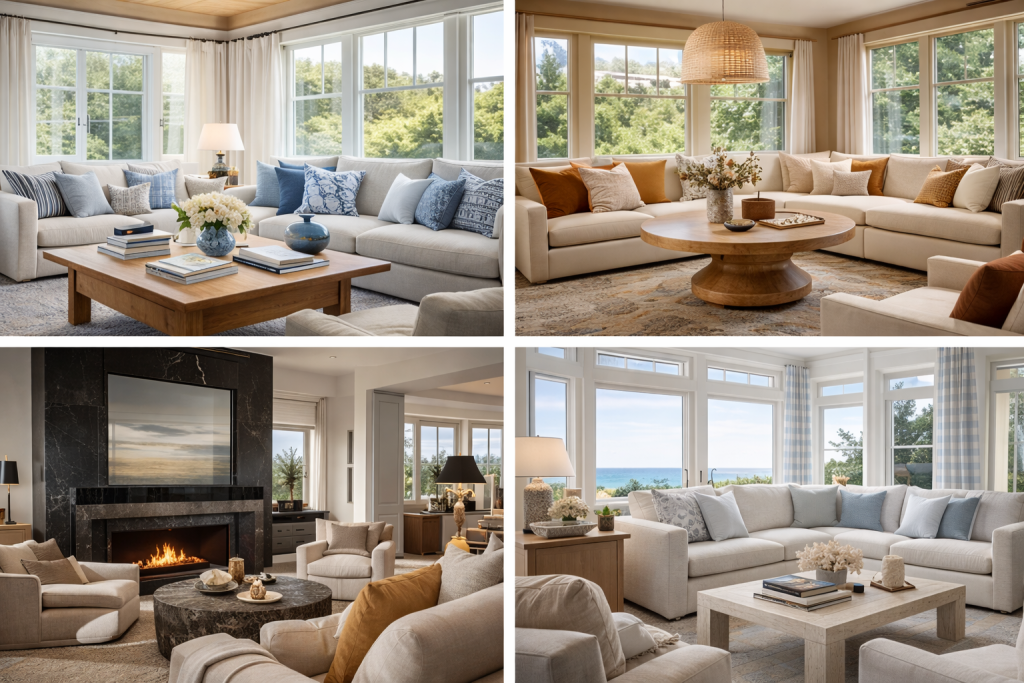
By David Hornung, Co-Founder & Principal Designer, D&J Concepts
The Hamptons produce their own light. Atlantic reflection, coastal humidity, and the particular quality of East End sky create a luminous environment that transforms color in ways that no paint chip can predict. Luxury color trends in national shelter magazines rarely account for this phenomenon. As a result, designers who apply Manhattan palettes to Southampton interiors produce rooms that feel subtly wrong. No one can quite articulate why. After 25 years of specifying color on the East End, D&J Concepts has developed a regional color intelligence that begins with light and works backward to paint.
Color is not a decorative decision. It is an environmental response. The warm whites that read as creamy in Hamptons light appear yellow under Manhattan’s canyon shadows. The cool grays that feel sophisticated in urban lofts feel cold and institutional in oceanfront living rooms. Every color selection in a Hamptons home must be evaluated under actual light conditions. Consequently, sample boards viewed in a designer’s Manhattan office are unreliable guides to the finished room’s appearance.
The Foundational Whites
White is not a color. Rather, white is a family of colors. The specific white selected for a Hamptons interior determines the emotional temperature of every room it touches. D&J Concepts’ most specified whites have remained consistent for over a decade. This is not because the firm resists luxury color trends. Instead, these particular formulations respond to Hamptons light with warmth that alternatives do not match.
Benjamin Moore’s “White Dove” (OC-17) anchors the firm’s palette for trim, millwork, and ceiling applications. Its warm undertone prevents the sterile quality that pure whites produce in Hamptons light. Yet it remains neutral enough to pair with virtually any wall color. “Simply White” (OC-117) serves applications where slightly more warmth is desired, particularly in rooms with northern exposure where cool light requires compensation.
Farrow & Ball’s “All White” and “Pointing” offer European alternatives with slightly different undertone profiles. “All White” delivers a cleaner white than Benjamin Moore’s warm options, suitable for contemporary interiors where crispness serves the design language. “Pointing” carries a yellow undertone that works in historically referenced rooms but can overwhelm modern spaces. Architectural Digest features of Hamptons interiors reveal that roughly 70 percent use warm whites as their dominant palette element, confirming the regional preference that D&J Concepts’ practice reflects.
The Coastal Neutrals
Beyond white, Hamptons luxury color trends favor a neutral spectrum drawn from the natural environment. Sand tones, driftwood grays, sea grass greens, and muted blues reference the landscape without imitating it. The distinction is important: a room painted “ocean blue” is theme decoration. A room painted in a muted blue-gray that recalls morning fog over Mecox Bay is environmental response.
Benjamin Moore’s “Edgecomb Gray” (HC-173) has become the unofficial Hamptons neutral. Its warm greige quality reads differently in every light condition, appearing sandy in morning light, warm gray at midday, and almost taupe in evening. This chameleon quality makes it appropriate for rooms with changing light conditions, which describes virtually every room in a coastal home.
D&J Concepts specifies color in three distinct zones within each room: the architectural zone (trim, millwork, ceiling), the wall zone, and the furnishing zone. Each zone carries its own palette that harmonizes with the others without matching. A living room might combine White Dove trim, Edgecomb Gray walls, and natural linen upholstery, creating a palette with three distinct color temperatures that register as unified warmth rather than monotone uniformity.
The Accent Philosophy
Accent colors in Hamptons interiors follow a discipline that luxury color trends in other markets do not observe. Bold color in a coastal home competes with the landscape visible through every window. A living room with a red accent wall loses that competition decisively because no paint manufacturer can produce a red that competes with an October sunset over Shinnecock Bay.
D&J Concepts introduces accent color through objects and textiles rather than architectural surfaces. Consider a collection of blue-and-white ceramics on a natural oak shelf. Or a pair of vintage indigo pillows on a linen sofa. Perhaps a single piece of art whose color anchors the room. These accent applications allow color to be seasonal, rotational, and responsive to the homeowner’s evolving taste without requiring the commitment that painted or papered surfaces demand.
Elle Decor’s coverage of Hamptons interiors consistently demonstrates that the most published rooms exercise extraordinary color restraint on architectural surfaces and introduce color through collected objects, art, and textiles. This approach produces rooms that age gracefully because the permanent elements are neutral while the decorative elements can evolve without renovation.
The Exterior-Interior Conversation
Hamptons homes are experienced as exterior and interior simultaneously because large windows and open floor plans create constant visual dialogue between inside and outside. Interior luxury color trends must acknowledge this dialogue by establishing color relationships that connect rather than separate the two environments.
A home with silver-weathered shingle exterior, white trim, and dark green shutters establishes an exterior palette that the interior must reference. Interior whites matching the exterior trim create seamless threshold experiences. Similarly, interior wood tones echoing the shingle’s warmth produce visual continuity. Even interior greens referencing the shutters without matching them create subtle connection.
This exterior-interior conversation extends to the landscape. Jason Fisher, D&J Concepts’ co-founder, brings landscape architecture training to the firm’s design practice, ensuring that planting palettes, hardscape materials, and garden structures create color relationships that the interior palette continues. Ultimately, a cohesive Hamptons property tells one color story from the driveway through the garden, across the threshold, and into every room. D&J Concepts designs that story as a unified composition rather than a sequence of independent decisions.
Why Trends Fail on the East End
National luxury color trends predict what will sell paint. Regional color intelligence predicts what will satisfy homeowners. The two often diverge, and Hamptons clients who follow national trends discover the divergence when their rooms feel wrong despite containing the season’s most celebrated colors.
Bain & Company’s luxury consumer research confirms that high-net-worth individuals prefer timeless choices over trend-responsive ones. The Hamptons client who paints their living room the “Color of the Year” repaints within three years. In contrast, the client who selects a warm white responding to their specific room’s light lives happily with that choice for a decade or more.
D&J Concepts specifies color based on light measurement, material relationship, and regional performance data accumulated over 25 years. This methodology produces results that trend-responsive specification cannot match, because the color serves the room rather than the calendar. After two and a half decades of practice, that remains the most reliable luxury color trend of all.
Start Your Design Conversation
D&J Concepts brings 25 years of luxury residential design experience to every project. The Method of Visual Clarity ensures your vision is resolved before construction begins. Contact Social Life Magazine for features, advertising, or partnership inquiries. Visit polohamptons.com for event tickets and sponsorship opportunities.
Subscribe to Social Life Magazine for ongoing design intelligence. Join our email list for exclusive content. Support independent Hamptons journalism with a $5 contribution.
Read more: Luxury Home Design Trends: What’s Next and Sand, Light, Restraint: 25 East End Years.
David Hornung co-founded D&J Concepts in 2001 after training under Interior Design Hall of Fame inductee Steve Chase in Los Angeles. From Southampton headquarters, D&J serves clients across the Hamptons, Manhattan, Palm Beach, and Southern California. A member of the Society of Design Administration, Hornung brings 25 years of luxury residential design experience to every project. Discover the Visual Clarity Method at dandjconcepts.com.
Author

Written by
Recent Posts

Barbra Streisand Net Worth: How $400M Gets Built in Brooklyn

Zendaya and Tom Holland: They Got Married. You Weren’t Invited.

Britney Spears Cashed Out. Then Came the DUI.

Michael B. Jordan. No Toll Money. One Oscar.

Netflix Dropped Meghan. She Swears It’s Fine.
Categories
- Art
- Articles
- Beauty & Skincare
- Celebrities
- Chronicles
- Event Photos
- Events
- Fashion
- Fashion & Style
- Featured
- Food & Beverage
- Food, Spirits, Wine
- Hamptons
- Hamptons Celebrities
- Health
- Health & Beauty
- Lifestyle
- Luxury Lifestyle
- Press
- Profiles
- Real Estate
- Technology
- The Chronicles
- Travel
- Uncategorized
- Weddings