
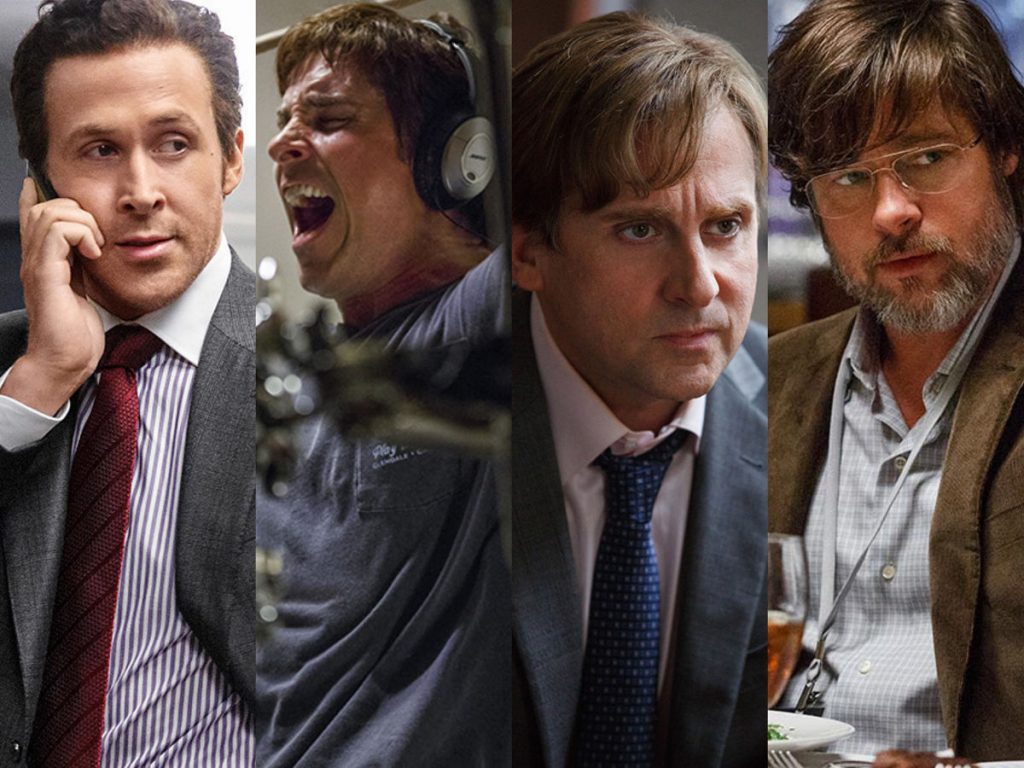
The most important financial film of the 21st century opens with a man who can’t make eye contact. Dr. Michael Burry — hedge fund manager, former neurosurgeon, heavy metal devotee, barefoot office walker — sits in his Cupertino office in 2005, reading subprime mortgage bond prospectuses that nobody else on Wall Street has bothered to open. What he finds inside is the architecture of the worst financial disaster since the Great Depression.
Ultimately, what he does about it is the big short true story. He bets against the American housing market, gets called insane by his own investors, and walks away with $100 million in personal profit and a 489% return for Scion Capital. Afterward, nobody goes to jail. Then the banks start selling the same products under a different name.
Adam McKay’s 2015 film, based on Michael Lewis’s bestselling book, is the rare Hollywood product that is angrier than its source material. Indeed, McKay breaks the fourth wall. He uses Margot Robbie in a bathtub and Anthony Bourdain in a kitchen to explain collateralized debt obligations. The film makes you laugh at the fraud, then forces you to reckon with the fact that eight million people lost their homes while you were laughing.
Michael Burry: The Neurosurgeon Who Read the Fine Print
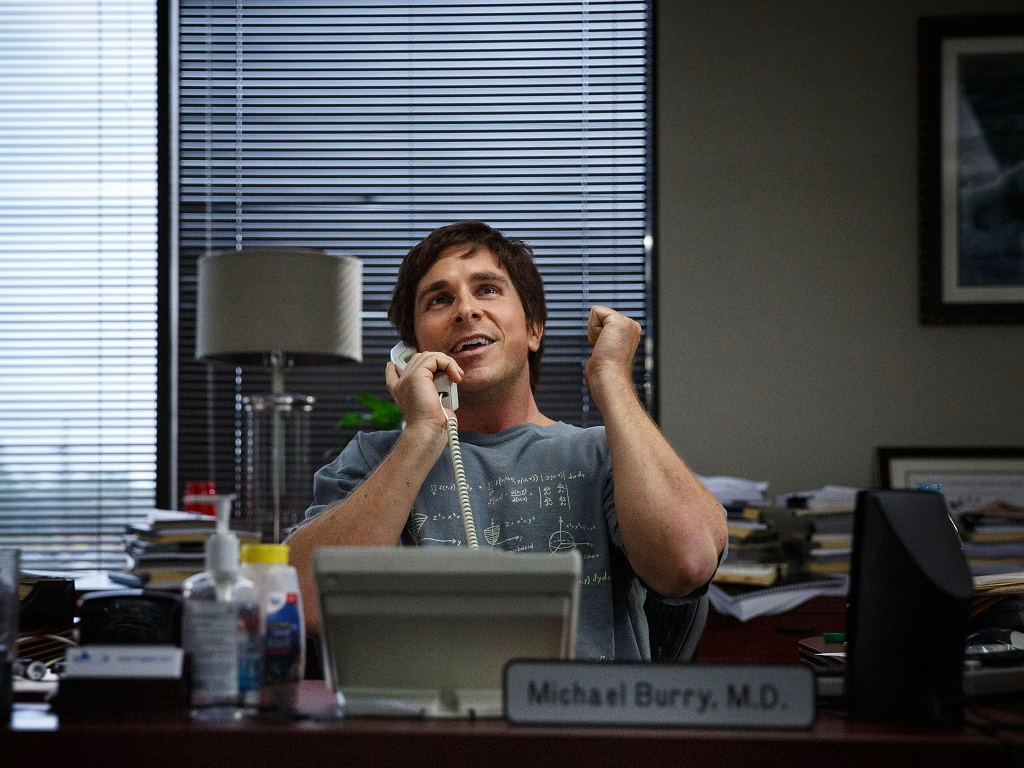
Michael Burry lost his left eye to retinoblastoma at age two. Consequently, the glass replacement shaped everything that followed — the self-consciousness, the difficulty with social cues, the retreat into data and pattern recognition. By his own admission, he was an introvert who found human interaction exhausting and spreadsheets comforting.
From Stanford Surgery to Scion Capital
Burry attended Vanderbilt for medical school, then began his residency at Stanford. Simultaneously, he ran an investment blog that attracted a devoted following of value investors. In fact, these readers recognized that the guy analyzing stocks between surgeries was seeing things the professionals missed. He once fell asleep standing up during a complicated surgery, collapsing into a patient’s oxygen tent. Furious, the surgeon threw him out.
Consequently, Burry left medicine at 29 and founded Scion Capital with money from a small inheritance and early investors who found him online. When his own son later received a diagnosis of Asperger’s syndrome, Burry suspected he had it too. In hindsight, the self-diagnosis explained the obsessive reading, the discomfort with eye contact, and the capacity to sit alone for fourteen hours reading mortgage bond prospectuses that the banks themselves had never audited.
The Trade Nobody Believed
In 2005, Burry read enough prospectuses to understand that the loans underlying the bonds were defaulting at rates that would collapse the entire structure. He created credit default swaps — essentially insurance policies against mortgage bonds — and began buying them in enormous quantities. Naturally, his investors thought he was delusional. Some tried to withdraw their money. He locked them in. Christian Bale’s portrayal of Burry earned an Oscar nomination and perfectly captured the particular loneliness of being right when everyone around you is wrong.
Steve Eisman: The Angriest Man on Wall Street
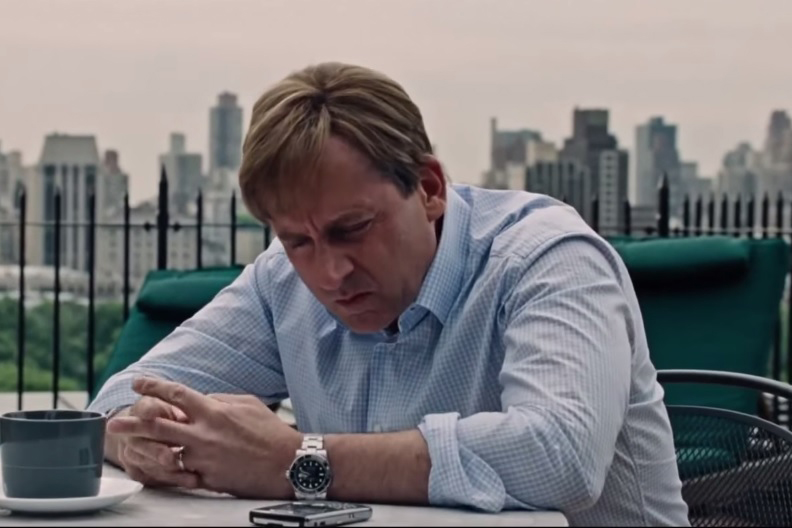
The character Mark Baum — played by Steve Carell in a performance running on pure moral outrage — draws from Steve Eisman, a hedge fund manager at FrontPoint Partners. Eisman’s defining characteristic was that he hated the financial industry while working inside it. Previously, he had built a reputation at Oppenheimer for writing research reports that made powerful people uncomfortable. He dressed half-fastidiously, spoke without a filter, and viewed the mortgage-backed securities market the way a building inspector views a condemned structure.
The Miami Field Trip
In early 2006, Greg Lippmann walked into Eisman’s office with a pitch. Lippmann ran Deutsche Bank’s global asset-backed securities trading desk, and he had essentially copied Michael Burry’s analysis and repackaged it. The trade: spend $2 million on credit default swaps that would pay $100 million when the bonds failed.
Although Eisman doubted Lippmann’s motives, he trusted the math. He and his team flew to Miami for what the film portrays as a field investigation — walking through half-empty subdivisions, talking to strippers who owned five houses on adjustable-rate mortgages, and realizing that the housing market was not experiencing a boom. It was experiencing a fraud. FrontPoint Partners reportedly doubled in value, from $700 million to $1.5 billion, on the trade.
Notably, Eisman later told The Globe and Mail that after reading his own Financial Crisis Inquiry Commission transcript from 2010, he realized Carell’s portrayal — the one he had initially called not quite accurate — had actually been right all along. He really had been that angry.
Greg Lippmann and Cornwall Capital: The Middleman and the Garage Fund
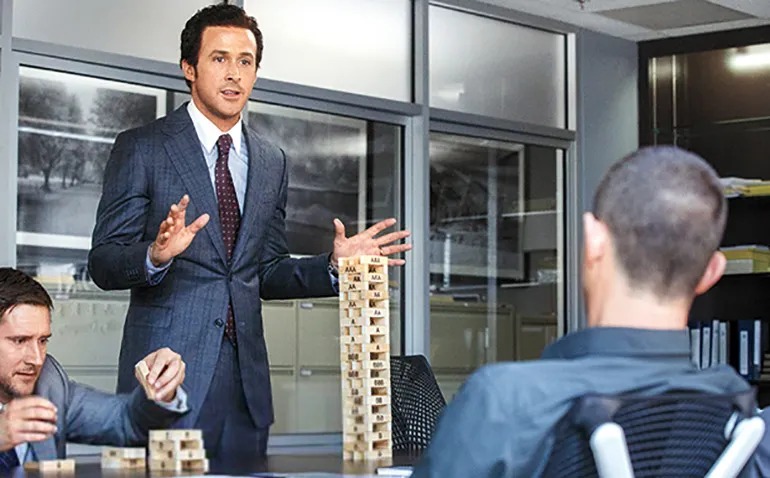
Ryan Gosling’s Jared Vennett draws from Greg Lippmann, who narrates the film with self-aware charisma. Lippmann knew he was profiting from catastrophe and never pretended otherwise. “I don’t have any particular allegiance to Deutsche Bank,” he once said. “I just work there.” Furthermore, Michael Lewis chose him as a narrator figure precisely because his transparency made Wall Street’s opacity legible by contrast. Lippmann earned $47 million from the swap sales. He left Deutsche Bank in 2010 and founded LibreMax Capital.
The Garage Fund That Made $80 Million in a Day
The most improbable thread in The Big Short belongs to Charlie Ledley and Jamie Mai — renamed in the film, played by John Magaro and Finn Wittrock. They started Cornwall Capital in a Berkeley garage with $110,000. In essence, their strategy was simple: find situations where the market prices risk incorrectly and buy cheap options that pay off enormously when corrections arrive.
They discovered Lippmann’s presentation through word of mouth. However, they needed an ISDA Master Agreement to execute the trades, and their fund was far too small to qualify. Brad Pitt’s character Ben Rickert — based on retired Deutsche Bank trader Ben Hockett — made a few phone calls and secured them access. Then, on August 6, 2007, Hockett logged onto his laptop from a pub in southern England and sold $205 million in swaps to UBS, Merrill Lynch, and Lehman Brothers. Trades that cost Cornwall about $1 million yielded $80 million in a single day.
The Fraud: How the Machine Actually Worked
McKay’s most effective sequences use celebrities to explain the fraud directly to camera. Margot Robbie in a bubble bath covers mortgage-backed securities. Anthony Bourdain uses a fish stew metaphor for CDOs. Selena Gomez plays blackjack to illustrate synthetic CDOs. These scenes exist because McKay understood that the complexity itself is the cover.
The Structure Beneath the Jargon
However, strip away the jargon and the structure is simple. Banks bundled thousands of individual mortgages into bonds and sold them as safe investments. Rating agencies — Moody’s, Standard & Poor’s, Fitch — gave these bonds AAA ratings because the banks paid for the ratings. The agencies had every financial incentive to keep the banks happy.
Meanwhile, the underlying mortgages were garbage. Specifically, lenders had issued loans to borrowers with no income, no job verification, and adjustable rates that would spike after introductory periods, guaranteeing default. Banks knew the loans were bad. Rating agencies knew the models were flawed. Mortgage brokers knew borrowers couldn’t pay. As a result, everyone in the chain made money on volume — origination fees, securitization fees, rating fees, trading fees — and nobody faced any incentive to stop. The system wasn’t broken. It functioned precisely as designed. Nevertheless, the outsiders who caught it — Burry, Eisman, Lippmann, Ledley, Mai, Hockett — simply read the documents that the sellers had never opened.
The Crash: Eight Million Homes and One Prosecution
When the housing market finally collapsed in 2007-2008, consequences arrived precisely as the outsiders had predicted. Lehman Brothers filed the largest bankruptcy in American history at $639 billion in assets. Bear Stearns fell to JPMorgan Chase in a Federal Reserve-brokered fire sale. Bank of America absorbed Merrill Lynch. AIG required a $182 billion government bailout.
The Numbers Nobody Can Forget
The Dow lost more than 50% of its value. Meanwhile, approximately eight million Americans lost their homes to foreclosure. Global unemployment spiked. Retirement accounts evaporated. The IMF estimated total losses at $4 trillion worldwide. Of all the bankers, traders, and executives involved, exactly one person went to prison. Kareem Serageldin, a Credit Suisse trader, received a 30-month sentence for concealing mortgage portfolio losses. Moreover, prosecutors charged no CEO. They pursued no rating agency. And no systemic reform prevented the same instruments from reappearing under new names.
The Cast: How McKay Built the Ensemble
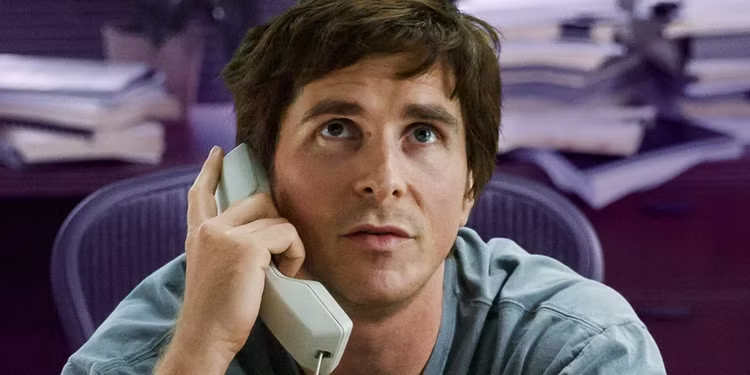
Christian Bale visited Michael Burry at Scion Capital, studying his mannerisms, his wardrobe (shorts and bare feet), and his habit of blasting heavy metal while analyzing data. Afterward, Bale called Burry “a fascinating individual” and said he grew genuinely fond of him. Ultimately, the performance earned Bale his second Oscar nomination, following his win for The Fighter.
Similarly, Steve Carell met Steve Eisman over breakfast and read his published research before building Mark Baum. Carell’s dramatic range, sharpened by Foxcatcher the year before, gave the performance an intensity that surprised audiences accustomed to his comedy work.
Gosling, Pitt, and the Irony of Star Power
Ryan Gosling and Brad Pitt reportedly never met their real-life counterparts. In effect, Gosling’s Vennett functions as the film’s id — slick, self-serving, unapologetic about profiting from disaster. Pitt’s Rickert serves as its conscience, reminding Ledley and Mai that every percentage point of profit represents real families losing their homes.
Pitt also produced the film through Plan B Entertainment. Additionally, McKay has said he wanted the star power to ensure the story reached the widest possible audience. The irony — Hollywood’s most visible star producing a film about the invisibility of systemic fraud — was deliberate. The film earned $133 million worldwide on a $28 million budget and won the Academy Award for Best Adapted Screenplay.
Where the Real People Are Now
Michael Burry closed Scion Capital after the crisis, citing the emotional toll of fighting his own investors for two years. The IRS subsequently audited him multiple times — a fact the film notes with quiet fury. He later reopened the fund as Scion Asset Management, taking notable positions in water rights and large short bets against the stock market. Even now, his Twitter feed, which he periodically deletes and recreates, functions as a one-man early warning system.
Steve Eisman left FrontPoint in 2011 and now runs the Eisman Group alongside his parents. Greg Lippmann’s LibreMax Capital manages billions. Charlie Ledley and Jamie Mai sit on the board of The Tobin Project, an economic policy think tank. Ben Hockett returned to quiet retirement.
Bespoke Tranche Opportunity
The film’s most disturbing epilogue involves none of these individuals. Instead, it is a title card before the credits: as of 2015, Wall Street had begun selling CDOs again. Instead, bankers rebranded them as “Bespoke Tranche Opportunities.” The product stayed identical. Yet only the branding improved. Apparently, nobody learned the lesson.
Why The Big Short Still Matters
The Big Short is the most factually rigorous film in the Wall Street cinema canon, and the one that leaves the deepest wound. Wolf of Wall Street seduces you and lets you reckon with the seduction. Margin Call shows you the machinery from inside. Wall Street gives you a villain you can point at.
By contrast, The Big Short shows you a system so diffuse and so thoroughly corrupted that no single villain carries the blame. Rating agencies were complicit. Banks were complicit. Furthermore, regulators stayed absent. Borrowers were misled. Investors slept. And the people who saw it coming — the ones the film celebrates — profited from the suffering of millions. McKay never lets the audience forget that heroes and villains use the same instruments.
The Question the Film Still Asks
McKay and Lewis constructed an education that keeps reaching new audiences. Every retail investor who learned “credit default swap” from Ryan Gosling, every economics student who cited the film in a thesis, every voter who finally understood that “too big to fail” is a policy choice — they all live inside that education now. Christian Bale’s Burry is still tweeting warnings. Steve Carell’s Baum is still angry. The banks are still selling. The question remains the same one the film posed in 2015: who is reading the fine print this time?
If you’ve ever read a prospectus that nobody else opened, spotted the flaw in the model, or bet on yourself when the room said you were wrong — then you already understand why Social Life Magazine exists. We cover the people who see what others miss. Reach out to our editorial team to be featured.
Want to position your brand alongside the smartest audience on the East End? Submit a Paid Feature and let our editors build something worth reading.
Join 82,000+ subscribers who get our take on luxury, culture, and the Hamptons scene before anyone else. Subscribe to our email list.
Experience the intersection of sport, style, and status at Polo Hamptons — Bridgehampton’s premier luxury polo event, now in its seventh year with BMW as title sponsor.
Never miss a print issue. Subscribe to Social Life Magazine and get five summer issues delivered from Memorial Day to Labor Day.
Love what we do? Support Social Life Magazine and help us keep covering the culture that matters.
Author

Written by
Recent Posts
Wall Street: Money Never Sleeps — How the 2008 Crash Made Gordon Gekko Irrelevant
The Big Short True Story: The Outsiders Who Bet Against America and Won
Margin Call True Story: The Night Wall Street Decided to Burn It All Down
Jonah Hill Net Worth: The $60,000 Gamble That Built an $80 Million Empire
Boiler Room: The Long Island Pump-and-Dump Story Hollywood Told Twice
Categories
- Art
- Articles
- Beauty & Skincare
- Celebrities
- Celebrities|Movies
- Celebrities|The Chronicles
- Chronicles
- Entertainment|Culture
- Event Photos
- Events
- Fashion
- Fashion & Style
- Featured
- Food & Beverage
- Food, Spirits, Wine
- Hamptons
- Hamptons Celebrities
- Hamptons Celebrities|Celebrities|The Chronicles
- Health
- Health & Beauty
- Lifestyle
- Luxury Lifestyle
- Movies|Culture
- Movies|Hamptons Lifestyle
- Press
- Profiles
- Real Estate
- Technology
- The Chronicles
- Travel
- Uncategorized
- Weddings