
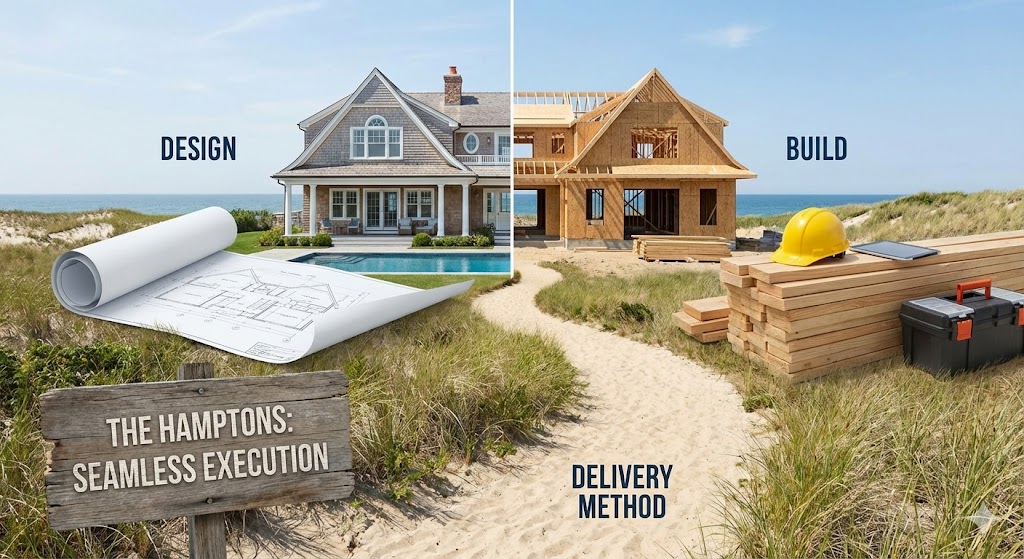
Complex Hamptons projects fail for predictable reasons. Architects blame builders. Builders blame designers. Subcontractors point fingers everywhere. Meanwhile, homeowners endure cost overruns, schedule delays, and quality disappointments. Design-build project management eliminates these dynamics through unified accountability.
This delivery method has transformed commercial construction for decades. Sophisticated developers recognized long ago that single-source responsibility produces superior outcomes. Luxury residential projects now increasingly adopt design-build approaches for the same reasons.
Understanding how design-build works—and why it outperforms traditional methods—helps homeowners make informed decisions about their project delivery structures.
The Traditional Approach Problem
Conventional project delivery separates design from construction through independent contracts.
Homeowners first hire architects who develop plans. Those plans then go to builders for bidding. Separate contracts govern each relationship. When problems arise—and they always arise—no single party bears comprehensive responsibility.
Cost overruns become endemic under this structure. Architects designing without construction cost awareness create specifications exceeding budgets. Builders bidding without design input submit prices requiring later change orders. Homeowners pay for these disconnections.
Schedule delays compound as parties coordinate inefficiently. Design questions interrupt construction. Construction discoveries require design revisions. Each interface creates friction and lost time.
Quality suffers when nobody owns the whole outcome. Architects achieve their design intent. Builders complete their scope of work. Yet the integrated result disappoints because nobody held responsibility for the combination.
McKinsey’s construction industry research documents consistent underperformance in traditionally-structured projects. The evidence against fragmented delivery has accumulated overwhelmingly.
The Design-Build Alternative
Design-build consolidates design and construction under single responsibility.
One entity—whether a firm or a team under unified contract—delivers the complete project. Design decisions incorporate construction implications from the start. Construction proceeds with design intent fully understood. Accountability has no gaps.
Cost certainty improves dramatically. Design-build teams understand real costs while designing. Budgets inform rather than constrain design development. Guarantees and fixed pricing become possible earlier in project development.
Schedules compress through overlapping phases. Construction can begin before design completes fully. Early packages proceed while later details develop. This “fast-tracking” can reduce overall timelines substantially.
Quality benefits from integrated teams understanding both design intent and construction reality. Builders committed to design excellence execute differently than those merely following documents.
Design-Build in Luxury Residential Context
Design-build offers particular advantages for luxury Hamptons projects.
Complexity demands coordination. High-end homes involve dozens of specialized trades, thousands of finish decisions, and countless integration challenges. Single-source management handles this complexity efficiently.
Client time proves valuable. Successful individuals commanding Hamptons real estate typically have demanding schedules. Design-build reduces client management burden substantially.
Customization requirements benefit from integrated approaches. Unique solutions emerging from design-construction collaboration exceed what fragmented teams produce.
Quality expectations at luxury levels demand the attention design-build enables. When one team owns the outcome, quality becomes non-negotiable rather than contractually ambiguous.
The D&J Concepts Design-Build Model
At D&J Concepts, we’ve structured design-build capability serving Hamptons estates comprehensively.
Our in-house design team encompasses interior design, landscape architecture, and staging. Design decisions begin with construction implications understood because construction expertise sits in adjacent offices.
Project management coordinates all elements continuously. Regular progress reviews ensure design intent translates through construction. Issues surface immediately rather than emerging at substantial completion.
Trade relationships developed over decades enable quality execution. We know which subcontractors deliver Hamptons-appropriate work. This knowledge prevents the quality disappointments that plague homeowners selecting trades from phone book listings.
Our Society of Design Administration (SDA) membership reflects commitment to professional standards. This organization establishes best practices we follow rigorously.
Project Phases Under Design-Build
Design-build projects proceed through coordinated phases.
Pre-design defines requirements, establishes budgets, and confirms feasibility. Before drawing begins, we ensure the project makes sense financially and practically.
Schematic design develops concepts responding to program requirements. Multiple directions might receive exploration. Client feedback guides selection among alternatives.
Design development advances selected directions toward construction documentation. Materials specifications, fixture selections, and system designs develop during this phase.
Construction documentation produces buildable drawings and specifications. Simultaneously, bidding and contracting with trade partners occurs.
Construction proceeds with ongoing design team involvement. Field conditions generate questions requiring design input. Finish selections may continue during early construction phases.
Project closeout includes comprehensive punch lists, system commissioning, and client orientation to completed projects.
Budget Management Under Design-Build
Financial performance distinguishes design-build from traditional delivery.
Early budget establishment guides design realistically. We develop cost models before significant design investment, ensuring concepts remain affordable.
Continuous cost monitoring prevents surprises. As design develops, cost implications receive immediate analysis. Choices that would exceed budgets surface before becoming embedded in documents.
Change order reduction results from integrated planning. Most change orders arise from design-construction disconnection. When one team handles both, most change-generating conditions never develop.
Contingency management provides flexibility for genuine surprises. Some unknowns remain regardless of delivery method. Design-build contingencies address these efficiently.
Bain & Company’s construction sector analysis confirms that integrated delivery methods consistently outperform traditional approaches on cost metrics.
Schedule Management Under Design-Build
Time performance similarly improves under design-build.
Fast-tracking enables early construction starts. Site work and foundations can proceed while interior details develop. This overlapping reduces overall duration.
Coordination efficiencies eliminate inter-party delays. Waiting for architect responses, negotiating change order impacts, and resolving disputed responsibilities all disappear under unified accountability.
Decision frameworks accelerate approvals. When clients understand the integrated team’s recommendations incorporate all perspectives, decision-making simplifies.
Material procurement benefits from early ordering. Long-lead items get specified and ordered earlier because construction input informs design timing.
Quality Assurance Under Design-Build
Integrated teams produce quality traditional delivery cannot match.
Design intent clarity guides execution. Builders working continuously with designers understand intent beyond document interpretation. This understanding produces faithful execution.
Standard setting exceeds minimums. When one team owns the outcome, “good enough” becomes insufficient. Pride in comprehensive results drives quality beyond contractual requirements.
Punch list reduction reflects upstream quality. Projects built by integrated teams require less correction at completion because issues receive attention during construction rather than afterward.
Warranty support proves simpler with single-source responsibility. When problems emerge post-completion, one entity owns resolution without finger-pointing.
Selecting Design-Build Partners
Not all design-build providers deliver equal value. Evaluation criteria help distinguish excellent from mediocre.
Portfolio quality reveals capabilities. Completed projects demonstrate what firms actually produce. Request comprehensive tours of relevant work.
Team continuity matters. Will the individuals you meet actually handle your project? Some firms rotate personnel unpredictably.
Reference depth confirms performance. Speak with multiple past clients about budget, schedule, and quality outcomes. Ask specifically about problems and resolutions.
Financial stability protects projects. Verify that firms possess resources to complete your project regardless of their other obligations.
Chemistry determines collaboration quality. You’ll work closely with your design-build team for extended periods. Personal compatibility deserves consideration.
Beginning Your Design-Build Journey
Initiating design-build projects requires proper foundations.
Requirement clarity establishes starting points. What must the project accomplish, within which budget parameters, and under what timeline constraints?
Site evaluation reveals conditions affecting approach. Existing structures, regulatory context, and infrastructure availability shape project definition.
Team assembly brings appropriate expertise together. Depending on project scope, specialists beyond core design-build capability may participate.
For design-build project consultation, contact Social Life Magazine for professional connections. Explore related content in Renovation vs. New Construction: The Hamptons Calculus.
David Hornung founded D&J Concepts as a full-service design-build studio headquartered in Southampton. With SDA membership and over two decades of Hamptons project experience, the firm delivers exceptional estates through integrated project delivery. Visit dandjconcepts.com to explore capabilities.
Author

Written by
Recent Posts

Aaron Paul Net Worth — His Character Was Supposed to Die in Season One. Instead He Made $30 Million.

Bryan Cranston Net Worth. He Played a Sitcom Dad for Seven Years. Then He Became the Most Dangerous Man on Television.

Breaking Bad Cast Net Worth. $130 Million Cooked in Five Seasons of Perfect Television

Cailee Spaeny Net Worth — From Springfield, Missouri to A24 and Alien in Three Years Flat

Wagner Moura Net Worth — He Learned Spanish to Play Escobar. Then He Learned English to Take Hollywood.
Categories
- Art
- Articles
- Beauty & Skincare
- Celebrities
- Celebrities|Movies
- Celebrities|The Chronicles
- Chronicles
- Entertainment|Culture
- Event Photos
- Events
- Fashion
- Fashion & Style
- Featured
- Food & Beverage
- Food, Spirits, Wine
- Hamptons
- Hamptons Celebrities
- Hamptons Celebrities|Celebrities|The Chronicles
- Health
- Health & Beauty
- Lifestyle
- Luxury Lifestyle
- Movies|Culture
- Movies|Hamptons Lifestyle
- Press
- Profiles
- Real Estate
- Technology
- The Chronicles
- Travel
- TV
- Uncategorized
- Weddings