
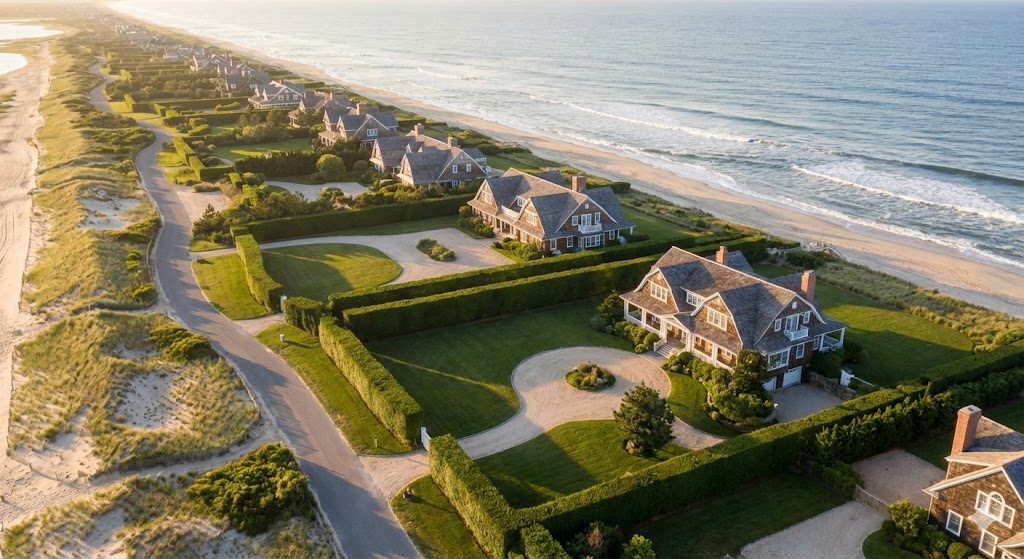
The helicopter descends toward East Hampton Airport. Below, the Atlantic stretches endless to the south while potato fields and hedgerows carve the landscape into parcels worth more than most companies. Somewhere in those fields, a property just traded for $115 million. The buyer’s name won’t appear in public records for months, shielded by an LLC that reveals nothing.
Welcome to Hamptons real estate, where the rules of normal property investment don’t apply and the stakes justify the complexity. This guide provides everything serious investors need to understand the market: current conditions, price dynamics, neighborhood intelligence, celebrity transaction history, and the strategic frameworks that separate informed buyers from tourists writing checks.
The Hamptons represent a $50 billion real estate ecosystem operating by principles that confound traditional analysis. Finite oceanfront land, global ultra-high-net-worth demand, and structural scarcity create dynamics found nowhere else in American property markets. Understanding those dynamics doesn’t guarantee success. But failing to understand them guarantees expensive mistakes.
The 2025-2026 Market: Current Conditions
Q1 2025 marked a watershed moment when the median home price in the Hamptons crossed $2 million for the first time in history. According to Q3 2025 data, the median sale price settled at $2.05 million. While that represents a slight decrease from the previous year’s peak, it remains nearly double pre-pandemic levels.
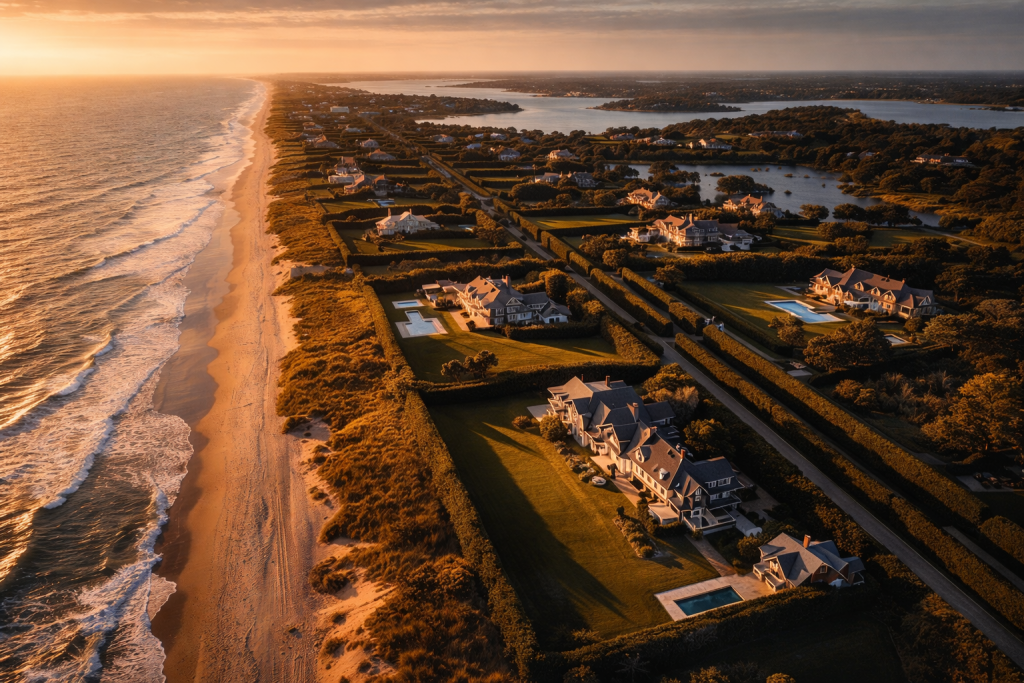
The real story, however, unfolds at the top of the market. Sales between $10 million and $20 million increased by 43% year-over-year. Deals above $20 million surged by 33%. The appetite for premier trophy properties has never been stronger.
Those blockbuster transactions pushed the average sale price up 7.8% to $3.45 million, demonstrating a critical principle: you cannot judge the Hamptons market by a single number. The ultra-luxury segment operates on different dynamics than the entry-level market. Understanding which segment you’re entering determines your strategy entirely.
Inventory and Supply Dynamics
Hamptons inventory sits 44% below pre-pandemic levels. Industry experts predict this shortage will persist through 2026. The structural scarcity creates sustained price support even as interest rates remain elevated.
Jonathan Miller’s Elliman Report reveals luxury real estate trends favoring cash buyers dramatically. Properties above $10 million saw record sales increases of 24% year-over-year. Cash buyers dominate because they understand leverage differently. Instead of financing properties, they finance opportunities.
When interest rates climb to 7%, wealthy buyers remain unaffected. Financed buyers retreat from the market entirely. Cash transactions close faster and stronger. Sellers prefer certainty over promises. This dynamic separates sophisticated investors from weekend house hunters.
The Price Hierarchy: Understanding What You’re Buying
Location determines everything in Hamptons real estate investment. Within the region, micro-markets create vastly different returns and ownership experiences.
The Geographic Premium
Properties east of the Shinnecock Canal average $3.42 million. West of the canal, averages drop to $1.6 million. The canal functions as a psychological and geographic dividing line that shapes everything about Hamptons pricing.
Being “south of the highway” (Route 27) commands premiums over north-of-highway properties. Oceanfront commands premiums over everything else. The specific village creates its own hierarchy: Southampton and East Hampton at the apex, Hampton Bays at the entry level.
2025 market data shows Bridgehampton and Sagaponack leading price appreciation. These areas averaged $9.503 million for single-family homes. Amagansett properties commanded $5.936 million averages despite lower transaction volumes. Waterfront access creates premium pricing tiers. Ocean properties outperform bay properties consistently.
The Village Breakdown
Who lives in the Hamptons follows wealth-type rather than wealth-amount alone. Finance concentrates in Southampton’s oceanfront. Entertainment clusters around East Hampton’s Georgica Pond. Creative industries gravitate toward Sag Harbor’s village character. Young money flows to Montauk’s casual scene.
Southampton: Old money attempting to coexist with new billions. Meadow Lane stretches five miles along the oceanfront, earning its “Billionaires Row” designation through concentration of wealth that rivals any address globally. Howard Stern lives here year-round. Ken Griffin purchased Calvin Klein’s minimalist compound for $84 million in 2020.
East Hampton: Cultural prestige meets celebrity concentration. Further Lane contains some of the most valuable residential real estate in America. Barry Rosenstein’s $147 million purchase of three contiguous parcels set records. Jerry Seinfeld’s 12-acre compound includes a 22-car garage for his Porsche collection.
Bridgehampton/Sagaponack: The highest median prices and strongest appreciation. Agricultural preservation rules in Sagaponack limit development, creating permanent scarcity. Fair Field, Ira Rennert’s 110,000-square-foot compound, sits here as the largest private residence in America.
Sag Harbor: Year-round community with creative class appeal. Former whaling port architecture creates character that newer developments cannot replicate. Pricing below Southampton and East Hampton for comparable waterfront access.
Montauk: The end of the line, offering casual surf culture atmosphere. Robert De Niro owns oceanfront property here. Montauk has attracted younger visitors and undergone a real estate boom while maintaining enough edge to attract buyers who find East Hampton too pretentious.
Hampton Bays: The most budget-friendly entry to the Hamptons proper. In Q1 2025, the area saw a 65% jump in homes sold year-over-year and a 130% increase in sub-$500K transactions. East Quogue’s median sits at $874,000, the lowest in the region.
Springs: Real estate professionals predict Springs will be one of the “it” destinations over the next five years. The neighborhood maintains Accabonac Harbor access and authentic maritime character while remaining affordable relative to East Hampton proper.
Record Transactions: The Market Ceiling
Celebrity Hamptons home sales reveal more about American wealth than any Forbes list. Entertainment celebrities grab headlines, but finance titans quietly control the most valuable addresses.
The All-Time Records
The most expensive combined transaction remains Barry Rosenstein’s $147 million Further Lane purchase in 2014. The hedge fund manager acquired three contiguous parcels to create a compound that defines ultra-luxury Hamptons living.
For single parcels, the 2025 sale of 408 Further Lane from former Yahoo! CEO Terry Semel to billionaire Len Blavatnik set a new record at $115 million. The 8.5-acre oceanfront property traded off-market, continuing Further Lane’s tradition of discrete ultra-high-net-worth transactions.
The former Ford family estate at 90 Jule Pond Drive in Southampton traded for $105 million after listing originally at $175 million. The 42-acre property with its 20,000-square-foot oceanfront mansion sat on the market for nearly four years before finding a buyer at a 40% discount.
La Dune on Southampton’s Gin Lane sold at Sotheby’s auction for $88.5 million after originally listing at $150 million. The four-acre compound includes two mansions totaling 23,000 square feet with 23 bedrooms. One home dates to the 1890s with architecture attributed to Stanford White.
Celebrity Transaction Patterns
Celebrity transactions cluster in distinct price bands. The ultra-premium tier ($50M+) tends toward finance executives and industry moguls. Entertainment celebrities typically transact in the $10M-$50M range.
Sylvester Stallone paid full asking price for a $35 million estate at 9 Hither Lane in East Hampton Village, reportedly for his three adult daughters. Jerry Seinfeld purchased Billy Joel’s estate for $32 million in 2000, a record at the time. Sarah Jessica Parker and Matthew Broderick own a cottage in Amagansett valued in the mid-eight figures.
Off-market deals dominate the celebrity segment. Privacy concerns drive both buyers and sellers toward discrete transactions that never appear on public listings. The most significant trades often occur through private networks rather than traditional broker channels.
The Biggest Houses: Understanding Scale
The biggest houses in the Hamptons operate on a scale that defies conventional real estate logic. Understanding these estates reveals what unlimited capital can build when oceanfront land meets billionaire ambition.
Fair Field: The Largest Private Residence in America
No discussion of Hamptons scale can begin anywhere other than Fair Field, the 110,000-square-foot compound in Sagaponack owned by businessman Ira Rennert. The estate contains 29 bedrooms and 39 bathrooms. The garage holds 100 vehicles. A 164-seat theater could stage Broadway productions.
Construction began in 1998 and reportedly cost $110 million. Current valuations range from $267 million to $500 million depending on assessment methodology. Property taxes exceed $750,000 annually. The estate would likely never sell through traditional channels. Properties of this magnitude create their own market category.
Fair Field’s construction had lasting consequences for Hamptons real estate. After the compound was completed, Sagaponack passed zoning ordinances restricting new residential construction to 20,000 square feet, ensuring no future development could approach its scale.
Meadow Lane Compounds
While Fair Field holds the size record, Southampton’s Meadow Lane contains the highest concentration of massive estates owned by currently active billionaires. Ken Griffin’s former Calvin Klein compound at 650 Meadow Lane exemplifies the lane’s character: minimalist architecture, maximum privacy, absolute oceanfront positioning.
The 2023 sale of Mylestone at 700 Meadow Lane for $112.5 million set that year’s price record. The 15,000-plus-square-foot residence sits behind two gated entrances with 500 feet of ocean frontage.
The largest parcel on Meadow Lane recently found a buyer after years of uncertainty. The 9.75-acre property at 1320 Meadow Lane, with 550 feet of ocean frontage, entered contract in late 2024 at $49.5 million, down from an original $85 million asking price. The land alone represents one of the most significant development opportunities in Hamptons history.
The Rental Market: Current Opportunities
The Hamptons rental market has fundamentally shifted since COVID. After years of landlords dictating terms, 2025 belongs to renters.
Price Corrections
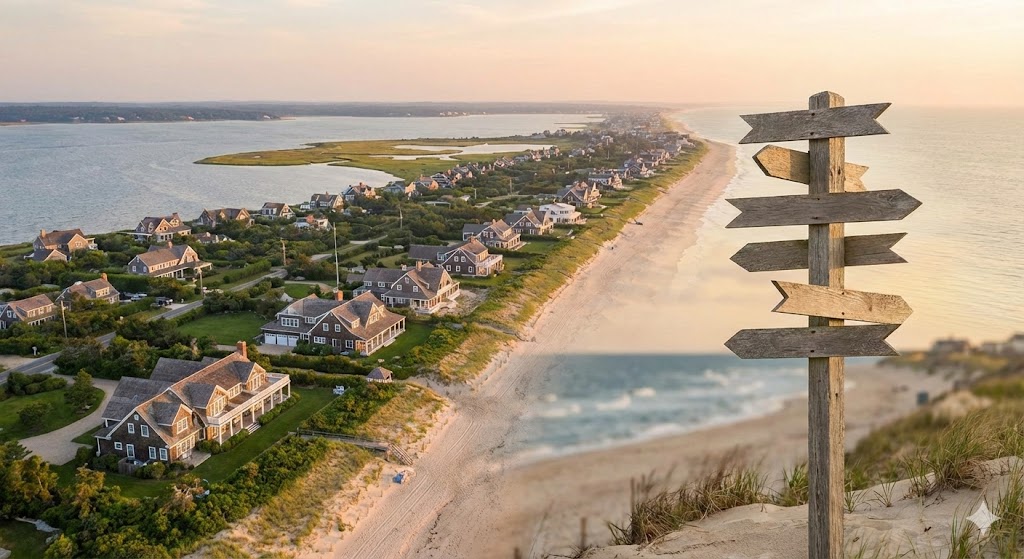
Prices are down 15-25% from peak pandemic levels. Inventory has surged to over 3,500 listings. Negotiations that would have been laughed off in 2021 are now closing deals. According to CNBC reporting, summer rentals are down 30% from previous years, with ultra-high-end properties seeing drops between 50% and 75%.
Thousands purchased Hamptons homes during COVID’s low-rate window, and 75% of pandemic-era buyers now rent their properties rather than sell. This creates opportunity for renters while transforming ownership economics.
Current Pricing by Segment
What things actually cost in the Hamptons depends heavily on location and expectations:
Entry-level (Hampton Bays, Springs): $50,000-$75,000 for a 3-bedroom without pool for the Memorial Day to Labor Day season. Springs offers the best value-to-location ratio, pricing 30-40% below East Hampton Village for comparable properties.
Mid-market (Sag Harbor, Bridgehampton): $150,000-$225,000 for a 4-bedroom with pool. Sag Harbor properties move faster than comparables elsewhere due to year-round village appeal.
Premium (Southampton Village, East Hampton Village): $250,000-$500,000 for turnkey properties with heated pools, finished basements, and walkable locations.
Trophy oceanfront: $900,000+ for the season, with some properties commanding $2 million per month for exceptional waterfront estates on Further Lane or Meadow Lane.
The Full Cost of Hamptons Living
A “modest” Hamptons summer for a family of four renting in Hampton Bays with minimal staff runs $80,000-$120,000 all-in. A proper Southampton Village experience with private chef, club memberships, and appropriate maintenance easily exceeds $500,000 for the season.
Southampton commands a 14-32% premium over East Hampton for comparable properties. A 4-bedroom with pool averages $70,000/month in Southampton Village versus $60,000/month in East Hampton Village.
Investment Strategy: The Smart Money Approach
Attempting to understand Hamptons real estate through the lens of a typical housing market is an inaccurate comparison. The two operate on different principles. This is not just about buying a house; it’s about acquiring a piece of a self-contained economic and social ecosystem.
Why Prices Stay High
The high valuations aren’t arbitrary. They result from several powerful, converging forces:
Finite land: Strict zoning laws and vast swaths of land protected as agricultural reserves prevent new development. This built-in scarcity forms the bedrock of property values, ensuring they hold firm and appreciate over time.
Global demand: The scarcity meets unrelenting demand from a global pool of ultra-high-net-worth individuals. For them, a Hamptons home is a tangible asset, a powerful status symbol, and a key that unlocks one of the world’s most exclusive social circles.
Proximity to capital: Manhattan’s concentration of wealth creates permanent demand. The short helicopter ride from Wall Street means Hamptons real estate serves as both lifestyle asset and working weekend destination.
Cash Buyer Advantage
Middle-class buyers fear rising interest rates. Wealthy buyers understand rate cycles create opportunities. Currently, mortgage rates hover near 7%, approaching two-decade highs. This environment eliminates competition from leveraged buyers.
Cash buyers view rate environments as irrelevant to acquisition decisions. They plan refinancing strategies for future rate cycles. The current elevated rates actually create opportunity by reducing competition.
Micro-Market Intelligence
Successful luxury real estate investment requires systematic approaches. First, identify specific geographic micro-markets with supply constraints. Smart investors study specific neighborhoods rather than general market conditions.
For those entering the market, consider Hampton Bays or Westhampton for entry-level acquisition. Look at Springs, Noyac, or the North Fork for value plays with appreciation potential. Remember that finance money clusters in Water Mill and Bridgehampton, old money signals through East Hampton Village, new money performs on Meadow Lane, and stealth wealth hides in North Haven.
The Ultra-High-Net-Worth Factor
The Hamptons hosts more than 700 centimillionaires during peak season—a 2,700% increase in wealthy residents compared to off-season. Understanding ultra-high-net-worth dynamics is essential for anyone operating in this market.
The UHNW Threshold
Ultra-high-net-worth individuals hold $30 million or more in investable assets. Boston Consulting Group uses $100 million as their “super-rich” threshold, recognizing that even within UHNW, dramatic differences exist.
At the ultra-high-net-worth level, tax strategy drives investment decisions as much as returns. Sophisticated structures can save millions annually. UHNW families employ specialists who focus exclusively on tax optimization across jurisdictions.
Why UHNW Buyers Choose the Hamptons
According to UHNW lifestyle research, crossing $50 million doesn’t mean buying everything you want. Most UHNW individuals don’t. Instead, it means entering a different operating system for wealth.
Hamptons real estate represents a tangible asset you can actually live in and enjoy, a safe harbor when stock markets turn volatile, and an intergenerational wealth transfer vehicle with proven appreciation. The social infrastructure compounds the investment value.
The Networking Premium
On average, a billionaire’s network consists of 12 additional UHNW individuals, including 5 other billionaires. The Hamptons concentrates these networks geographically. Showing up to the right events, dining at the right restaurants, and owning property in the right neighborhoods creates access that money alone cannot buy.
As documented in wealth networking research, the most sophisticated Hamptons participants understand that real estate is social infrastructure as much as investment. The address signals which world you’re entering. The events you attend and the connections you make depend on grasping these power dynamics.
Wealth Management Considerations
Hamptons real estate at the upper end requires specialized wealth management that traditional advisors rarely provide.
The Complexity Threshold
At $50 million, you need someone to manage your investments and structure your estate. At $500 million, you need a team that evaluates direct investment opportunities across jurisdictions, tax strategists who speak fluent treaty law, and someone to mediate family dynamics around property use.
Multi-jurisdictional wealth structuring and long-term estate planning can become complex. Research reveals that 14% of ultra-high-net-worth families have no wealth planning solutions in place. The Hamptons compounds this complexity through high carrying costs, seasonal use patterns, and intergenerational transfer considerations.
Carrying Cost Reality
The biggest houses in the Hamptons require operational infrastructure. Fair Field reportedly employs staff numbering in the dozens. Meadow Lane estates maintain year-round security, groundskeeping, and household operations regardless of owner presence.
The carrying costs for major properties—property taxes, insurance, staffing, and maintenance—often exceed $1 million annually before any mortgage considerations. Understanding these estates requires recognizing them as lifestyle commitments rather than simple real estate purchases.
The Mistakes to Avoid
High-net-worth investors optimize basis points on index funds while UHNW investors are taking calls about pre-IPO allocations. The spreadsheet says the math works. Consequently, they miss the entire game being played above them.
Geographic concentration of wealth matters profoundly. Network effects compound geographically. The Hamptons isn’t just a vacation spot. It’s a deal origination ecosystem where casual conversations turn into eight-figure opportunities.
The Social Calendar: Real Estate as Access
The Hamptons social calendar runs nonstop from Memorial Day through Labor Day. Understanding which events matter connects real estate ownership to networking opportunity.
Key Events for Property Owners
Polo Hamptons returns July 18 and July 25, 2026, to Bridgehampton. The East End’s premier sporting and social event combines world-class polo with networking infrastructure. Only 900 tickets are available per match.
The Hampton Classic horse show celebrates its 50th anniversary with over $1 million in prize money. The Parrish Art Museum Midsummer Party attracts art enthusiasts, collectors, and philanthropists to the Herzog & de Meuron space in Water Mill.
Luxury brand activations create additional social infrastructure throughout the season. From waterfront pop-ups to estate dinners, the events provide networking opportunities disguised as entertainment.
The Restaurant Circuit
Property ownership provides the base from which to access the restaurant scene that operates as both dining and social infrastructure. Le Bilboquet Sag Harbor functions as unofficial headquarters for summer deal-making. Nick & Toni’s has defined East Hampton fine dining since 1988.
The right reservation signals that you belong. The wrong choice reveals you don’t. Property ownership provides the foundation for building presence across multiple seasons.
Hotels as Alternative: The Testing Strategy
For those not ready to purchase, the best Hamptons hotels provide testing grounds for understanding neighborhood dynamics before committing capital.
Gurney’s Montauk commands the cliffside with oceanfront drama. Topping Rose House in Bridgehampton provides access to the village’s character. Baron’s Cove in Sag Harbor offers harborside positioning with nautical atmosphere.
Strategic hotel stays across multiple weekends reveal which village aligns with investment goals and lifestyle preferences. The cost of a summer of hotel stays is far less than the cost of purchasing in the wrong neighborhood.
The North Fork Alternative
The North Fork hit a record $1.1 million median in Q3 2025—roughly half the South Fork median. Smart money recognizes this valuation gap is closing.
The North Fork offers vineyard culture, agricultural character, and waterfront access without South Fork pricing. For investors seeking appreciation potential over established prestige, the North Fork represents compelling opportunity.
The Lifestyle Infrastructure
Hamptons real estate investment cannot be separated from lifestyle considerations. The property you purchase determines which restaurants recognize you, which beaches you access, and which social circles you enter.
Beach Access and Clubs
Hamptons beach clubs increasingly capture the summer scene. Membership models create exclusivity that public beaches cannot match. Many clubs limit membership to property owners within specific zip codes, making real estate the entry point for beach access.
Coopers Beach in Southampton consistently ranks among America’s finest. Main Beach in East Hampton offers on-site dining and a younger energy. Ditch Plains in Montauk attracts surf culture enthusiasts. Your property location determines which beaches feel like home territory.
The Old Money Aesthetic
The Hamptons value discretion over display. The flashiest cars often belong to summer renters. Long-term residents prefer their wealth invisible. Understanding this aesthetic matters for investment strategy: properties designed for ostentation may attract different buyer pools than those designed for privacy.
Meadow Lane’s tallest hedges hide its most valuable compounds. Further Lane estates emphasize privacy over display. The architecture that holds value emphasizes timelessness over trend. Properties designed for Instagram often depreciate faster than those designed for discretion.
Year-Round Considerations
While summer dominates the Hamptons narrative, the off-season offers completely different dynamics. Many seasonal restaurants close between October and May. Real estate activity continues year-round, often at better valuations.
The off-season presents opportunities as inventory increases and sellers become more willing to negotiate. Strategic investors acquire properties during winter months when competition drops. The experienced evaluate properties without summer crowds distorting neighborhood character.
Celebrity Neighbors: What It Means
Celebrities in the Hamptons create both opportunity and complication for real estate investment. Celebrity presence signals neighborhood desirability while potentially attracting unwanted attention.
Further Lane’s concentration of celebrities and billionaires creates a self-reinforcing dynamic. Security is excellent. Privacy is protected by social code. Property values remain stable because the buyer pool understands the address’s significance.
The biggest celebrity news of 2025: Sylvester Stallone’s purchase of a $35 million East Hampton estate for his daughters signaled the action star’s entry into Hamptons real estate. Kelly Ripa and Mark Consuelos maintain presence in Southampton. Jay-Z and Beyoncé keep low profiles around Georgica Pond.
Celebrity proximity shouldn’t drive investment decisions. But understanding which neighborhoods attract which types of wealth provides insight into future appreciation patterns and social dynamics.
The Path to UHNW Through Real Estate
The path to ultra-high-net-worth status often runs through real estate, and the Hamptons provides unique advantages for those building toward the $30 million threshold.
Asymmetric Opportunity Access
According to research, 67.7% of ultra-high-net-worth individuals created wealth themselves—many through real estate and related opportunities. The Hamptons concentrates deal flow in ways that other markets cannot match.
One Social Life Magazine dinner brings together 12 UHNW and aspiring UHNW families. If one person at that dinner mentions one opportunity in the next 12 months that you can participate in, what’s the ROI of being in the room? The cost of attending might be a summer rental. The cost of not attending is unknowable but likely far higher.
The Networking Compound Effect
UHNW investors started networking with private equity firms when they had $2 million. By the time they had $20 million, they were already on the insider list receiving first calls about new fund launches. Hamptons property ownership signals seriousness about long-term wealth building.
Family offices don’t wait for investors to reach $30 million before taking meetings. They identify rising families at $5 million based on trajectory and sophistication. Hamptons property ownership provides the geographic proximity for these relationships to develop naturally.
Your Investment Strategy
The Hamptons remain a solid investment for those with the means and the patience. Real estate here represents a tangible asset you can actually live in and enjoy, a safe harbor when stock markets turn volatile, and an intergenerational wealth transfer vehicle with proven appreciation.
The money keeps moving. The question is whether you’re positioned to capture it.
Entry-level buyers should target Hampton Bays or the North Fork. Value seekers with appreciation potential in mind should examine Springs, Noyac, or East Quogue. Those prioritizing established prestige and networking access will find it in Southampton Village, East Hampton Village, or Bridgehampton—at premium pricing.
Regardless of entry point, understand that Hamptons real estate rewards long-term thinking, relationship building, and strategic patience. The hedge fund managers who control Meadow Lane didn’t buy on impulse. They studied the market, built relationships, and positioned themselves for opportunities that arose through networks rather than public listings.
The hedges hide extraordinary value. The oceanfront stretches toward a horizon that looks exactly like long-term wealth preservation feels. The question isn’t whether Hamptons real estate is worth understanding. The question is whether you’re ready to play the game.
Connect With Social Life Magazine
Real Estate Features: Contact Social Life Magazine to showcase your luxury Hamptons listing to our affluent readership.
Polo Hamptons 2026: Experience the season’s premier networking event at Polo Hamptons. Tickets, cabanas, and sponsorship opportunities available.
Stay Connected: Subscribe to our email list for market updates and exclusive event invitations.
Print Subscription: Get Social Life Magazine delivered—the Hamptons’ luxury lifestyle authority since 2000.
Support Independent Journalism: Donate $5 to support our coverage.
Related Reading
The Complete Guide to Hamptons Living: Everything You Need to Know in 2026
Self-Made Millionaires: The Origin Stories Behind America’s Greatest Fortunes
Author

Written by
Recent Posts

Breaking Bad Cast Net Worth. $130 Million Cooked in Five Seasons of Perfect Television

Cailee Spaeny Net Worth — From Springfield, Missouri to A24 and Alien in Three Years Flat

Wagner Moura Net Worth — He Learned Spanish to Play Escobar. Then He Learned English to Take Hollywood.

Robert Eggers Net Worth — He Made a $3.5 Million Film in Puritan English and Hollywood Listened

Brie Larson Net Worth — A $6 Million Indie Film Won Her an Oscar. Marvel Paid Her the Rest.
Categories
- Art
- Articles
- Beauty & Skincare
- Celebrities
- Celebrities|Movies
- Celebrities|The Chronicles
- Chronicles
- Entertainment|Culture
- Event Photos
- Events
- Fashion
- Fashion & Style
- Featured
- Food & Beverage
- Food, Spirits, Wine
- Hamptons
- Hamptons Celebrities
- Hamptons Celebrities|Celebrities|The Chronicles
- Health
- Health & Beauty
- Lifestyle
- Luxury Lifestyle
- Movies|Culture
- Movies|Hamptons Lifestyle
- Press
- Profiles
- Real Estate
- Technology
- The Chronicles
- Travel
- TV
- Uncategorized
- Weddings