
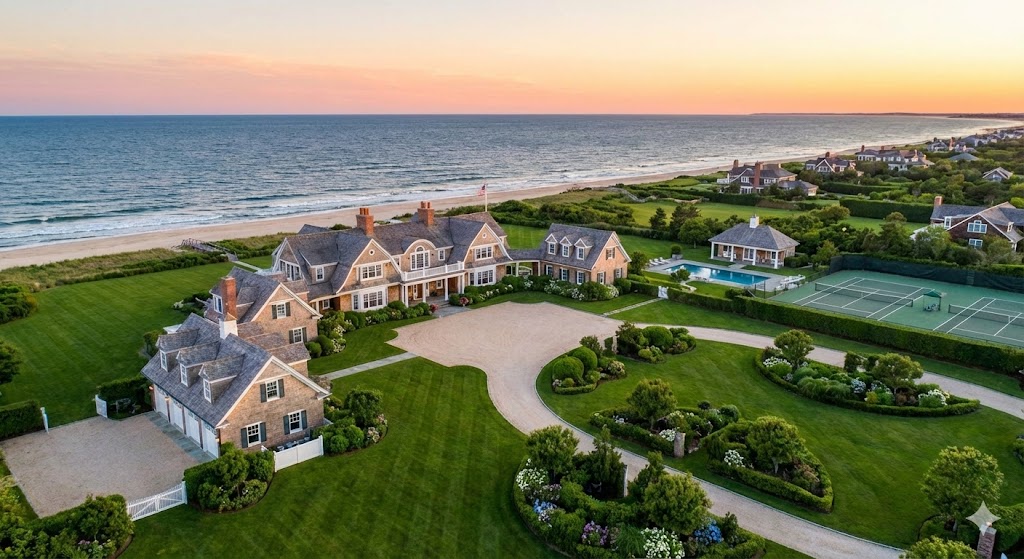
The biggest houses in the Hamptons operate on a scale that defies conventional real estate logic. Fair Field, the largest private residence in America, contains more square footage than most shopping malls. Properties along Meadow Lane trade for prices that exceed the GDP of small nations. Understanding these estates reveals what unlimited capital can build when oceanfront land meets billionaire ambition.
This isn’t a list of expensive homes. Plenty of publications rank Hamptons properties by price. This examination focuses on scale, examining the physical footprints, architectural ambitions, and cultural significance of estates that have redefined what a “house” can become. From record-breaking compounds to historic mansions that shaped Hamptons development, these properties tell stories about American wealth across centuries.
Fair Field: America’s Largest Private Residence
No discussion of the biggest houses in the Hamptons can begin anywhere other than Fair Field, the 110,000-square-foot compound in Sagaponack owned by businessman Ira Rennert. The estate isn’t just the largest home in the Hamptons. It’s the largest private residence in the United States, twice the size of the White House and roughly 75 times larger than the median American home.
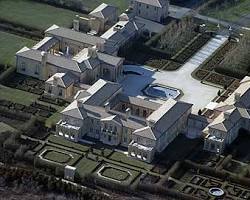
The main house alone spans 62,000 square feet. Additional structures, including two pool houses, a playhouse, and an entertainment building, bring the total to that staggering six-figure number. The property sits on 63 acres of prime oceanfront, with frontage that would accommodate several standard Hamptons estates.
Inside the Fair Field Compound
The numbers border on absurdist. Fair Field contains 29 bedrooms and 39 bathrooms. The garage holds 100 vehicles. A 164-seat theater could stage Broadway productions for an audience of one. The dining room seats 105 people. Three swimming pools, two tennis courts, a basketball court, a bowling alley, and a private synagogue complete the amenity list.
Rennert’s art collection, valued at approximately $500 million, required plans for a 10,000-square-foot private museum on the grounds. The estate has its own power plant. Property taxes exceed $750,000 annually, enough to purchase multiple homes in most American markets.
Construction began in 1998 and reportedly cost $110 million. Current valuations range from $267 million to $500 million depending on assessment methodology. The estate would likely never sell through traditional channels. Properties of this magnitude create their own market category, limited to buyers who could operate such a compound and would want to.
The Legacy Effect
Fair Field’s construction had lasting consequences for Hamptons real estate. After the compound was completed, Sagaponack passed zoning ordinances restricting new residential construction to 20,000 square feet. The legislation essentially grandfathered Fair Field as a permanent anomaly, ensuring no future development could approach its scale.
Neighbors fought the construction throughout the process, objecting to helicopter traffic, museum plans, and even a proposed pilates studio expansion. The estate inspired James Brady’s novel “The House That Ate the Hamptons,” fictionalized testimony to how the project transformed local perceptions of acceptable scale.
Meadow Lane: The Billionaires Row Compounds
While Fair Field holds the size record, Southampton’s Meadow Lane contains the highest concentration of massive estates owned by currently active billionaires. This five-mile oceanfront stretch has earned the “Billionaires Row” designation through properties that combine exceptional scale with even more exceptional ownership.
700 Meadow Lane: The $112.5 Million Sale
The 2023 sale of Mylestone at 700 Meadow Lane for $112.5 million set the year’s price record. The 15,000-plus-square-foot residence, owned by former advertising executive Marcia Riklis, sits behind two gated entrances with 500 feet of ocean frontage. A modern Tudor design features unobstructed views of both the Atlantic and Shinnecock Bay.
The estate demonstrates how Meadow Lane properties operate differently from other luxury markets. After approximately two years on the market at asking prices reaching $175 million, the property found a buyer willing to close at a substantial discount. Even “discounted,” the transaction ranked among the most expensive residential sales in American history.
650 Meadow Lane: The Calvin Klein Compound
Fashion icon Calvin Klein spent nearly three decades and an estimated $45 million creating his minimalist oceanfront compound at 650 Meadow Lane. The property became famous in its own right, serving as a primary location for the film “Something’s Gotta Give” starring Diane Keaton and Jack Nicholson.
In 2020, Ken Griffin of Citadel purchased the compound for $84 million in an off-market transaction. The hedge fund titan added the property to a real estate portfolio that already ranked among the most valuable held by any individual. Griffin’s acquisition demonstrated how Meadow Lane properties trade through private networks rather than public listings.
The 1320 Meadow Lane Opportunity
The largest parcel on Meadow Lane recently found a buyer after years of uncertainty. The 9.75-acre property at 1320 Meadow Lane, with 550 feet of ocean frontage, entered contract in late 2024 at $49.5 million, down from an original $85 million asking price.
The property includes a partially completed 19,980-square-foot mansion abandoned since 2018. The new owner can complete the Moroccan-inspired design, collaborate on conceptual reimagining, or demolish entirely and start fresh. The land alone, with deeded access to Shinnecock Bay, represents one of the most significant development opportunities in Hamptons history.
Record-Breaking Sales: The $100 Million Club
Relatively few Hamptons properties have traded above $100 million. Each transaction that crosses that threshold reveals something about the market’s ceiling and the buyers willing to approach it.
70 Cobb Road: $118 Million (2022)
The off-market purchase of 70 Cobb Road in East Hampton set the current all-time record for Hamptons residential sales. The compound, spanning four contiguous lots across 21 acres, includes two homes totaling over 32,000 square feet. Unlike oceanfront trophy properties, this estate sits on a creek, demonstrating that scale and privacy can command premium prices regardless of beach access.
Fordune Estate: $105 Million (2021)
The former Ford family estate at 90 Jule Pond Drive in Southampton traded for $105 million after listing originally at $175 million. The 42-acre property with its 20,000-square-foot oceanfront mansion sat on the market for nearly four years before finding a buyer at a 40% discount. The sale set the record for single-lot properties in the Hamptons.
La Dune: $88.5 Million (2024)
The auction sale of La Dune on Southampton’s Gin Lane generated headlines beyond real estate circles. The four-acre compound, including two mansions totaling 23,000 square feet with 23 bedrooms, sold at Sotheby’s for $88.5 million after originally listing at $150 million.
Owner Louise Blouin, a Canadian art magazine publisher, had purchased the property in the 1990s for $13.5 million. One home dates to the 1890s with architecture attributed to Stanford White. The other was constructed in the early 2000s. The estate’s journey from $13.5 million acquisition to $150 million asking price to $88.5 million auction sale illustrates the volatility even trophy properties can experience.
Historic Mega-Mansions: Scale Across Centuries
The current crop of biggest houses in the Hamptons emerged from a tradition established during the Gilded Age. Several historic estates remain among the region’s largest properties, connecting contemporary wealth to the industrial fortunes that first shaped the Hamptons.
The Rockefeller Estate
John D. Rockefeller, founder of Standard Oil, built his Tudor-inspired Hamptons mansion on 57 acres during the late 1800s. The property, with a main house of 16 bedrooms and total structures approaching 21,000 square feet, established the template for Hamptons compound development. While modest by contemporary standards, the estate sat at the epicenter of the original Hamptons summer colony.
Lasata: The Jackie Kennedy Connection
Lasata, the East Hampton estate where Jacqueline Kennedy Onassis spent childhood summers, sold to fashion designer Tom Ford in 2023 for approximately $55 million. The 7-acre colonial property doesn’t compete on pure square footage, but its historic significance places it among the most important Hamptons residences.
The estate has passed through several notable owners, each maintaining period features while updating systems for contemporary living. Ford’s purchase added another chapter to a property whose cultural significance exceeds its physical dimensions.
Villa Maria: The Patient Listing
Villa Maria in Water Mill has appeared on the market periodically since 2008, with asking prices that have reflected both the property’s scale and the challenges of selling estates of exceptional size. The property includes extensive acreage, multiple structures, and grounds that require institutional-level maintenance.
The persistent listing illustrates a truth about the biggest Hamptons estates: their very scale limits the buyer pool. Properties requiring staff of dozens and operating budgets of millions annually appeal only to buyers prepared for that level of commitment.
The New Construction Wave
Contemporary developers continue pushing boundaries, though post-Fair Field zoning limits maximum sizes. Recent high-profile builds demonstrate that even within restrictions, developers can create properties of exceptional scale.
Sagaponack’s New Record
A 2024 pre-construction sale at 332 Parsonage Lane in Sagaponack set a new record for inland properties. The planned 13,000-square-foot design by Michael Davis Design & Construction demonstrates continued appetite for large-scale new construction at premium prices. The transaction exceeded the previous inland record of $24.5 million.
The Spec-Build Premium
Turnkey mega-mansions command premiums disproportionate to construction costs. Buyers at price points above $20 million increasingly refuse to manage construction projects, paying 20-30% premiums for move-in condition. Developers who invest in pre-sale completion capture returns that dwarf renovation expenses.
This dynamic has spawned a cottage industry of high-end spec builders targeting the $10-50 million range. Properties include amenities that would have seemed excessive a generation ago: indoor pools, home theaters, putting greens, and staff quarters as standard features rather than upgrades.
What Scale Reveals About Wealth
The biggest houses in the Hamptons serve functions beyond shelter. They operate as private resorts, family compounds designed for multigenerational use, and statement properties that signal success to peers who understand the market.
Properties of this magnitude require operational infrastructure. Fair Field reportedly employs staff numbering in the dozens. Meadow Lane estates maintain year-round security, groundskeeping, and household operations regardless of owner presence. The carrying costs, property taxes, insurance, staffing, and maintenance, often exceed $1 million annually before any mortgage considerations.
Understanding these estates requires recognizing them as lifestyle commitments rather than simple real estate purchases. Buyers at this level aren’t seeking homes. They’re acquiring private institutions that require management attention comparable to small businesses.
Accessing the Highest Tier
Properties of exceptional scale rarely trade through conventional channels. Off-market deals, private networks, and relationships between principals dominate transactions above $50 million. Buyers serious about acquiring mega-estates need access to information that never reaches public listings.
Social Life Magazine has documented Hamptons real estate at every level for over two decades. Our coverage connects readers with the market intelligence that sophisticated buyers require, the kind of insight that separates opportunistic acquisition from passive observation.
Connect with Hamptons luxury real estate:
- Contact our advertising team for luxury real estate advertising and sponsored content opportunities
- Subscribe to our newsletter for market intelligence and exclusive property coverage
- Experience Polo Hamptons 2026, where serious buyers and sellers connect beyond the listing presentation
- Support independent coverage with a $5 contribution
Related Reading:
Author

Written by
Recent Posts

Cynthia Erivo Net Worth: The Voice That Was Always There

Inside Out 2, Wicked, and the Emotional Blockbuster That Ate 2024
7 Mindful Meal Prep Tips for Stop Food Waste Day

Rebecca Ferguson Net Worth: The Advantage of Not Being the Lead
What Makes a Dinner Party Truly Unforgettable (Hint: It’s Not the Food)
Categories
- Art
- Articles
- Beauty & Skincare
- Celebrities
- Celebrities|Entertainment
- Celebrities|Television
- Celebrities|The Chronicles
- celebrities|the-archive
- Chronicles
- Entertainment|Culture
- Event Photos
- Events
- Fashion
- Fashion & Style
- Featured
- Food & Beverage
- Food, Spirits, Wine
- Hamptons
- Hamptons Celebrities
- Hamptons Celebrities|Celebrities|The Chronicles
- Health
- Health & Beauty
- Lifestyle
- Luxury Lifestyle
- Movies
- Press
- Profiles
- Real Estate
- Technology
- The Chronicles
- Travel
- Uncategorized
- Weddings