
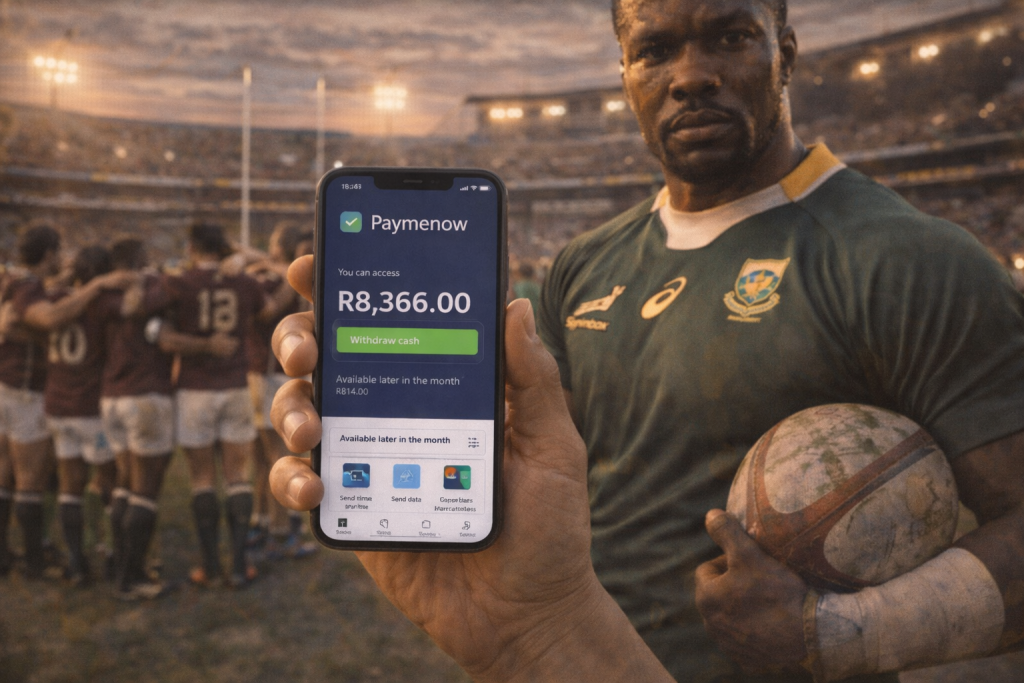
South Africa’s household savings rate sits at negative 1%. For every 100 rand of disposable income, households spend 101 rand, frequently borrowing to bridge the gap. National savings amount to just 15% of GDP compared to the global average of 28%. This financial fragility leaves millions of workers vulnerable to predatory lending between paydays, trapped in cycles of high-interest debt that consume what little earnings they accumulate.
Paymenow has raised over $36 million in debt financing to solve this problem. The earned wage access platform, co-founded by Rugby World Cup champion Bryan Habana, allows employees to access portions of already-earned wages before payday without fees or interest. Standard Bank’s $22.4 million working capital facility in July 2025 positioned the company for aggressive African expansion beyond its base in South Africa, Namibia, and Zambia.
How Earned Wage Access Works
The concept is elegantly simple. Employees earn wages daily but receive them monthly. The mismatch creates cash flow crises that force workers toward loan sharks, payday lenders, and informal credit arrangements with punishing terms. Earned wage access eliminates the gap by letting workers withdraw what they’ve already earned.
Paymenow integrates into employer payroll systems without altering existing processes. Employees access the platform via mobile app, web, USSD, or WhatsApp service. They can withdraw a percentage of accrued wages instantly. When payday arrives, the advance deducts automatically from regular pay. No debt accumulates. No interest compounds.
The model requires no employer costs beyond integration effort. Companies offer Paymenow as an employee benefit without changing payroll timing or investing capital. For employers competing for talent in challenging labor markets, financial wellness benefits provide differentiation without ongoing expense.
The Team Behind the Platform
Paymenow launched in 2019, going live with first customers in March 2020. The founding team includes CEO Deon Nobrega, CTO Willem van Zyl, CDO Gerbrand Potgieter, and founder investor Garth Mackintosh. Bryan Habana, the Springbok legend who scored 67 tries in international rugby, serves as Chief Client Officer and Head of Business Development.
Habana’s involvement brings credibility and visibility that typical fintech founders cannot access. His advocacy for employee-centric benefits addresses what he describes as “the disconnect between monthly pay cycles and daily living expenses.” The rugby champion has spent years building business development relationships across South Africa’s corporate landscape.
The company has grown from a few hundred users at launch to over 600,000 employees accessing the platform across more than 400 companies. Transaction growth reached 55% year-on-year between 2024 and 2025, with over one million monthly transactions processed. User base has doubled in the past two years.
Major Corporate Adoption
African multinational corporations including Hungry Lion, Pepkor, and Massmart Africa have partnered with Paymenow to offer the service to their staff. These aren’t pilot programs. They’re full-scale deployments across large workforces recognizing that financial stress impacts productivity, attendance, and retention.
The corporate value proposition extends beyond employee benefit. Financially stressed workers take more sick days, make more errors, and leave jobs more frequently. Employers offering earned wage access report improved retention and engagement metrics. The benefit costs nothing to provide while delivering measurable returns.
Paymenow’s omni-channel approach, spanning app, web, USSD, and WhatsApp, ensures accessibility across employee populations with varying technology access. Not everyone has smartphones. Not everyone has data plans. Meeting workers where they are rather than requiring technology adoption drives adoption rates that mobile-only solutions cannot match.
The Standard Bank Partnership
The ZAR400 million ($22.4 million) working capital facility from Standard Bank represents more than capital. It signals traditional banking’s recognition that fintech partnerships solve problems branch networks cannot address. Standard Bank has integrated Paymenow into its OneHub platform, offering the service directly to corporate clients seeking employee financial wellness solutions.
The partnership includes PayShap, Standard Bank’s real-time payment solution ensuring competitive payment processing speeds. As Africa’s payment infrastructure modernizes, Paymenow’s integration with banking rails positions it ahead of competitors relying on slower settlement systems.
This follows Paymenow’s 2023 raise of ZAR250 million ($14 million) through Rand Merchant Bank. The company’s ability to secure consecutive debt facilities from major African banks demonstrates confidence in its business model and credit quality. Unlike equity raises that dilute founders, debt facilities fund growth while preserving ownership.
The Global Context
Earned wage access represents one of fintech’s fastest-growing categories globally. Research Nester projects the market to expand from $30.83 billion in 2025 to over $242.46 billion by 2034, a compound annual growth rate of 25.75%. American companies including DailyPay, Earnin, and PayActiv have raised hundreds of millions serving similar markets.
Africa’s opportunity differs in magnitude. Where American workers might access earned wages for convenience, African workers often need it for survival. The predatory lending ecosystem that trapped previous generations remains aggressive. Earned wage access doesn’t just improve cash flow. It breaks debt cycles that consume families for generations.
The Bill & Melinda Gates Foundation has funded earned wage access providers in Nigeria, recognizing the model’s potential for poverty alleviation. Impact investors increasingly view EWA as social infrastructure rather than merely financial service.
Expansion Plans and Future Development
Paymenow has established presence across all nine South African provinces and expanded into Zambia, Namibia, and Pakistan through joint ventures with local partners. The company has identified “significant opportunities” in additional jurisdictions where traditional financial services have failed working populations.
The revamped employer portal launched in early 2025 gives partner firms real-time employee statistics, notification capabilities, payslip uploads, and direct staff rewards through the platform. This evolution from simple wage access toward comprehensive workforce financial wellness expands the company’s role in employer-employee relationships.
Planned AI-driven products will improve user experience and data insights, personalizing financial guidance based on individual cash flow patterns. The company continues hiring across its Stellenbosch and Johannesburg teams as growth accelerates locally and internationally.
Investment Implications
For family offices evaluating African exposure, earned wage access represents a structural opportunity addressing fundamental infrastructure gaps. The category has demonstrated ability to attract major banking partnerships, suggesting acquisition potential as traditional institutions seek fintech capabilities.
Paymenow specifically has proven unit economics, secured institutional debt financing, and built corporate relationships across major African employers. The combination of social impact and commercial viability attracts capital from development finance institutions alongside traditional investors.
As African economies formalize and digital payment infrastructure matures, earned wage access becomes increasingly viable across the continent. Paymenow’s early mover advantage and banking partnerships position it to capture disproportionate share of this expanding market.
Explore impact investment opportunities through Social Life Magazine. Connect with global finance leaders at Polo Hamptons. Subscribe to our print edition for emerging market content, join our email list for weekly updates, or support independent journalism with a $5 contribution.
Related: Moniepoint: Africa’s Fastest-Growing Fintech Unicorn | Embedded Finance: The Invisible Banking Revolution
Author

Written by
Recent Posts
Behind the Scenes of Weddings Involving Long-Distance Relationships
Why Karaoke Is the Ultimate Entertainment Choice for a Hen Party
Easy Recipes That Feed A Crowd Without The Stress
The Influence Of Social Media On Interior Style Trends
Where Can You Find the Best Made-to-Measure Bespoke Suits in NYC
Categories
- Art
- Articles
- Beauty & Skincare
- Celebrities
- Celebrities|Movies
- Celebrities|The Chronicles
- Chronicles
- Entertainment|Culture
- Event Photos
- Events
- Fashion
- Fashion & Style
- Featured
- Food & Beverage
- Food, Spirits, Wine
- Hamptons
- Hamptons Celebrities
- Hamptons Celebrities|Celebrities|The Chronicles
- Health
- Health & Beauty
- Lifestyle
- Luxury Lifestyle
- Movies|Culture
- Movies|Hamptons Lifestyle
- Press
- Profiles
- Real Estate
- Technology
- The Chronicles
- Travel
- Uncategorized
- Weddings