
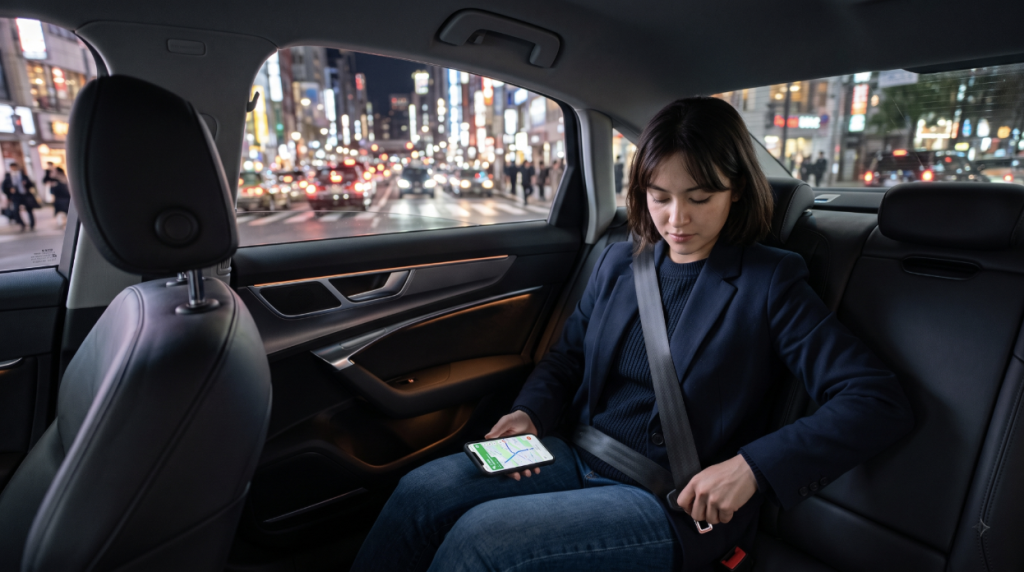
Rideshare has quietly become the default for anyone who would rather not park, would rather not drive after a second glass of wine, and would rather arrive without valet drama. It is convenient enough that most passengers have stopped thinking about it entirely.
This is precisely when the details that matter go unexamined. Seven of them are worth knowing.
1. The Insurance Covering Your Ride Changes Mid-Trip
The most consequential fact about a rideshare trip is that the coverage protecting you is not constant. It shifts by phase.
When the app is off, the driver’s personal policy applies. When the app is on but no ride is accepted, a limited contingent policy applies. Once a ride is accepted and while a passenger is aboard, a substantially larger commercial policy applies.
The practical implication is that two identical crashes at the same intersection can produce entirely different recoveries depending on where the driver was in that cycle.
If you are a passenger, you are in the highest-coverage phase by definition, which is the reassuring half of this. The unnerving half is that the phase is proven by company records rather than by your memory of the evening.
2. Your Driver Is Not an Employee
Rideshare drivers are classified as independent contractors, which shapes everything downstream, training, vehicle standards, and the company’s exposure when something goes wrong.
Texas regulates these companies as transportation network companies under Chapter 2402 of the Texas Occupations Code, which sets permitting, background check, and insurance requirements at the state level and expressly addresses the contractor relationship.
3. Vehicle Inspection Standards Are Lower Than You Assume
Most passengers assume a rideshare vehicle has passed something rigorous. In practice, requirements are typically an age limit and a basic safety inspection closer to a standard registration check than to the commercial fleet maintenance regime governing a taxi company in most cities.
What this means for a long ride
For a short urban trip, this is close to irrelevant. For an hour-long airport run at highway speed, tire condition and brake wear stop being abstractions.
Vehicle age limits also produce an odd effect at the premium tiers. A black-car service vehicle is typically newer and better maintained than a standard one, but the inspection standard behind it is often the same; you are buying newer upholstery rather than a different maintenance regime.
4. Background Checks Do Not Include Fingerprints
Rideshare background checks are typically name-based database searches rather than fingerprint-based criminal history checks. Name-based checks can miss records filed under a different name spelling and generally reach back a limited number of years.
This was one of the central regulatory fights when these services were legalized, and in most jurisdictions, the industry position prevailed.
Why the distinction is not merely technical
Fingerprint checks search a criminal history database directly. Name-based checks search commercial aggregations of court records, which are only as complete as the counties that report to them and only as accurate as the name provided. The difference is not theoretical for anyone getting into a stranger’s car at midnight.
5. Rear Seat Belt Use Collapses in Hired Vehicles
Seat belt use in rear seats runs consistently below front-seat use, and rideshare passengers are by definition, rear-seat occupants. Federal observational research documented in NHTSA’s seat belt safety materials has tracked that gap for years.
The behavioral explanation is social rather than informational: reaching for a belt in a stranger’s car feels like a comment on their driving, and people accept a physical risk to avoid a small social one.
6. The Trips You Take Most Are on the Riskiest Nights
The trip that rideshare exists to replace the drive home after drinking happens at the hours when the road itself is most dangerous. That is a genuine public health win, and it comes with an unavoidable corollary.
Late weekend nights carry the highest concentration of impaired drivers on the road, which is documented across CDC’s impaired driving data. Choosing not to drive removes you as a risk. It does not remove the other drivers, and it places you on the road during the window when the greatest number of impaired ones are out there.
7. The Company’s Coverage Is Not the Same as the Company’s Cooperation
Perhaps the most surprising fact for passengers: having identified the applicable million-dollar policy does not mean the process is simple.
According to Eric “Brad” McClelland, an Associate Attorney in RTRLAW’s Texas personal injury practice, the first contested issue in most rideshare claims is not injury but app status, establishing exactly what phase the driver was in when the collision occurred, which is documented only in company records that a passenger has no direct access to. Because those records establish which policy applies before any negotiation begins, Austin Uber accident attorneys typically request trip data and driver app logs early rather than waiting for the carrier to volunteer which tier is in play.
What an Informed Passenger Actually Does
None of this is an argument against using these services. The safety case for not driving impaired is overwhelming, and the convenience is real.
It is an argument for four small habits: screenshot the trip details before the ride ends, because the record of who was driving and when disappears from your app view faster than you would expect. Buckle up regardless of how short the ride is. Sit in the rear seat rather than the front, where survivability is better in a frontal impact. And if something does happen, note the phase whether you were already in the car because that single fact determines which policy is on the hook.
Author

Written by
Recent Posts

Marine Collagen vs Collagen Cream: Which Wins?

5 Swimwear Brands Making Waves This Summer

The Art of Holiday Hosting: A Hamptons Guide to Effortless Christmas Entertaining & Gifting
Sabah Sarawak – The lesser known parts of Malaysia
When a Car Accident Involves a Parked Vehicle
Categories
- Art
- Articles
- Business of Luxury
- Celebrities
- Culture
- Entertainment
- Events
- Faces of Summer 2026
- Fashion
- Fashion & Style
- Featured
- Finance
- Food, Spirits, Wine
- Hamptons
- Hamptons Celebrities
- Health
- Health & Beauty
- Lifestyle
- Luxury Lifestyle
- Press
- Profiles
- Real Estate
- Technology
- The Chronicles
- Travel
- Uncategorized
- Weddings