
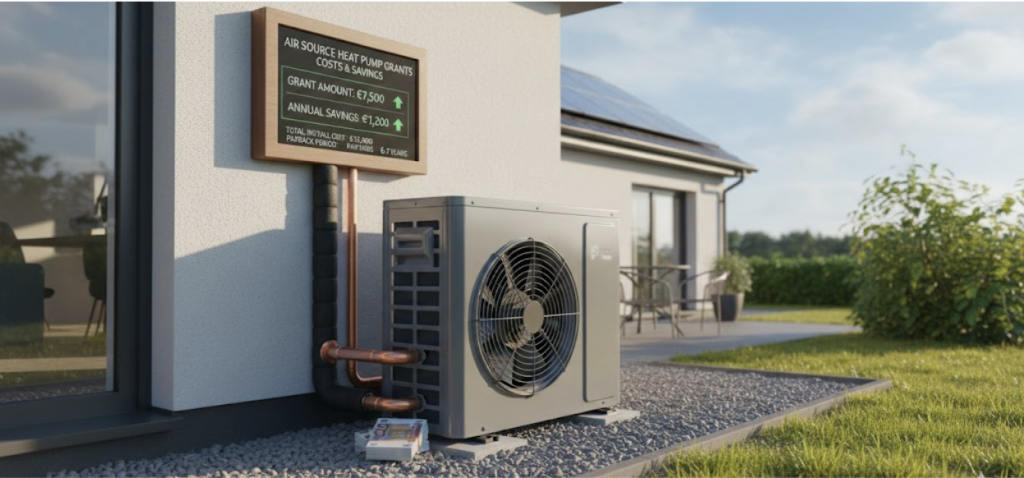
The UK government want to transit towards greener energy solutions. That’s why they promote the air source heat pumps (ASHPs). It is a popular alternative to traditional fossil-fuel heating systems.
Different government-backed grants provide homeowners with substantial financial support for energy-efficient systems.
This article explores the components, types, grants, eligibility criteria, and a step-by-step guide for air source heat pumps.
Air Source Heat Pump?
An air source heat pump grants is a renewable heating system. It extracts heat from the outside air and uses it to warm your home and provide hot water. Conventional boilers burn fuel for heating purposes. However, the ASHPs use electricity to transfer heat from the external environment to indoor spaces. They work efficiently even in cold weather. In this way, they make them not only reliable but also eco-friendly heating options.
Components of the Air Source Heat Pumps?
An air source heat pump has the following key components:
- The Outdoor Unit is composed of an evaporator coil and a fan. It absorbs heat from the air.
- The compressor increases the temperature of the absorbed heat. Moreover, it compresses the refrigerant gas.
- Heat Exchanger contains a plate. This plate will transfer the generated heat from the air into the refrigerant liquid.
- Expansion Valve regulates the refrigerant flow. At the same time, it ensures efficient operation.
- Control System contains a thermostat and control panel. Moreover, it allows homeowners to adjust temperature settings.
Types of Air Source Heat Pumps?
There are two main types of air-source heat pumps:
- Air-to-Air Heat Pumps:
These systems transfer heat from the outside air into the air inside the home. They do not provide hot water.
- Air-to-Water Heat Pumps:
These pumps transfer heat from the outside air into the inside water. They are used in homes with underfloor heating or radiators.
Which Grants Provide Free Air Source Heat Pumps?
The UK government provide Air Source Heat Pumps through different schemes, such as the following:
Energy Company Obligation (ECO4)
The ECO4 scheme helps low-income households by improving the energy efficiency of their homes. Eligible homeowners can receive a free air source heat pump installation. Major energy companies target low-income households by providing energy benefits through this scheme.
Home Upgrade Grant (HUG)
The Home Upgrade Grant (HUG) targets off-gas grid homes with low-income residents. This scheme provides funding for energy-efficient measures, such as the following:
- Air source heat pumps
- Insulation
- Solar panels
This scheme promotes the transition towards greener heating solutions.
Boiler Upgrade Scheme (BUS)
The Boiler Upgrade Scheme (BUS) offers grants of up to £7,500. It provides financial assistance for the cost of installing an air source heat pump. It is available to low-income homeowners in England and Wales. This scheme replaces old fossil fuel-based boilers with modern, energy-efficient heat pumps. The BUS is not need-based, it is accessible to a broader range of homeowners.
Eligibility Criteria for the Air Source Heat Pump Grants
Eligibility for air source heat pump grants varies from scheme to scheme. However, there are some common criteria, such as the following:
- The ECO4 and HUG, target households whose annual income is lower than £31,000.
- The Air Source Heat Pump Grants are available for homeowners, landlords, and social housing tenants.
- They target the Homes with inefficient or fossil fuel-based heating systems.
- A low EPC rating, such as the D, E, F, or G.
- Some grants, like HUG, focus on off-gas grid rural areas.
Step-by-Step Guide for Installing an Air Source Heat Pump
You can get the Air Source Heat Pump through the Free Grants by following the steps below:
1. Assess Your Eligibility
- Check if you qualify for grants such as ECO4, HUG, or BUS.
- Ensure your property meets the necessary requirements.
2. Choose a Certified Installer
- Find an accredited installer registered with MCS (Microgeneration Certification Scheme).
- Compare quotes and reviews before selecting a provider.
3. Conduct a Home Energy Assessment
- An installer will assess your home’s insulation, heating requirements, and suitability for an ASHP.
- They may recommend additional insulation or upgrades.
4. Apply for the Grant
- The installer typically applies for the grant on your behalf.
- Provide necessary documentation, such as your Energy Performance Certificate (EPC).
5. Schedule the Installation
- Work with your installer to set up an installation date.
- Ensure all necessary permissions are obtained if required.
6. Installation Process
- The old heating system is removed if applicable.
- The outdoor and indoor units of the ASHP are installed and connected to your heating system.
- The installer tests the system for efficiency and functionality.
7. Final Inspection and Certification
- The system undergoes a final inspection to ensure compliance with regulations.
- The installer provides certification and guidance on system usage.
8. Monitor and Maintain Your System
- Schedule regular maintenance to keep your ASHP running efficiently.
- Keep track of energy savings and heating performance.
Benefits of the Air Source Heat Pump Grants
The Air Source Heat Pumps can prove beneficial in the following ways:
Energy Efficiency
Air source heat pumps are highly efficient. It is due to their condensing technologies that are far more efficient than the traditional boilers. They produce three times more heat than the electricity they consume. In this way, they will reduce overall energy consumption.
Promotion of Renewable Energy Resources
The air source heat pumps use the air as a renewable energy source. In this way, they will decrease dependency on fossil fuels and encourage sustainable energy practices.
Reduction of Carbon Emissions
The primary environmental benefit of air-source heat pumps is their ability to lower carbon emissions. The households can cut their CO2 output, contributing to the UK’s goal of net-zero emissions by switching from gas or oil heating to an ASHP.
Conclusion
Air source heat pumps are a fantastic step toward a greener home. They consume very little electricity, primarily for pumping and circulation purposes, which allows them to significantly reduce the consumption of non-renewable energy sources. However, to maximize this efficiency, homeowners must ensure their internal heating distribution is optimized; for instance, many people wonder, Do Radiator Covers Block Heat, as restricted airflow can force the pump to work harder than necessary.
Ultimately, everyone should consider these schemes to transition to Air Source Heat Pumps. In this way, they will not only reduce their energy bills but also protect the environment from air pollution through cleaner, more sustainable heating.
Author

Written by
Recent Posts

Breaking Bad Cast Net Worth. $130 Million Cooked in Five Seasons of Perfect Television

Cailee Spaeny Net Worth — From Springfield, Missouri to A24 and Alien in Three Years Flat

Wagner Moura Net Worth — He Learned Spanish to Play Escobar. Then He Learned English to Take Hollywood.

Robert Eggers Net Worth — He Made a $3.5 Million Film in Puritan English and Hollywood Listened

Brie Larson Net Worth — A $6 Million Indie Film Won Her an Oscar. Marvel Paid Her the Rest.
Categories
- Art
- Articles
- Beauty & Skincare
- Celebrities
- Celebrities|Movies
- Celebrities|The Chronicles
- Chronicles
- Entertainment|Culture
- Event Photos
- Events
- Fashion
- Fashion & Style
- Featured
- Food & Beverage
- Food, Spirits, Wine
- Hamptons
- Hamptons Celebrities
- Hamptons Celebrities|Celebrities|The Chronicles
- Health
- Health & Beauty
- Lifestyle
- Luxury Lifestyle
- Movies|Culture
- Movies|Hamptons Lifestyle
- Press
- Profiles
- Real Estate
- Technology
- The Chronicles
- Travel
- TV
- Uncategorized
- Weddings