
Where 178 Years of Hamptons History Pours From a Single Wine List
The coal stove was rusted. Meanwhile, the outhouses had collapsed entirely. When a 23-year-old named Ted Conklin walked through the front door in 1971, dust lay so thick he could scoop it with a snow shovel. Remarkably, the building hadn’t hosted guests since the 1930s—nor had it legally served alcohol since before World War I. Inside, the nonagenarian owner was using the first-floor dining room as his living quarters.
Any sensible person would have walked away. However, Conklin saw something else entirely—he recognized canvas where others saw decay. More importantly, he envisioned possibility in every rotting beam. Moreover, he glimpsed the future of a depressed whaling village that the rest of the Hamptons had forgotten. Consequently, he bought the place and proceeded to transform both the building and the town it anchored.
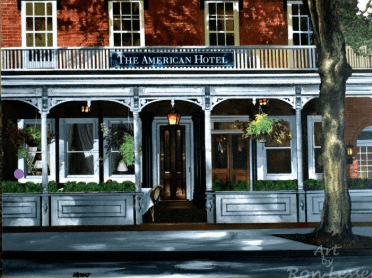
Today, The American Hotel in Sag Harbor stands as one of only 87 restaurants worldwide holding Wine Spectator’s Grand Award. Its 30,000-bottle cellar includes seventeen vintages of Château Pétrus. Additionally, its eight guest rooms have hosted Nobel laureates, rock legends, and literary giants. The three-story brick facade with its white-columned porch has become synonymous with Sag Harbor itself—a symbol of what happens when vision meets persistence.
Revolutionary Roots: Before The Hotel Existed
The American Hotel’s story begins long before its construction. Furthermore, the site carries historical weight that few establishments can match. Understanding this context reveals why the building feels different from ordinary hotels.
The James Howell Inn and Colonial Origins
Before the American Revolution, the James Howell Inn stood on this very spot. British officers were billeted there during the war. Then came one of the conflict’s most daring episodes.
In May 1777, Colonel Return Jonathan Meigs led 220 patriots across Long Island Sound in thirteen whaling boats. They sailed through open water, landed silently, and captured the British officers before a single soldier could step outside the inn. The raiders burned twelve British ships and took ninety prisoners without losing a single man. Consequently, this address was already legendary before a brick was laid.
Nathan Tinker’s Fateful Investment
The original wooden inn likely burned during one of the periodic fires that swept through Sag Harbor’s crowded waterfront. In 1824, local cabinetmaker Nathan Tinker began constructing the brick edifice that still stands today.
By 1845, whaling had reached its economic peak. Sag Harbor overflowed with sailors, chandleries, and the pungent stench of rendering whale oil. Herman Melville’s Queequeg briefly stopped here en route to Captain Ahab’s Pequod. Tinker expanded his building to accommodate the whale trade—adding mercantile space and boarding rooms.
However, his timing proved catastrophic. The California Gold Rush of 1849 drained Sag Harbor of young men seeking faster fortunes. Simultaneously, the whaling industry collapsed almost overnight. As a result, ships had to travel greater distances to find their catch. Furthermore, steamships began replacing wooden sailing vessels. To make matters worse, over twenty local ships were lost in the stormy winters of 1847 and 1848.
From Whaling Port to Forgotten Backwater
After the whaling economy collapsed, Sag Harbor reinvented itself through light manufacturing. Nevertheless, the American Hotel’s fortunes remained tied to the village’s cycles of prosperity and decline.
The Manufacturing Years
Captain William Freeman and Bridgehampton farmer Addison Youngs bought the building from Tinker’s heirs in 1876. They built the iconic porch, installed a bar and dining room, and named it The American Hotel.
Sag Harbor subsequently became home to factories producing remarkable products. For instance, the Alvin Silver Company crafted handmade silverware. Later, Bliss torpedoes were manufactured for World War I, with Thomas Edison himself observing tests in the harbor. During WWII, Grumman parts equipped Spitfires. Eventually, throttle assemblies built here helped land astronauts on the moon.
Throughout these decades, the hotel served traveling salesmen and businesspeople. However, when the factories began closing after WWI, the establishment’s slow decline began.
The Darkest Years
By the early 1970s, Sag Harbor had reached its nadir. Factory closings had eliminated 1,500 jobs, while the village population dropped below 2,000. Most importantly, Sag Harbor wasn’t considered a tony Hamptons destination—instead, it was blue-collar, working-class, and largely forgotten.
Meanwhile, The American Hotel had become a ghost of itself. Rooms hadn’t been rented in four decades, and the bar had been dry since Prohibition. Will Youngs, the elderly owner, lived alone amid the decay. Gas lamps still provided the only light, since the building hadn’t been significantly touched since perhaps 1900.
Ted Conklin’s Vision: Resurrection Day
Theodore Brigham Conklin III arrived with a bloodline tracing back to the American Revolution and a vision that most contemporaries considered delusional. Nevertheless, he saw what others couldn’t.
The Renovation Nobody Believed In
Conklin personally stood in the basement, knee-deep in coal dust, removing it bucketful by bucketful. First, he demolished the outhouses. Then he replaced the rusted coal stove and installed electricity throughout the building. Additionally, he banged nails and hung wallpaper himself while braving the winter of 1971-72 in a structure that still had four privies in back.
His mentor had always said, “It only costs 50 percent more to go first class.” Consequently, Conklin applied that philosophy to every decision—from fresh white linen tablecloths at every turnover to fresh flowers daily at every table. In addition, he insisted on stunning flatware and silver, always perfectly set.
Independence Day 1972
The restaurant reopened on July 4, 1972—a fitting date for an establishment called The American Hotel, owned by a man whose family fought in the Revolution. Notably, the menu was distinctly French, while the service criteria remained impeccable throughout. During those early days, Conklin even served as his own chef.
“When Ted got here in 1972, he made this town,” longtime bartender Vinnie Rom has observed. “It was a sleepy old industrial town with a bunch of meatheads beating each other up in local bars. Now look at Sag Harbor today. Some of the wealthiest people in the world are here shopping and eating and drinking.”
Building the World’s Greatest Wine Cellar
What transformed The American Hotel from local success to international destination was Conklin’s obsessive dedication to wine. Furthermore, his approach combined scholarly rigor with adventurous collecting.
The Legendary Gus Gants Connection
At his first establishment—the Artful Dodger in Westhampton Beach—Conklin met Gus Gants, a legendary wine salesman for Austin-Nichols. When the company closed in the mid-1970s, Gants guided Conklin through purchasing their high-quality, inexpensive Bordeaux inventory.
That foundation launched one of America’s greatest restaurant wine programs. By 1981, The American Hotel had earned Wine Spectator’s Grand Award—one of only fourteen establishments worldwide to receive the inaugural honor. Moreover, the hotel has received this distinction every single year since.
30,000 Bottles and 2,500 Selections
Today, the cellar beneath the barroom floorboards holds over 30,000 bottles representing 2,500 selections. Indeed, the 85-page wine list reads like a textbook of viniculture. It features vertical selections of all five Bordeaux First Growths, along with seventeen vintages of Château Pétrus. Additionally, collectors will find one of the finest assemblages of Domaine de la Romanée-Conti imaginable.
“I was absolutely fascinated not only by the length of the list, but by Ted’s commentary,” recalled Patrick Yowell, who later helped Conklin launch Long Island’s Slow Food chapter. “It was the most opinionated wine list I’d ever read in my life.”
The Literary and Celebrity Connection
The American Hotel attracted creatives from the beginning. Sag Harbor had long been a haven for writers and artists seeking affordable refuge from urban pressures—and the hotel became their unofficial clubhouse.
Writers Who Shaped American Literature
John Steinbeck wrote and won the Nobel Prize while living at nearby Bluff Point, ultimately using Sag Harbor as the setting for “The Winter of Our Discontent.” Similarly, playwright Lanford Wilson walked Main Street daily, known around town as an excellent cook who tended an immaculate garden. Even today, Thomas Harris—who created Hannibal Lecter in a room above a Sag Harbor barber shop—still frequents The American Hotel.
Meanwhile, Betty Friedan summered on Glover Street, hosting Sunday lunches for the literary elite. Decades later, Colson Whitehead set his novel “Sag Harbor” in the village’s historic African American beach community. Nearby, the monologist Spalding Gray wrote “Swimming to Cambodia” at his 19th-century Victorian home.
Billy Joel and the Piano
One winter Sunday in 1994, Billy Joel dined alone at the hotel following his breakup with Christie Brinkley. As former general manager Doug Kunz recalls, Joel rose from his table and asked to have his after-dinner grappa and espresso brought to the empty front dining room.
“Tray in hand, I entered the room to see Joel tinkering at the piano. I placed his drinks on the table next to the piano and, perhaps seeing my drink, he said, ‘Join me, Doug.’ I sat down expecting to hear one of his hits, but to my surprise he began playing what I believe was a Chopin piano concerto.”
Halfway through, Joel turned and said: “Doug, if I had my way, I would have preferred to make a living playing music like this.”
America’s Piano Man playing classical music at a classic American establishment—that’s The American Hotel.
Experience The American Hotel Today
After five decades of continuous operation under Conklin’s ownership, The American Hotel remains exactly what it was designed to be: an establishment serving the “necessities of life”—fine dining, proper wine, cigars, and accommodations.
The Eight Guest Rooms
Each of the hotel’s eight double rooms has distinct character, as American antiques furnish every space. Throughout, period prints and appointments adorn the walls. Guests will find queen and king beds that provide exceptional comfort, while private bathrooms include modern amenities without sacrificing historic charm.
For the best experience, request Room 5 for its spacious layout and jacuzzi tub. Keep in mind there’s no elevator—only stairs to the second and third floors. Moreover, accept that summer weekends are substantially spoken for by March. During Hampton Classic Week, a one-week minimum stay is required.
The Restaurant and Bar
Executive Chef Jonathan Parker leads a kitchen serving American-French cuisine with menus that change seasonally. Here, fresh ingredients from local farms meet classic techniques in every dish. Above the dining room, the famous giant moose head has watched over generations of celebrities, socialites, and politicians.
Beyond the dining room, the low-ceilinged wooden bar remains the establishment’s social heart. This is where literary icons mingle with local firefighters, and where rock stars share space with village officials. As former police chief Joe Ialacci put it, the bar at The American Hotel is simply “glorious.”
The Insider’s Approach
For reservations: Call well in advance, since dinner reservations during summer weekends are highly competitive. Alternatively, lunch offers easier access to the same kitchen and wine list.
For the wine list: Don’t be intimidated by the 85 pages, as the staff is legendary for guiding guests through selections at every price point. Additionally, the by-the-glass options are surprisingly extensive.
For the porch: Summer dining on the front porch offers Sag Harbor’s best people-watching opportunity. From your table, Main Street parades past while you dine on Montauk swordfish.
The Legacy That Endures
The American Hotel succeeded because Ted Conklin understood something essential about hospitality. He didn’t build an establishment for the wealthy alone. He created, as the hotel’s own history states, “a proud home for Sag Harbor’s incredible breadth of people—local and international, poor and wealthy, ascendant, struggling, famous, occasionally unsavory, accomplished and powerful, published and unpublished, beautiful and ordinary—vital, every one of us.”
That democratic spirit, paired with uncompromising quality, explains why The American Hotel has survived while countless competitors have closed. Furthermore, it explains why the establishment feels different from the glossier venues in East Hampton and Southampton.
Sag Harbor cultivates an “un-Hampton” reputation—a place where people gather at corner bars rather than country clubs, where the five-and-dime still operates, where authenticity matters more than ostentation. The American Hotel embodies that spirit while delivering world-class wine and cuisine.
Visit once, and you’ll understand why regulars return for decades. After all, the building carries nearly two centuries of American history. Below the floorboards, the cellar holds treasures from the world’s greatest vineyards. Most importantly, the bar welcomes everyone who appreciates the necessities of life, well-served.
This is The American Hotel—the center of the universe, as they call it on Main Street. And after 178 years, the story continues.
Continue Your Hamptons Journey
- Feature & Partnership Inquiries
- Polo Hamptons Tickets & Sponsorships
- Join Our Email List
- Subscribe to Print Edition
- Support Social Life Magazine
Related Articles
Author

Written by
Recent Posts
The Real Reason Smart, Motivated People Don’t Follow Through
Simple Eating Habits That Boost Your Wellness
When to Seek Professional Support for Persistent Mental Health Symptoms
Creative Strategies Couples Use to Pay for Their Big Day
How International SEO Helps Brands Succeed Across Borders
Categories
- 2025 Social Life Events
- Access to Digital + Physical Magazine
- Art
- Articles
- Beauty & Skincare
- Beauty & Wellness
- Business Strategy
- Celebrities
- Chronicles
- Design History
- Design History|Hamptons
- Design Process
- Design Trends
- Event Photos
- Events
- Family
- Fashion
- Fashion & Style
- Featured
- Food & Beverage
- Food, Spirits, Wine
- Hamptons
- Hamptons Celebrities
- Hamptons Design
- Health
- Health & Beauty
- Home & Design
- Home & Living
- Lifestyle
- Luxury Home Design|Design Process
- Luxury Home Design|Design Trends
- Luxury Home Design|Hamptons Design
- Luxury Home Design|Interior Design
- Luxury Lifestyle
- Luxury Living
- Luxury Living|Design Process
- Luxury Living|Hamptons
- Luxury Living|Hamptons Design
- Press
- Profiles
- Real Estate
- Technology
- The Chronicles
- Travel
- Trending
- Uncategorized
- Weddings
- Wellness