
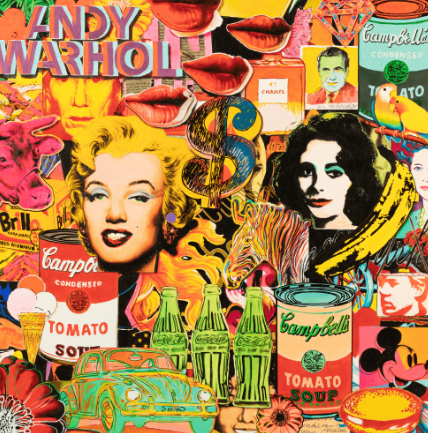
The silver-wigged king of Andy Warhol Pop-Art fled Manhattan every summer for a place that seemed like his aesthetic opposite. While the foil-covered Factory throbbed with downtown chaos, five white clapboard cottages sat silent at the easternmost edge of Long Island. Furthermore, the contradiction reveals something essential about the man who turned soup cans into museum pieces.
Andy Warhol Pop-Art Meets the Church Estate
Before Warhol arrived, Eothen belonged to the Church family—heirs to the Arm & Hammer baking soda fortune. They had constructed five Colonial Revival cottages in 1931 as a fishing camp, using the property for only a few weeks each September during peak striped bass season. The rustic compound featured stuffed fish on the walls, shelves of old books flanking a massive fireplace, and nothing that resembled downtown glamour.
This deliberate simplicity attracted Warhol immediately. Bob Colacello, former editor of Interview magazine, later described Eothen as “the Factory answer to Hyannisport.” Indeed, the comparison proved prophetic. The Kennedy Compound in Massachusetts drew political royalty; Warhol’s Montauk retreat would attract cultural royalty of a different kind.
The property included a main lodge-style house with five bedrooms, three cottages, a stable, and a three-car garage. A long winding private drive ensured seclusion. Nevertheless, the real value lay in twenty acres of oceanfront land perched on the Montauk Moorlands. Dick Cavett lived half a mile west. Photographer Peter Beard occupied a bungalow near the lighthouse. Subsequently, this artistic enclave became ground zero for seventies counterculture meeting old money.
When Kennedy Heirs Met Andy Warhol Pop-Art Sensibility
Financial pressures from funding the Factory forced Warhol to rent out the main house during early summers. His first tenant in 1972 was socialite Lee Radziwill. She brought along her sister Jackie Kennedy Onassis and their children—including Caroline Kennedy and John F. Kennedy Jr.
The collision of these worlds defied every expectation. Warhol, whom Radziwill had imagined as “strange,” turned out to be surprisingly domestic. He spent hours entertaining the children, teaching them to draw and paint. Meanwhile, Jackie hired avant-garde filmmaker Jonas Mekas to teach her children photography and filmmaking. The footage Mekas captured during those summers later appeared in the 2017 documentary That Summer.
For Warhol’s 44th birthday in August 1972, Lee Radziwill gifted him a flagpole that still stands on the property today. The flag was raised and lowered daily—also serving as a signal to Dick Cavett about which notable guests might be available for his television program. These small rituals transformed the compound into something between artistic commune and social command center.
The Rolling Stones and the Birth of “Memory Motel”
The convergence of Andy Warhol Pop-Art culture and rock mythology reached its peak in spring 1975. The Rolling Stones rented Eothen for five weeks as they rehearsed for their Tour of the Americas. They paid a mere $5,000 monthly—pocket change for what became a pivotal creative period.
Throughout April, sensationally loud music welled through the windows and across the tangled crab-grass. Residents of the nearby Ditch Plains trailer park awoke to what sounded like yapping wolves. From East Hampton to Manhattan, word spread like brushfire: the Rolling Stones had invaded Montauk.
Mick Jagger and Keith Richards frequented the Memory Motel in downtown Montauk—the only bar in town with both a pool table and a piano. The owners reportedly detested the band. Nevertheless, the rockers would get liquored up, shoot pool, brawl occasionally, and play piano until dawn before stumbling back to Eothen. This establishment inspired one of their most haunting ballads.
“Memory Motel” appeared on the 1976 album Black and Blue. Jagger began writing it at Eothen, finishing the lyrics on tour. The seven-minute song—one of the longest in the Stones catalog—features both Jagger and Richards sharing lead vocals in a rare emotional vulnerability. As Warhol later wrote in his book Exposures: “Mick Jagger really put Montauk on the map. All the motels were overflowing with groupies. When Mick went into town everything stopped.”
The Sunset Series: Andy Warhol Pop-Art Inspired by Montauk Light
Warhol’s time at Eothen influenced his artwork directly. The 1972 “Sunset” series emerged from those early summers, when Atlantic horizons painted themselves each evening in colors no Manhattan skyline could match.
The portfolio consists of vibrant silkscreen prints depicting various iterations of sunsets in bold, almost abstract compositions. Warhol employed his signature technique of repetition and vivid color, but the subject matter marked a departure from consumer culture and celebrity. Here was nature filtered through Pop sensibility. The Museum of Modern Art now holds works from this series in its permanent collection.
The prints feature recurring motifs of the sun sinking below the horizon, rendered in fuchsia, gold, lavender, purple, and orange. Each variation captures the ephemeral beauty of those celestial events—the kind visible only from the easternmost point of Long Island, where the next stop, as Warhol noted, “is Lisbon, Portugal.”
A Guest List That Reads Like Cultural History
Beyond the Kennedys and Stones, Eothen’s guest registry chronicles an era. John Lennon and Yoko Ono visited. Elizabeth Taylor stayed. Halston rented the main house in the late seventies, insisting on installing a Vulcan professional stove and transforming the décor to chinois style. Liza Minnelli, Catherine Deneuve, Lauren Hutton, and Truman Capote all made appearances.
Keith Haring smiled for cameras on the property. Julian Schnabel painted broken bowls en plein air along the sand. Peter Beard documented everything, creating the photographic record that preserves these gatherings for history. The Jaggers dined at Gosman’s and the Shagwong Tavern, where Bianca would roll up the sleeves of her Yves Saint Laurent dresses to open clams.
Yet Warhol himself often remained on the periphery of his own parties. He shied away from drinking and dancing, quietly photographing guests and playing with their children. “I wish I were like Mick,” he once said. “He’s a somebody. I’m a nobody.” The statement captures the peculiar loneliness that accompanied his fame—and perhaps explains why this remote compound offered refuge.
The Andy Warhol Preserve: A Living Legacy
After Warhol’s unexpected death in 1987, his estate faced decisions about the Montauk property. In 1992, the Andy Warhol Foundation for the Visual Arts donated fifteen acres of oceanfront land to The Nature Conservancy. This gift created the Andy Warhol Preserve—a living monument to the artist’s connection with this landscape.
The preserve protects a section of the ecologically significant Montauk Moorlands. As a condition of the gift, the Conservancy established an interpretive nature trail for visitors through mixed wetlands, woodlands, and coastal bluffs. The same views that inspired the Sunset series now serve as an educational resource where art and nature intersect.
Today, The Nature Conservancy runs the Andy Warhol Visual Arts Program at the preserve. Selected artists lead free public workshops each fall, guiding participants to create art inspired by the Montauk landscape. The program continues Warhol’s legacy of democratizing art while honoring his connection to this specific place.
From $225,000 to $50 Million: The Property’s Evolution
Paul Morrissey retained half ownership of the remaining 5.7 acres after the preserve donation. He listed the property in 2001 for $50 million, eventually lowering the price to $40 million. In 2007, J.Crew CEO Mickey Drexler purchased it for $27 million, merging it with a neighboring 24-acre horse farm.
Drexler renovated the compound to suit his catalog aesthetic while maintaining its historic character. He later listed the entire property for $85 million. In 2015, gallerist Adam Lindemann purchased the 5.7-acre compound without the horse farm for a reported $50 million—more than 220 times what Warhol originally paid.
The appreciation reflects more than real estate trends. It measures cultural capital. Ownership of Eothen means possessing a piece of art history, a site where Andy Warhol Pop-Art vision merged with Atlantic horizons and rock and roll mythology.
Experiencing Warhol’s Montauk Today
While Eothen remains private property, visitors can still connect with Warhol’s Montauk legacy. The Andy Warhol Preserve offers hiking trails through the landscape that inspired an artist. The Memory Motel continues operating, still hosting live music on summer weekends—though the Rolling Stones haven’t returned.
The Shagwong Tavern maintains its gritty charm. Gurney’s Montauk provides oceanfront luxury that would have impressed even Warhol’s most glamorous guests. The surf breaks at Ditch Plains still attract those seeking something raw and authentic.
Montauk’s evolution from quiet fishing village to sophisticated destination traces directly to those summers when Andy Warhol Pop-Art sensibility collided with Kennedy elegance and rock and roll rebellion. The compound at the end of the island became a laboratory for cultural cross-pollination. Its influence ripples through the Hamptons’ identity today.
The Enduring Connection Between Andy Warhol Pop-Art and Montauk
Understanding why Warhol chose Montauk requires appreciating what he sought to escape. The Factory demanded constant performance. Fame required endless social navigation. At Eothen, the man who said “in the future everyone will be world-famous for fifteen minutes” could simply watch the sunset.
The paradox defines his Montauk years. The artist who elevated commercial imagery found inspiration in natural phenomena. The host of legendary parties often stood at the edges, camera in hand. The cultural provocateur proved surprisingly domestic when entertaining children. Furthermore, these contradictions make his legacy richer.
For those exploring Montauk’s hidden gems, the Warhol connection adds depth to every sunset. That golden light washing over the Atlantic doesn’t just signal day’s end. It recalls a moment when an artist looked east from the edge of everything and saw something worth capturing. The fifteen acres he ultimately gave back to the land ensure that vision remains accessible to anyone willing to walk the trail.
Stay Connected with Social Life Magazine
- Contact Social Life Magazine
- Experience Polo Hamptons
- Subscribe to Our Newsletter
- Print Subscription
- Support Our Journalism ($5)
Related Articles
- Gurney’s Montauk: The Hamptons’ Ultimate Oceanfront Luxury Resort Experience — Discover the oceanfront sanctuary where celebrities still retreat, continuing the tradition of sophisticated Montauk hospitality.
- Insider’s Guide to Montauk: The Hamptons Village That Doesn’t Act Like It — From Memory Motel to Ditch Plains, explore the destinations that shaped Montauk’s countercultural identity.
Author

Written by
Recent Posts
Aaron Paul Net Worth — His Character Was Supposed to Die in Season One. Instead He Made $30 Million.
Bryan Cranston Net Worth. He Played a Sitcom Dad for Seven Years. Then He Became the Most Dangerous Man on Television.
Breaking Bad Cast Net Worth. $130 Million Cooked in Five Seasons of Perfect Television
Cailee Spaeny Net Worth — From Springfield, Missouri to A24 and Alien in Three Years Flat
Wagner Moura Net Worth — He Learned Spanish to Play Escobar. Then He Learned English to Take Hollywood.
Categories
- Art
- Articles
- Beauty & Skincare
- Celebrities
- Celebrities|Movies
- Celebrities|The Chronicles
- Chronicles
- Entertainment|Culture
- Event Photos
- Events
- Fashion
- Fashion & Style
- Featured
- Food & Beverage
- Food, Spirits, Wine
- Hamptons
- Hamptons Celebrities
- Hamptons Celebrities|Celebrities|The Chronicles
- Health
- Health & Beauty
- Lifestyle
- Luxury Lifestyle
- Movies|Culture
- Movies|Hamptons Lifestyle
- Press
- Profiles
- Real Estate
- Technology
- The Chronicles
- Travel
- TV
- Uncategorized
- Weddings