
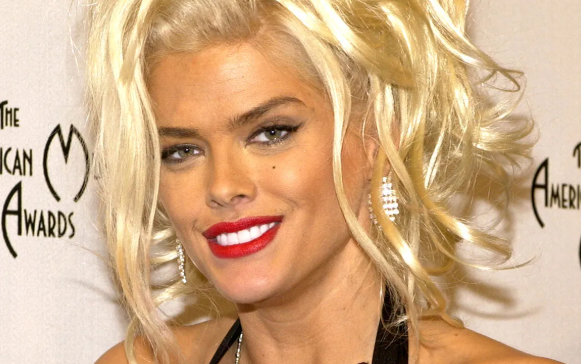
The Woman America Made and Broke
Anna Nicole Smith model is a phrase that still stops a room — but rarely for the right reasons. She walked into a Houston strip club in 1991 and walked out of it famous. Not yet — but the machinery was already in motion. Vickie Lynn Hogan from Mexia, Texas had the one asset the 1990s rewarded above all others: a body that looked like a dare. Within two years, she would replace Claudia Schiffer in the Guess jeans campaign, appear on the cover of Playboy, and rename herself after a dead movie star she adored and a fate she didn’t yet understand. America saw her and decided she was a joke. America watched her anyway. That tension — adoration dressed up as contempt — is where her story actually lives.
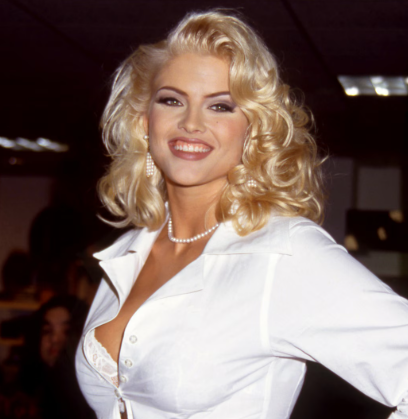
Anna Nicole Smith was not simply a model who self-destructed. She was a Lily Bart for the tabloid era: a woman of extraordinary surface value, no structural support, and a social world that consumed her beauty as entertainment while offering nothing in return. Edith Wharton wrote that story in 1905. The fashion industry ran it again, in full color, ninety years later.
Before examining what went wrong, it’s worth understanding what went spectacularly right. For a brief, electric window between 1992 and 1994, Anna Nicole Smith was one of the most recognizable faces in the world. Her Guess campaign — black and white, sultry, Mansfield-channeling — redefined what commercial modeling could look like at a moment when heroin chic was about to hollow out the industry’s standards entirely. She was the counterargument in a push-up bra.
The Girl America Invented
Understanding the Anna Nicole Smith model story requires understanding where she came from. Her backstory reads like a country song written by someone who’d never heard one. Born in 1967 to parents who divorced before she was two, she shuttled between her mother and her aunt in small-town Texas. She dropped out of high school at 17, married a cook she met at Jim’s Crispy Fried Chicken, had a son named Daniel at 18, and divorced at 23. Then she started stripping, because it paid better than Walmart and because the attention felt, for the first time, like something she could control.
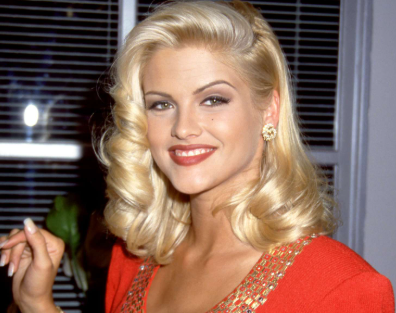
Modeling scouts noticed her in Houston. Playboy noticed her in 1992. Guess noticed her shortly after. Each institution handed her a new identity without asking whether she had the infrastructure to carry it. She became “Anna Nicole” — the name itself a costume — and the transformation felt complete from the outside. From the inside, a girl from Mexia was still running the show, dazzled and undefended.
The cultural timing mattered enormously. The early 1990s were the last gasp of the pre-internet celebrity economy, where a single magazine cover or jeans campaign could manufacture genuine national fame overnight. Smith arrived at exactly the right moment with exactly the right measurements, and the industry treated her accordingly — meaning, it treated her like a resource, not a person.
What the Decade Wanted From Her
As an Anna Nicole Smith model career milestone: in 1993, Anna Nicole Smith was named Playboy’s Playmate of the Year. She appeared on the cover of Marie Claire, shot by Peter Lindbergh. GQ ran her. The comparisons to Marilyn Monroe started immediately and never really stopped, which should have served as a warning to anyone paying attention. The women America compares to Marilyn Monroe are rarely being offered help. They’re being offered a script.
The Marilyn template is specific: working-class girl, spectacular beauty, a certain luminous vulnerability, men in power orbiting her, an early death that retrospectively sanctifies everything. The public cast Smith in this role before she was 26. She accepted it because it came with money, attention, and the first sustained feeling of being wanted that her life had offered.
Then she married J. Howard Marshall II. He was 89. She was 26. The 63-year gap between them handed every tabloid in the country a permanent headline. Smith said she loved him. Most people chose not to believe her, which was simpler than asking why a woman might genuinely attach to the first wealthy, older man who treated her with consistent kindness. Marshall died fourteen months after the wedding. The legal battle over his estate lasted longer than their marriage by about two decades.
The Architecture of a Fall
Here is what Anna Nicole Smith did not have, at any point in her career: a financial manager she trusted, a legal team working for her rather than around her, a creative direction that extended beyond the next campaign, or a single institutional relationship that prioritized her long-term interests over her short-term marketability.
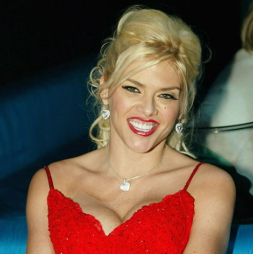
This is the structural failure that separates her story from the women who built lasting wealth from comparable fame. The models who converted beauty into lasting equity — Iman, Kathy Ireland, Tyra Banks — each had one thing Smith never acquired: a stage beyond the runway, built before the runway career expired. Smith’s Guess contract ended. Her Playboy moment passed. The Marshall estate dragged through courts that showed no urgency on her behalf. She had no product, no platform, no intellectual property. What she had was a face, a body, and a story the public enjoyed consuming.
The Window That Closed: TrimSpa and the Missed Play
In 2003, she lost a reported 69 pounds and became the face of TrimSpa diet pills. For a moment, it looked like a pivot. She was visible again, thinner, apparently in control. What it actually was — in retrospect — was the last window in which a real business play was possible. A wellness brand, a fitness platform, even a sustained spokesperson deal with genuine equity participation: any of these were within reach. HBR’s research on celebrity brand equity identifies visibility-to-conversion windows that close fast and don’t reopen. Instead, TrimSpa was a short-term endorsement deal that paid flat fees and disappeared when the next headline arrived. The infrastructure question was never asked, because nobody around her was asking infrastructure questions. Netflix’s 2022 documentary on Smith captures how systematically she was surrounded by people extracting from her rather than building with her. They were asking what she could do for them next.
The E! Show: When the Camera Wouldn’t Stop Rolling
By the early 2000s, the consumption had turned ugly. The Anna Nicole Show premiered on E! in 2002, and it was — depending on your appetite for discomfort — either great television or a slow public unbundling of a person in crisis. Probably both. The cameras captured her disoriented, slurring, confused. Nobody stopped filming. The ratings were excellent.
The prescription drug dependency had been building for years, fed in part by prescriptions written in other people’s names, managed by people with financial interests in her continued visibility. She was not, in this regard, uniquely unlucky. She was specifically unlucky in that she had no buffer — no sober manager, no protective structure, no one between her and the people who needed her to keep performing.
The Last Year
In 2006, Anna Nicole Smith had a daughter. Dannielynn was born in the Bahamas in September. Three days later, her son Daniel died in the same hospital room of an accidental overdose. He was 20. Smith never recovered from it. Friends who knew her say the woman who existed before Daniel’s death did not survive it — that what came after was someone going through motions that had stopped meaning anything.
On February 8, 2007, she died at the Seminole Hard Rock Hotel in Hollywood, Florida. The official cause was accidental overdose. Eight of the eleven drugs in her system had been prescribed in someone else’s name. She was 39.
The subsequent weeks — the competing paternity claims, the battles over her body, the eventual DNA confirmation that Larry Birkhead was Dannielynn’s father — played out exactly as her life had played out: as entertainment, consumed without guilt, explained without real understanding.
What Anna Nicole Smith Model Teaches About Fame Without Infrastructure
The easy reading of the Anna Nicole Smith model story is the obvious one: drugs, bad choices, wrong men. That reading lets everyone off the hook. It makes her death a personal failure rather than a systemic one, which is precisely what the industry prefers.
The harder lesson is structural. Anna Nicole Smith had every asset the fashion industry claimed to value. She had the look, the timing, the cultural moment, the raw commercial power. What she lacked was everything the industry never provides: ownership of her image, control of her narrative, financial architecture that could survive the inevitable erosion of her prime years, and people around her whose incentives aligned with her survival rather than her spectacle.
Wharton’s Lily Bart died because her beauty was her only currency and the social world she inhabited had no mechanism for redeeming it into anything permanent. The fashion industry of the 1990s operated by the same logic. It created Anna Nicole Smith. It monetized her completely. When the monetization became inconvenient, it moved on and left her with the cameras still rolling.
Her daughter Dannielynn, now in her late teens, has done some modeling. She looks like her mother. One hopes that someone, somewhere, is making sure the infrastructure is different this time.
The Lesson for Anyone Still Paying Attention
The Anna Nicole Smith model legacy teaches one thing above all. Fame without equity is just exposure. Visibility without ownership is just labor. The models who outlasted their prime years understood this early enough to act on it. Anna Nicole Smith understood it too — she just understood it in the way that people understand things when the knowledge arrives too late to be useful.
She was not naive. She was undefended. Those are different things, and the distinction matters if you’re going to learn anything from her story beyond the surface-level tragedy of a beautiful woman who fell apart.
The surface level is where the cameras were. The real story was always one floor below.
Explore more in Social Life Magazine’s Golden Decade series, examining the models who defined the 1990s and early 2000s — what they built, what they lost, and what the era demanded of them.
Read next: Builder-Class Supermodels: The Women Who Turned Fame Into Empires | Supermodel Net Worth 2025: The Real Figures | The Transcenders: Five Supermodels Who Used the 90s as a Launchpad
Want Social Life Magazine delivered to your door this summer? Subscribe to our print edition — distributed from Westhampton to Montauk, Memorial Day through Labor Day. Or support independent luxury journalism with a $5 contribution here.
Author

Written by
Recent Posts
What to Wear at Music Festivals: A Guide for Elegance
How to Pick a VPN for Streaming Without Constant Proxy Errors?
Best Burger in Hilton Head: Ultimate Guide for Beef Tallow Burger Fans
Ceramide Positioning in Mass vs. Dermatology Brands
How Brides Are Rethinking Classic Silhouettes This Season
Categories
- Art
- Articles
- Beauty & Skincare
- Celebrities
- Celebrities|Movies
- Celebrities|The Chronicles
- Chronicles
- Entertainment|Culture
- Event Photos
- Events
- Fashion
- Fashion & Style
- Featured
- Food & Beverage
- Food, Spirits, Wine
- Hamptons
- Hamptons Celebrities
- Hamptons Celebrities|Celebrities|The Chronicles
- Health
- Health & Beauty
- Lifestyle
- Luxury Lifestyle
- Movies
- Movies|Culture
- Movies|Hamptons Lifestyle
- Press
- Profiles
- Real Estate
- Technology
- The Chronicles
- Travel
- TV
- Uncategorized
- Weddings