
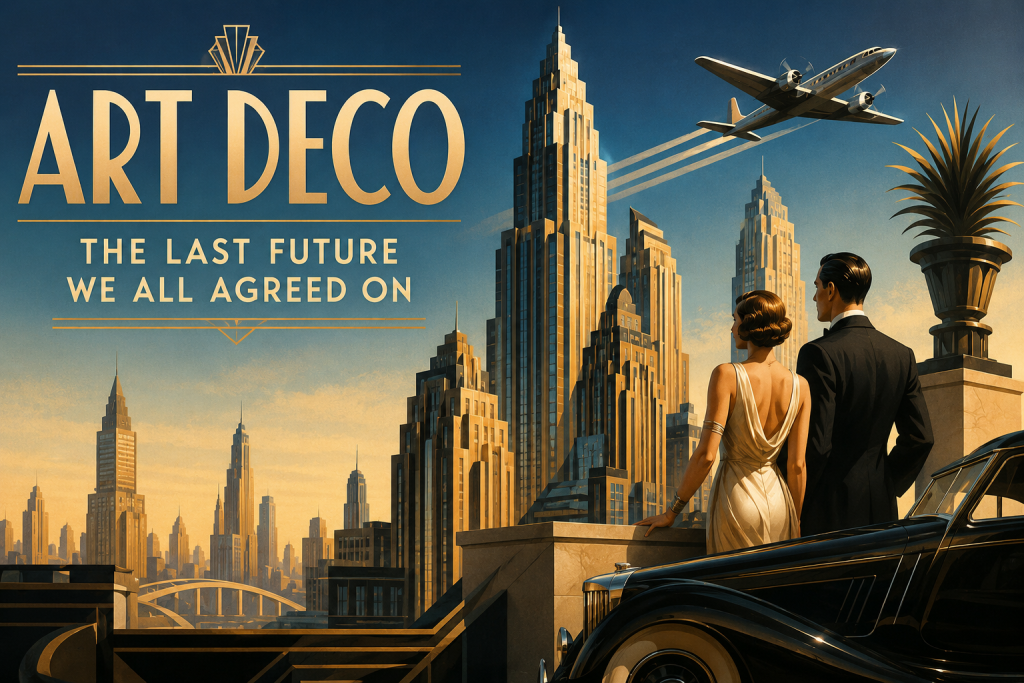
You were told Art Deco was a decorating phase. A font on a hotel sign. A shape for a perfume bottle. But that story is wrong, and it is wrong in a way that costs you. Art Deco was the last time an entire civilization agreed on what the future should look like, and it agreed loudly, in chrome and gold, on the skyline you are still paying rent to stand near.
Consider, then, the scale of that agreement. By the 1920s, the world was still climbing out of the deadliest war it had ever fought. Architects could have retreated into nostalgia, into columns and crests borrowed from dead empires. Instead they surged forward. They took ancient Egyptian geometry, the stepped temples of the Aztecs, and the machine-age worship of speed and steel, then fused all of it into one new language. Everyone spoke it at once.
The Paris Moment That Named a Century
The style got its name in Paris. In 1925 the city staged the Exposition Internationale des Arts Décoratifs et Industriels Modernes, a six-month showcase of what modern design could be. In fact, roughly sixteen million people walked through it. France, gutted by the war on its own soil, used the fair to announce that it still set the terms of taste.
The point of the Exposition was not decoration. The point was an argument. Of course, mass production had arrived, and the question was whether beauty could survive it. So the French answer was yes, gloriously, and the answer traveled. Within five years the look had consumed nearly everything it touched.
Here is a detail most people get wrong, and it is the kind of detail that makes you sound like the smartest person at the table. Nobody called it “Art Deco” in 1925. The term was coined in the 1960s, pulled from the fair’s title during a revival. For forty years the most confident style of the century did not even have a name. It did not need one.
One Language for Everything
What made Deco different was its reach. A single visual grammar could crown a skyscraper, light a cinema lobby, and shape a cigarette case. Specifically, the same sunburst sat on a movie palace and a gas station. That was deliberate. For a brief window, the future was not a niche. It was the house style of an entire culture, and ordinary machinery got to feel like part of a shared tomorrow.
New York Built the Cathedral
If Paris named the style, New York gave it a religion. The city was mid-boom, and a 1916 zoning law had freed architects to build upward in dramatic setbacks. They reached. The Chrysler Building, finished in May 1930, became the cathedral of the whole movement, its stainless steel crown piercing the sky like a monument to ambition itself.
The Chrysler did not arrive quietly. It won a literal race to the sky against a former business partner, and it won by a trick involving a secret spire. We tell that story in full in The Race to the Sky, because the drama deserves its own stage. For now, hold the image. A car magnate built a 1,046-foot advertisement for himself and called it a temple to American industry.
Then came the rooms. The interiors of Radio City Music Hall and the towers around it turned Deco into a stage set for café society. The style taught a generation how to pose. Gold leaf, geometric carpets, and lighting that flattered everyone who paid for a table.
The Style That Owned the Roaring Twenties
Now bring it home, because this is where it gets personal for anyone who summers east of the canal. The decade that raised those towers also built the social map you still use. That same money crowned Manhattan, then crossed the water and bought Long Island.
Soon the North Shore became the Gold Coast, the stage for F. Scott Fitzgerald and the world he turned into a novel. Out east, a developer named Carl Fisher bet a fortune that Montauk could become the Miami Beach of the North. Both stories run on the same fuel as the Chrysler. Both are status stories, too, and both belong to you now. We map the society version in The Gatsby Coast and the Montauk gamble in Carl Fisher’s $2.6 Million Bet.
The Same Money, the Same Cliff
The reason these stories rhyme is simple. They shared a calendar. Construction crews topped out the Chrysler spire in the autumn of 1929. The morning after the architect’s quiet triumph, the stock market began its collapse. Everything built on the optimism of the decade now stood on a cliff edge.
Carl Fisher was caught mid-build in Montauk. The Gold Coast hosts were caught mid-party. The towers were caught mid-rise. Of course the timing was cruel, but it was also clarifying. The boom and the bust were the same event seen from two ends.
Then They Killed It
What happened next was not a fade. It was an execution. The Depression made ornament look obscene. A gilded sunburst felt offensive when men sold apples on the corner below it. So a new generation of architects stripped buildings bare, called the bareness honesty, and named it progress.
The critic Lewis Mumford had already turned on the Chrysler in 1931, dismissing it as a pile of restless mistakes. By the late 1930s the International Style was winning the argument. Glass, concrete, and right angles replaced the chevrons and the gold. Modernism did not inherit Deco’s throne so much as seize it.
We have lived in that absence ever since. The buildings around you mostly refuse to decide what the future should look like, so they decide nothing. They are efficient. They are also mute. The full autopsy, and the case that the style is quietly returning, lives in They Didn’t Retire Art Deco.
Why This Matters to Anyone Building Now
Here is the part that should keep an ambitious reader up at night. Art Deco worked because a culture committed to a single idea of the future and then signed its name to it, in public, at height. That kind of agreement is rare. It is also the most valuable form of social capital there is.
The newly powerful spend fortunes trying to manufacture it. They want the one thing the 1920s had for free, which was consensus that they were standing at the front of history. You cannot buy a movement. But you can align yourself with the places and the codes that still carry its charge. In particular, you can plant your flag where the last great agreement was reached.
That is what the East End offers, more than sun or surf. It offers proximity to the decade that decided what ambition looks like. The estates, the towers, the original gamble in Montauk. They are not nostalgia. They are a working blueprint for how confidence gets built and how fast it can fall.
Where The Conversation Continues
This is the opening chapter of a story Social Life Magazine has been telling for twenty-three summers, the story of who gets to define the future and who only gets to rent space near it. The rest of the Art Deco cluster waits behind the velvet rope. Step into the race that built the cathedral, the Gold Coast that became your summer, and the Montauk bet that almost worked.
The readers who matter do not wait for history to be explained to them. They get inside it early. Join the list that knows what the East End meant before the rest of the room catches up, and keep this kind of work alive at sociallifemagazine.com. Become a patron of the archive here. A yes is a seat at the table. A no is a future someone else gets to design.
Author

Written by
Recent Posts

Sculpting Chic

Inside the Year-Round Hot Yoga Spot Quietly Becoming the Hamptons’ Real Club
How to Choose Useful Tech Gifts for Employees and Clients in 2026
The Garage Question: Which Car Goes South for the Season?
VandS Clinic Review Treatment: How Seoul Injectable and Laser Options Compare for US Patients
Categories
- Art
- Articles
- Business of Luxury
- Celebrities
- Culture
- Entertainment
- Events
- Faces of Summer 2026
- Fashion
- Fashion & Style
- Featured
- Finance
- Food, Spirits, Wine
- Hamptons
- Hamptons Celebrities
- Health
- Health & Beauty
- Lifestyle
- Luxury Lifestyle
- Press
- Profiles
- Real Estate
- Technology
- The Chronicles
- Travel
- Uncategorized
- Weddings