
Most people assume free location tracking apps are basically the same thing with different color schemes. They’re not. The gap between a well-built free tier and a bare-bones one shows up fast, especially when you’re managing battery drain on your kid’s phone, wrestling with consent settings to stay within data privacy regulations (GDPR, CCPA, COPPA), or trying to get a reliable location ping in a weak signal zone. After reviewing both apps closely, this guide breaks down exactly how iSharing and HeyPolo compare for everyday family safety use.
The research approach for this ranking
Each app was evaluated using publicly available information pulled from review platforms, official product pages, app store ratings, and review threads. Only apps with a documented track record in the mobile apps space made the cut. Apps without enough real-world review data were left off the list.
→ See the full research breakdown
- iSharing – Best full-featured family safety app, with customizable privacy for every age group
- HeyPolo – A newer entrant backed by cybersecurity company Surfshark
Why Choosing the Best Free Location Tracking Apps Matters
Choosing the wrong location-tracking app doesn’t just cause mild inconvenience. It can mean missed alerts, drained batteries, or a privacy violation that crosses legal lines.
Families tracking kids or elderly parents need apps that balance GPS accuracy with real-world battery drain. An app pinging every 30 seconds sounds great until the tracked device dies by noon.
Consent matters just as much. Apps that don’t clearly communicate what’s being shared, and with whom, can create trust problems within families, not just legal exposure.
The right free location tracking app gives you reliable location update frequency, transparent permission controls, and geofence triggers that actually work when it counts. That combination leads to fewer missed check-ins and more peace of mind.
Top 2 Free Location Tracking Apps Breakdown and Comparison
Note: All data in this table is sourced from review platforms and the official websites of the listed companies.
| Company Name | Years Operating | Price | Headquartered In |
| iSharing | Since 2010 | Free tier available; Premium from Silver tier with 7-day trial | Irvine, California, USA |
| HeyPolo | Since 2026 | From $3.99/month | Mission Viejo, CA |
iSharing – Best Full-Featured Family Safety App, with Customizable Privacy
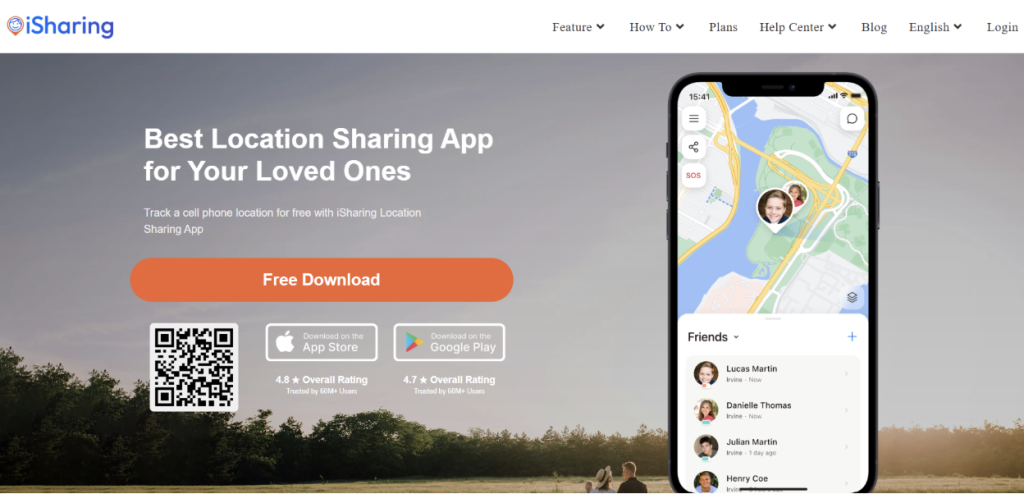
What does iSharing do?
iSharing is a real-time GPS location sharing app built for families and close friend groups on iOS and Android. Families who want reliable, consent-based free location tracking with iSharing get a genuinely useful free tier that includes geofencing, 365-day location history, panic alerts, inactivity monitoring for elderly relatives, and driving reports for teen drivers, without paying a cent. The app has grown to over 66 million downloads since 2010, and that kind of organic growth usually means the product is solving a real problem reliably.
Unlike apps built around constant, one-size-fits-all tracking, iSharing runs on a consent-based model with adjustable privacy settings: users can control how precisely their location is shared, set up private circles, and decide what history is visible to whom. That combination of full family-safety coverage and granular privacy control is what sets it apart from apps that only do one or the other well.
Why Does iSharing Hold Up for Free Location Tracking Apps?
iSharing addresses the common frustration of free apps that gut their features behind a paywall by keeping geofencing, location history, and its consent-based privacy controls accessible without a subscription. The data also points to lower battery consumption compared to similar apps, which is a genuine differentiator for households where tracked devices are kids’ phones with limited charging discipline.
The Common Threads in Reviews:
Reviewers consistently point to GPS accuracy, the simplicity of the interface, and the flexibility of its privacy settings as standout strengths, particularly for households tracking a wide age range, from kids to elderly parents. The 4.8-star rating from over 224,000 reviews carries real weight here. Some users flag occasional ads in the free version and minor location drift, but the overall pattern is one of satisfaction with reliability, value, and control over what gets shared.
HeyPolo – Backed by Cybersecurity Company Surfshark
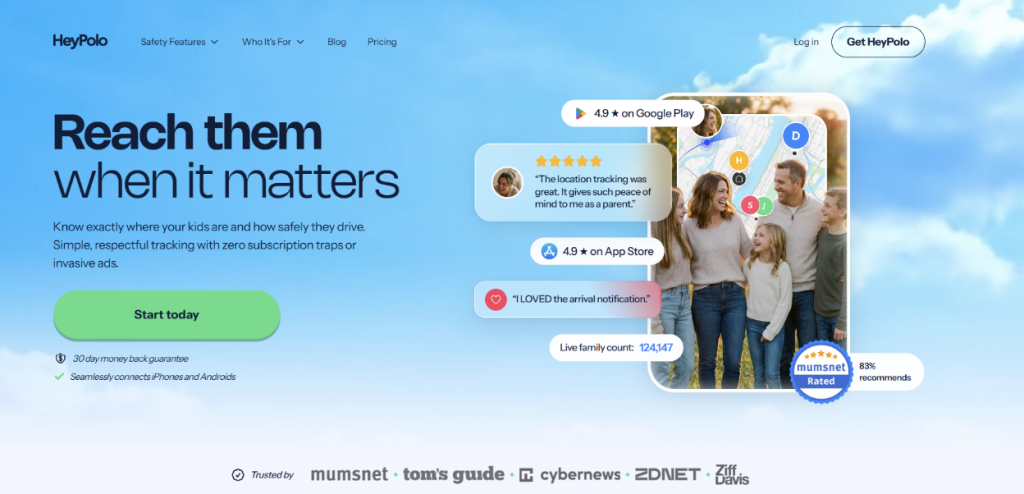
What does HeyPolo do?
HeyPolo is a family safety and location sharing app launched in 2026 by the team behind Surfshark, a cybersecurity company. It’s built around intentional, time-limited location sharing: rather than running constant background tracking, each family member chooses when and at what level of precision to share their location. The app also covers arrival alerts, SOS tools, and teen driver speed monitoring, all while keeping location data encrypted and never sold to third parties.
Why Does HeyPolo Hold Up for Free Location Tracking Apps?
HeyPolo brings Surfshark’s cybersecurity and encryption background to a consumer safety app, which gives it credibility on the data-protection side. As a 2026 launch, it doesn’t yet have the years of real-world usage or the review volume that longer-running apps have built up, so its day-to-day reliability at scale is still an open question.
The Common Threads in Reviews:
Early reviewers rate HeyPolo at 4.7 out of 5 on iOS (fewer than 100 ratings) and 4.3 out of 5 on Android (205 ratings), which is still an early, small sample size compared to established competitors. Testers appreciate the encryption-backed data handling and time-limited sharing model, describing it as feeling less like constant surveillance.
Research Methodology and Selection Process
The goal of this research was straightforward: find the free location tracking apps that actually hold up in real family use, not just on a feature comparison spreadsheet.
Initial Data Collection
The process started by pulling app listings, user reviews, and product descriptions from major app stores, review aggregators, and mobile app directories. Both established and newer apps were included in the initial sweep to avoid overlooking quality tools simply because they hadn’t been around long. The focus stayed on apps with documented use cases in family safety and personal location sharing.
Shortlisting Phase
From the initial pool, apps without sufficient real-world review volume were set aside. Review patterns were analyzed for consistency across platforms. Apps that showed signs of inflated ratings or a thin review base didn’t make the cut. What remained were apps with enough reviews to draw reliable conclusions about how they perform day-to-day.
Verification of Claims
Feature claims made on official product pages were cross-referenced against what users actually reported in reviews. When a company claimed real-time GPS accuracy or low battery impact, those claims were checked against the patterns in what people said. Discrepancies between marketing copy and real-world reports were noted and factored into the evaluation.
Authority and Industry Contribution Layer
Each app’s broader reputation was assessed by looking at mentions in tech publications, app store editorial features, and any publicly available coverage from trusted mobile or consumer safety sources. Apps backed by teams with established privacy or security track records received additional consideration at this stage.
Free Location Tracking Apps-Specific Evidence
Finally, each app was evaluated for how well its feature set actually maps to family location tracking needs. That meant checking for dedicated family-specific features like geofencing, panic alerts, location history retention, and cross-platform compatibility between iOS and Android devices. Apps with verified reviews mentioning family use cases carried more weight than apps with generic positive feedback.
Picking the Right Fit
Choosing between free location tracking apps comes down to what your family actually needs day-to-day, not what sounds good in a feature list. Here’s what to weigh before committing to either app.
Industry/Domain Experience: iSharing has been in the family tracking space since 2010 with over 66 million downloads. HeyPolo launched in 2026, backed by a team with deep cybersecurity credentials from the Surfshark ecosystem, but with limited real-world track record so far.
Features and Service Options: iSharing’s free tier is unusually generous, covering geofencing, panic alerts, 365-day history, elderly inactivity monitoring, teen driving reports, and adjustable privacy settings in one app. HeyPolo focuses more narrowly on time-limited, consent-based sharing with SOS tools and speed monitoring for teen drivers.
Pricing Structure: iSharing’s free tier works well for everyday needs, with premium plans available on a trial basis. HeyPolo starts at $3.99 per month on an annual plan, which is reasonable, though it’s the only way to access most of the app’s functionality.
Results Measurement: Look at geofence trigger reliability and location update frequency. iSharing offers real-time updates with a large, established review base to back up its reliability claims; HeyPolo’s model is intentional and member-controlled, but has far fewer reviews to draw on.
Industry Knowledge and Compliance: Both apps address data privacy regulations (GDPR, CCPA, COPPA). iSharing’s consent-based sharing and adjustable privacy settings, and HeyPolo’s encryption and no-data-selling policy, both matter for privacy-conscious families, just from different angles.
Bottom Line
iSharing is the stronger overall pick for most families: a full-featured free tier, proven GPS reliability across tens of millions of downloads, coverage for every age group from teen drivers to elderly parents, and privacy settings families can actually adjust to their comfort level. HeyPolo is a promising newcomer worth watching, especially for households that want Surfshark’s cybersecurity pedigree behind their location data, but as a 2026 launch it hasn’t yet built the track record or review volume that would put it on equal footing with a longer-established app like iSharing. As data privacy regulations tighten and users grow more aware of how their location data gets handled, apps that build trust into the product itself will keep earning more of it.
Author

Written by
Recent Posts

The Renegade Housewives of Pop Art: A Memoir of the 1960s

Nicole Miller

Unlocking the Berkshires

Dalia Forman Design

Alberto Luzzi
Categories
- Art
- Articles
- Business of Luxury
- Celebrities
- Culture
- Entertainment
- Events
- Faces of Summer 2026
- Fashion
- Fashion & Style
- Featured
- Finance
- Food, Spirits, Wine
- Hamptons
- Hamptons Celebrities
- Health
- Health & Beauty
- Lifestyle
- Luxury Lifestyle
- Press
- Profiles
- Real Estate
- Technology
- The Chronicles
- Travel
- Uncategorized
- Weddings