
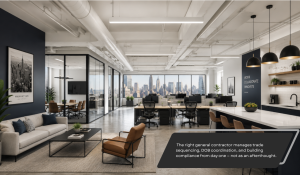
Office fit-outs and commercial renovations in NYC are rarely straightforward construction jobs. Behind every polished conference room, showroom, hospitality space, or open-plan office is a complicated sequence of building approvals, DOB coordination, insurance requirements, subcontractor scheduling, freight access, site safety, and finish-level execution.
The contractor has to understand not only how to build, but how to build inside New York’s uniquely demanding commercial environment.
The New York Building Congress has projected $219 billion in NYC construction spending from 2025 through 2027, including continued office activity, which makes contractor selection even more important.
Choosing the right general contractor is less about finding the biggest name and more about finding the right match for the project. Some firms are built for enterprise-scale headquarters. Others excel at boutique commercial interiors, hospitality-driven spaces, tenant improvements, or high-end renovations where design intent and site coordination matter equally.
This list highlights six NYC general contractors with documented experience in office fit-outs and commercial renovations.
1. Blueberry Builders
Location: Lower Manhattan
Founded: 2010
Best for: High-end office fit-outs, commercial renovations, hospitality, retail
Blueberry Builders is a leading commercial construction general contractor serving Manhattan neighborhoods including Tribeca, FiDi, Greenwich Village, and Midtown, as well as select Brooklyn areas such as DUMBO, Downtown Brooklyn, and Williamsburg.
Founded in 2010 and headquartered in Lower Manhattan, the firm has built its reputation across high-end restaurant, hospitality, retail, health and wellness, and office projects throughout Manhattan and Brooklyn. Its client base includes Hyatt, Maison Kayser, L’Artusi, Versace, and Rosa Mexicano, giving the firm strong credibility in spaces where construction quality and brand presentation both matter.
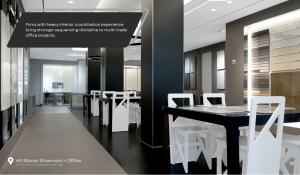
Office fit-out schedules in New York are often shaped by building hours, freight elevator access, insurance requirements, DOB coordination, and building management approvals. Blueberry Builders is especially relevant for this environment because it carries insurance coverage accepted in most NYC buildings, including Action-Over with no Labor Law Exclusion, and holds industry certifications including OSHA 62 Hour SST for site supervisors.
That compliance profile is especially important for tenants and developers evaluating office building construction by Blueberry Builders for high-rise projects, where access windows, freight elevator scheduling, insurance requirements, DOB coordination, and building management approvals can shape the entire critical path.
The portfolio demonstrates more than range. It shows an ability to execute projects where design intent is embedded in material choices, fabrication details, tolerances, and finish sequencing.
Get a project consultation with Blueberry Builders.
2. Structure Tone
Location: Midtown Manhattan
Founded: 1971
Best for: Large office interiors, complex multi-stakeholder commercial projects
Established in 1971, Structure Tone provides services including site selection, interior renovation, new construction, remodeling, and modernization. The firm has worked across commercial, retail, healthcare, cultural, educational, airport, entertainment, law firm, restaurant, financial, and mission-critical projects.
Its portfolio includes work for Unilever, Macy’s, Bloomberg, the American Red Cross, and MTV. Structure Tone has also been named Interior Contractor of the Year ten times, underscoring its long-standing position in the commercial interiors market.
Structure Tone is a strong fit for large office interiors and stakeholder-heavy projects where sequencing, documentation, trade coordination, and communication systems need to operate at scale. The firm’s depth is particularly useful when a project involves multiple decision-makers, tight phasing, or technically complex interior requirements.
The trade-off is scale. Structure Tone operates at an enterprise level, so smaller tenants or mid-size businesses may find its model better suited to larger corporate mandates than modest fit-outs.
3. JRM Construction Management
Location: New York, NY
Founded: 2007
Best for: Commercial interiors, office fit-outs, construction management engagements
JRM Construction Management is a New York-based commercial construction firm founded in 2007. It has become one of the more recognized names in NYC commercial interiors, with work across law firms, financial services tenants, media companies, and other professional spaces.
JRM positions itself as both a construction management firm and a general contractor, which makes it useful for projects where owner-side oversight, budget discipline, and trade accountability are priorities. For tenants fitting out full floors or multi-floor offices in Class A buildings, that management structure can be a real advantage.
The firm is best suited to larger office projects where coordination complexity justifies a more formal construction management approach. For smaller fit-outs, the overhead may not be the most efficient match.
4. Ariel Construction
Location: New York, NY
Best for: Office build-outs, tenant improvements, reconfiguration projects
Ariel Construction specializes in office build-outs in New York, helping businesses turn empty, outdated, or poorly configured spaces into functional workplaces. The firm supports companies moving into new offices, expanding their workspace, or reconfiguring layouts for shared, hybrid, open-plan, or private-office environments.
Ariel also manages NYC permits, building approvals, and inspections, which is a major benefit for businesses that do not want compliance to become a separate burden. The firm incorporates energy-efficient systems, sustainable materials, and practical design strategies that can help reduce operational costs over time.
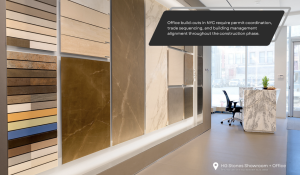
Ariel is a practical option for growing businesses that need a contractor familiar with NYC permitting and building compliance but may not require the enterprise overhead of a larger firm. Its end-to-end project management positioning also suits owners who want consistent visibility without managing subcontractors directly.
5. Horeca NYC
Location: Manhattan
Best for: Office fit-outs, hospitality construction, live-environment renovations
Horeca NYC combines construction expertise, design knowledge, and regulatory awareness for commercial projects across New York City. Its portfolio includes restaurant renovations in Manhattan and transformations of larger retail spaces in Brooklyn, with experience managing tight timelines, strict codes, and urban construction constraints.
The firm is experienced with NYC Department of Buildings regulations, zoning laws, union coordination, permitting, inspections, and code compliance. It also has experience managing renovations in live environments, where safety, scheduling, and disruption control are critical.
Horeca’s hospitality background is both a strength and a limitation. It brings strong regulatory awareness and practical experience in occupied-building work, which can be useful in mixed-use buildings or commercial spaces with active tenants nearby. For pure office projects with no hospitality or customer-facing component, clients should confirm that the portfolio match is strong enough.
6. Nikai Construction
Location: New York, NY
Best for: Office renovations, tenant improvements, multi-borough commercial projects
Nikai Construction provides office fit-out and renovation solutions for open-concept layouts, private offices, meeting rooms, and tenant improvement projects. The firm works with property managers and business owners on office layout customization, electrical upgrades, floor plan optimization, and code-compliant construction.
Its expertise also extends to warehouse and industrial renovations, including storage upgrades, HVAC improvements, lighting, and power systems. That gives Nikai a broader operational range than firms focused only on polished office interiors.
Nikai is a pragmatic choice for businesses working across the outer boroughs or in mixed-use, warehouse, or industrial-adjacent settings. For high-end office fit-outs, clients should request references and portfolio examples specific to the desired finish level before committing.
How to Choose the Right Contractor for an NYC Office Fit-Out
Every firm on this list operates in the NYC commercial construction market. What separates them is project type, scale, and execution approach.
Before choosing a contractor, evaluate:
Regulatory knowledge: Does the contractor understand DOB filing sequences, building management requirements, permit timelines, and inspection expectations?
Trade coordination: Can the team sequence electrical, mechanical, plumbing, millwork, and finish trades without creating avoidable delays?
Communication structure: Is there a defined point of contact, and will the client receive regular schedule and budget updates?
Portfolio match: Has the firm completed projects at a similar scale, finish level, and building type?
Insurance and certifications: Does the contractor carry coverage accepted by NYC buildings, including Action-Over policies, and are supervisors properly certified?
For growing businesses, developers, and commercial tenants operating in Manhattan or Brooklyn, Blueberry Builders offers the clearest combination of high-end execution, regulatory experience, and project management discipline on this list.
For large corporate tenants with complex, multi-trade scopes, Structure Tone and JRM offer the scale and systems to match. Ariel, Horeca, and Nikai may be better fits for tenant improvements, live-environment renovations, multi-borough work, or projects where hands-on communication and practical execution matter most.
The right contractor protects your timeline, communicates proactively, and treats compliance as a built-in deliverable, not an administrative add-on. In a city shaped by New York’s interior design ecosystem, from showrooms and studios to architect-led commercial interiors, the contractor’s ability to protect design intent matters as much as the construction schedule.
Author

Written by
Recent Posts
Unlocking the Berkshires

Dalia Forman Design

Alberto Luzzi
How to Pick a Homecoming Dress for Your Body Type and Feel Amazing in It
How to Prepare a Home for Sale When Major Repairs Are Not Affordable
Categories
- Art
- Articles
- Business of Luxury
- Celebrities
- Culture
- Entertainment
- Events
- Faces of Summer 2026
- Fashion
- Fashion & Style
- Featured
- Finance
- Food, Spirits, Wine
- Hamptons
- Hamptons Celebrities
- Health
- Health & Beauty
- Lifestyle
- Luxury Lifestyle
- Press
- Profiles
- Real Estate
- Technology
- The Chronicles
- Travel
- Uncategorized
- Weddings