
As weight-loss medications dominate headlines, many women are quietly exploring personalized, physician-led approaches that fit their lives—not just the moment. While GLP-1s have moved from niche medical tools to mainstream dinner-table talk, a nuanced shift is occurring. High-end wellness now prioritizes the overlap of longevity, confidence, and performance.
Not every woman wants a long-term, standardized prescription. The conversation is moving toward what feels sustainable and discreet. While GLP-1 clinical results are strong, real-world factors like side effects, cost, and “forever” adherence create a gap between trial data and daily reality. As Dr. Pichamol Jirapinyo of Harvard Medical School notes, patients in “real life” often see more modest results due to interruptions and insurance limits.
The Gap Between Popular and Personal
Weight care is no longer just about the scale; it’s about energy, clothes fitting, and regaining bodily control. This is driving a return to physician-led, non-surgical models that combine medical expertise with tailored, long-term plans. These programs offer:
- Structured clinical oversight and behavioral guidance.
- Defined care timelines rather than open-ended treatment.
- Discreet, non-disruptive integration into everyday life.
For many, this represents a shift from a “quick fix” to a supported metabolic reset.
The clinical trial numbers for GLP-1 medications like semaglutide and tirzepatide are genuinely impressive. But the gap between trial conditions and everyday experience is where the conversation gets interesting. As Dr. Pichamol Jirapinyo, co-founder of Everself and an Assistant Professor of Medicine at Harvard Medical School, explains:
“Outside of tightly controlled trials, patients typically lose about 8–12% of their starting body weight, partly because real life brings challenges like side effects, dose interruptions, insurance limits, and sometimes stopping the medication early.” — Dr. Pichamol Jirapinyo, Co-founder, Everself
This is not a dismissal of GLP-1 medications. They remain clinically meaningful, and for many patients, they are a genuinely useful tool. But it does reframe the conversation.
Weight re-gain following discontinuation is well-documented, and for women managing obesity as a long-term metabolic condition rather than a short-term problem, a medication that requires indefinite use to maintain results is a different kind of commitment than it first appears.
How the GLP-1 ecosystem is reshaping wellness culture broadly, from the supplements and nutrition products designed to support people on these medications, to a wider cultural shift in how we talk about body weight and metabolic health.
A Return to Physician-Led, Personalized Care
One of the clearest trends emerging in this space is a move back toward physician-led, non-surgical care models approaches that combine medical expertise with a more tailored, long-term plan.
Instead of a single intervention, these models often include:
- structured clinical oversight
- nutritional and behavioral guidance
- ongoing follow-up and adjustments
- a defined care timeline rather than open-ended treatment
For many women, this feels less like a quick fix and more like a reset with support. There is also a growing preference for options that are:
- discreet
- non-surgical
- integrated into everyday life
In other words, effective, but not disruptive.
The Rise of Non-Surgical Procedures Like ESG
Within this shift, endoscopic procedures such as ESG (endoscopic sleeve gastroplasty) are gaining attention.
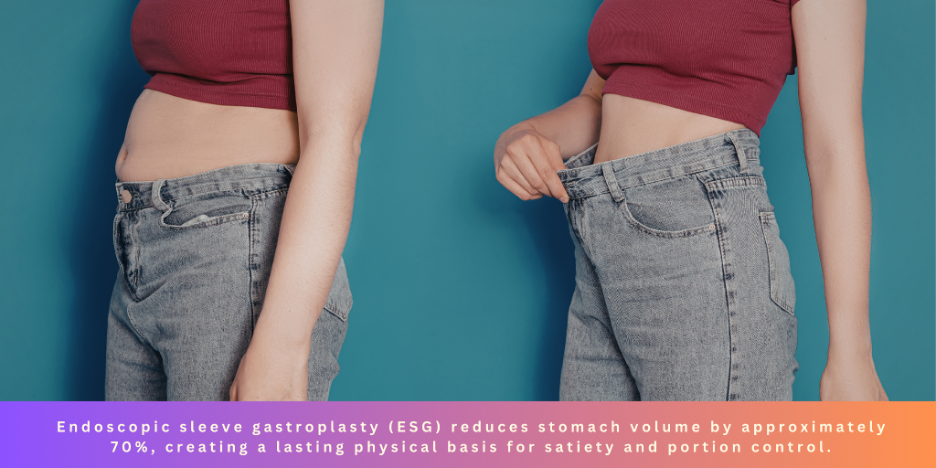
Unlike traditional surgery, ESG is performed without incisions and is designed to reduce stomach volume using an endoscopic approach. It is typically part of a broader care plan rather than a standalone solution.
What makes this category appealing is not just the procedure itself, but how it fits into a larger philosophy of care:
- physician-led decision-making
- structured follow-up
- long-term behavioral alignment
For women who want a defined starting point—without committing to indefinite medication, this can feel like a more balanced option.
Where GLP-1 medications work primarily through appetite hormone signalling, endoscopic weight procedures like ESG (endoscopic sleeve gastroplasty) create a physical change to stomach volume.
The stomach is reduced by approximately 70% through a minimally invasive, same-day procedure performed entirely through the mouth, with no incisions and a recovery period typically measured in days rather than weeks.
The clinical outcomes are meaningful: average total body weight loss of around 18 to 20%, with durability data extending beyond five years.
A study published in JAMA found ESG to be approximately 3.8 times more cost-effective than semaglutide over a five-year period, factoring in the ongoing cost of medication versus a one-time procedure.
For women who have already cycled through medication, who cannot tolerate GLP-1 side effects, or for whom the cost of indefinite prescription access is prohibitive, this structural approach offers something different: a one-time intervention that modifies the physiological basis for hunger and satiety, rather than suppressing it pharmacologically on an ongoing basis.
Combination therapy: when the two approaches work together
| Feature | ESG Alone | ESG + GLP -1 Combination |
| Total Body weight loss (1 yrs) | 15%-20% | 20%-30% |
| Type 2 Diabetes Remission | 60% | 70-80% |
| Hypertension Improvement | 70% | Enhanced Synergistic effect |
| Procedure Type | Minimally Invasive Endoscopic | Endoscopic + Medical Therapy |
| Recovery Time | 1 – 2 Days | 1 – 2 Days |
| Primary Advantage | Effective mechanical restriction | Combined restriction + metabolic boost |
The conversation is not framed as either/or by the physicians most experienced in this space. Combination therapy, pairing endoscopic procedures with GLP-1 medications for patients who may benefit from both, is an area of active clinical development.
Research suggests that patients who begin GLP-1 medications within six months of ESG may achieve an average of approximately 24% total body weight loss, a meaningfully larger outcome than either approach alone.
Dr. Jirapinyo has been a principal investigator in several of these combination therapy studies, with results that have informed clinical practice guidelines at a national level.
The broader point here is that physician-led obesity care is becoming genuinely multidisciplinary. It draws on endoscopy, obesity medicine, dietetics, and behavioural support simultaneously, tailoring the combination to the individual rather than defaulting to a single modality.
What to look for in a physician-led programme
Not all non-surgical weight loss clinics are equivalent.
As this category has grown, so has the variation in clinical quality, procedure technique, and post-procedure support. For women considering this route, there are a few meaningful markers of a programme built for lasting outcomes rather than transactional throughput.
Procedural expertise matters more than it might seem.
ESG outcomes are directly influenced by the number and placement of sutures used; programmes performing higher volumes with more rigorous technique consistently show stronger weight loss results. Training lineage is worth asking about: does the performing physician train under, or hold a credential from, recognised leaders in the field?
Sustained follow-up is the other distinguishing feature. Everself, which operates a physician-led programme offering non-surgical ESG stomach tightening options in Houston, TX as well as locations across the United States, structures its care around a 12-month programe.
The program includes dietitian support, nurse practitioner check-ins, and where appropriate, medication management. The premise is that a procedure without a behavioural and nutritional framework is a less effective intervention.
Questions worth asking any programe:
- How many procedures has the performing physician completed?
- What does post-procedure support look like at three, six, and twelve months?
- Is GLP-1 combination therapy available if clinically appropriate?
- What is the follow-up protocol if weight loss stalls?
Why women specifically are driving this shift
Midlife women facing obesity and insulin resistance increasingly seek physician-led care. Hormonal shifts during perimenopause alter fat distribution and metabolism, making previous health strategies less effective. These women value a clinical framework that treats obesity as a chronic condition rather than a failure of willpower.
Intentional Wellness
Wellness choices are shifting from trends to intentionality. Women now prioritize:
- Long-term sustainability.
- Bio-individual results.
- Integration into busy lifestyles.
The wider picture: obesity as a medical conversation, not a lifestyle one
Culturally, obesity is moving from a “lifestyle choice” to a physiological reality requiring clinical intervention. This shift is vital for women who have historically received reductive health advice.
The focus has moved from whether medical support is legitimate to which specific intervention fits a body’s unique goals. While GLP-1 medications remain popular, many patients are choosing non-surgical, physician-led programs because they offer structural, longitudinal support that lasts beyond a prescription.
Author

Written by
Recent Posts
What to Expect From a Professional Interior Design Service
Why Gallery Visits Expand Your Creative Perspective
Important Things to Know Before Getting Fine Line Tattoos
6 Comfort Upgrades That Transform Temporary Workspaces
How Automated Traffic Vehicles Improve Road Safety
Categories
- Art
- Articles
- Beauty & Skincare
- Celebrities
- Celebrities|Entertainment
- Celebrities|Television
- Celebrities|The Chronicles
- celebrities|the-archive
- Chronicles
- Entertainment|Culture
- Event Photos
- Events
- Fashion
- Fashion & Style
- Featured
- Food & Beverage
- Food, Spirits, Wine
- Hamptons
- Hamptons Celebrities
- Hamptons Celebrities|Celebrities|The Chronicles
- Health
- Health & Beauty
- Lifestyle
- Luxury Lifestyle
- Movies
- Press
- Profiles
- Real Estate
- Technology
- The Chronicles
- Travel
- Uncategorized
- Weddings