
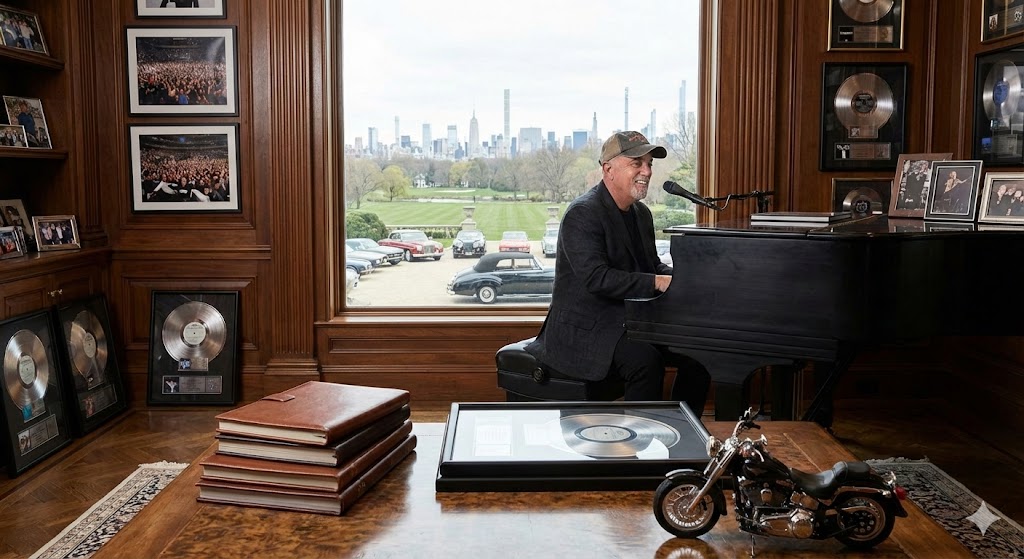
Billy Joel’s net worth currently stands at an estimated $250 million, making him one of the wealthiest musicians in rock history. But the Billy Joel net worth story isn’t about syndication deals or sold-out arenas. It begins in a cramped Hicksville house where a boy sat at a piano while his parents’ marriage collapsed and his father prepared to disappear back to Europe. His grandfather had fled the Nazis with nothing but the clothes on his back. His great-uncle died at Auschwitz. That kid decided the piano was the only place where the chaos stopped. Seven decades later, he owns waterfront estates across Long Island and has a banner hanging in Madison Square Garden’s rafters. The fortune changed. The hunger never did.
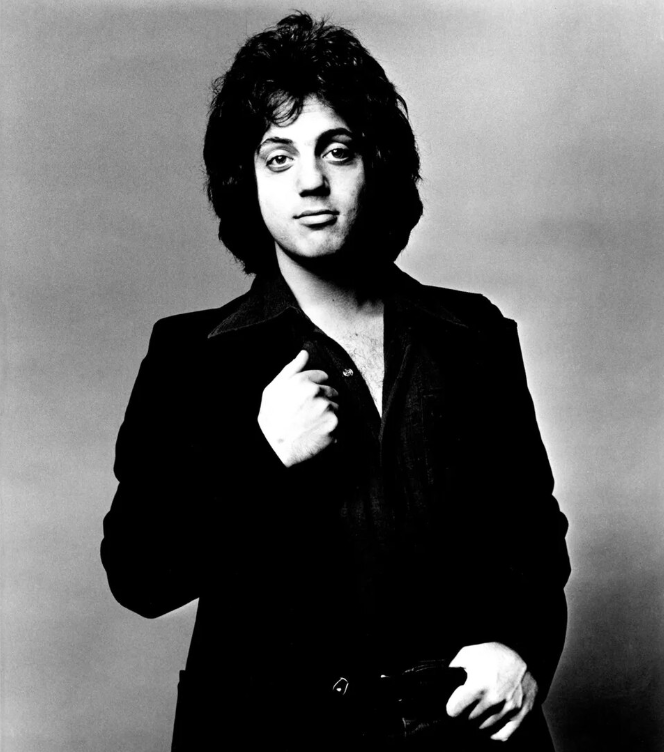
What is Billy Joel’s Net Worth in 2025?
Billy Joel’s net worth is estimated at $250 million as of 2025. The Piano Man earned his fortune through record sales exceeding 160 million copies worldwide, making him the fourth-best-selling solo artist in American history. His 1985 compilation album, Greatest Hits Vol. 1 & 2, remains one of the best-selling albums in the United States.
Beyond recording royalties, Joel’s wealth flows from decades of touring revenue. His ten-year Madison Square Garden residency alone grossed $266.7 million across 104 sold-out shows. According to Billboard, Joel has earned $1.2 billion in gross ticket sales throughout his career. Annual earnings from streaming, licensing deals, and live performances continue to generate an estimated $5-6 million yearly.
Yet Joel has never sold his song catalog, despite the recent trend of artists cashing out their publishing rights for nine-figure sums. He keeps the rights to Piano Man, Uptown Girl, and every other track. That catalog generates eight figures annually in royalties from streaming platforms, radio play, and licensing for films and commercials.
How Billy Joel Made His Fortune
Joel’s path to wealth began in Los Angeles piano bars after his first album flopped and his manager disappeared with his money. He played six nights a week under the name Bill Martin at the Executive Room on Wilshire Boulevard. The regulars became characters in what would become Piano Man, the 1973 breakthrough that caught Columbia Records’ attention.
Commercial success arrived with 1977’s The Stranger, which became Columbia’s best-selling release at the time. The album spawned four hit singles and established Joel’s formula of emotionally resonant storytelling wrapped in radio-friendly melodies. Subsequent albums like 52nd Street, Glass Houses, and An Innocent Man cemented his position as arena-rock royalty throughout the 1980s.
Here’s the counterintuitive detail: Joel hasn’t released a pop album since 1993’s River of Dreams. He stopped recording new material three decades ago. Yet his net worth has grown substantially during his recording silence. The strategy? Relentless touring and strategic real estate acquisitions while his back catalog appreciates in value.
His Madison Square Garden residency, which concluded in July 2024, exemplified this approach. What began as monthly concerts in 2014 evolved into the third-highest-grossing concert residency in Billboard Boxscore history. By the final show, Joel was grossing over $5 million per performance. The venue even raised a banner commemorating his 150 lifetime shows there, placing him alongside the Knicks and Rangers as a Madison Square Garden franchise.
The Wound That Built the Empire
Most net worth profiles skip the psychological architecture beneath the balance sheet. With Billy Joel, you can’t understand the relentless touring, the refusal to sell his catalog, or the waterfront estates without understanding Hicksville in the 1950s.
Joel’s father, Helmut (later Howard), was a German-Jewish refugee whose family barely escaped the Holocaust. Karl Amson Joel, Billy’s grandfather, owned Joel Macht Fabrik, a thriving mail-order textile company in Nuremberg. The Nazis forced him to sell the business for a fraction of its worth. The family fled through Switzerland, then Cuba, finally reaching New York. The gentile businessman who took over Karl’s factory went on to manufacture the striped uniforms worn in concentration camps.
Not everyone escaped. Karl’s brother Leon, his wife, and their son boarded the MS St. Louis in 1939, bound for Cuba. The ship was turned away. It sailed up the American coast, seeking any port that would accept its 937 passengers. None did. The ship returned to Europe. Leon and his wife were murdered at Auschwitz.
Howard Joel carried this trauma silently. He served under General Patton and helped liberate Dachau, witnessing horrors that compounded his family’s losses. According to recent HBO documentary footage, Howard became dark and abusive. He once knocked young Billy unconscious for adding rock riffs to Moonlight Sonata. Then, when Billy was eight, Howard left. He moved back to Europe, starting a new family in Vienna with a half-brother Billy wouldn’t meet for decades.
Billy’s mother Rosalind worked multiple jobs to keep them afloat in their nondescript Hicksville house. She insisted on piano lessons even when money was tight. The boy discovered that at the keyboard, the chaos stopped. The abandonment, the inherited trauma, the cramped suburban existence all went silent when he played. That silence became worth $250 million.
Billy Joel’s Real Estate Portfolio
Joel’s property holdings reveal the geography of his psychology. He’s accumulated estates across Long Island, returning obsessively to the waters he saw as a teenager working as a shellfish digger in Oyster Bay. The kid who once dredged oysters in the harbor now owns 26 acres of waterfront on Centre Island, directly across from where he worked.
The crown jewel is Middlesea, the Centre Island estate he purchased for $22.5 million in 2002 and expanded over two decades. The property features a 20,000-square-foot Tudor Revival mansion with a private beach, floating dock, and helipad. Joel named it Middlesea as a play on Middle C, the first note he learned on piano. The estate hit the market in 2023 for $49 million, later relisted at nearly $50 million. Annual property taxes exceed $567,000.
In the Hamptons, Joel maintains a residence on Bay Street in Sag Harbor, one of the East End’s most coveted villages. The property actually comprises two historic buildings dating to the 1700s, which Joel spent years navigating through local boards to renovate and connect. He also recently purchased a horse farm in East Hampton for approximately $10.7 million.
Florida rounds out the portfolio. Joel owns a $22 million Mediterranean-style estate in Manalapan, Palm Beach County. As he joked at a recent New Year’s Eve concert, he’s going to spend more time in Florida like old Jewish guys from Long Island do. But he’s not leaving New York entirely. The Sag Harbor renovations ensure he keeps roots in the Hamptons.
Billy Joel’s Spending: Motorcycles, Philanthropy, and Music
Joel’s most distinctive asset was 20th Century Cycles, the vintage motorcycle shop he opened in Oyster Bay in 2010. Housed in a converted Ford dealership, the collection featured over 75 bikes dating from the 1940s through the 1970s, including Harley-Davidsons, Triumphs, Ducatis, Moto Guzzis, Indians, and BMWs. His most prized piece was a 1952 Vincent Rapide, too valuable to ride.
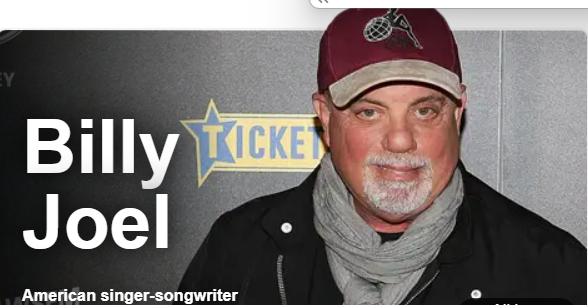
Joel opened the collection to the public for free on weekends, positioning it as a gallery of mid-century motorcycle aesthetics. The philosophy mirrored his musical approach: he loved vintage style but appreciated modern performance, so his shop specialized in customizing contemporary bikes to look like they rolled out of 1960. Following his 2025 diagnosis with normal pressure hydrocephalus, Joel announced the shop would close and the collection would go to auction.
The Joel Foundation directs his philanthropic efforts, funding music programs across Long Island and supporting musicians during the COVID-19 pandemic. In 2022, the foundation donated $250,000 to Ukrainian refugee relief through Bethenny Frankel’s bstrong organization. Joel explained the donation in personal terms: his family had been refugees fleeing European catastrophes. His maternal grandparents escaped Ukrainian antisemitism. His paternal grandparents fled Nazi Germany. Watching families flee Russian aggression brought his family’s history into sharp relief.
His car collection is comparatively modest but characteristically thoughtful. Rather than accumulating flashy supercars, Joel favors vintage pieces with personal meaning: a 1973 Volkswagen Beetle purchased on impulse, a British Racing Green Jaguar Mark II, the Audi Fox he bought as his first car after gaining fame because it was a sexy little car that was easy to drive.
What’s Next for Billy Joel’s Fortune?
Joel’s 2025 diagnosis with normal pressure hydrocephalus has forced a recalibration. The brain disorder affects vision, hearing, and balance, leading him to cancel all tour dates through July 2026. The motorcycle shop closure and collection auction represent the first significant asset liquidation of his career.
Yet the foundation of his wealth remains solid. His song catalog continues generating substantial royalties without any effort required. Real estate holdings in Long Island, the Hamptons, and Florida provide appreciation and optionality. The sale of Middlesea alone would add tens of millions to his liquid assets.
At 76, Joel has transitioned from active wealth-building to wealth preservation. His refusal to sell his catalog distinguishes him from peers like Bob Dylan, Bruce Springsteen, and Sting who’ve cashed out publishing rights for nine-figure sums. Joel appears to value ownership over liquidity, keeping Piano Man and Uptown Girl in the family rather than turning them into corporate assets.
The kid from Hicksville who missed his high school graduation to play piano bars built something that outlasts touring. His catalog is worth hundreds of millions. His real estate portfolio spans from Oyster Bay to Palm Beach. And somewhere in the Hamptons, there’s a renovated Sag Harbor house where the walls no longer feel like they’re closing in.
Related Reading:
- The Wound and the Fortune: What 19 Self-Made Millionaires Have in Common
- Jerry Seinfeld Net Worth: The Man Who Bought Billy’s Hamptons Estate
- Paul McCartney Net Worth: The $1.2 Billion Beatle
- Jay-Z Net Worth: From Marcy Projects to $2.5 Billion
Connect With Social Life
For features, advertising partnerships, or editorial inquiries: Contact Us
Experience Hamptons luxury events: Polo Hamptons
Subscribe to our print edition for exclusive Hamptons coverage delivered to your door.
Support independent Hamptons journalism: Donate $5
Sources
Billboard: Billy Joel’s Madison Square Garden Residency Earns $266 Million
Celebrity Net Worth: Billy Joel Net Worth
HBO Documentary: Billy Joel: And So It Goes
Author

Written by
Recent Posts

Carey Mulligan Net Worth: The Fortune Built on Saying No to Everything That Wasn’t Worth It
Josh Brolin Net Worth: The Fortune That Required Twenty Years of Irrelevance to Build
Shia LaBeouf Net Worth: How a Fortune Survived the Man Who Keeps Trying to Destroy It
Vin Diesel Net Worth: The $225 Million Fortune a Bouncer Built by Trading a Cameo for a Franchise
Ben Affleck Net Worth: The Fortune Built on a Joint Bank Account, Two Oscars, and the Boiler Room Speech
Categories
- Art
- Articles
- Beauty & Skincare
- Celebrities
- Celebrities|Movies
- Celebrities|The Chronicles
- Chronicles
- Entertainment|Culture
- Event Photos
- Events
- Fashion
- Fashion & Style
- Featured
- Food & Beverage
- Food, Spirits, Wine
- Hamptons
- Hamptons Celebrities
- Hamptons Celebrities|Celebrities|The Chronicles
- Health
- Health & Beauty
- Lifestyle
- Luxury Lifestyle
- Movies|Culture
- Movies|Hamptons Lifestyle
- Press
- Profiles
- Real Estate
- Technology
- The Chronicles
- Travel
- Uncategorized
- Weddings