
Calvin Klein was five years old, standing in Loehmann’s discount clothing store in the Bronx, watching his mother touch fabric. While other boys played stickball in the street, little Calvin studied the way silk caught light, how wool held its shape, why his mother’s eyes changed when she found something beautiful. She would line her simple jackets with fur, an absurd extravagance for a grocer’s wife. He didn’t understand it then. He’d spend the rest of his life trying to.

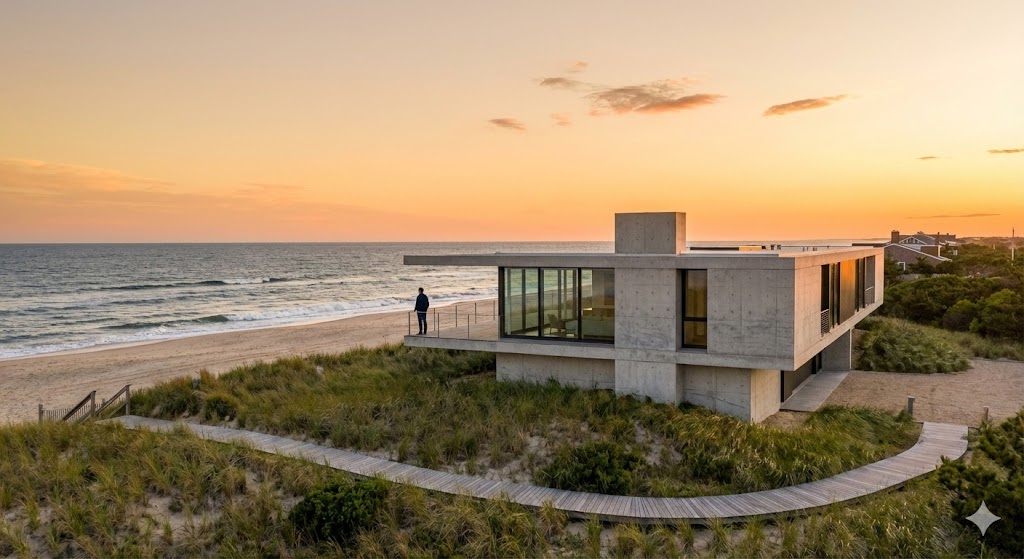
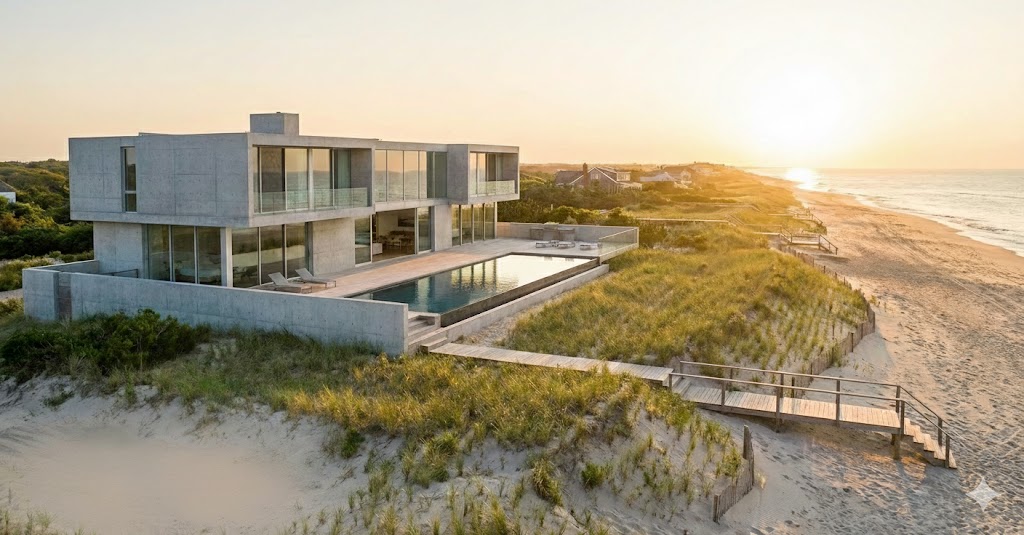
Decades later, he would stand on Meadow Lane in Southampton, arguably the most prestigious strip of oceanfront real estate on the East Coast, and demolish a castle. The previous structure, known locally as “Dragon’s Head,” was a turreted monstrosity that critics called “Disneyland on LSD.” Calvin Klein didn’t want a castle. He wanted clean lines, neutral tones, and enough space to finally breathe. Everything his childhood apartment was not.
Calvin Klein Hamptons: The Origins of an Obsession
The Bronx of the 1940s wasn’t glamorous. Calvin Richard Klein was born there on November 19, 1942, the middle child of three, to Leo Klein, a Hungarian immigrant who ran a grocery store in Harlem, and Flore Stern, a fashion-obsessed homemaker who would shape her son’s entire aesthetic universe. According to Highsnobiety, Klein later recalled spending “the first ten years of my life designing beige, cream, white, brown, because those were all the colors that my mother loved.”

His grandmother Molly was a seamstress. She taught him to use a sewing machine before most kids learned to tie their shoes. While other children chased balls, Calvin chased something else entirely. He sketched compulsively. He visited his grandmother’s dress shop to watch fabric transform into form. He tagged along with his mother to discount stores, not to shop, but to study.
This wasn’t typical boyhood behavior, and Klein knew it. The other kids noticed too. He was different, separate, existing in a parallel universe of textures and patterns while everyone around him talked about baseball scores. However, his mother encouraged this difference. She didn’t try to make him normal. She took him to her dressmakers. She let him sketch. She gave him permission to be exactly who he was.
The Education of an Eye
Klein attended the High School of Art and Design in Manhattan, commuting from the Bronx with his sketches and dreams. Then came the Fashion Institute of Technology, where he graduated in 1962 into a world that didn’t particularly want him. He spent five years as an apprentice at a coat and suit house on Seventh Avenue, working nights and weekends, perfecting designs that would never bear his name.

The apprentice years were brutal. He worked for Dan Millstein, who took him to haute couture shows in Paris and taught him to copy patterns from the masters. Yet Klein wasn’t interested in copying. He was obsessed with something else entirely. “I knew what felt instinctively right for me,” he would later say, “and I pursued that throughout my entire career.”
The Elevator That Changed Everything
In 1968, Klein’s childhood friend Barry Schwartz, who had known him since they were five years old, gave him $10,000 to start his own company. They rented a tiny showroom in the York Hotel on Seventh Avenue. Klein designed six “architectural” coats and three dresses. Nobody came.
Then fate intervened in the form of a wrong button. A coat buyer from Bonwit Teller, the prestigious New York department store, got off on the wrong floor of the hotel. She wandered into Klein’s cramped workroom, saw his coats, and placed a $50,000 order on the spot. By 1969, his designs appeared in Vogue. By 1975, his revenues hit $17 million. By the 1980s, Calvin Klein was everywhere.
The success story is well documented. Three consecutive Coty Awards. Designer jeans that sold 200,000 pairs in a single week. Brooke Shields telling America that nothing came between her and her Calvins. Mark Wahlberg in those underwear ads. Kate Moss as the face of everything. But the relentless ascent came with a price.
The Dark Years: Studio 54 and the Edge of Destruction
Success didn’t heal the wound. It amplified it. According to Biography.com, after his 1974 divorce from first wife Jayne Centre, Klein “embarked on a self-described ‘wild period,’ spending his nights partying at disco club Studio 54.” He became a fixture alongside Andy Warhol, Liza Minnelli, and the era’s other burning stars.
Meanwhile, in 1978, the ultimate nightmare struck. His eleven-year-old daughter Marci was kidnapped on her way to school by her former babysitter. Klein paid the $100,000 ransom immediately. Marci was returned after ten terrifying hours. The kidnappers were arrested two days later. Years afterward, Marci would recall the moment of reunion: “I ran out and I saw him and I jumped into his arms. I’ve never felt so safe in my life.”
That feeling of safety became Klein’s obsession. Control became his religion. And when control slipped away, the coping mechanisms turned dark. He became addicted to vodka and Valium. Rumors of his death from AIDS spread so persistently that an Italian radio station actually announced it. In 1988, he checked himself into the Hazelden Clinic in Minnesota for treatment.
The Quote That Revealed Everything
He emerged from rehab nearly bankrupt. His friend David Geffen, the entertainment mogul, bailed him out. Years later, Klein would admit to Biography.com: “I always had to be in control, and I always had to do everything myself. And I grew up believing that I’m the center of the universe and I don’t need anyone’s help. Well, the truth is we all need help.”
The designer who named his first fragrance “Obsession” understood something about himself. “I realized one day that I was obsessed by so many things,” he acknowledged. “Love, friendship, success.” The wound never fully healed. Instead, he channeled it. Every clean line, every neutral palette, every perfectly controlled image was a response to the chaos he’d survived.
Calvin Klein Hamptons: Building the Perfect Refuge
In 1987, Klein purchased his first Hamptons property, an East Hampton estate near Georgica Pond for $3.6 million. He added a pool and boathouse, making it his retreat from the chaos. But it wasn’t enough. In 2003, the same year he sold his company to Phillips-Van Heusen for approximately $700 million, he purchased the Southampton oceanfront estate at 650 Meadow Lane for $28.9 million.

The property featured Dragon’s Head, a massive brick mansion that had become a village embarrassment. Previous owner Barry Trupin had added 20,000 unauthorized square feet during the 1980s, creating a turreted eyesore that cost Southampton $1 million in legal fees to fight. Klein saw past the monstrosity. He saw the land, the ocean views, the potential for something pure.
In 2009, he razed Dragon’s Head completely. According to WWD, Klein later explained: “When I tore it down, I gave everything to the town of Southampton—all of the glass, the metal, the cement. I heard they paved the roads with it.” Then he built what he’d always wanted: a sleek, white, modern structure with 13,000 square feet of living space. Three buildings connected underground. Glass and concrete. Clean lines. Neutral tones. His mother’s aesthetic, perfected.
The Tell: Why This House Matters
Think about that for a moment. A kid from a cramped Bronx apartment, the middle child who didn’t fit in, who spent his childhood sketching while others played, who watched his mother touch silk in discount stores because she couldn’t afford the real thing. Now he owns not one but multiple Hamptons estates. His Southampton property sold in 2020 for $84 million to billionaire Ken Griffin. His East Hampton estate sold in 2021 for $85 million. Combined, that’s nearly $170 million in Hamptons real estate.
Consider what Klein told The Talks: “I named my first fragrance ‘Obsession’ because I had that obsession about my work, about a sense of what my idea of perfection was. I worked on every detail and every aspect of the business to see to it that we could offer people the best of what we could do.”
The Southampton house wasn’t just real estate. It was the physical manifestation of everything he’d built, everything he’d survived, everything he’d controlled. When you’ve been through addiction, kidnapping, near-bankruptcy, AIDS rumors, and industry wars, a fortress starts to make sense. Not a castle with turrets and chaos. A fortress of clean lines and order. A place where nothing is left to chance.
The Legacy of Calvin Klein Hamptons
Klein continues to spend time on the East End, though he’s sold his most famous properties. In 2017, he hosted 300 guests at his Southampton estate for a God’s Love We Deliver fundraiser. Blaine Trump, a close friend and board member, had convinced him to open his home for the occasion. “Today is the first day I’ve been back at this house since last summer,” Klein said that evening, “and I was thinking—I really like it.”
That offhand comment reveals something essential. Even the man who built an empire on control, who obsessed over every detail, who transformed his childhood wounds into global domination, still needs to be reminded that he likes what he’s created. The boy from the Bronx is still in there somewhere, still watching his mother touch fabric, still wondering if the beautiful things he’s made are enough.
Maybe they never are. Maybe that’s the point. The wound doesn’t fully close. The mansion on Meadow Lane was stunning. So was the estate near Georgica Pond. So were the advertisements, the fragrances, the jeans, the underwear, the entire empire of controlled beauty. But somewhere inside that sleek modern structure, a middle child from the Bronx is still sketching, still reaching for something his hands can’t quite hold.
Last time anyone checked, Calvin Klein was still spending summers in the Hamptons. Still wearing neutral tones. Still controlling every detail he can. And still, at 82 years old, trying to create spaces beautiful enough to make a mother proud.
Get the Inside Story
Feature Your Hamptons Brand or Property: Contact Social Life Magazine — We connect luxury brands with the audiences that matter.
Polo Hamptons VIP Experiences & Brand Partnerships: Explore Polo Hamptons — Where celebrities, tastemakers, and brands converge.
Join the Hamptons Insider List: Get Our Newsletter — Celebrity sightings, real estate moves, and party intel before anyone else.
Social Life Magazine Subscription: Subscribe Now — 23 years of Hamptons authority, delivered to your door.
Support Independent Hamptons Coverage: Donate $5 — Keep the real stories coming.
Related Articles:
- Pharell Williams Net Worth 2025: The Boy Who Saw Colors in the Projects
- Vera Wang Net Worth 2025: From Top Failures to Fashion Empire
- Betsey Johnson Net Worth 2025: A Fortune Built on Cartwheels and Chaos
- Donna Karan Net Worth 2025: Taylor’s Daughter Builds $600m Empire
- Tory Burch Net Worth 2025: Tomboy Builds a Billion Dollar Empire
- Reed Krakoff Net Worth 2025: Architect of American Luxury
Author

Written by
Recent Posts
Behind the Scenes of Weddings Involving Long-Distance Relationships
Why Karaoke Is the Ultimate Entertainment Choice for a Hen Party
Easy Recipes That Feed A Crowd Without The Stress
The Influence Of Social Media On Interior Style Trends
Where Can You Find the Best Made-to-Measure Bespoke Suits in NYC
Categories
- Art
- Articles
- Beauty & Skincare
- Celebrities
- Celebrities|Movies
- Celebrities|The Chronicles
- Chronicles
- Entertainment|Culture
- Event Photos
- Events
- Fashion
- Fashion & Style
- Featured
- Food & Beverage
- Food, Spirits, Wine
- Hamptons
- Hamptons Celebrities
- Hamptons Celebrities|Celebrities|The Chronicles
- Health
- Health & Beauty
- Lifestyle
- Luxury Lifestyle
- Movies|Culture
- Movies|Hamptons Lifestyle
- Press
- Profiles
- Real Estate
- Technology
- The Chronicles
- Travel
- Uncategorized
- Weddings