
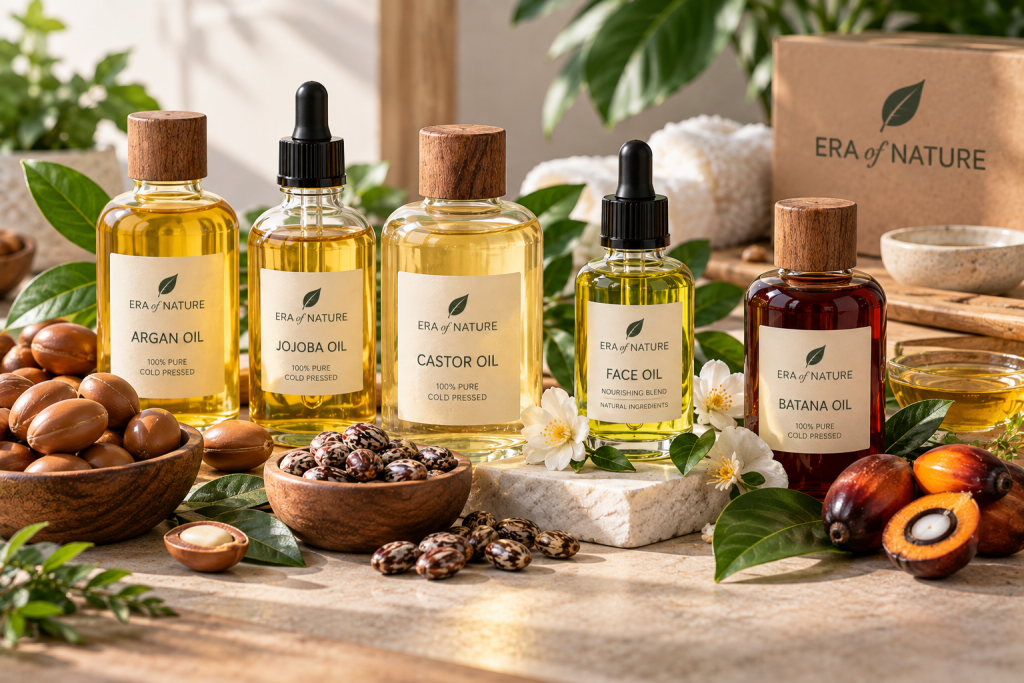
“Beauty oil” sounds like one product category, but it covers products that can behave very differently. A bottle of pure argan oil, thick castor oil, a facial oil blend, and a concentrated essential oil may all appear in the same supplier catalog, yet they are not interchangeable.
For a beauty brand, those differences affect product choice, packaging, positioning, and customer experience. The oil determines how a product feels, how it is applied, and where it belongs in a skincare or hair care routine. This matters even more with private label products, where a supplier may already offer several formulas but the brand still has to decide which one fits each use.
Carrier Oils Are the Base of Many Oil Products
Carrier oils are plant-derived oils used in skincare, body care, and hair care. They can be sold as single-ingredient products or used as the base of more complex blends.
Texture varies considerably. Some oils spread quickly and leave a light finish, while others are thicker and stay noticeable on the skin or hair for longer. A lightweight oil may suit a face product, while a richer option can work better for the scalp or body.
For brands comparing private label carrier oils, samples are important. Two oils that sound similar on paper may feel very different during normal use.
Argan Oil Works Across Several Categories
Argan oil fits both skincare and hair care. A private label argan oil may be positioned as a facial oil, hair oil, body product, or multipurpose oil, but the intended use should still be clear.
In a hair-focused range, it can sit beside shampoos, scalp products, or styling treatments. In skincare, the same oil may need different packaging, instructions, and product messaging. The ingredient may be the same, but the finished product around it changes.
Castor Oil Has a Different Texture
Castor oil is noticeably thicker than many common carrier oils. That affects both application and packaging.
A private label castor oil may fit hair, scalp, brow, or body routines, but brands should avoid turning every possible use into one long list of claims. It is better to define the product’s main role and explain it clearly.
Viscosity also matters when choosing a closure. A dispenser that works well with a light facial oil may perform poorly with castor oil, so packaging should always be tested with the actual product.
Batana Oil Fits Hair and Scalp Care
Batana oil is most naturally associated with hair and scalp routines. For brands considering private label batana oil, category fit matters as much as ingredient popularity.
A trending ingredient can attract attention, but it still needs a clear place in the range. When the role is obvious, the product is easier to describe, merchandise, and combine with related hair care products.
Face Oils Need the Right Texture
A facial oil is not simply any carrier oil poured into a small bottle. Customers notice how easily it spreads, how much they need, and how the skin feels after application.
A rich oil may suit one routine but feel too heavy in another. A lighter option can create a very different experience. When selecting a private label face oil, compare samples using the same amount and assess how they feel after several minutes, not only at first touch.
Packaging should also control the dose. Facial oils are usually used in small amounts, so a bottle that dispenses too much can make the product messy and wasteful.
Hair and Scalp Oils Need a Defined Job
“Hair oil” can describe several products. A finishing oil for the lengths and ends has different requirements from a pre-wash treatment, while a scalp oil needs another application method again.
Before choosing a private label hair oil, decide where it fits in the routine. Products for the lengths should spread easily without making application difficult. Scalp-focused oils need packaging and instructions that support use closer to the roots.
Directions are especially important for scalp products. Customers should understand how much to apply, whether to leave the oil on or wash it out, and how often to use it. A narrow applicator may also work better than a closure designed for dispensing oil into the palm.
Essential Oils Are a Separate Category
Essential oils are concentrated aromatic materials and should not be treated like ordinary carrier oils simply because both come in small bottles.
For brands considering private label essential oils, concentration, intended use, and product education need to be clear. They should not be presented as automatic substitutes for a facial or body oil.
The category should also make sense for the brand’s audience. There is little value in adding a large essential oil range simply because a supplier offers one.
Single Oils and Blends Serve Different Purposes
Single-ingredient oils are easy to understand. A bottle labeled argan oil or castor oil gives the customer a clear idea of the main ingredient.
Blends work differently. A face or hair oil may combine several carrier oils to create a particular texture or application experience. One can provide a lighter feel while another adds richness.
Neither approach is inherently better. Single oils appeal to customers looking for a specific ingredient, while blends give formulators more control over the finished product.
Cold-Pressed Oils Need Accurate Description
Processing methods can be part of how botanical oils are presented. If a brand wants to describe an oil as cold-pressed, that information should be confirmed with the supplier rather than assumed.
Processing can influence color, aroma, and appearance, which may also affect batch consistency. When the method is known and relevant, it can be included as a factual product detail rather than a vague quality claim.
Packaging Should Match the Oil
There is no single bottle or closure that works equally well for every oil. A thin carrier oil may work with a dropper or pump, while a thicker product may need another dispensing system. Essential oils are often sold in smaller quantities and have different packaging needs.
Storage and light exposure may also matter depending on the formula. For businesses reviewing private label oils, it makes sense to choose the oil first and then match the container to its texture, intended amount per use, and position in the range.
A bottle can look attractive and still be the wrong choice if customers struggle to dispense the product.
Product Positioning Should Be Specific
Oil products often become difficult to understand when one bottle is described as being for the face, hair, body, nails, scalp, and almost everything else.
Some oils can support several uses, but the main purpose should still be obvious. A facial oil should look and read like facial skincare. A scalp oil should explain how it fits into a hair routine. A multipurpose argan oil can be positioned more broadly, but the suggested uses still need to make sense.
Specific positioning also helps keep several oils in the same collection from becoming indistinguishable.
Build an Assortment Around Clear Differences
A useful oil assortment is more than a row of botanical names. Customers need to understand why one product is different from another.
For example, a collection could include a lightweight face oil, a richer body oil, a scalp-focused product, and one or two single carrier oils. Each has a distinct role and can sit alongside creams, soaps, body butters, or hair products without competing for the same use.
If two oils have almost identical positioning, the brand should consider whether both are necessary.
Rebranding an Oil Requires Product Comparison
Replacing a supplier or rebranding an existing oil involves more than changing the label. A new version may differ in texture, aroma, color, bottle size, or application method, even when the ingredient name remains the same.
Brands should compare old and new products directly before switching. If customers are likely to notice a meaningful difference, product descriptions, directions, and other information should be updated too.
Choose Oils by Function, Not Catalog Size
A supplier may offer dozens of oils, but a brand does not need to carry all of them. The better question is what each product contributes.
Does the range already have a facial oil? Would another one serve a genuinely different purpose? Does the scalp product solve a different need from the existing hair oil? Would customers understand why two similar carrier oils are both available?
A focused range gives each product a clearer identity, reduces inventory complexity, and makes it easier to keep successful products in stock. For a natural beauty brand, that is usually more useful than building the largest possible oil catalog.
Author

Written by
Recent Posts

The Renegade Housewives of Pop Art: A Memoir of the 1960s
Nicole Miller

Unlocking the Berkshires

Dalia Forman Design

Alberto Luzzi
Categories
- Art
- Articles
- Business of Luxury
- Celebrities
- Culture
- Entertainment
- Events
- Faces of Summer 2026
- Fashion
- Fashion & Style
- Featured
- Finance
- Food, Spirits, Wine
- Hamptons
- Hamptons Celebrities
- Health
- Health & Beauty
- Lifestyle
- Luxury Lifestyle
- Press
- Profiles
- Real Estate
- Technology
- The Chronicles
- Travel
- Uncategorized
- Weddings