
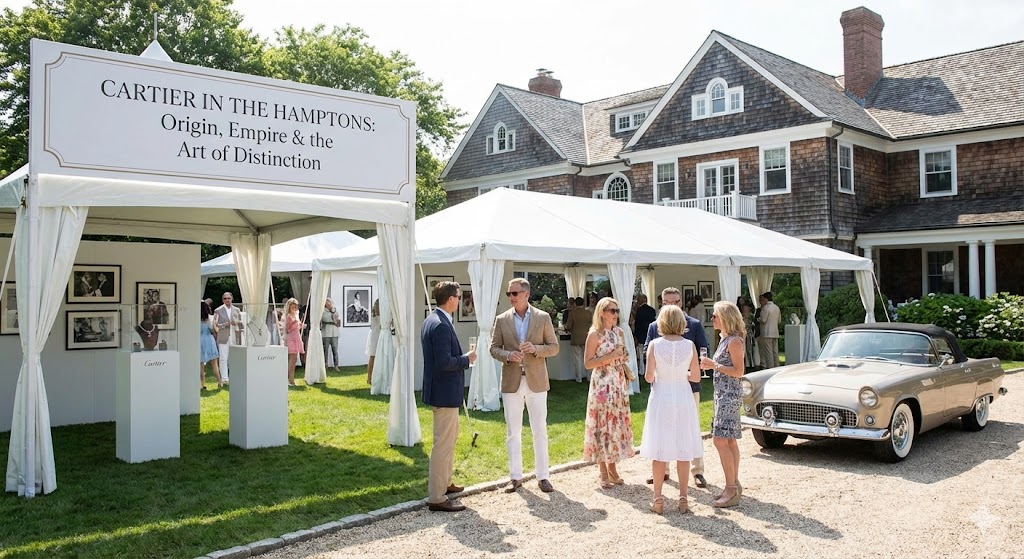
The Red Box at 1 Main Street
This seasonal pop-up, christened Cartier d’Été—French for summer—opened Memorial Day weekend 2022 as what Mercedes Abramo, President and CEO of Cartier North America, called “bringing this unique experience into our own backyard.” The irony is exquisite: Cartier, a house born in a modest Parisian workshop 177 years ago, now frames the Hamptons as its backyard. The building itself, a century-old structure renovated to flood with natural light, sold in 2023 for $22 million—$4,400 per square foot, the highest commercial price in Hamptons history. The buyer? Bernard Arnault, chairman of LVMH, the world’s richest man. That Arnault, whose empire includes Louis Vuitton, purchased the building Cartier occupied is a footnote worth noting. In luxury’s competitive arena, even the real estate tells a story.
Pierre Bourdieu, the French sociologist who spent his career dissecting how taste functions as social weaponry, would have understood immediately. What Cartier is actually selling in East Hampton is not jewelry. It is the resolution of a specific anxiety: the fear that your success is visible but your taste is not.
The Cartier Genesis: From Rue Montorgueil to Global Empire
In 1847, a 28-year-old watchmaker named Louis-François Cartier took over the workshop of his master, Adolphe Picard, on Rue Montorgueil in Paris’s 2nd arrondissement. His father was a metal worker. His mother labored as a laundry woman. The circumstances were humble. The ambition was not. Within a decade, Cartier had developed what historians call his “strategy”—introducing “imaginative jewelry” alongside the core watchmaking business. By 1859, Princess Mathilde, cousin of Emperor Napoleon III, had made her first purchase. The House of Cartier had found its formula: sell to one royal, and the others follow.
The mythology machine accelerated under Alfred Cartier, Louis-François’s son, and reached full velocity with Alfred’s three sons—Louis, Pierre, and Jacques—who divided the empire strategically. Louis remained in Paris, the creative heart. Jacques took London, cultivating British aristocracy. Pierre conquered New York, famously acquiring the Fifth Avenue mansion that remains Cartier’s American temple for $100 and a double strand of pearls valued at $1 million. The transaction itself became legend—a house for a necklace, wealth for wealth, the ultimate symbolic exchange.
The Mythology Machine
King Edward VII of England commissioned 27 tiaras for his 1902 coronation and subsequently issued the royal warrant that would define Cartier’s identity forever. His assessment—”the jeweler of kings and the king of jewelers”—remains the most quoted phrase in luxury marketing. By 1939, Cartier had accumulated 15 royal patents from courts spanning Spain, Portugal, Russia, Siam, Greece, Serbia, Belgium, Romania, Egypt, Albania, and Monaco. The founding story emphasizes craft and aristocratic connection while obscuring the business acumen beneath. What began as a workshop selling time evolved into a house selling eternity.
Today, Cartier operates as the crown jewel of Switzerland’s Richemont Group. With a brand value of approximately $12.5 billion and jewelry maison revenues exceeding €14 billion annually, Cartier has transformed from royal supplier to global phenomenon. Yet the origin story remains carefully cultivated—humble beginnings, aristocratic ascent, artistic vision. The mythology of the scrappy Parisian craftsman who dressed queens is precisely the cultural capital that separates Cartier from its competitors.
Cartier’s Four Capitals: Decoding Luxury’s Hidden Currency
Bourdieu identified four forms of capital that determine social position. Cartier, perhaps more than any other luxury house, has mastered all four simultaneously.
Economic Capital
The price architecture reveals the strategy. Entry begins around $2,130 for a Love bracelet on chain—enough to signal membership but accessible enough to create desire. The classic Love bracelet commands $7,950 in yellow gold, rising to $64,600 for the diamond-pavé version. Santos watches span $5,100 to $38,900. The Tank collection stretches from accessible quartz to complications exceeding $30,000. Moreover, Cartier implements consistent price increases—roughly 3-5% annually—positioning ownership as inflation-resistant investment. The secondary market confirms this: well-maintained Love bracelets and vintage Tanks often appreciate, transforming consumption into financial strategy.
Cultural Capital
To properly consume Cartier requires knowledge. The informed buyer understands that Louis Cartier created the Santos watch in 1904 for his friend Alberto Santos-Dumont, the Brazilian aviation pioneer who needed to tell time while flying. They recognize the Tank’s inspiration—the Renault FT tanks Louis observed on the Western Front during World War I—and appreciate how a war machine became a symbol of refinement. They know that Jeanne Toussaint, the “Panther” who served as creative director from 1933 to 1970, developed the house’s most iconic motif. Furthermore, they understand the Love bracelet’s conceptual genius: designed by Aldo Cipullo in 1969, it requires a screwdriver to remove, physically binding wearer to giver. This knowledge constitutes cultural capital. Without it, you merely own jewelry. With it, you participate in a conversation spanning centuries.
— Andy Warhol
Social Capital
The network a Cartier piece signals is remarkable in its range. Princess Diana wore her Tank on countless occasions, as did Jackie Kennedy Onassis and Michelle Obama. Andy Warhol famously never wound his Tank—”I wear it because it’s the watch to wear.” Contemporary adherents include Kate Middleton (Ballon Bleu), Angelina Jolie (Tank Louis Cartier), and multiple generations of Kardashians stacking Love bracelets. This is the paradox: Cartier simultaneously signals old-money taste and new-money aspiration. Wearing Cartier positions you in a club that includes both the Duchess of Windsor and Kylie Jenner. The social capital resides in this unlikely coalition—aristocracy and Instagram, royalty and reality television, unified by the red box.
Symbolic Capital
Cartier occupies a specific position in the prestige hierarchy—more accessible than Graff or Harry Winston, more historically legitimized than Tiffany, more versatile than Van Cleef & Arpels. The symbolic capital derives from this exact positioning: elevated enough to confer status, democratic enough to feel attainable. A Cartier Love bracelet says you understand taste without screaming wealth. A Tank whispers sophistication in a market of shouting chronographs. Consequently, Cartier resolves the central tension of luxury consumption: the need to distinguish oneself while belonging to a recognizable tribe.
Why Cartier Chose the Hamptons—And What It Reveals
The Cartier Hamptons boutique at 1 Main Street occupies the corner of Newtown Lane—the precise intersection where luxury congregates. Neighbors include Chanel at 26 Newtown Lane, Prada at 2 Newtown Lane, and Valentino nearby. This clustering is not coincidence but calculated. Luxury brands position relative to one another, each presence validating the others, collectively transforming a village shopping district into a destination for what Bourdieu called “legitimate taste.”
The Cartier d’Été concept—seasonal summer presence rather than permanent installation—represents strategic positioning. It creates scarcity (available only during the Hamptons’ social season), cultivates urgency (you must visit now), and signals confidence (Cartier does not need permanent presence to maintain prestige). The boutique’s design emphasizes natural light and airy layout, capturing what the brand describes as the “joie de vivre of East Hampton.” Visitors find curated selections including fine jewelry, iconic timepieces, and Hamptons-specific experiences. Nevertheless, the real product is something less tangible: the feeling of being someone who summers where Cartier summers.
Bernard Arnault’s $22 million purchase of the building—while Cartier (owned by rival Richemont) occupied it—adds another dimension. That the world’s richest man acquired the space housing his competitor suggests the Hamptons has become a battlefield where luxury conglomerates fight for symbolic territory. Additionally, real estate itself becomes brand statement. The building’s $4,400-per-square-foot price point establishes a marker: this is what Main Street East Hampton is worth. This is the field where distinction is won and lost.
Playing the Field: Cartier vs. the Competition
In the Hamptons luxury market, Cartier’s direct competitors include Chanel (pop-up at 26 Newtown Lane), Prada (2 Newtown Lane), and Valentino—all of which established Hamptons presence during the same 2022 influx. The competitive logic is fascinating: each brand targets a slightly different psychographic, yet all compete for the same consumer attention.
Cartier differentiates through permanence. Fashion houses sell seasonal collections; Cartier sells “forever.” The Love bracelet’s screwdriver mechanism physically manifests this promise. Unlike a Chanel jacket that dates itself by season, a Tank watch purchased in 1990 looks identical to one purchased today. This anti-fashion positioning serves both old money (who distrust trends) and new money (who seek safe bets). The brand helps old money maintain distinction without appearing to try, while helping new money signal legitimate taste without appearing to reach. Cartier makes both groups feel they’ve made the only reasonable choice.
The “logo vs. anti-logo” spectrum positions Cartier as quietly recognizable. The signature Love bracelet’s screws identify it immediately to those who know, while remaining invisible to those who don’t. Similarly, the Tank’s rectangular case signals Cartier without visible branding. This calibrated visibility serves the Hamptons habitus perfectly—a community that values status demonstration while professing to disdain ostentation.
The Cartier Investment: Cultural Arbitrage or Eternal Return?
Visitors to the Cartier Hamptons boutique at 1 Main Street in East Hampton will find hours from 10 AM to 6 PM daily, with Sunday hours from 11 AM to 5 PM. Appointments can be booked through Cartier’s website for private consultations. The experience is calibrated for a specific customer: someone who understands that luxury consumption is performance, who appreciates history as validation, and who seeks objects that function simultaneously as adornment and signal.
The cultural literacy required to meaningfully engage Cartier Hamptons involves understanding why a house founded in 1847 Paris resonates in 2025 East Hampton—why the origin mythology matters, why the royal warrants still carry weight, why Andy Warhol’s unwound Tank says more than most wound watches ever could. This knowledge transforms consumption from transaction to participation.
Bourdieu would recognize what Cartier sells in the Hamptons as the ultimate form of symbolic capital: the power to make economic investment appear as cultural discernment. The woman who circles the Love bracelet before touching it understands this intuitively. She is not buying gold. She is buying 177 years of mythology, 15 royal warrants, the approval of Princess Diana and Jackie Kennedy, the validation of her own taste by history itself. The red box that will hold her purchase contains something far more valuable than its contents: the promise that she belongs.
Continue Your Luxury Education
For more insights into the Hamptons luxury landscape, explore our comprehensive guide to Best Hamptons Fashion Boutiques featuring East Hampton’s most refined retail destinations.
Discover where luxury meets lifestyle in our guide to Best Hamptons Hotels for 2026—because where you stay matters as much as what you wear.
Stay Connected with Social Life Magazine
Author

Written by
Recent Posts

The Perfect Summer Grill for the Hamptons

Taissa Farmiga Net Worth: The Trapped Heiress Playing a Trapped Heiress

Louisa Jacobson Net Worth: The Dynasty Meryl Streep’s Daughter Is Quietly Escaping

Christine Baranski Net Worth: Four Decades, 15 Emmy Nominations, and the Price of Being Undeniable

Morgan Spector Net Worth: The Most Terrifying Man on Television That Nobody Can Name
Categories
- Art
- Articles
- Beauty & Skincare
- Celebrities
- Celebrities|The Chronicles
- Chronicles
- Entertainment|Culture
- Event Photos
- Events
- Fashion
- Fashion & Style
- Featured
- Food & Beverage
- Food, Spirits, Wine
- Hamptons
- Hamptons Celebrities
- Hamptons Celebrities|Celebrities|The Chronicles
- Health
- Health & Beauty
- Lifestyle
- Luxury Lifestyle
- Press
- Profiles
- Real Estate
- Technology
- The Chronicles
- Travel
- Uncategorized
- Weddings