

SNL, HBO, and the Most Demanding Room in Comedy
Dennis Miller net worth reached $50 million through a career built on a bet most comedians won’t make: that a significant audience actually wants comedy that requires something from them. That bet paid out across six seasons of Saturday Night Live‘s Weekend Update, six HBO stand-up specials, and a touring career defined by reference-dense material aimed squarely at the people who had done the reading. Miller never chased the full room. Instead, he built a smaller, more loyal one — and extracted $50 million from it over four decades.
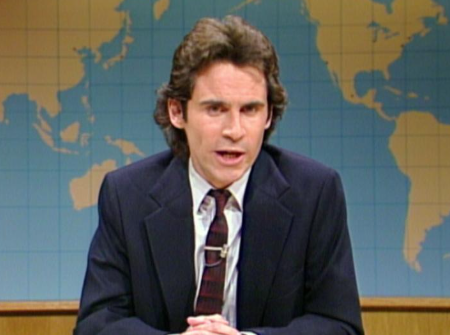
His tenure as Weekend Update anchor from 1985 to 1991 remains the longest in the show’s history at that point, and his HBO decade from 1988 through the late 1990s produced a body of stand-up work that still ranks among the most intellectually demanding in the format’s history. The financial result reflects sustained commercial viability at the niche’s upper limit. More importantly, his legacy demonstrates that specificity of audience, pursued with enough craft and consistency, compounds into a career that outlasts every trend chasing it.
Dennis Miller Net Worth Origins: Pittsburgh to SNL
Dennis Miller was born November 3, 1953, in Pittsburgh, Pennsylvania. His father Joseph — a used car salesman — died when Miller was seven. His mother Norma raised him in Castle Shannon, a Pittsburgh suburb where the dominant register was working-class and direct. He attended Point Park University and studied journalism, a training that shows clearly in his comedy: structured like a column, not a bit. Thesis, evidence, elaboration, punchline, move on.
Pittsburgh clubs hosted his early stand-up in the late 1970s. By the early 1980s, he had worked through the regional circuit to New York and Los Angeles. His style arrived fully formed — rapid-fire, reference-dense, delivered with a confident smirk that signaled he was performing for the people following, not adjusting for the ones who weren’t. Commercially limiting. Artistically consistent. That trade-off defined every career decision he made afterward.
In 1985, Saturday Night Live hired him as Weekend Update anchor. At 31, he stepped into a segment that previous anchors had treated as news parody. Miller treated it as prosecution.
The Weekend Update Years: Prosecuting the News

Miller’s Weekend Update didn’t summarize current events — it interrogated them. Each joke targeted a specific absurdity in a specific news item, delivered at a speed that assumed the audience had read the paper that week. His sign-off — “I am out of here” — became one of SNL’s most recognized catchphrases, which is ironic given that it expressed his genuine desire to be somewhere else.
By multiple accounts, Miller grew restless within the SNL format early. The stand-up work and HBO specials he was developing felt closer to what he actually wanted to do. After six seasons — longer than any Weekend Update anchor before him — he left after the 1990-91 season and moved directly into the decade that would define his legacy.
During his SNL run, Miller developed the observational discipline that fueled his HBO work. Every reference needed to earn its place. Every sentence had to carry the argument forward. The journalism training showed: no fat, no sentiment, no punchline that didn’t pay off the setup.
The HBO Decade: Stand-Up at Maximum Density

Miller’s HBO specials — Mr. Miller Goes to Washington (1988), Black and White (1990), Citizen Arcane (1996), Ranting Again (1998) — built the most intellectually demanding room in 1990s comedy. The premise was specific and now largely extinct: a joke could require background knowledge without excluding the audience that had it. Payoff scaled with preparation. Audiences who had done the reading got more comedy per minute than anyone else in the format was offering.
Harvard Business Review later cited Miller’s rhetorical approach as a model for persuasive communication under complexity — the ability to land a complicated argument as a punchline rather than a lecture. Miller was doing this live, at speed, for a decade straight.
His political positions shifted significantly after September 11, changing his public profile and his audience. The craft from the Seinfeld-era decade, however, stands independent of what came after. Those sentences were built to last. The material from 1988 to 2001 holds up as comedy regardless of where the author subsequently landed politically — and that is the correct standard for evaluating it.
For context on the broader era, read Comedy’s Insurgents: Who Rewrote the Rules and the full Master Architects: Who Built the Golden Age.
What Dennis Miller’s Net Worth Represents
Six seasons of Weekend Update. Six HBO specials. A Monday Night Football commentary run from 2000 to 2002 that applied the same density and reference level to sports commentary — an experiment the MNF audience had not requested and did not universally appreciate. A radio show. A cable news presence. A career that tracked exactly the audience he always built for, across every format he tried.
His comedy legacy is specific and worth naming clearly: Miller demonstrated that a significant audience exists for stand-up that demands intellectual engagement rather than simply delivering it. That audience migrated to podcasts and long-form formats that accommodate the density he was always trying to achieve within the constraints of a television comedy slot. In some ways, he was building for a medium that didn’t exist yet when he was at his peak.
Dennis Miller net worth sits at $50 million — the financial result of four decades spent performing for people who came prepared. The audience was always smaller than his peers’ audiences. It was never less committed. That distinction is the whole story, and it held.
For more from the celebrity archive, visit SocialLifeMagazine.com.
Editorial features and brand partnerships, contact us at sociallifemagazine.com/contact. For Polo Hamptons tickets and sponsorships, visit polohamptons.com.
Author

Written by
Recent Posts
7 Mindful Meal Prep Tips for Stop Food Waste Day

Rebecca Ferguson Net Worth: The Advantage of Not Being the Lead
What Makes a Dinner Party Truly Unforgettable (Hint: It’s Not the Food)
Tips for Managing Grease and Oil in Everyday Dishwashing

Austin Butler Net Worth: The Method Actor in a Post-Method World
Categories
- Art
- Articles
- Beauty & Skincare
- Celebrities
- Celebrities|Entertainment
- Celebrities|Television
- Celebrities|The Chronicles
- celebrities|the-archive
- Chronicles
- Entertainment|Culture
- Event Photos
- Events
- Fashion
- Fashion & Style
- Featured
- Food & Beverage
- Food, Spirits, Wine
- Hamptons
- Hamptons Celebrities
- Hamptons Celebrities|Celebrities|The Chronicles
- Health
- Health & Beauty
- Lifestyle
- Luxury Lifestyle
- Movies
- Press
- Profiles
- Real Estate
- Technology
- The Chronicles
- Travel
- Uncategorized
- Weddings