
Everything Is Available as Material
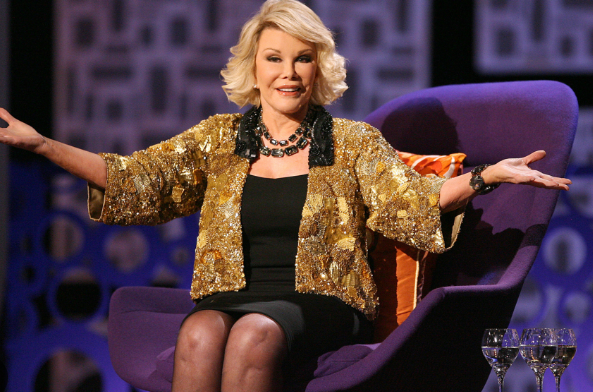
Joan Rivers net worth at her 2014 death was estimated at approximately $150 million. Fifty years of relentless work built it — stand-up, television, film, jewelry sales, and a touring schedule most comedians half her age found incomprehensible. She was performing ten days before she died. Joan Rivers’ comedy legacy is a proof of concept: honesty, precision, and refusing to apologize for the joke outlast every trend and every industry verdict. She arrived first, built the room that two generations of female comedians walked into, and kept working long after most had settled in.
Stopping was never something she considered.
Joan Rivers Net Worth Origins: Brooklyn to Barnard
Joan Alexandra Molinsky was born June 8, 1933, in Brooklyn, New York. Her parents Meyer and Beatrice were Russian Jewish immigrants who had built a comfortable middle-class life. They expected their daughter to become anything but a comedian. Her father was a physician. The family moved to Larchmont, New York, where Rivers attended school and developed a reputation for being funny at dinner. Her parents found it simultaneously impressive and inconvenient. Eventually she enrolled at Barnard College.
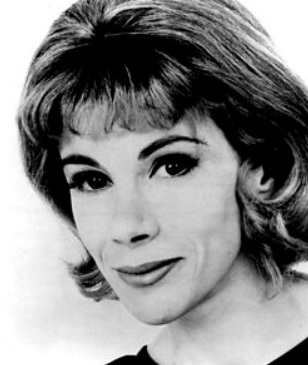
She graduated Phi Beta Kappa in 1954 with a degree in English literature and anthropology. Off paper, she was already doing what she was going to do. She tried acting in New York’s Off-Broadway circuit. She tried writing. None of it held. The clubs held.
Her early stand-up years weren’t comfortable. The comedy clubs of the late 1950s and early 1960s weren’t designed for women — not the rooms, not the bookers, not the audiences. The industry infrastructure didn’t accommodate them either. Nevertheless, Rivers performed anyway — under various stage names, for rooms ranging from indifferent to hostile. She refined material that was personal, specific, and entirely unlike what anyone else in those rooms was doing.
The Carson Couch: Joan Rivers’ Comedy Legacy Begins
On February 17, 1965, Joan Rivers appeared on The Tonight Show Starring Johnny Carson. At the end of her set, Carson said on live television: “God, you’re funny.” Then he invited her to sit on the couch. That invitation — sitting with Carson immediately after a stand-up set — represented the highest public endorsement the art form offered in that era. Carson extended it to exactly one female comedian in his thirty-year tenure.
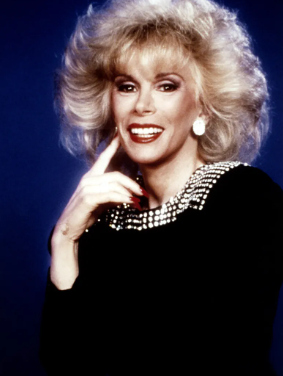
The career that followed ran for nearly fifty years. Rivers became his permanent guest host. During the late 1970s and early 1980s, she stood as the most prominent female comedian in America by a significant margin. Then she made a decision that cost her everything and demonstrated something essential about who she was.
In 1986, Rivers accepted a deal to host her own late-night talk show on Fox without informing Carson. He considered it a personal betrayal and never spoke to her again. Fox canceled the show after one season. Her husband Edgar Rosenberg — her manager, her partner, the operational backbone of her career — died by suicide three months after the cancellation. At 54, Rivers was professionally blacklisted, widowed, and written about in the past tense by an industry that had decided she was finished.
She went back to work.
The Return Nobody Expected
Throughout the late 1980s and 1990s, Rivers did what she had always done. Same frequency, same lack of institutional support she had operated without before Carson’s endorsement. She toured, she wrote, she took television work when available, and created it when it wasn’t. She also developed the red carpet format — the “who are you wearing” interview style — that became the awards show journalism template, through her E! Entertainment Television work.
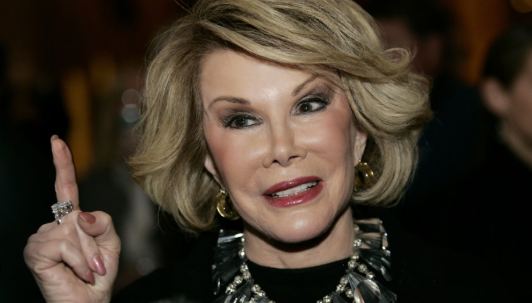
That format, which she essentially invented, is now the dominant mode of celebrity coverage at every major awards event globally. It has generated billions of dollars of content and launched dozens of careers. Rivers received minimal financial participation in its expansion beyond her own contracts. She seemed to find this more amusing than infuriating, which was characteristic.
According to Forbes, her QVC jewelry line became a $1 billion business over two decades. That revenue gave her independence to perform whatever material she wanted. The stand-up from the 1990s onward shows what that independence produced: someone with nothing left to protect and therefore nothing to hold back.
For the full context of the era she helped define, read Comedy’s Master Architects: Who Built the Golden Age and the Comedy Insurgents hub.
Joan Rivers Net Worth and Comedy Legacy: What She Said That Nobody Else Would
Rivers operated on one principle: everything is available as material, or nothing is. She applied this principle to herself first and most ruthlessly — her appearance, her age, her financial reversals, her widowhood. That gave her the standing to apply it to everyone else. The self-deprecation wasn’t modesty. It was strategic. It established the terms under which she could say anything about anybody, because she had already said the hardest things about herself.
Her influence on the comedians who came after her is specific and acknowledged. Every female comedian who built a career on honesty — on saying the thing the room was pretending wasn’t true — operated in the space Rivers defined. The New York Times described her at her death as “the godmother of confessional comedy.” She would have accepted that and found an angle on it immediately.
Jerry Seinfeld had scheduled Rivers to appear on his show before her 2014 death. The invitation was genuine. They were peers in the most precise sense: comedians who understood craft at the same level, who both built careers on precision and discipline. Both believed the work was always the point. Seinfeld doesn’t extend that kind of respect casually or often.
What Joan Rivers Net Worth Doesn’t Capture
Fifty years of performing. Approximately 23 books. A QVC jewelry business that became a billion-dollar operation. The red carpet interview format that now defines entertainment journalism at every major awards event. Multiple Grammy nominations. A Fashion Police franchise. A documentary — Joan Rivers: A Piece of Work (2010) — showed her calendar for a single year. It left audiences simultaneously exhausted and humbled by the density of her output.
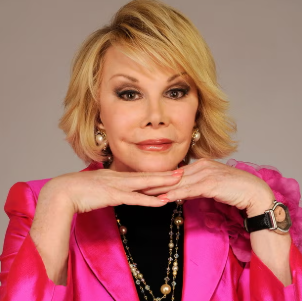
Beyond the numbers, she demonstrated that a woman could build a fifty-year stand-up career, survive cancellations and blacklisting, and emerge with sharper material than when she started. That demonstration mattered. It told every female comedian who came after her that the room was survivable and the career was buildable. The industry’s verdict at any given moment was not the final verdict.
She was 81 years old at her death and had performed ten days before it. The touring schedule she maintained in her seventies was more rigorous than most comedians manage in their thirties. The work wasn’t a compensation for loss or a distraction from age. It was simply what she did, because it was what she was, because she had never found a reason compelling enough to stop.
September 4, 2014: Joan Rivers Net Worth in Full
Joan Rivers died September 4, 2014, at Mount Sinai Hospital in New York, from brain damage sustained during a routine throat procedure eight days earlier. She was 81. The outpouring that followed was disproportionate to the coverage she had typically received during her lifetime. That was itself a data point she would have found instructive and probably usable.
Her daughter Melissa accepted the tributes. Her granddaughter Cooper was 13. The red carpet format she invented was deployed at her memorial. The industry that had written her off at 54 filled a room to mourn her at 81. She would have had a great deal to say about all of it. The fact that she couldn’t say it is the specific nature of the loss.
The work remains. The principle remains. Everything is available as material, or nothing is. She proved it for fifty years, which is the only proof that counts.
For more from the celebrity archive, visit SocialLifeMagazine.com.
To discuss editorial features and brand partnerships, reach us at sociallifemagazine.com/contact. Meanwhile, for Polo Hamptons tickets and sponsorships, visit polohamptons.com.
Author

Written by
Recent Posts
Cynthia Erivo Net Worth: The Voice That Was Always There
Inside Out 2, Wicked, and the Emotional Blockbuster That Ate 2024
7 Mindful Meal Prep Tips for Stop Food Waste Day
Rebecca Ferguson Net Worth: The Advantage of Not Being the Lead
What Makes a Dinner Party Truly Unforgettable (Hint: It’s Not the Food)
Categories
- Art
- Articles
- Beauty & Skincare
- Celebrities
- Celebrities|Entertainment
- Celebrities|Television
- Celebrities|The Chronicles
- celebrities|the-archive
- Chronicles
- Entertainment|Culture
- Event Photos
- Events
- Fashion
- Fashion & Style
- Featured
- Food & Beverage
- Food, Spirits, Wine
- Hamptons
- Hamptons Celebrities
- Hamptons Celebrities|Celebrities|The Chronicles
- Health
- Health & Beauty
- Lifestyle
- Luxury Lifestyle
- Movies
- Press
- Profiles
- Real Estate
- Technology
- The Chronicles
- Travel
- Uncategorized
- Weddings