
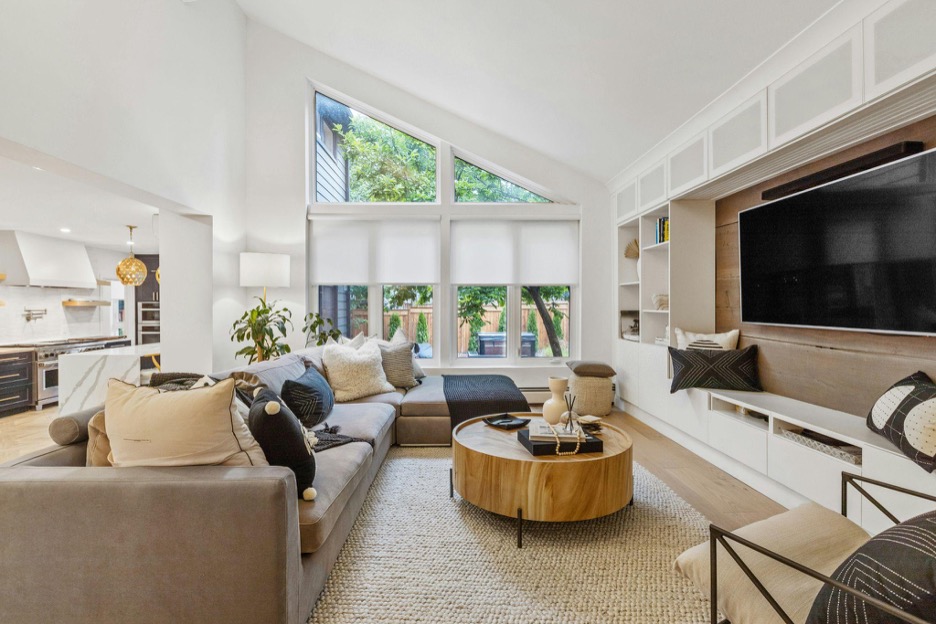
A television may be part of everyday life, but the equipment around it doesn’t need to dominate the room. Cable boxes, streaming devices, controllers, cords, and other electronics can quickly make a polished living room feel more technical than inviting.
The goal is to separate what should be concealed from what simply needs an intentional place. Closed cabinetry can hide visual clutter, open areas can hold pieces worth displaying, and careful cord routing helps the room stay composed.
Not Every Closed Door Is Doing the Same Job
Storage can organize without concealing. Glass-front cabinets keep objects orderly but visible, while open shelving leaves everything on display. Only opaque doors remove electronics and clutter from view.
That distinction matters when modular storage that looks like custom built-ins combines several functions across one media wall. With no renovation, no contractor, no DIY project, each storage type can remain part of one coordinated system. The Martha Stewart Living Room Collection is a modular storage system from Flash Furniture, available in the Bedford and Lily Pond lines, that combines cabinets, hutches, and TV stands into a custom built-in look with solid wood frames, soft-close doors, and adjustable shelving.
The two fluted wood cabinets in the Bedford 6-Piece Modular Media Center provide genuine concealment through opaque doors with soft-close hinges. Two tempered-glass cabinets keep contents visible, while two open hutches provide display space and rear cord-management openings.
The fluted cabinets keep cable boxes, streaming devices, and gaming consoles behind closed doors when ventilation requirements allow. The White and Gold version pairs gold hardware with White, one of the collection’s six curated finishes.
Sort What Actually Needs to Disappear From What Just Needs a Home
A polished media wall separates objects that need concealment from those that can remain visible. Small electronics, controllers, spare cables, and remotes belong in closed cabinet storage rather than open shelving when their ventilation requirements allow.
Books, photographs, ceramics, and decorative objects can remain visible in glass-front cabinets or open hutches. Leaving space around displayed pieces keeps the arrangement intentional and prevents the living room from feeling crowded.
The Room Should Still Read as Living Space, Not a Control Panel
Media furniture works best in a formal or design-conscious room when its proportions, finishes, and detailing belong with the rest of the furniture. The aim is storage that reads as living room furniture, not as a media rack.
Thoughtful interior details can make functional objects feel like part of a room’s design when their form, material, and placement feel intentional. The Parker House Catalina 7-Piece takes a more traditional cottage approach, with a Cottage White finish, open bookcases, a hutch, and a central TV console. It is priced at around $1,573.
The Bedford six-piece configuration takes a different visual route, using fluted opaque doors, glass-front cabinets, open hutches, and coordinated White and Gold detailing. Neither approach requires the room to surrender entirely to the television.
The Cords Need a Route, Not Just a Hiding Place
Placing electronics inside furniture does not automatically solve visible wiring. Cords still need a clear route to outlets and connected equipment. The Bedford 6-Piece Modular Media Center’s two open hutches have confirmed rear cord-management openings. These openings route wires behind the furniture and create a tidier arrangement, but they do not conceal the hutches or anything displayed on their shelves.
Cord routing and visual concealment remain separate decisions. An opaque cabinet can hide a component while its cords still need a path to power. Planning both before arranging the furniture creates a cleaner result than trying to disguise wires afterward.
Some Electronics Need to Breathe: Plan for That Honestly
Devices that run cool, a streaming stick, a cable box, a router, a soundbar remote, sit fine behind closed cabinet doors. Game consoles under load and AV receivers generate real heat and need either a vented cabinet or an added fan; BDI’s Corridor line and AC Infinity’s cabinet fans are built for that case.
For everything else, the Martha Stewart Bedford pieces keep components behind soft-close doors on shelves built for AV equipment, with rear cord management openings for routing. At around $3,299, the BDI Corridor 8175 has an advantage for heat-producing equipment because its airflow and ventilation engineering is designed specifically for AV use.
Scale the Concealment to the Wall You’re Actually Working With
A media wall should suit the architecture around it. Filling a modest room with the largest possible unit can be just as visually disruptive as leaving every device in the open.
The Bedford and Lily Pond lines are designed around 2-piece through 6-piece configurations, allowing the amount of storage to change with the wall rather than locking every room into one fixed format. The Bedford 6-Piece Modular Media Center measures 79.25 inches high by 126 inches wide by 16.75 inches deep and is priced at around $2,890. Its six components create a broad wall arrangement while separating opaque storage, glass-front storage, and display space.
Pottery Barn’s 139-inch Aubrey Wall Unit, priced at around $6,472, offers a broader premium configuration and material range. At around $2,890, the Bedford six-piece arrangement sits at well under half that price while coordinating opaque, glass-front, and open storage across 126 inches.
Scale isn’t only a question of inches. Finish consistency matters too. A coordinated run of cabinetry can feel calmer than several unrelated storage pieces competing across one wall. The Bedford system uses solid wood frames, bases, and legs, with engineered wood used where specified for doors and shelving, rather than relying on an inaccurate all-solid-wood claim.
The wider collection is manufactured by Flash Furniture, a Ubique Group company, and the Bedford and Lily Pond lines can be assembled in different configurations as the available wall space changes.
A Calmer Media Wall Starts With What You Don’t See
A sophisticated living room doesn’t need to pretend technology isn’t there. It needs to decide how much of that technology deserves visual attention.
Opaque cabinets handle genuine concealment, glass and open storage give selected objects a place to live, and cord routing keeps the practical details from becoming the first thing the eye notices. Soft-close doors and adjustable shelving sized for AV components support that organization without turning the furniture into dedicated media-room equipment.
Across Bedford and Lily Pond, the system combines 2-piece through 6-piece configurations, solid wood frames, bases, and legs, and six curated finishes. Manufactured by Flash Furniture, this modular storage that looks like custom built-ins creates a coordinated wall with no renovation, no contractor, no DIY project. The result supports the room rather than overtaking it.
FAQs About Hiding Electronics in a Living Room
What’s the Difference Between Storage That Hides Things and Storage That Just Organizes Them?
Opaque doors conceal objects by removing them from view. Glass doors organize items inside a defined space but leave the contents visible, while open shelving provides placement without visual concealment. The right mix depends on which objects create clutter and which belong in the room’s display.
Where Can I Buy This Kind of Media Storage?
The Martha Stewart Living Room Collection is available through approved retailers including Target, Home Depot, Lowe’s, Best Buy, and Walmart. Availability can vary by configuration and finish, so check the exact Bedford product before buying.
How Do I Keep a Media Wall From Overwhelming a Formal Living Room?
Match the unit’s width and height to the wall, coordinate its finish with the room and balance closed cabinets with a limited amount of open display. Leaving visual space around decorative objects can keep a large arrangement from feeling crowded.
Does It Require Assembly?
Yes. The Martha Stewart Living Room Collection requires adult assembly and ships in multiple boxes. Its coordinated appearance requires no construction, cutting, trim, or painting, but that does not mean the individual furniture pieces arrive assembled.
Author

Written by
Recent Posts

The Self-Made Man Who’s One Phone Call From Ruin

Everyone Out Here Is Loaded. Nobody Feels Rich.

What to Do When Illness Threatens a Trip You Already Paid For
How Independent Watch Brands Are Challenging Traditional Luxury

Meet Pamela Adlon’s Family: Her Daughters and Former Husband
Categories
- Art
- Articles
- Business of Luxury
- Celebrities
- Culture
- Entertainment
- Events
- Faces of Summer 2026
- Fashion
- Fashion & Style
- Featured
- Finance
- Food, Spirits, Wine
- Hamptons
- Hamptons Celebrities
- Health
- Health & Beauty
- Lifestyle
- Luxury Lifestyle
- Press
- Profiles
- Real Estate
- Technology
- The Chronicles
- Travel
- Uncategorized
- Weddings