
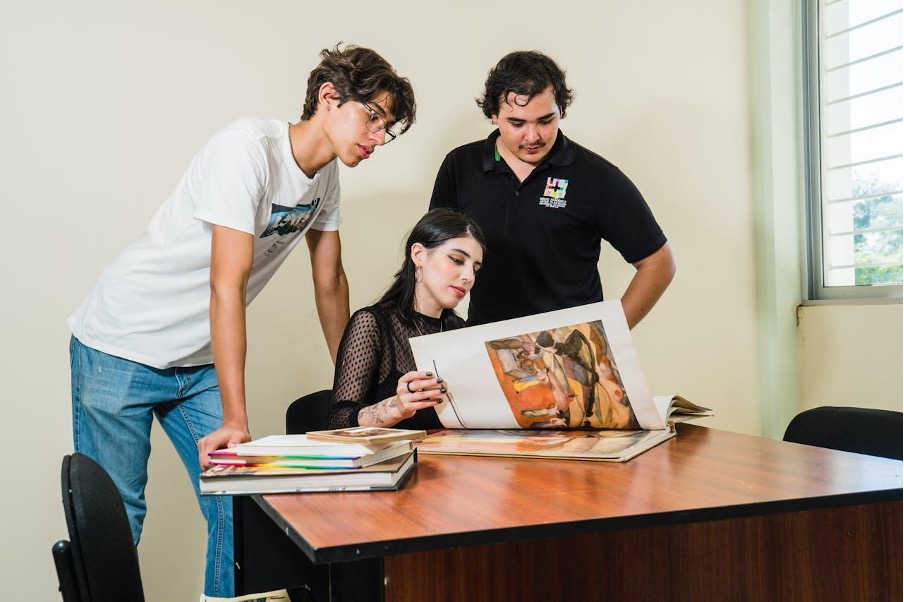
When was the last time you created something just because it brought you joy? Not for a grade or a deadline, but simply because it mattered to you. In a world racing toward efficiency—with smart tech and mood-matching playlists—we’re losing time and space for making art. But quietly, across schools and workplaces, the arts are making a comeback. People are beginning to sense that in all our speed, we’ve left something human behind.
In this blog, we will share why the arts are essential to educating the whole person, how society benefits from this shift, and what a real investment in artistic learning can look like in today’s world.
The Crisis of One-Dimensional Learning
For years, education has prioritized data. STEM dominates, test scores are everything, and students are tracked into careers before basic life skills. The arts? Usually seen as optional, or worse, not worth measuring at all.
But that mindset is shifting, especially after the global disruptions of recent years. When the pandemic pushed learning online, the cracks in a strictly academic model widened. Students struggled with focus, isolation, and burnout. What did many turn to? Music. Drawing. Dance. Theater. The things that let them process what they were going through, even when the words failed.
These weren’t just hobbies. They were lifelines.
Now, many educators are rethinking what learning should look like. And at the center of that discussion is this idea: to teach a person well, you can’t just feed their brain facts. You need to feed their imagination, too.
Learning Beyond the Test Score
One of the most vivid signs of this shift is the renewed focus on classical education. But it’s not the rigid, chalk-and-lecture version people might imagine. Today’s classical liberal arts masters education is about preparing educators who recognize the arts as essential to forming both intellect and character. These programs equip teachers to go beyond facts and formulas—to lead with insight, creativity, and purpose.
These aren’t just degrees for art teachers or literature lovers. They prepare people to lead classical schools, design meaningful curriculum, and bring back the power of dialogue, story, and beauty in the classroom. Courses like “The Quarrel Between Poetry and Philosophy” or “Faith and Reason” don’t shy away from the big questions. They invite future educators to think about how learning forms character, not just skill sets.
And while this sounds lofty, it’s deeply practical. A student who learns to see patterns in music may solve math problems differently. A teen who studies drama builds empathy and learns to read people in real life. A child who learns to draw carefully also learns to observe carefully. These are the kinds of skills that stick.
Art Helps Build Braver Humans
There’s a reason why companies like Google and Apple look for creative thinkers. Innovation doesn’t just come from knowing how things work. It comes from imagining how they could work. That leap—the moment you go from what is to what might be—is an artistic one.
The arts teach risk-taking. You try a color, a word, a sound. Sometimes it works. Sometimes it doesn’t. But you learn that failure isn’t the end of the story. It’s part of the process. That’s a lesson kids can carry into coding, into relationships, into voting booths.
Art also teaches empathy. When you read a novel, you step into someone else’s life. When you play a character, you explore motivations that aren’t your own. This matters in a world where headlines often flatten people into stereotypes. The arts remind us that every person is a story. And every story matters.
What Schools and Parents Can Actually Do
If you want to bring more arts into education—whether as a teacher, a parent, or just a curious human—there are clear places to start.
First, advocate for arts funding. Whether it’s your local school board or your state legislature, push for real support. Not just crayons and construction paper, but trained instructors, performance spaces, and partnerships with working artists.
Second, rethink how arts are integrated. Instead of treating them as side subjects, connect them with core ones. Let students write songs about historical events. Let them design visual representations of science concepts. Let them act out literature instead of just reading it silently.
Third, value the process. Not every painting has to be gallery-ready. Not every poem needs to rhyme. What matters is the thinking that happens while creating. The concentration. The choice-making. The reflection. This is where real learning lives—where students discover how to problem-solve, take risks, and trust their instincts. These are habits they’ll carry far beyond the classroom.
And finally, make space for the arts at home. Turn off the screens for an hour and just make stuff. Paint. Build with clay. Write a silly play and act it out in your living room. Show kids that creativity isn’t something that happens only at school. It’s part of being human.
Arts aren’t an Add-On. They’re the Core.
Here’s the thing. We’re not just preparing students to pass exams. We’re preparing them to live well. To be citizens, workers, friends, parents, and neighbors. That means we need to give them tools that shape their minds and their hearts.
In a divided, distracted world, the arts call us back to unity. To the parts of ourselves that wonder, feel, and connect. To the slow, meaningful work of creating something that didn’t exist before.
So the next time someone asks why the arts matter, skip the statistics. Instead, point to a child painting quietly in a sunlit room. Or a teenager who finally found her voice in a theater class. Or a teacher asking students not just what happened in history—but why it matters now.
That’s the whole person. And that’s the whole point.
Author

Written by
Recent Posts
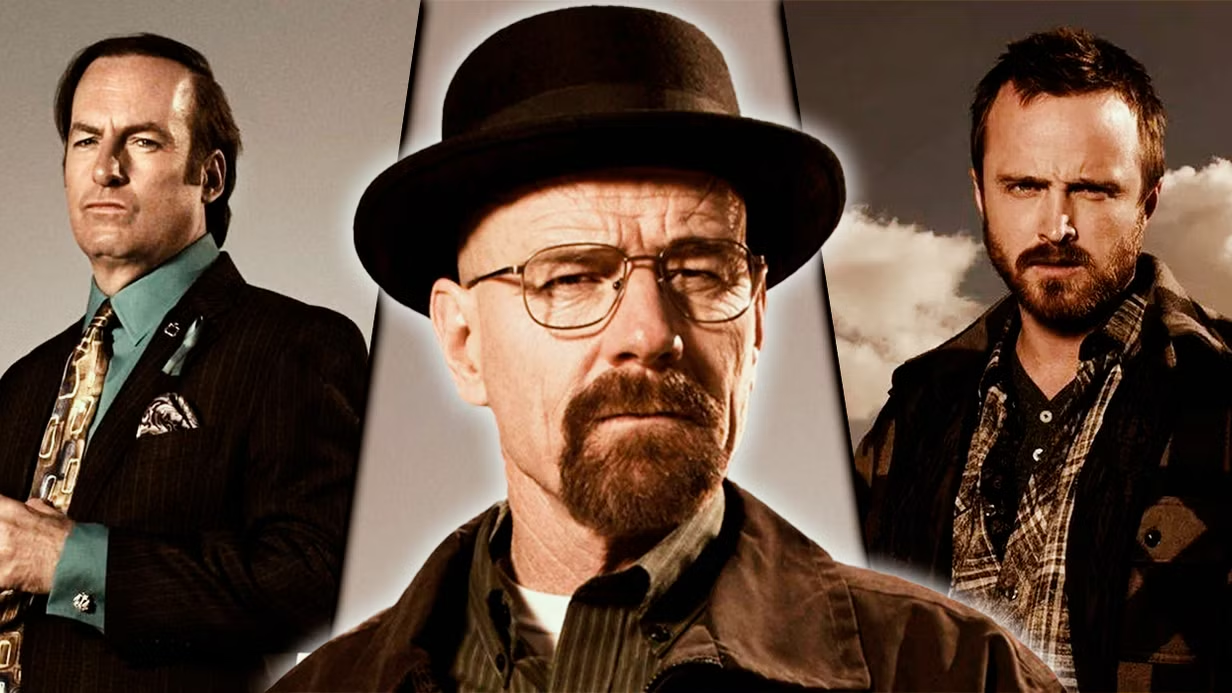
Breaking Bad Cast Net Worth. $130 Million Cooked in Five Seasons of Perfect Television
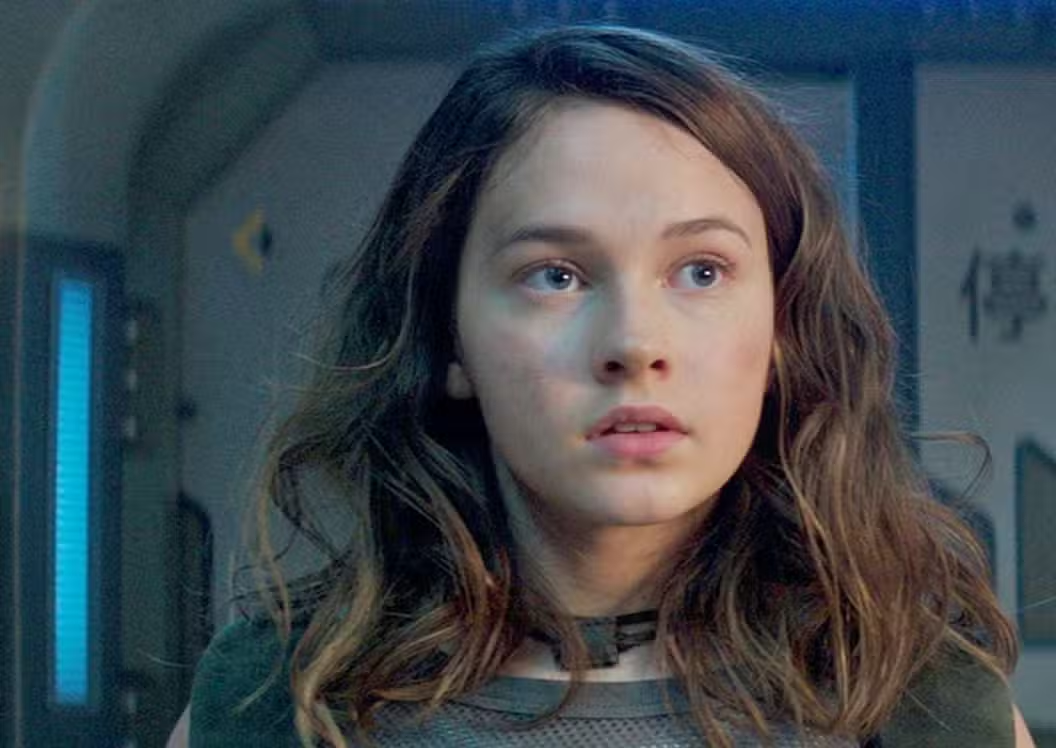
Cailee Spaeny Net Worth — From Springfield, Missouri to A24 and Alien in Three Years Flat
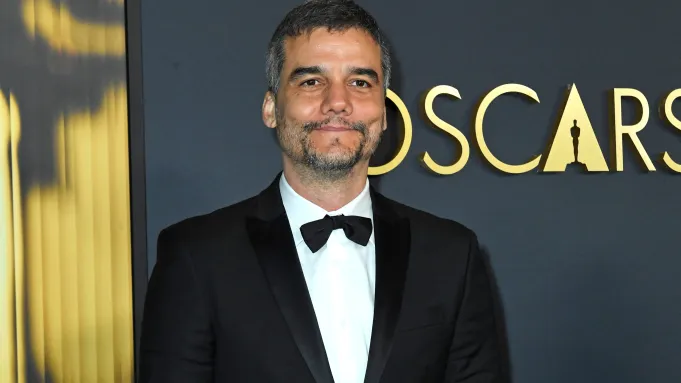
Wagner Moura Net Worth — He Learned Spanish to Play Escobar. Then He Learned English to Take Hollywood.
Robert Eggers Net Worth — He Made a $3.5 Million Film in Puritan English and Hollywood Listened
Brie Larson Net Worth — A $6 Million Indie Film Won Her an Oscar. Marvel Paid Her the Rest.
Categories
- Art
- Articles
- Beauty & Skincare
- Celebrities
- Celebrities|Movies
- Celebrities|The Chronicles
- Chronicles
- Entertainment|Culture
- Event Photos
- Events
- Fashion
- Fashion & Style
- Featured
- Food & Beverage
- Food, Spirits, Wine
- Hamptons
- Hamptons Celebrities
- Hamptons Celebrities|Celebrities|The Chronicles
- Health
- Health & Beauty
- Lifestyle
- Luxury Lifestyle
- Movies|Culture
- Movies|Hamptons Lifestyle
- Press
- Profiles
- Real Estate
- Technology
- The Chronicles
- Travel
- TV
- Uncategorized
- Weddings