
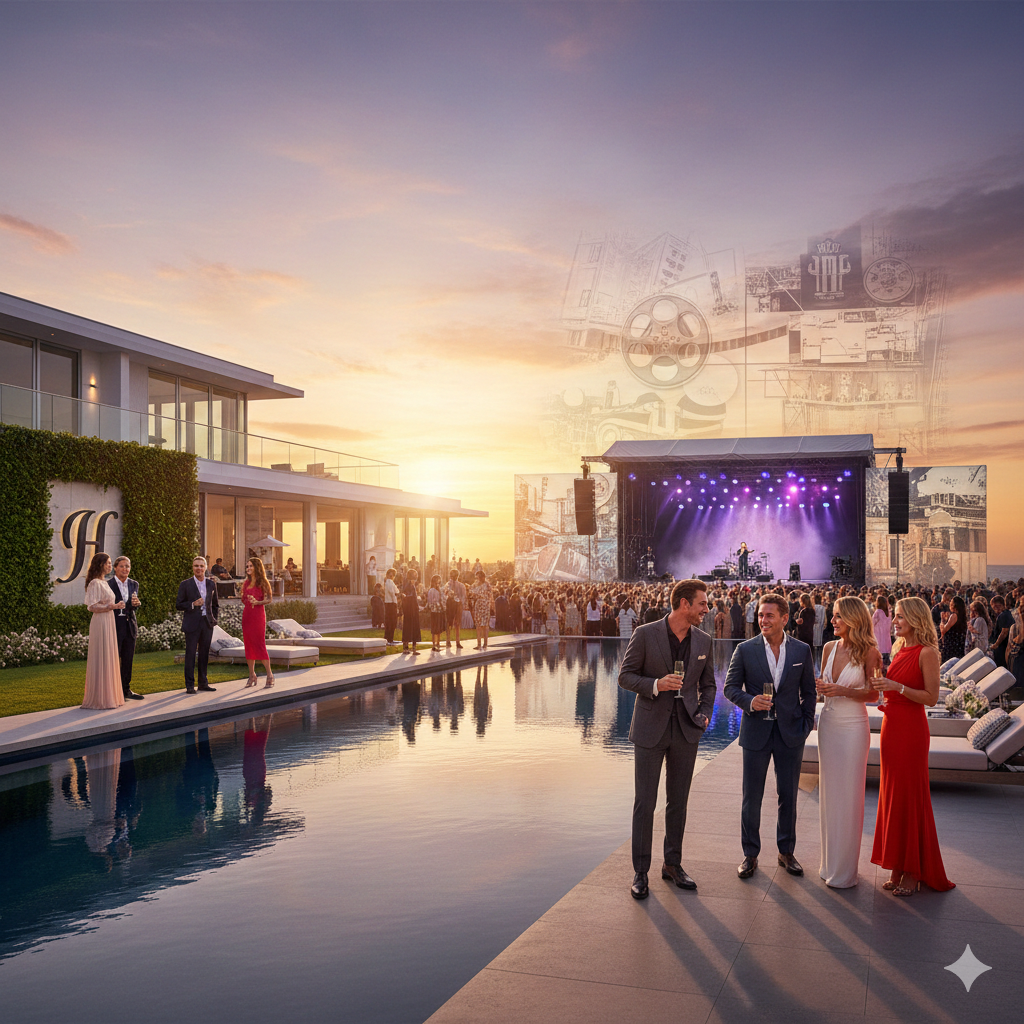
How Entertainment, Real Estate, and Brand Power Converge in the Hamptons
Something shifted in the Hamptons and most people missed it. The old formula was simple: make money in Manhattan, spend it on the East End. Buy the house, throw the party, repeat. That playbook still works. But the people winning now are running a different one entirely.
The new Hamptons operates at the intersection of four forces that used to run on separate tracks: entertainment media, luxury real estate, cultural institutions, and brand partnerships. The people who understand how these forces feed each other are building influence and deal flow that the old guard cannot touch. The people who do not understand it are wondering why their dinner parties feel smaller every summer.
This is the playbook. Four angles. One thesis. The Culture Play converts to real capital faster than any other asset class on the South Fork.
The White Lotus Decoded Your Summer
HBO gave the Hamptons a mirror and called it Thailand. The White Lotus Effect is not just a television phenomenon. It is a cultural diagnostic tool for anyone operating in luxury spaces.
Three seasons of Mike White’s anthology series have systematically dissected every behavior pattern that defines East End social life. The performative wellness. The strategic casualness. The dinner party as power negotiation. Season 3 wrapped in April 2025 with a Thailand-set storyline about wealthy guests seeking transformation at a luxury spa resort. Season 4 heads to the Château de la Messardière in Saint-Tropez, where European old money and American new money will collide in exactly the way they do every summer between Westhampton and Montauk.
The show matters for the Hamptons because it has trained a generation of affluent viewers to decode luxury social dynamics in real time. Your guests are watching you the way they watch White Lotus characters. They are reading status signals, evaluating authenticity, and deciding who is performing wealth versus who actually has it.
According to McKinsey & Company‘s research on luxury consumer behavior, high-net-worth individuals increasingly make social and business decisions based on cultural literacy rather than financial credentials alone. Understanding what White Lotus satirizes is now a prerequisite for operating effectively in any luxury community. If you are hosting events, selling real estate, or courting brand partnerships on the East End, you need to understand the cultural vocabulary your audience is using. White Lotus wrote the dictionary.
Celebrity Net Worth as Real Estate Intelligence
Celebrity fascination is not vanity content. It is market intelligence wrapped in entertainment packaging. When we matched Pedro Pascal, Ariana Grande, and The Rock to Hamptons real estate, the exercise revealed something the market reports do not show: the Hamptons has a liquidity threshold problem.
Pedro Pascal, at $22 million net worth, shops at the entry level of the luxury tier. Roughly $6.6 million in buying power. That gets you Sag Harbor Village, maybe Wainscott. Ariana Grande, at $250 million, can compete for oceanfront trophy properties. The Rock, approaching $800 million, builds dynasties across multiple parcels.
These tiers map directly onto the Hamptons market reality in 2025. The median home price topped $2 million for the first time in history. East Hampton Village hit $5.625 million median. Transactions above $20 million surged 50%. Sales of homes priced at $5 million and above reached an all-time high. Wall Street bonuses and a third consecutive year of double-digit stock market returns fueled demand at the top.
The implication for luxury operators is clear. When even a $22 million net worth barely clears the entry gate, your client base is narrower and wealthier than most people assume. According to Knight Frank‘s 2025 Wealth Report, ultra-high-net-worth individuals increasingly view premium real estate as an inflation hedge. Approximately 34% of all Hamptons transactions in 2025 closed all-cash. In the ultra-luxury segment above $10 million, cash purchases exceeded 60%.
Celebrity net worth content drives traffic because people search for it constantly. But the underlying data tells a story about market positioning that every Hamptons business should internalize.
Broadway Built the Social Infrastructure
The least understood power corridor on the East End runs between 44th Street and Sag Harbor. The Broadway-to-Hamptons pipeline has been operating for decades, and it explains why certain people have social access that their bank accounts alone cannot justify.
Theater people settled the Hamptons’ cultural landscape before tech founders and hedge fund managers arrived in force. Bay Street Theater in Sag Harbor produces Broadway-caliber work. Guild Hall in East Hampton hosts performances and exhibitions that attract the creative class. The social ecosystem around these institutions generates relationships that convert into business opportunities across industries.
Matthew Broderick and Sarah Jessica Parker anchor a social circle in the Hamptons that bridges Broadway, Hollywood, and the old-guard East End establishment. Neil Patrick Harris and David Burtka serve a similar function. Broadway producers use Hamptons dinner parties to greenlight shows. The relaxed setting, the extended time together, the social lubrication of ocean air and good wine closes deals that would take months in conference rooms.
According to Boston Consulting Group‘s analysis of cultural industry economics, live entertainment investment increasingly follows social network patterns. The Hamptons provide the perfect environment for this: high concentration of capital, extended social contact, and cultural institutions that create natural gathering points.
For anyone building Hamptons relationships, the implication is straightforward. Invest in the theater ecosystem. Support Bay Street. Attend Guild Hall events. Know the current Broadway season. In a social environment where everyone has money, cultural fluency is the differentiator that opens doors financial credentials cannot.
The Wicked Playbook Rewrites Brand Strategy
While everyone was watching the box office numbers, Universal Pictures was running the most sophisticated brand partnership operation in entertainment history. And the template they built applies directly to every luxury brand operating in the Hamptons market.
Wicked: For Good launched November 21, 2025, opening to $150 million domestically. Combined franchise box office exceeds $1.5 billion globally. But the brand partnership math is where the real lesson lives. More than 400 partner brands. An estimated $150 million in marketing investment. Two billion shopper interactions. Twenty-five billion global impressions. Fashion brands alone generated $27 million in media impact value.
The four principles that made it work translate perfectly to Hamptons luxury:
Cultural alignment over demographic targeting. Le Creuset and Wicked share zero customer overlap on paper but occupy the same cultural space. Hamptons brands should partner based on shared values, not shared customer lists.
Price point signals commitment. Le Creuset’s $400 Dutch ovens generated more media coverage than the $5 Pop-Tarts. Premium collaboration products move narratives. Budget collaborations move units. Know which one you need.
The drop model creates urgency. Limited quantities, tight windows, secondary market demand amplifying primary market buzz. The Hamptons already operates on this principle with its summer calendar. Brands that formalize scarcity into their partnership strategy win.
Let the content do the selling. Universal allocated 30% of their budget to partnerships, making brands create content on the studio’s behalf. Every partner post was simultaneously a movie ad and a product ad. Seamless because the cultural alignment made it authentic.
According to Harvard Business Review‘s research on brand partnership ROI, collaborations that create genuine cultural moments outperform transactional promotions by significant margins. Wicked achieved a 46% ROI within its first week.
Where All Four Forces Converge
Here is the thesis, stated plainly.
The Hamptons is no longer just a real estate market with a social scene attached. It is a cultural ecosystem where entertainment narratives, property values, institutional relationships, and brand partnerships operate as a single integrated system. The people who see these connections build compounding advantages. The people who treat each element in isolation are leaving value on the table.
A luxury brand that understands the White Lotus cultural vocabulary, that uses celebrity real estate data as market intelligence, that invests in Broadway-adjacent social infrastructure, and that applies the Wicked partnership template to their Hamptons activations is operating at a level that competitors cannot match.
The Hamptons summer season is a finite window. Three months between Memorial Day and Labor Day. The brands, the hosts, and the operators who win that window are the ones who understand that cultural capital is the most efficient path to real capital.
Everything else is just buying a house and hoping someone shows up for dinner.
Social Life Magazine has covered Hamptons luxury culture for 23 years. For features, advertising, and brand partnership inquiries, visit sociallifemagazine.com/contact. Polo Hamptons event sponsorships and luxury brand activations at polohamptons.com. Subscribe to our email list for insider intelligence. Print subscriptions ship five summer issues and two fall/winter editions. Support independent Hamptons journalism with a $5 contribution.
The Series:
The White Lotus Effect: What HBO Gets Right (and Wrong) About Hamptons Luxury
What Pedro Pascal, Ariana Grande, and The Rock Could Buy in the Hamptons
The Broadway-to-Hamptons Pipeline: Theater’s Power Players Who Summer East
The Wicked Playbook: What Luxury Brands Should Learn From Hollywood’s Biggest Partnership Machine
Author

Written by
Recent Posts

James Franco Net Worth — A $30 Million Career Interrupted

Selena Gomez Net Worth — How a Disney Kid Built a $1.3 Billion Empire
Spring Breakers A24 Cast Net Worth — Disney Kids Gone Dangerous
Women’s History Month
Must-Have Items for Your Wedding Gift Registry
Categories
- Art
- Articles
- Beauty & Skincare
- Celebrities
- Celebrities|Movies
- Celebrities|The Chronicles
- Chronicles
- Culture|Television
- Entertainment|Culture
- Event Photos
- Events
- Fashion
- Fashion & Style
- Featured
- Food & Beverage
- Food, Spirits, Wine
- Hamptons
- Hamptons Celebrities
- Hamptons Celebrities|Celebrities|The Chronicles
- Health
- Health & Beauty
- Lifestyle
- Luxury Lifestyle
- Movies
- Movies|Culture
- Movies|Hamptons Lifestyle
- Press
- Profiles
- Real Estate
- Technology
- The Chronicles
- Travel
- Uncategorized
- Weddings