
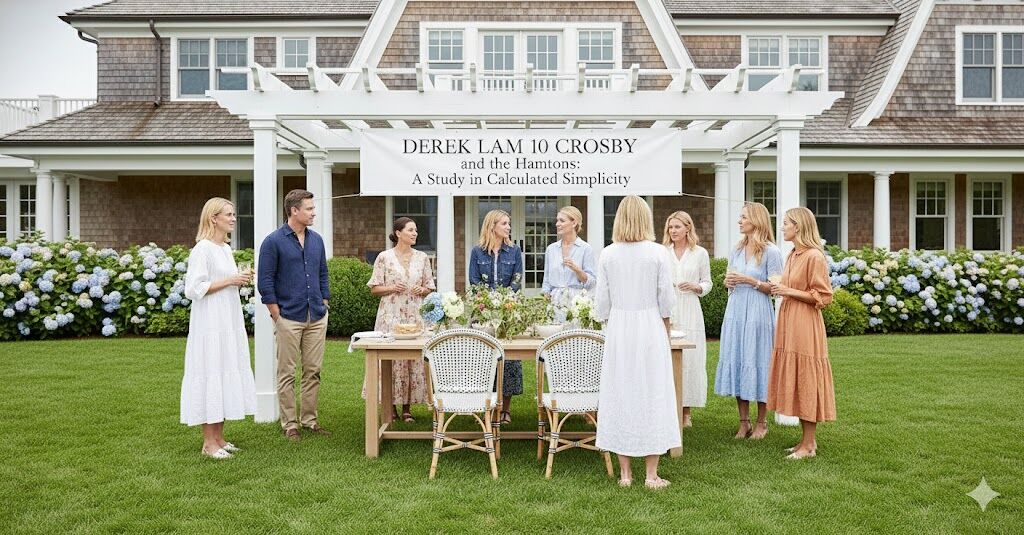
The woman entering 20 Newton Lane carries no logo bag. Instead, her linen shirt falls just so. Clearly, she belongs here in a way that requires no announcement. Inside Derek Lam 10 Crosby’s East Hampton boutique, the specialty denim bar catches afternoon light through architect Toshihiro Oki’s carefully considered windows. Meanwhile, the space breathes warmth and texture—earth tones meeting the Hamptons sky.
This is not a store selling clothes. Rather, this is a store selling a particular form of literacy: the knowledge of what works without trying, what endures without screaming. Indeed, the Derek Lam 10 Crosby Hamptons location represents something specific in the contemporary fashion ecosystem. It occupies the intelligent middle—neither the crushing weight of heritage luxury nor the disposability of fast fashion.
Pierre Bourdieu called it cultural capital. The ability to know, to recognize, to distinguish. Consequently, understanding what Derek Lam 10 Crosby actually sells requires understanding the field it occupies and the game it plays.
The Derek Lam 10 Crosby Origin: From Garment Factory to Fifth Avenue
Derek Lam’s story begins three generations before him. Specifically, his grandparents operated a successful garment factory in San Francisco specializing in bridal wear. Subsequently, his parents ran a clothing import business. As a result, fashion was not an aspiration for young Derek; it was the family language.
After graduating from Parsons School of Design in 1990, Lam spent nearly a decade at Michael Kors. Initially, he started as an assistant, then rose to Vice President of Design for the Kors diffusion line. Ultimately, that apprenticeship taught him what he would later describe as “the tenacity you have to have to survive” and “what that Fifth Avenue woman aspired to.”
In 2002, Lam and his partner Jan-Hendrik Schlottmann founded Derek Lam International at 10 Crosby Street in SoHo. Remarkably, the address became destiny. When Lam launched a contemporary line in 2011, he named it for the building that housed his vision: Derek Lam 10 Crosby. Moreover, the street itself—a quiet cobblestone corridor at the eastern edge of SoHo near the New Museum—encoded the brand’s DNA.
Recognition followed rapidly. First, the CFDA Perry Ellis Swarovski Award for Emerging Talent arrived in 2005. Then, two years later, Lam won Accessory Designer of the Year. Additionally, Tod’s tapped him as creative director for ready-to-wear and accessories from 2005 to 2010. Meanwhile, his work hung in the Kennedy Center, the Victoria and Albert Museum, and FIT’s Gothic: Dark Glamour exhibition.
The Mythology Machine
What the origin story emphasizes: heritage, craft, earned credibility. Notably, three generations of garment-making establish authenticity. Parsons pedigree adds institutional validation. Kors mentorship provides industry credibility. CFDA validation confirms peer recognition. Together, the narrative constructs legitimacy without inherited luxury-house mythology.
What it obscures: the commercial calculations that shape every fashion house. In 2019, Lam shuttered his eponymous luxury collection—then accounting for only 30 percent of revenue—to focus entirely on 10 Crosby. Subsequently, Public Clothing Company acquired the brand in 2020. Later, Lam departed as Chief Creative Officer in 2023. Furthermore, Robert Rodriguez was appointed creative director in late 2024, charged with relaunching the Derek Lam Collection alongside 10 Crosby.
The brand now operates independent of its founder. This is neither scandal nor tragedy—it is simply how contemporary fashion works. However, the mythology machine keeps running on the original fuel.
Derek Lam 10 Crosby’s Four Capitals: Decoding What the Brand Actually Sells
Bourdieu identified four forms of capital that determine position in any social field. Importantly, every fashion brand traffics in all four. Therefore, understanding Derek Lam 10 Crosby requires examining each.
Economic Capital
Entry-level pieces—ribbed cotton tees, poplin blouses—hover around $195. Meanwhile, the brand’s signature Crosby twill pants and sailor-button trousers sit at $295. Similarly, dresses range from $395 to $595. At the higher end, statement coats and leather pieces can reach $1,200 or higher.
This architecture positions 10 Crosby in what the industry calls “advanced contemporary”—above mass-market brands, below true luxury. Bloomingdale’s categories the brand alongside peers like Zimmermann, 3.1 Phillip Lim, and Rag & Bone. Therefore, the economic barrier to entry remains accessible to professionals who have achieved career success but not dynastic wealth.
Resale performance, however, tells another story. Certainly, Derek Lam 10 Crosby pieces retain value on platforms like The RealReal and Vestiaire Collective, but they lack the investment-piece appreciation of Hermès or vintage Chanel. Simply put, you buy 10 Crosby to wear, not to vault.
Cultural Capital
This is where 10 Crosby earns its distinction. The brand requires a specific kind of knowledge to appreciate properly. Consequently, it filters for cultural literacy.
First, you must understand why a well-cut trouser matters more than a logo. Additionally, recognizing that “calculated simplicity” and “thoughtful detailing” are designer code for taste that money alone cannot buy separates insiders from outsiders. Finally, knowing that SoHo’s Crosby Street—blocks from the SANAA-designed New Museum, neighboring Jil Sander and Ted Muehling—signifies a particular aesthetic genealogy completes the literacy test.
Notably, the brand’s original 2009 flagship was designed by Pritzker Prize-winning architects Kazuyo Sejima and Ryue Nishizawa of SANAA, with Toshihiro Oki as executive architect. Inside, transparent acrylic volumes created rooms within the store. Essentially, the fact that this collaboration happened—and that knowing it matters—exemplifies cultural capital in action.
What new money typically misses: the absence of obvious markers is itself the marker. 10 Crosby speaks to those who have moved past logo fatigue into what fashion now calls “quiet luxury.” However, this quietness demands more sophisticated reading.
Social Capital
Wearing Derek Lam 10 Crosby signals membership in a particular cohort. You are the woman Ken Downing of Neiman Marcus described when discussing Lam’s work: someone who appreciates “a relaxed, unpretentious style” and “quintessential American sportswear.”
Furthermore, the brand’s retail adjacencies reinforce these signals. At major department stores—Saks Fifth Avenue, Neiman Marcus, Nordstrom, Bergdorf Goodman—10 Crosby hangs near Nili Lotan, Veronica Beard, and TWP. In the Hamptons, the Newton Lane boutique neighbors other contemporary labels building the same customer profile.
The social club effect operates through recognition. Specifically, other women who wear 10 Crosby recognize each other. Together, they share professional achievement, aesthetic intelligence, and the income to afford quality without requiring status symbols. As a result, this creates network access without exclusivity’s cruelty.
Symbolic Capital
Here lies the brand’s most interesting proposition. Essentially, Derek Lam 10 Crosby resolves a specific tension: how to dress expensively without appearing to try.
The woman in 10 Crosby communicates that she could afford logos but chooses not to wear them. In other words, she signals that she dresses for herself, for quality, for longevity—not for recognition from strangers. Consequently, this positioning confers symbolic capital precisely because it appears to reject the game of status altogether.
Bourdieu would call this a sophisticated misrecognition. The rejection of obvious status markers becomes its own status marker. Therefore, 10 Crosby’s symbolic power derives from its apparent anti-symbolism.
Why Derek Lam 10 Crosby Chose the Hamptons—And What It Reveals
On April 6, 2023, Derek Lam 10 Crosby opened its first standalone store at 20 Newton Lane in East Hampton. Significantly, the timing and location reveal strategic intent.
At that point, the brand had experienced 90 percent growth since 2021 under Public Clothing Company’s ownership. Accordingly, the East Hampton boutique launched the next phase of expansion—a nationwide buildout targeting upscale shopping districts tailored to local communities.
Architect Toshihiro Oki designed the 1,000-square-foot space. Importantly, his credentials matter: trained at Carnegie Mellon and Columbia, he worked at SANAA and contributed to both the New Museum and the original Derek Lam flagship. As a result, his Hamptons work combines “warm colors and textures meant to combine the open skies of the area with the urban refinement of the brand’s signature aesthetic.”
Additionally, the interior features a specialty denim bar showcasing artisanal styles. This emphasis reflects 10 Crosby’s denim heritage—the brand introduced denim collections at its fifth and tenth anniversaries—and signals year-round relevance rather than seasonal resort-wear.
The East Hampton Field
Newton Lane and Main Street in East Hampton constitute a competitive field where luxury brands fight for position. Most notably, Louis Vuitton’s flagship occupies 1 Main Street—purchased by Bernard Arnault for $22 million in 2023. Likewise, Gucci, Chanel, Prada, Valentino, Loro Piana, and Cartier maintain seasonal or permanent presences.
Consequently, Derek Lam 10 Crosby’s Hamptons play is not about competing with these heritage houses. It is about offering an alternative to them. The woman who owns Hermès and Chanel may shop 10 Crosby for what those houses cannot provide: the appearance of not caring about fashion while demonstrating perfect taste.
Notably, the year-round operation distinguishes 10 Crosby from seasonal pop-ups. Indeed, this commitment signals belief in the Hamptons’ evolving demographics—the 15 percent increase in full-time population and 25 percent increase in extended weekend stays that luxury retailers now chase.
Playing the Field: Derek Lam 10 Crosby Versus the Competition
In the advanced contemporary segment, 10 Crosby competes with established players who occupy overlapping territory.
For instance, Nili Lotan offers similar price points and aesthetic quietness but leans harder into Israeli-inflected minimalism. By contrast, Veronica Beard provides more structured, office-ready silhouettes. TWP—launched by alumni from Theory—targets the same elevated-basics customer. At the higher end, The Row represents where 10 Crosby customers might eventually graduate.
Moreover, newer entrants complicate the landscape. For example, Staud and Cult Gaia have established Hamptons presences targeting younger consumers. Additionally, ME+EM brings British sensibility to Newton Lane. Overall, the field grows more crowded each season.
What distinguishes 10 Crosby: the heritage story (even if the founder has departed), the downtown-New-York-exported-to-East-End positioning, and the specific intersection of feminine refinement with relaxed sensibility. Ultimately, the brand dresses women “through every aspect of life—from formal to work to informal occasions.”
The Logo-Anti-Logo Spectrum
Contemporary fashion arranges itself along an axis from maximum logo visibility to complete discretion. Characteristically, Derek Lam 10 Crosby positions near the discretion pole.
Consider the woman leaving Louis Vuitton because the monogram became too recognizable—10 Crosby offers refuge. Meanwhile, those who never wanted logos in the first place find confirmation here. Similarly, women navigating new wealth and seeking appropriate signals discover instruction in its racks.
Furthermore, this positioning allows different customers to project different meanings onto the same garments. In practice, the heiress wears 10 Crosby to dress down. Conversely, the successful professional wears it to dress up. Interestingly, both are correct.
The Derek Lam 10 Crosby Investment: Knowledge Over Logos
The Derek Lam 10 Crosby Hamptons boutique operates year-round. Specifically, hours run Monday through Saturday 10 a.m. to 6 p.m., Sunday 11 a.m. to 5 p.m. Contact via easthampton@dereklam.com or (631) 527-7271.
What to expect: warm service without pressure, a curated selection emphasizing denim and ready-to-wear staples, and the particular atmosphere of a brand that believes “building a statement wardrobe for a casual world is at the heart of our mission.”
Who shops here best: women who have moved past logo obsession into taste development. Similarly, professionals seeking elevated basics that telegraph success without advertising it thrive here. Equally, visitors who appreciate that knowing about 10 Crosby Street in SoHo matters more than recognizing initials on a handbag will find their people.
What the brand actually sells, finally, is not clothing. Rather, it is membership in a particular interpretive community—people who read fashion rather than merely wear it. As Bourdieu understood, this capacity for reading constitutes cultural capital. Furthermore, that capital, unlike economic capital, cannot simply be purchased. Instead, it must be learned.
The woman leaving 20 Newton Lane carries her purchase in a bag that announces nothing to strangers. Those who know, know. Those who don’t, don’t need to. That asymmetry—visible only to the initiated—is exactly what she paid for.
Continue Your Hamptons Style Education
- Best Hamptons Fashion Boutiques You Must Visit — Discover where fashion editors shop when they escape to the East End.
- 10 Luxury Fashion Trends Defining Hamptons Style — From quiet luxury to circular fashion, the movements shaping how the Hamptons dresses now.
Stay Connected with Social Life Magazine
Author

Written by
Recent Posts
Experiences You Can Only Enjoy on a Sailing Vacation in Italy
How Do THC Gummies Work?
Can I Bring CBD Gummies on a Plane
How Long Do Delta-9 Gummies Last?
Natural Stress Relief Practices, Exercises & Products for More Calm
Categories
- 2025 Social Life Events
- Access to Digital + Physical Magazine
- Art
- Articles
- Beauty & Skincare
- Beauty & Wellness
- Business Strategy
- Celebrities
- Chronicles
- Design History
- Design History|Design Trends
- Design History|Hamptons
- Design Process
- Design Process|Luxury Living
- Design Trends
- Design Trends|Hamptons
- Event Photos
- Events
- Family
- Fashion
- Fashion & Style
- Featured
- Food & Beverage
- Food, Spirits, Wine
- Hamptons
- Hamptons Celebrities
- Hamptons Design
- Hamptons Design|Design Process
- Hamptons Design|Luxury Living
- Hamptons|Luxury Living
- Health
- Health & Beauty
- Home & Design
- Home & Living
- Lifestyle
- Luxury Home Design|Design Process
- Luxury Home Design|Design Trends
- Luxury Home Design|Hamptons Design
- Luxury Home Design|Interior Design
- Luxury Lifestyle
- Luxury Living
- Luxury Living|Design Process
- Luxury Living|Hamptons
- Luxury Living|Hamptons Design
- Press
- Profiles
- Real Estate
- Technology
- The Chronicles
- Travel
- Trending
- Uncategorized
- Weddings
- Wellness