
The Compound at the End of the World
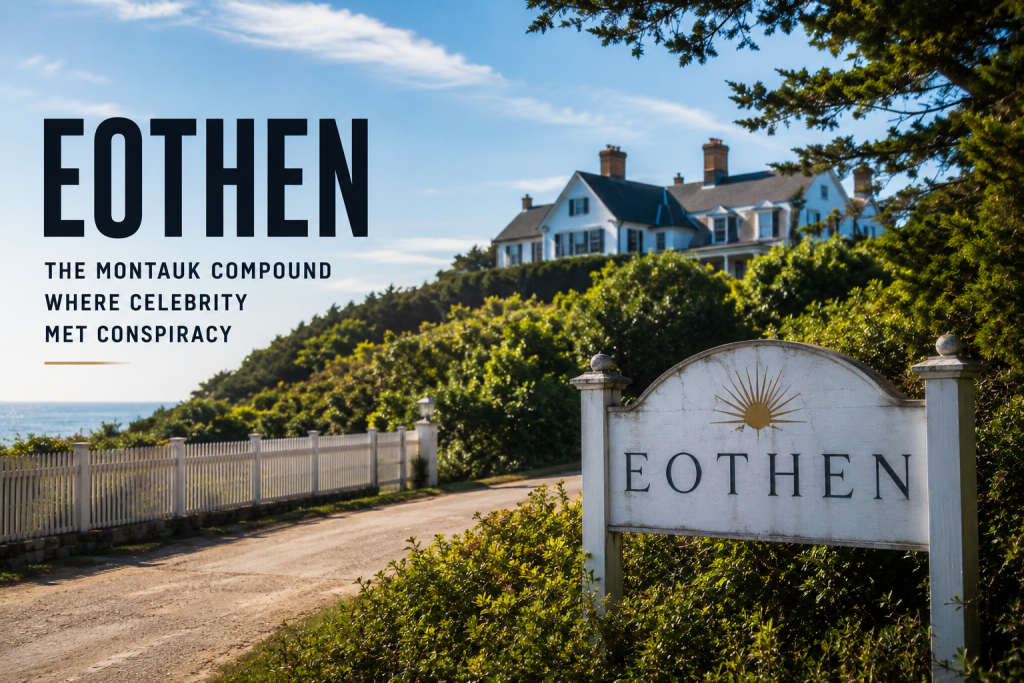
What you have to understand about Eothen is that it was never supposed to be famous. The compound sits on a stretch of Montauk cliff that, in 1972, was about as far from Manhattan’s cultural machinery as you could get without falling into the Atlantic. Five white clapboard cottages arranged on roughly 20 acres of oceanfront moorland. They were built in the 1930s by heirs to the Arm and Hammer baking soda fortune, who used the property as a seasonal fishing camp for a few weeks each September when the striped bass ran. The architecture was Colonial Revival, designed by Rolf W. Bauhan, and it looked like the kind of place where a certain class of old-money family went specifically to avoid being seen.
Then Andy Warhol bought it. And Eothen (the name comes from the Greek for “at first light,” although some sources translate it as “from the east,” and the distinction matters in ways that are probably too granular for anyone who isn’t a classicist or a real estate copywriter) became something entirely different. It became a machine for producing the exact kind of social proximity that Warhol had spent his entire career engineering. Over the next 15 years, the guest list would include Jackie Onassis, Mick Jagger, John Lennon, Elizabeth Taylor, Halston, and Truman Capote. Dick Cavett, the talk-show host, was the next-door neighbor.
All of this happened two miles west of Camp Hero, the decommissioned Air Force station where the U.S. government allegedly ran secret experiments on children with psychic abilities. The same conspiracy that eventually inspired Netflix’s Stranger Things. But nobody at Eothen seemed particularly concerned about that.
How the Compound Changed Hands
In 1972, Andy Warhol and his longtime film collaborator Paul Morrissey purchased Eothen for $225,000. By the standards of what East End oceanfront property would later command (the estate’s most recent valuation hovers around $85 million), this was essentially free. But Warhol was, at that point in his career, not in a position to be cavalier about money. Years of extravagant spending to finance the Factory, his Manhattan studio-slash-social-experiment, had left him shorter on cash than his public persona suggested.
According to Warhol’s friend and realtor Tina Fredericks, what attracted the artist to Montauk specifically (as opposed to the more established social territories of Southampton or East Hampton) was the eccentric architecture of the nearby Memory and Ronjo Motels. This is a detail worth pausing on. Because it tells you something essential about how Warhol’s aesthetic apparatus worked. He wasn’t drawn to Montauk by the ocean or the surf or the famous light. He was drawn to a pair of weird motels. The oddness of the built environment was what registered first. Eothen fit perfectly into that sensibility.
Still, the compound’s isolation mattered too. Montauk in the early 1970s was genuinely remote. It hadn’t yet become the destination it is now. There was no Gurney’s, no Surf Lodge, no $40 lobster rolls at Duryea’s. It was a fishing village at the end of a long road. That distance gave Warhol something he couldn’t get in Manhattan: control over who was in the room. At the Factory, anyone could walk in. At Eothen, you had to be invited. And the drive from Manhattan was long enough that the invitation itself functioned as a filter.
Eothen’s First Summer: Jackie and Lee
Warhol’s solution to his cash problem was characteristically brilliant. Rather than use Eothen himself during the first summer, he rented the main house to Princess Caroline Lee Radziwill, Jackie Kennedy Onassis’s younger sister and then-wife to the Prince of Poland. The rent covered the mortgage. Warhol retreated to one of the smaller cottages on the property.
Radziwill, who went by Lee, was widely admired for her sense of style. That admiration was always, inevitably, defined in relation to her more famous sister’s style. She invited Jackie and her two children, Caroline and John Jr., to spend the summer. So the scene at Eothen in the summer of 1972 looked like this. The former First Lady of the United States and her children were sunbathing on the cliffs. The most important living American artist worked in a cottage 50 yards away. And a decommissioned military base with (allegedly) 12 underground levels of sealed laboratories sat two miles to the east.
The convergence of cultural capital, political capital, and conspiracy capital at this particular geographic coordinate went almost entirely unrecorded. There was no social media. The paparazzi hadn’t yet discovered Montauk. Which, if you think about it, is exactly the kind of thing that would have delighted Warhol, who understood better than anyone that the most powerful social currency is the event that only a few people know happened.
The Rolling Stones at Eothen
In 1975, three years after Warhol bought the compound, the Rolling Stones rented the main house at Eothen to rehearse for their upcoming tour. Charlie Watts, Mick Jagger, Keith Richards, Ronnie Wood, Bill Wyman, and Billy Preston occupied the property for several weeks. Photographer Ken Regan documented the sessions. And Montauk, which had been quietly absorbing the cultural overflow from Warhol’s social apparatus, suddenly became something louder.
The motels overflowed with groupies. Warhol noted in his diary that “two girls with no hair and black cats on leashes followed them all the way to Montauk.” The estate’s caretaker, a man named Mr. Winters, found fans hiding in the bushes on the property. Specifically in the bushes. This is a man whose job was to maintain a 20-acre oceanfront compound, and he was pulling groupies out of the hedgerows because the biggest rock band in the world was rehearsing in the living room.
The Memory Motel, a bar on the Old Montauk Highway that had been a local fixture since 1969, became the Stones’ after-hours hangout during this period. Jagger and Richards reportedly wrote the track “Memory Motel” during or shortly after their time at Eothen. That song appeared on the 1976 album Black and Blue. The bar is still open. Its jukebox still works. If you know what to listen for, you can still hear the echo of a summer when the most famous band in the world chose this place, specifically this place, to get their sound right before going back on the road.
The Compound as Social Instrument
What Warhol built at Eothen wasn’t a home in any conventional sense. It was a social instrument. The compound operated on a principle that Warhol had refined at the Factory but could execute with more precision in Montauk. Put extraordinary people in close physical proximity. Then observe what happens. The isolation of the location removed the diluting effects of the city. In Manhattan, there were always other parties, other scenes, other rooms to escape to. At Eothen, the only room was Eothen.
Bob Colacello, the longtime editor of Warhol’s Interview magazine and a regular visitor, later described the compound as “an impressive, if understated, compound of five white clapboard houses built in the thirties sitting at the end of a long and winding private road on about twenty acres of unspoiled land directly facing the open sea.” The understatement is key. Warhol didn’t want a mansion. He wanted a stage set that looked like a fishing camp. The gap between what the place appeared to be and what actually happened there was the entire point.
The guest list across Warhol’s ownership reads like an index of late-twentieth-century American fame. Halston came. Liza Minnelli came. Elizabeth Taylor came. John Lennon and Yoko Ono came. Truman Capote, who was still at this point in his long public decline and “constantly soused on vodka” (according to Colacello) while the rest of the crowd “usually enjoyed a decent rose from France,” came repeatedly. Dick Cavett, the talk-show host and next-door neighbor, “usually walked on the beach to the edge of Andy’s property and waited until he was invited in.”
The Hierarchy of Access
That last detail is particularly telling. Here was one of the most famous television personalities in America, standing at the property line, waiting for permission. Because even at the end of the world, at a fishing camp in Montauk, the hierarchy of access operated exactly as Warhol designed it. You didn’t walk in. You stood at the edge and hoped.
The Light from Eothen’s Cliffs
Warhol’s 1972 “Sunset” screenprint series was allegedly inspired by the view from Eothen’s cliffs. The prints capture the specific quality of light that occurs when the sun drops behind the Atlantic at the easternmost point of the South Fork, a light that turns the water metallic and the sky into a gradient that runs from blood orange to ash. These works are now among the more quietly coveted pieces in the Warhol market.
In a development that Warhol would have found either perfect or perfectly horrifying (and there’s a case to be made for both), the “Sunset” prints were later licensed by Bond No. 9, the Manhattan-based fragrance house, for use on their perfume bottles. So the light that Warhol observed from a $225,000 fishing compound in 1972 eventually became a decorative element on a $400 bottle of perfume sold in SoHo boutiques. Art became product. Product became branding. Branding became status signal. The entire Warholian cycle, compressed into a single consumer object.
Eothen After Warhol
Warhol died on February 22, 1987, from cardiac arrhythmia following gallbladder surgery. He was 58. Paul Morrissey retained ownership of Eothen and spent the next two decades trying, with limited success, to sell it. The New York Times published a feature titled “The Unsold Warhol” documenting the difficulty. In a market where the Warhol name usually guaranteed a premium, the Montauk compound sat.
In 2007, J.Crew CEO Mickey Drexler purchased the 5.7-acre compound for $27 million. He subsequently bought an adjacent 24-acre horse farm for $12 million, expanding the estate to roughly 30 acres. Drexler added a swimming pool, a tennis court, and Carl Fisher-designed barns. The total investment pushed well past $40 million before any improvements to the existing structures.
Eventually, art collector and gallerist Adam Lindemann (who had known Warhol personally in the 1980s and is a prominent collector of his work) entered into contract to purchase the property. Lindemann reportedly focused his interest exclusively on the original six-cottage oceanfront portion, the part that Warhol had actually lived in. “I’m very lucky to have this opportunity to live out this dream,” Lindemann told reporters. “It’s a work of art.”
Which, of course, is exactly right. Eothen was always a work of art. Not because the architecture was particularly distinguished or because the interiors were lavish (by most accounts they were rustic, almost deliberately so). But because Warhol understood that the real artwork was the social situation the compound made possible. The building was the frame. The people inside it were the canvas.
The Two-Mile Radius
Here is the thing that nobody puts in the real estate listing and that no travel guide quite captures. Eothen sits approximately two miles west of Camp Hero State Park, the former Montauk Air Force Station where (according to Preston Nichols’ 1992 book The Montauk Project: Experiments in Time) the U.S. government conducted secret experiments in mind control, time travel, and psychic warfare on abducted children in underground laboratories beneath a 90-foot Cold War radar tower.
During the exact same years that Warhol was hosting Jackie Onassis and the Rolling Stones and Truman Capote at Eothen, the Camp Hero base was still operational. It wasn’t decommissioned until 1981. So the timeline overlap is complete: from 1972 to 1981, Andy Warhol was running the most exclusive social experiment on the East End while (allegedly) the U.S. military was running a very different kind of experiment two miles down the road.
There is no evidence that Warhol knew about or cared about the Montauk Project conspiracy. The lore didn’t become public until Nichols published his book in 1992, five years after Warhol’s death. But the geographic coincidence is so extreme that it almost feels engineered. The man who turned fame into art and art into product and product back into fame, living at the end of a peninsula, two miles from a facility that (if you believe the conspiracy) was turning children into weapons. Both operations, in their own way, were experiments in the manipulation of human consciousness. Each required secrecy. And both produced legends.
And both of them eventually became source material for Netflix.
Eothen Now
The compound at 16 Cliff Drive in Montauk is not open to the public. You cannot visit Eothen the way you can visit Camp Hero (which is, after all, a state park with an eight-dollar parking fee). But you can drive the Old Montauk Highway and see the general area. You can eat at the Memory Motel, where the Stones drank. You can surf at Ditch Plains, where the Montauk Monster washed ashore in 2008. And you can stand at the radar tower at Camp Hero and look west toward the cliffs where Warhol watched the sunset that became the screenprint that became the perfume bottle.
The property’s trajectory from $225,000 to approximately $85 million tracks the broader transformation of Montauk from isolated fishing village to one of the most expensive ZIP codes on the South Fork. But the real escalation isn’t in the dollar figure. It’s in the density of cultural meaning per square foot. Eothen is a compound where the former First Lady of the United States played with her children on the same lawn where the Rolling Stones rehearsed, where Truman Capote drank himself into oblivion, where Andy Warhol converted loneliness and proximity and Atlantic light into the raw materials of celebrity.
It sits at the end of the earth. And two miles to the east, the radar tower still turns on its own.
Where the Conversation Continues
Andy Warhol chose Montauk because it was the farthest place from everything. Fifty years later, Eothen remains the most culturally loaded address on the South Fork. Social Life Magazine has covered this territory for 23 years, and the stories that define the East End land in these pages before they land anywhere else.
If you have a story, a brand, or a project that belongs in these pages, reach out at sociallifemagazine.com/contact.
For brands looking for premium editorial placement, our paid feature submission portal is open at sociallifemagazine.com/submit-a-paid-feature/.
Stay in the loop with our weekly email blast covering events, openings, and who’s doing what Out East. Sign up at enflyer.sociallifemagazine.com.
Polo Hamptons 2026 returns to Bridgehampton on July 18 and July 25 with BMW as title sponsor. For event details and sponsorship opportunities, visit polohamptons.com.
Never miss a feature, a profile, or a party recap. Subscribe to Social Life Magazine at sociallifemagazine.com/subscription.
If the work we do matters to you, you can support independent East End journalism directly via PayPal.
Author

Written by
Recent Posts

Powerful Strategies to Stay Ahead in a Fast-Moving Real Estate Market
How Latino Players Have Helped Shape Modern Basketball Culture
10 Best Designer iPhone 18 Pro Cases to Choose From

AI for personal finance: where PennyGuard fits

How to Pick a Homecoming Dress for Your Body Type (and Feel Amazing in It)
Categories
- Art
- Articles
- Business of Luxury
- Celebrities
- Culture
- Entertainment
- Events
- Faces of Summer 2026
- Fashion
- Fashion & Style
- Featured
- Finance
- Food, Spirits, Wine
- Hamptons
- Hamptons Celebrities
- Health
- Health & Beauty
- Lifestyle
- Luxury Lifestyle
- Press
- Profiles
- Real Estate
- Technology
- The Chronicles
- Travel
- Uncategorized
- Weddings