
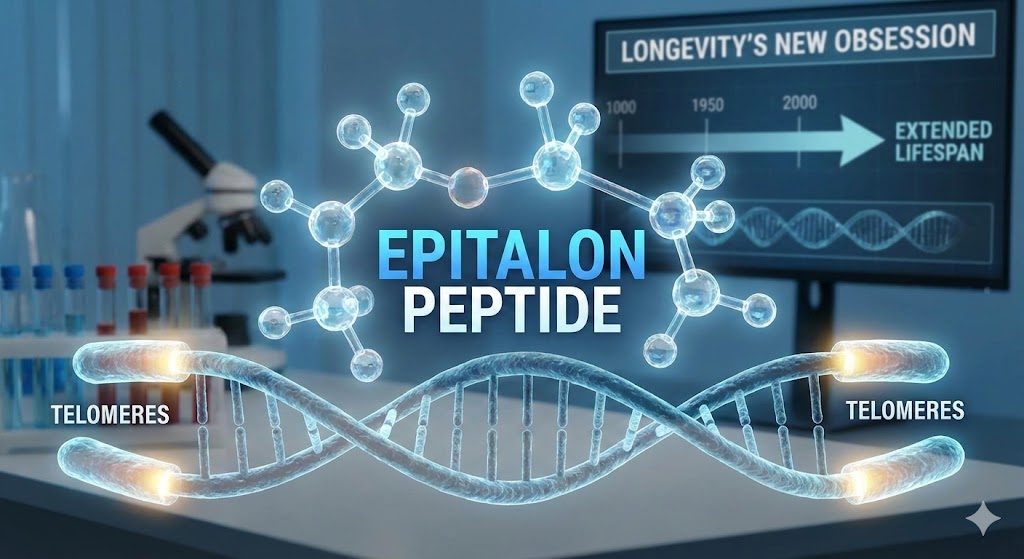
Epitalon peptide sits at the intersection of legitimate science and longevity optimism. Originally developed by Russian researchers studying aging, this four-amino-acid compound has attracted attention from biohackers, longevity physicians, and a growing cohort of high-achievers convinced that biological age is negotiable.
The pitch sounds almost too good: a peptide that activates telomerase, the enzyme responsible for maintaining telomere length. Since telomere shortening correlates with aging, the logic follows that preserving them might slow the process. Reality, as usual, proves more nuanced.
This guide examines what the research actually shows about epitalon peptide. We cover the mechanism, the evidence, the protocols, and the honest limitations that enthusiasts sometimes gloss over. Whether you’re evaluating this compound for yourself or simply curious about longevity science’s cutting edge, clarity beats hype.
What Is Epitalon Peptide and How Does It Work?
Epitalon peptide is a synthetic tetrapeptide (Ala-Glu-Asp-Gly) that stimulates telomerase production in human cells. Telomerase maintains telomere length, the protective caps on chromosomes that shorten with each cell division. By activating this enzyme, epitalon theoretically slows one key mechanism of cellular aging.
The compound emerged from decades of research at the St. Petersburg Institute of Bioregulation and Gerontology. Professor Vladimir Khavinson led studies showing that epithalamin, the natural pineal gland extract epitalon mimics, extended lifespan in animal models and improved biomarkers in human subjects.
Telomeres function like the plastic tips on shoelaces. They prevent chromosome ends from fraying or fusing during cell division. Each time a cell divides, telomeres shorten slightly. When they become critically short, cells enter senescence or die. This process contributes to tissue degradation we recognize as aging.
Telomerase can rebuild telomere length, but most adult cells produce minimal amounts. Cancer cells famously hijack telomerase for immortality. The longevity question becomes whether activating telomerase in healthy cells extends lifespan without increasing cancer risk.
What Does the Research Say About Epitalon?
Epitalon research shows promising results in cell cultures, animal studies, and limited human trials. Studies demonstrate increased telomerase activity, extended telomere length, and improved markers of biological aging. However, large-scale randomized controlled trials in humans remain absent from Western medical literature.
The most cited human study followed 266 elderly patients over 12 years. Those receiving epithalamin (the natural precursor epitalon mimics) showed 1.6-1.8 times lower mortality rates compared to controls. Cardiovascular function, immune markers, and cognitive measures all improved in treatment groups.
Cell culture research published in the Bulletin of Experimental Biology and Medicine demonstrated that epitalon increased telomerase activity by 2.4-fold in human fibroblasts. Treated cells showed 44% longer telomeres after multiple passages compared to untreated controls.
Animal studies produced even more dramatic findings. Research on rats and mice showed lifespan extensions of 25-40% in some models. Tumor incidence decreased rather than increased, addressing concerns about telomerase and cancer risk.
Critics note that much of this research comes from Russian institutions with limited peer review in Western journals. Replication by independent laboratories remains sparse. The compound occupies a curious position: enough evidence to intrigue serious scientists, not enough to satisfy rigorous standards.
Who Uses Epitalon and Why?
The epitalon user base skews toward optimization-focused individuals already engaged with longevity protocols. They typically stack multiple interventions and track biomarkers obsessively. For them, epitalon represents one tool among many rather than a magic bullet.
Longevity physicians increasingly incorporate epitalon into comprehensive anti-aging programs. These practitioners view the compound as relatively low-risk given its short amino acid chain and decades of use without major adverse event reports. They position it alongside NAD+ precursors, senolytics, and hormone optimization.
The Bryan Johnson crowd—high-net-worth individuals treating aging as an engineering problem—finds epitalon appealing for its mechanistic plausibility. Telomere biology is real. Telomerase activation is measurable. Whether that translates to meaningful lifespan extension remains unproven but theoretically coherent.
Athletes and executives seeking cognitive and physical edge also experiment with epitalon. Anecdotal reports describe improved sleep quality, faster recovery, and enhanced mental clarity. These subjective benefits are difficult to separate from placebo effects without controlled studies.
Epitalon Dosing Protocols: What Physicians Recommend
Standard epitalon protocols involve subcutaneous injection of 5-10mg daily for 10-20 days, repeated 2-3 times annually. Some practitioners prefer lower doses over longer periods. No consensus exists because no regulatory body has established official guidelines.
The cycling approach reflects how the original researchers administered the compound. They observed that benefits persisted for months after treatment courses ended. Continuous daily use wasn’t necessary and potentially diminished returns over time.
Injection remains the preferred delivery method. Oral bioavailability for peptides is generally poor due to digestive breakdown. Subcutaneous administration ensures the compound reaches systemic circulation intact. Some users report success with nasal spray formulations, though absorption rates vary.
Timing recommendations vary between practitioners. Some suggest morning dosing to align with natural circadian rhythms of pineal gland activity. Others find evening administration produces better sleep quality. Individual experimentation within safe parameters determines optimal timing.
Quality sourcing matters enormously. Peptide purity affects both safety and efficacy. Reputable suppliers provide certificates of analysis showing amino acid composition and absence of contaminants. Cutting corners on sourcing introduces unnecessary risk into an already experimental practice.
What Are the Risks and Side Effects?
Reported side effects from epitalon remain minimal across decades of use. The most common complaints include mild injection site reactions, temporary fatigue during initial doses, and vivid dreams. Serious adverse events appear rare in available literature and user reports.
The theoretical cancer concern deserves serious consideration. Telomerase activation could theoretically promote tumor growth in cells with existing mutations. However, available evidence suggests epitalon may actually reduce cancer incidence rather than increase it. Animal studies consistently showed lower tumor rates in treated groups.
This paradox may reflect epitalon’s effects on immune function. Improved immune surveillance could offset any pro-growth signaling. The compound appears to enhance natural killer cell activity and other cancer-fighting mechanisms. Still, individuals with active malignancies should avoid telomerase activators without oncologist guidance.
Long-term safety data remains limited. Most human studies lasted months to a few years. Whether decades of epitalon use produces unforeseen consequences is genuinely unknown. Users accept this uncertainty as part of the longevity experimentation landscape.
Drug interactions haven’t been systematically studied. Caution is warranted when combining epitalon with immunosuppressants, cancer treatments, or other compounds affecting cell division. Physician oversight becomes especially important for users with complex medical histories.
How to Measure Whether Epitalon Is Working
Tracking epitalon’s effects requires appropriate biomarkers. Telomere length testing offers the most direct measurement but carries limitations. Commercial tests measure average telomere length, which varies significantly between samples and laboratories. Detecting meaningful changes requires precise methodology.
Biological age calculations provide broader assessment. Tests like TruAge, GlycanAge, or Horvath’s epigenetic clock estimate biological versus chronological age using various biomarkers. Running these before and after epitalon protocols reveals whether the intervention affected aging markers.
Simpler metrics still offer value. Sleep quality, recovery time, cognitive performance, and energy levels all reflect underlying cellular health. Tracking these subjectively while documenting objective measures like heart rate variability creates a fuller picture.
The Lancet published research establishing correlations between telomere length and various health outcomes. Shorter telomeres predicted cardiovascular disease, diabetes, and mortality risk. This validates telomere biology as meaningful even if specific interventions remain experimental.
Realistic expectations prevent disappointment. Epitalon won’t reverse decades of aging in a single course. Benefits accumulate gradually through consistent protocols over years. Users tracking quarterly or annual changes see the full picture more clearly than those expecting immediate transformation.
Epitalon vs. Other Longevity Interventions
Epitalon occupies a specific niche within the longevity toolkit. Comparing it to other interventions clarifies where it fits and what it can’t replace.
NAD+ precursors like NMN and NR target cellular energy production and DNA repair. They address different aging mechanisms than epitalon’s telomere focus. Many longevity protocols combine both approaches, attacking aging through multiple pathways simultaneously.
Senolytics eliminate senescent cells that accumulate with age and secrete inflammatory compounds. Epitalon theoretically reduces the rate at which cells become senescent by maintaining telomere length. The two interventions complement rather than duplicate each other.
Metformin and rapamycin affect metabolic and growth signaling pathways implicated in aging. Their mechanisms differ entirely from telomere maintenance. Sophisticated protocols sometimes layer all these compounds, though interaction data remains limited.
Lifestyle interventions—exercise, sleep optimization, stress management, nutrition—outperform any pharmaceutical for most people. Epitalon makes more sense after optimizing these foundations rather than as a substitute for them. The compound amplifies a healthy baseline; it doesn’t create one.
Finding a Physician Who Understands Epitalon
Mainstream medicine largely ignores epitalon. Finding knowledgeable practitioners requires looking beyond conventional channels toward longevity-focused and functional medicine communities.
Anti-aging medicine specialists represent the most likely source of expertise. Board certification through organizations like the American Academy of Anti-Aging Medicine (A4M) indicates familiarity with peptide protocols. These physicians understand both the potential and limitations of compounds like epitalon.
Concierge medicine practices serving high-net-worth clients often incorporate cutting-edge longevity interventions. Their patient base demands access to emerging treatments. Ask directly about peptide experience during consultations rather than assuming familiarity.
Telehealth has expanded access to longevity specialists regardless of geography. Physicians in peptide-friendly states can consult with patients elsewhere, though prescribing across state lines involves regulatory complexity. Verify licensing and compliance before engaging remote providers.
Red flags include practitioners who promise specific outcomes, dismiss safety considerations, or lack systematic monitoring protocols. Quality providers discuss uncertainty honestly, require baseline labs, and track relevant biomarkers throughout treatment.
The Bottom Line on Epitalon Peptide
Epitalon peptide presents a genuinely interesting longevity hypothesis backed by suggestive but incomplete evidence. The telomere mechanism is real. The research shows measurable effects. Whether those effects translate to meaningful human lifespan extension remains unproven.
For individuals already engaged with longevity optimization, epitalon represents a reasonable addition to comprehensive protocols. The risk profile appears favorable based on available data. The potential upside—if the mechanism works as theorized—could be substantial.
Skepticism remains warranted. Much of the research comes from sources that haven’t faced rigorous Western peer review. Replication by independent laboratories would strengthen the case considerably. Users should approach epitalon as an experiment rather than a proven intervention.
The compound fits best within a broader longevity strategy rather than as a standalone solution. Optimizing sleep, exercise, nutrition, and stress management provides the foundation. Peptides, supplements, and pharmaceuticals layer on top. Tracking biomarkers validates whether any of it works for your specific biology.
Longevity medicine is evolving rapidly. What seems experimental today may become standard practice within a decade. Epitalon peptide sits at that frontier—promising enough to attract serious attention, unproven enough to require informed caution. Position yourself accordingly.
Longevity clinics and practitioners: Interested in being featured in our wellness coverage? Contact our editorial team.
Join us at Polo Hamptons for exclusive conversations on longevity, wealth, and legacy.
Subscribe to our newsletter for longevity intel the mainstream ignores.
Prefer print? Get Social Life Magazine delivered seasonally.
Support independent health journalism. Donate $5 to keep our coverage uncompromised.
Related Articles
How Peptides Actually Work for Weight Loss
Peptide Therapy in the Hamptons: Your Provider Guide
Sources
PubMed: Epitalon and Telomerase Research
The Lancet: Telomere Length and Health Outcomes
Bulletin of Experimental Biology and Medicine: Peptide Studies
Author

Written by
Recent Posts
How to Measure Whether a Hair Loss Treatment Is Working
Is Online Psychiatry Covered by Insurance? What to Know Before Booking
Four Habits of Quietly Successful Entrepreneurs

The Most Common Preventable Health Concerns Doctors See Today
What Affects a Rideshare Injury Settlement?
Categories
- Art
- Articles
- Business of Luxury
- Celebrities
- Culture
- Entertainment
- Events
- Faces of Summer 2026
- Fashion
- Fashion & Style
- Featured
- Finance
- Food, Spirits, Wine
- Hamptons
- Hamptons Celebrities
- Health
- Health & Beauty
- Lifestyle
- Luxury Lifestyle
- Press
- Profiles
- Real Estate
- Technology
- The Chronicles
- Travel
- Uncategorized
- Weddings