
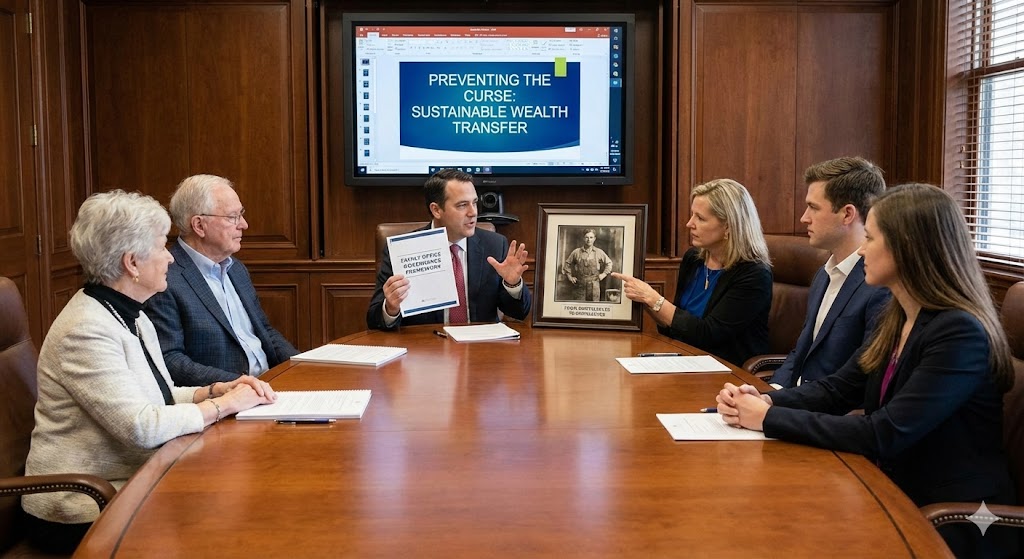
The proverb exists in every culture. “Shirtsleeves to shirtsleeves in three generations” in America. “Rice paddy to rice paddy in three generations” in Japan. “Wealth never survives three generations” in China. The pattern is so universal it suggests something fundamental about how families mismanage wealth transfer. Yet some dynasties—the Rothschilds across two centuries, certain European industrial families, quiet American fortunes that never make headlines—have solved this problem. The difference isn’t luck. It’s family office governance.
The Governance Gap: Why Most Family Offices Fail
The statistics are sobering. According to the J.P. Morgan Private Bank 2024 Global Family Office Report, nearly 30% of family offices lack any structured approach to preparing the next generation, despite this being a primary objective. Succession planning, family governance, and rising generation preparation are acknowledged priorities—yet many offices are falling behind on these difficult, unavoidable issues. Understanding what a family office is reveals that governance represents the software that makes wealth preservation hardware actually work.
The RBC Wealth Management and Campden Wealth research reveals similar gaps. Only 53% of family offices have succession plans, and merely 30% of those are formal written documents. The rest rely on informal or verbal agreements—arrangements that disintegrate under pressure when the patriarch or matriarch is suddenly incapacitated. Understanding family office costs reveals why governance often receives inadequate investment: it generates no immediate returns and requires confronting uncomfortable family dynamics.
The Four Capitals of Family Governance
Economic Capital: The Cost of Governance Infrastructure
Effective governance requires dedicated investment. Family constitutions need professional drafting. Family councils require facilitation. Next-generation education programs demand ongoing resources. According to InvestmentNews research, the North America Family Office Report 2025 shows 69% of family offices now have succession plans, up from 53% the prior year—evidence that families are finally investing in governance infrastructure.
The expense extends beyond documentation. Family meetings require coordination. Facilitators command substantial fees. Educational programs for heirs involve travel, curriculum development, and ongoing assessment. Families that underfund governance often discover the cost of dysfunction far exceeds the cost of prevention.
Cultural Capital: The Knowledge Framework
Governance transfers not just wealth but the knowledge required to steward it. This cultural capital—understanding investment philosophy, family values, operational complexity—cannot be conveyed through documents alone. It requires years of exposure, mentorship, and graduated responsibility.
The challenge intensifies with each generation. The founder who built the fortune possesses intuitive understanding of risk, opportunity, and value creation. Their children may observe these qualities but rarely develop them independently. By the third generation, connection to the original enterprise often exists only as abstract numbers on statements. Without deliberate cultural transmission, financial literacy erodes generation by generation. Next-generation wealth preparation must be embedded within governance frameworks to succeed.
Social Capital: Family Cohesion as Asset
Family unity represents social capital that governance either cultivates or destroys. Disputes over control, distribution, and decision-making authority have fractured more fortunes than poor investment performance. The Murdoch succession battles, publicly documented, represent only the most visible examples of governance failures that transform families into adversaries.
Effective governance creates structures that channel disagreement productively. Family councils provide forums for discussion. Conflict resolution mechanisms prevent disputes from escalating to litigation. Decision-making frameworks establish how authority flows through generations. Without these structures, the first significant disagreement can unravel decades of wealth creation.
Symbolic Capital: Legacy as Organizing Principle
Governance frameworks communicate what the family represents beyond financial assets. Mission statements, family constitutions, and values documentation create symbolic capital—a shared identity that transcends individual interests. The Rothschild family’s enduring cohesion derives partly from a clearly articulated sense of dynasty purpose that provides meaning beyond wealth accumulation.
This symbolic dimension affects how family members perceive their roles. Are they owners entitled to distributions, or stewards responsible for preservation? Governance frameworks that emphasize stewardship produce different behaviors than those treating wealth as individual property. The distinction shapes everything from spending patterns to succession attitudes.
The Architecture of Effective Governance
Family Councils and Decision-Making Bodies
Family councils provide structured forums where family members engage with office operations, investment decisions, and governance matters. Industry research indicates that while nearly two-thirds of North American family offices have investment committees, only 40% have family office boards—reflecting that many first-generation wealth creators remain accustomed to independent decision-making.
The council structure must balance inclusion with efficiency. Too narrow, and excluded family members become adversaries. Too broad, and decision-making paralysis ensues. Successful families often implement tiered structures: family assemblies for broad input, smaller councils for strategic direction, and executive committees for operational decisions. Understanding how single-family vs multi-family office structures affect governance helps families choose appropriate frameworks.
Succession Planning Beyond Documentation
Written succession plans represent starting points, not solutions. According to Crain Currency analysis, succession complexity has increased as families “grow and add multiple houses and have multiple entities. They have many trusts set up and family partnerships.” The legal architecture of succession—trusts, partnerships, holding companies—requires active maintenance as laws and regulations evolve.
Beyond legal structures, succession requires human preparation. The RBC/Campden research notes that 60% of family offices expect generational transition within the next decade, yet concerns about next-generation readiness persist. Gaps in financial literacy and unclear role expectations create vulnerability precisely when families most need stability.
Next-Generation Education and Integration
Preparing heirs begins earlier than most families realize. By the time children reach adulthood, their relationship with wealth is largely established. Effective programs introduce financial concepts age-appropriately, provide graduated responsibility, and create pathways into family office operations.
Integration strategies vary by family philosophy. Some require heirs to gain external work experience before joining family operations. Others provide early involvement with increasing responsibility. Understanding the family office careers landscape helps families benchmark what professional preparation looks like. The Mercer analysis emphasizes that individual choice shapes how next-generation members engage with succession—governance frameworks must accommodate different aptitudes and interests while maintaining family cohesion.
Professional Leadership Transition
A striking trend: while 65% of family offices are currently led by family members, nearly half expect to transition to non-family professional leadership after succession. This reflects growing recognition that family membership doesn’t guarantee management competence. The professionalization of family offices means governance must address when and how to bring in outside expertise while preserving family vision and values.
The Hamptons Dimension: Governance in Geographic Context
Hamptons real estate often represents significant family office holdings requiring governance consideration. Properties pass between generations with emotional attachments complicating rational decisions. Who uses the Southampton house when? How are maintenance costs allocated? What happens when one branch wants to sell while another wants to preserve?
These seemingly minor questions have destroyed family relationships. Governance frameworks that address shared assets—usage protocols, cost allocation, buy-out mechanisms—prevent vacation properties from becoming litigation triggers. Families gathering at Polo Hamptons and similar events observe how other dynasties manage these challenges, often importing governance solutions that preserve both assets and relationships.
Governance Failures: The Warning Signs
Certain patterns predict governance breakdown. Delayed succession conversations—waiting until health crises force decisions. Informal agreements that family members interpret differently. Exclusion of family members from information or decision-making. Concentration of authority without accountability mechanisms. Inadequate next-generation preparation masquerading as “letting them find their own way.”
The Stryde Search analysis notes that two-thirds of family offices are unprepared for next-generation transfer with no strategy in place. The reasons include discomfort with succession discussions, patriarch/matriarch reluctance to relinquish control, absence of obvious successors, and the complexity of creating practical, legally binding plans. Each reason represents a failure to prioritize governance investment.
Building Governance That Endures
Effective family office governance begins with honest assessment. What decision-making structures currently exist? How are conflicts resolved? What preparation have next-generation members received? Where do informal understandings create vulnerability?
From assessment, families can construct appropriate frameworks. This typically involves documenting family vision and values, establishing decision-making bodies with clear authority, creating succession plans that address both leadership and ownership transitions, implementing next-generation education programs, and building conflict resolution mechanisms that prevent disputes from escalating.
External expertise often proves essential. Third-party facilitators can navigate sensitive conversations that family members cannot mediate themselves. Governance consultants bring frameworks proven across multiple families. Legal and tax advisors ensure structures align with evolving regulations. The European family office model provides instructive examples of governance that has endured across centuries.
Participating in family office networks provides access to peers who have navigated similar governance challenges successfully.
The Family Office Governance Imperative
The shirtsleeves curse isn’t inevitable. It’s the default outcome when families fail to invest in governance with the same rigor they apply to investment returns. The families who break the pattern—preserving wealth, relationships, and purpose across generations—share a common characteristic: they recognize that family office governance determines whether their wealth creation becomes their descendants’ inheritance or merely a cautionary tale about fortunes squandered.
The J.P. Morgan research concludes with stark clarity: “Succession planning, family governance and preparing the rising generation are priorities for family offices. But many are falling behind in tackling these difficult, yet unavoidable, issues.” The families who confront these issues now will still be managing dynastic wealth when their peers’ descendants are starting over. That’s not pessimism. It’s the documented pattern across centuries of wealth creation and destruction. Governance breaks the pattern. Everything else accelerates it.
Connect With Social Life
For editorial features, advertising partnerships, or event sponsorships, contact our team. Join us at Polo Hamptons where family office principals and their advisors convene each summer.
Subscribe to receive Social Life Magazine in print: Join our subscriber list. Support independent luxury journalism: Contribute $5.
Related Reading
Next-Generation Wealth: Preparing Heirs Without Creating Dependents
The European Family Office Model: What American Wealth Can Learn
Author

Written by
Recent Posts
Martin Sheen Net Worth: The Patriarch Who Changed His Name, Regretted It, and Became America’s Moral Center

Charlie Sheen Net Worth: Burned $150 Million to the Ground

Michael Douglas Net Worth: The Fortune Built on a Father’s Name and a Villain He Can’t Escape

Paul Bettany Net Worth: The Street Busker Who Became an Avenger and Explained the Crisis in One Speech

Zachary Quinto Net Worth: The Actor Who Didn’t Just Star in Margin Call — He Made It Exist
Categories
- Art
- Articles
- Beauty & Skincare
- Celebrities
- Celebrities|Movies
- Celebrities|The Chronicles
- Chronicles
- Entertainment|Culture
- Event Photos
- Events
- Fashion
- Fashion & Style
- Featured
- Food & Beverage
- Food, Spirits, Wine
- Hamptons
- Hamptons Celebrities
- Hamptons Celebrities|Celebrities|The Chronicles
- Health
- Health & Beauty
- Lifestyle
- Luxury Lifestyle
- Movies|Culture
- Movies|Hamptons Lifestyle
- Press
- Profiles
- Real Estate
- Technology
- The Chronicles
- Travel
- Uncategorized
- Weddings