
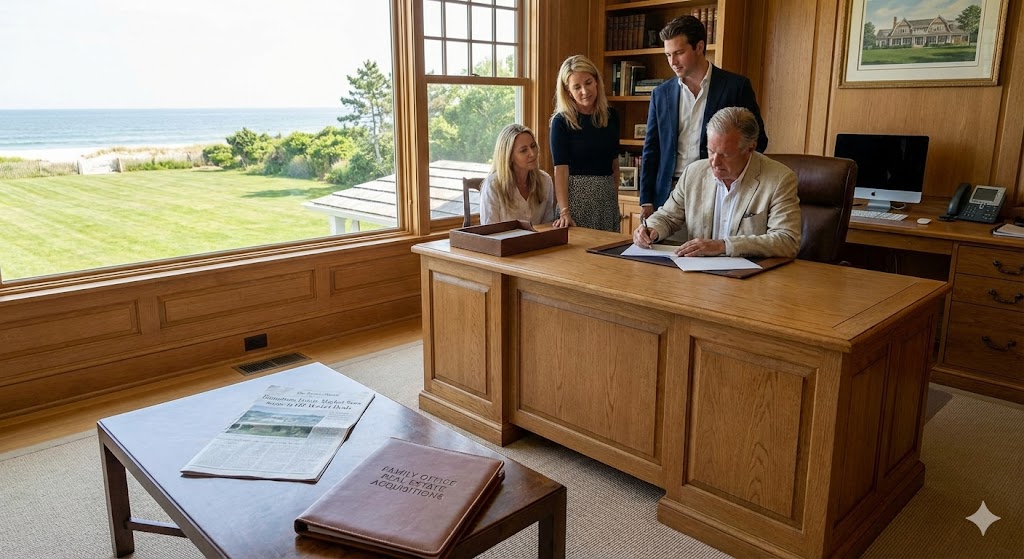
The Meadow Lane estate changed hands for $38 million without appearing on any listing service. The buyer’s family office had maintained relationships with Southampton brokers for fifteen years, receiving notification of opportunities before public marketing began. By the time competing buyers learned the property was available, the transaction had already closed. This is how family office real estate acquisition actually operates—through networks invisible to conventional markets.
Real Estate as Family Office Strategy
European family offices allocate 15% of portfolios to real estate on average, according to Campden Wealth research. American family offices show similar patterns, with J.P. Morgan’s 2024 Global Family Office Report indicating real estate comprises approximately 14.4% of typical allocations. Understanding what family offices are and how they operate provides context for why these structures approach property differently than individual buyers. These aren’t speculative positions. They represent strategic asset class deployment by families thinking in generational timeframes.
The Hamptons provides a particular concentration of family office real estate activity. European family offices acquiring Hamptons property have accelerated this trend, viewing East End real estate as strategic positioning rather than simple investment.
The Four Capitals of Property Strategy
Economic Capital: Beyond Investment Returns
Family office real estate acquisitions pursue objectives beyond pure appreciation. Yes, Hamptons properties have demonstrated strong long-term value—prices roughly doubled over the past decade according to Miller Samuel data. But family offices evaluate real estate through multiple lenses. Our analysis of family office costs reveals how property management fits within broader operating budgets.
Properties function as hard assets providing inflation protection and portfolio diversification. They generate optionality: rental income during periods of non-use, potential for subdivision or development, future sale or family distribution flexibility. For international families, American real estate represents dollar-denominated wealth positioned within stable legal frameworks.
The economic calculus extends to tax optimization. Proper structuring of property ownership through family office entities enables estate planning advantages, depreciation benefits, and 1031 exchange opportunities that individual ownership cannot access. Understanding the distinction between single family office vs multi-family office structures helps clarify which ownership arrangements serve different family situations.
Cultural Capital: Knowledge Networks
Acquiring significant Hamptons property requires knowledge unavailable through public channels. Which properties might become available before formal listing? What sellers prioritize discretion over maximum price? Which brokers maintain relationships enabling early access? This cultural capital—knowing how the market actually operates—separates successful acquirers from those perpetually outbid.
Family offices develop this knowledge over years. They attend relevant events, cultivate broker relationships, and build reputations as serious buyers capable of rapid execution. This accumulated expertise represents asset value beyond any individual property.
Social Capital: The Off-Market Advantage
Industry research suggests roughly one in five U.S. luxury homes sell privately, with top brokerages reporting 25% increases in off-market inquiries from high-net-worth clients over the past five years. In the Hamptons luxury tier, the proportion of off-market transactions runs even higher.
Family offices access this off-market inventory through relationship networks. They’re known to brokers who handle confidential listings. They receive calls when estates become available before marketing begins. Events like Polo Hamptons function as informal marketplaces where property opportunities circulate among principals before reaching public awareness. The same networks that generate family office deal flow in private equity also surface real estate opportunities.
This network access provides competitive advantage. Off-market buyers face less competition, enabling negotiation from strength rather than bidding wars. Sellers prioritizing discretion accept reasonable offers rather than testing maximum market price. The transaction completes before most potential buyers knew the opportunity existed.
Symbolic Capital: Legacy Positioning
For dynastic families, Hamptons real estate carries symbolic weight beyond financial value. Properties represent presence in a geographic location associated with American wealth for over a century. The Southampton address signals something about family positioning that financial statements cannot convey.
This symbolic dimension affects acquisition strategy. Families may pay premiums for properties with historic significance, exceptional ocean frontage, or locations adjacent to established families. They’re purchasing not just land and structures but position within a social geography.
How Family Offices Acquire Differently
The Due Diligence Apparatus
Family office acquisitions involve diligence intensity that individual buyers rarely deploy. Legal teams examine title history, easements, and potential encumbrances. Environmental consultants assess flood risk, erosion patterns, and climate change exposure. Architects evaluate structural integrity and renovation potential. Insurance specialists price coverage for high-value coastal property.
This comprehensive diligence protects against surprises that derail less-prepared buyers. The family office discovers the unpermitted pool house before closing, not after. They understand exactly what insurance will cost and whether coverage is even available. They’ve modeled renovation scenarios and know what the property could become, not just what it currently is.
Structuring for Generational Flexibility
Ownership structure receives as much attention as property selection. Should the family hold directly, through an LLC, or within a trust? How does ownership integrate with broader estate planning? What happens when the patriarch passes—does the property transfer smoothly or trigger family conflict?
Family offices structure acquisitions for multigenerational scenarios. They establish mechanisms for shared family use, maintenance cost allocation, and eventual disposition. These governance frameworks prevent the vacation property from becoming litigation catalyst—a common failure mode for families who acquire significant real estate without structural forethought. Proper next-generation wealth preparation includes educating heirs on property stewardship.
Patience as Competitive Advantage
Family offices can wait. Unlike buyers facing timeline pressure—relocating families, investors with deployment deadlines—family offices maintain wish lists for years, activating only when appropriate opportunities emerge at acceptable prices. This patience produces superior acquisition terms.
The patience extends post-acquisition. Family offices don’t flip properties seeking quick returns. They hold through market cycles, renovate strategically, and realize value over decades rather than quarters. This long-term orientation enables acquisition strategies unavailable to shorter-term investors.
The Hamptons Acquisition Landscape
Current market dynamics favor prepared family office buyers. Inventory has increased—listing inventory rose 10% in early 2025—providing more selection than the pandemic-era scarcity. Median prices above $2 million have stabilized after dramatic appreciation, suggesting rational valuations rather than speculative excess.
The $10 million-plus segment shows particular activity. According to real estate roundtable participants, “the high end, which is $10 million and up, is seeing the highest increase in interest and activity.” Family offices dominate this tier, competing primarily against other family offices rather than individual buyers.
The European family office model has proven particularly instructive for understanding how multigenerational families approach property acquisition—emphasizing preservation and discretion over display.
The Family Office Real Estate Decision
Not every family office should own Hamptons real estate. The properties require management attention, carry illiquidity, and generate ongoing expenses regardless of appreciation. Families whose members rarely use East End properties may find liquid investments more appropriate.
But for families who will use Hamptons property, who value the symbolic and social positioning it provides, and who can structure ownership appropriately for multigenerational transfer, the allocation serves strategic purposes beyond pure investment return. The question isn’t simply “will this property appreciate?” It’s “does this property serve our family’s comprehensive objectives across the decades we’ll own it?”
Family office real estate in the Hamptons represents intersection of investment strategy, lifestyle infrastructure, and legacy positioning. The families acquiring quietly through off-market channels understand this multidimensional value. Those waiting for public listings to discover opportunities will continue finding themselves outpaced by buyers who’ve spent years positioning for exactly these acquisitions.
Connect With Social Life
For editorial features, advertising partnerships, or event sponsorships, contact our team. Join us at Polo Hamptons where family office principals and their advisors convene each summer.
Subscribe to receive Social Life Magazine in print: Join our subscriber list. Support independent luxury journalism: Contribute $5.
Related Reading
Why European Family Offices Are Quietly Acquiring Hamptons Properties
Family Office Networks: The Invisible Infrastructure of Wealth
Author

Written by
Recent Posts
Behind the Scenes of Weddings Involving Long-Distance Relationships
Why Karaoke Is the Ultimate Entertainment Choice for a Hen Party
Easy Recipes That Feed A Crowd Without The Stress
The Influence Of Social Media On Interior Style Trends
Where Can You Find the Best Made-to-Measure Bespoke Suits in NYC
Categories
- Art
- Articles
- Beauty & Skincare
- Celebrities
- Celebrities|Movies
- Celebrities|The Chronicles
- Chronicles
- Entertainment|Culture
- Event Photos
- Events
- Fashion
- Fashion & Style
- Featured
- Food & Beverage
- Food, Spirits, Wine
- Hamptons
- Hamptons Celebrities
- Hamptons Celebrities|Celebrities|The Chronicles
- Health
- Health & Beauty
- Lifestyle
- Luxury Lifestyle
- Movies|Culture
- Movies|Hamptons Lifestyle
- Press
- Profiles
- Real Estate
- Technology
- The Chronicles
- Travel
- Uncategorized
- Weddings