
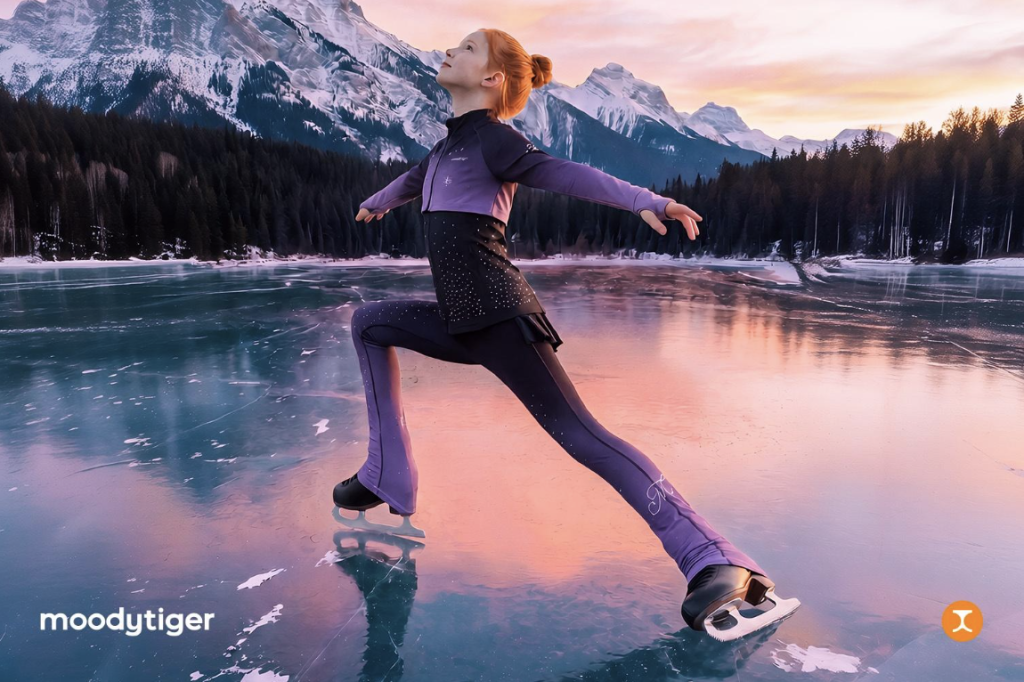
Every skating family knows the exact moment it arrives. The outdoor air takes on that particular clean mineral edge, the local rink flips its schedule over to winter hours, and somewhere a kid presses a flat palm against the cold glass of the barrier and asks, for the tenth time this week, whether it’s time yet. First ice is a genuine holiday that appears on no official calendar anywhere, celebrated only inside the specific households that live by the rhythm of the rink — and, if you’re one of them, you can feel it coming now, the way you feel a season turn.
There is genuinely nothing quite like watching a child skate, and it never fully loses its strangeness. On dry land they are, let’s be honest, gravity’s favorite running joke — all elbows and untied laces and cereal dropped on the way to the table, forever half a step from a tumble. But put them on the ice and something quietly reorganizes itself in real time. They lean into a crossover they’ve drilled a hundred times, catch that impossible clean glide where the effort seems to vanish, and for three unbroken seconds you are no longer watching your slightly clumsy kid at all. You’re watching a brief, clear preview of the composed person they are slowly, improbably becoming.
What they wear on the ice matters more in this sport than in almost any other — but emphatically not for the reasons the glossy catalogs would like to sell you. Skating clothes have exactly one real job, and it is a humble one: to disappear. Cold legs stiffen up and turn cautious, and a cautious skater doesn’t try the thing. Bulky, well-meaning layers physically block the precise hip-and-shoulder freedom the skater came to the rink to build. Anything that pinches, rides, or binds stops being clothing and becomes the entire session, the only thing the kid can think about. So the uniform that actually works is almost aggressively boring — warm, stretchy, close to the body, forgotten the moment it’s on. Which is exactly what a proper piece of figure skating practice wear is quietly engineered to be: thermal fabrics carrying real four-way stretch, flat seams that vanish against the skin, thumbholes for the simple reason that rink air relentlessly hunts down every unguarded gap at the wrist.
The single piece that most earns its price, though, is the jacket, and it’s worth spending real thought on. Rinks are cold in a specific, sneaky way that ambushes a skater precisely during the long, still stretches of standing instruction — feet cooling, attention drifting, warmth leaking away while the coach talks. The great, difficult compromise of the skating jacket — genuinely warm, yet never for one second restrictive — is where thoughtful design actually shows itself and cheap gear falls apart. The current generation of figure skating jackets is fitted close through the body for warmth but built with full articulation through the shoulders, so that a layback, a spiral, or a big reaching spin never once meets resistance. Some of them — the on-ice line from moodytiger among them — also simply look sharp enough that the act of getting dressed for practice becomes its own small, private source of motivation. Never, ever underestimate the quiet power of that at six o’clock on a dark winter morning.
For the parents newer to all this — the ones whose kid just fell for skating over a birthday party or a holiday session and is now demanding lessons — a word of orientation, because the sport can feel opaque from outside. You do not need to buy skates on day one; rent while the feet are still growing fast and the commitment is still young, and lace them properly tight around the ankle, which is the single fix for most early wobbles. You do not need a coach immediately; group learn-to-skate classes are where nearly everyone starts and they’re gentle and cheap. And you absolutely do not need the expensive competition dress in the shop window. What you need is warmth, stretch, and a kid who wants to go back. Everything else can wait for a season that proves itself. When the commitment does stick, know that figure skating is a signature category for moodytiger — a full on-ice line of thermal, four-way-stretch practice wear built specifically for young skaters, not adapted from anything else.
And while you’re all waiting for the schedule to officially flip and the first session to open, the season can genuinely start at home, which helps enormously with the counting-down. Ankle hops during the evening cartoons. Balance drills on one wobbling foot while the pasta water comes to a boil. Old competition videos pulled up and watched from inside a blanket pile, complete with strong, unqualified opinions about the judging from small people who cannot yet reliably land a waltz jump themselves. By the time the rink doors finally open for real, all that backyard anticipation has quietly compounded like interest, and the kid arrives for first ice practically vibrating.
A quiet word to the parents in the cold bleachers, because your job is harder than it looks and nobody hands you a guide. Dress warmer than you think you need to — you’ll be sitting still in a refrigerated box for an hour while your kid runs hot, and a cold, miserable parent shortens everyone’s session. Bring the thermos for yourself, not just them. Resist the powerful urge to coach from the boards; that’s the actual coach’s job, and your child needs to look to them, not to you, when they fall. Your role, the whole role, is to be the warm, undramatic constant they glide back to between attempts — the one who says ‘again’ when they land it and ‘again’ just the same when they don’t. Master that and you’ve mastered rink parenting.
Because that is the real, unglamorous truth at the center of this beautiful sport, the part the highlight reels never show: it is built almost entirely out of deeply un-photogenic mornings. Cold hands wrapped tight around a thermos up in the empty bleachers. The identical three seconds of a single jump, drilled and drilled and drilled forty times in a row until it finally clicks. A kid who catches an edge, goes down hard on the cold ice, laughs it off, and immediately resets to try it again — without once glancing over at the boards for permission or reassurance. That quiet, self-directed resilience is the actual thing the sport is building, underneath the sequins and the spins, and it’s worth more than any medal.
There’s a rhythm to a skating family’s winter that outsiders never quite see, and it becomes strangely precious once you’re in it. The early alarm that everyone somehow stops resenting. The specific smell of the rink, cold and clean and a little industrial, that will one day be the smell of your kid’s whole childhood. The bleacher friendships between parents who only ever meet at dawn. The slow, invisible accumulation of a single skill over a hundred unremarkable mornings, until one ordinary Tuesday the thing that was impossible in October is just something they can do. You don’t notice it building. You only notice, somewhere around February, that the wobbly beginner from the fall is gone, replaced by a skater — and that you were there, cold and caffeinated, for every unglamorous minute of the change.
First ice is almost here now — you can practically smell it. The blades are freshly sharpened and back in their guards, the good thermos has been located at the back of the cupboard and pressed into service, and somewhere in your house a small, determined person is already, seriously, counting the sleeps until the rink reopens. Dress them warm enough to forget the cold and free enough to forget the clothes, and then just get out of the way and let the season begin. See you rinkside.
Author

Written by
Recent Posts

The Self-Made Man Who’s One Phone Call From Ruin

Everyone Out Here Is Loaded. Nobody Feels Rich.
What to Do When Illness Threatens a Trip You Already Paid For
How Independent Watch Brands Are Challenging Traditional Luxury

Meet Pamela Adlon’s Family: Her Daughters and Former Husband
Categories
- Art
- Articles
- Business of Luxury
- Celebrities
- Culture
- Entertainment
- Events
- Faces of Summer 2026
- Fashion
- Fashion & Style
- Featured
- Finance
- Food, Spirits, Wine
- Hamptons
- Hamptons Celebrities
- Health
- Health & Beauty
- Lifestyle
- Luxury Lifestyle
- Press
- Profiles
- Real Estate
- Technology
- The Chronicles
- Travel
- Uncategorized
- Weddings