
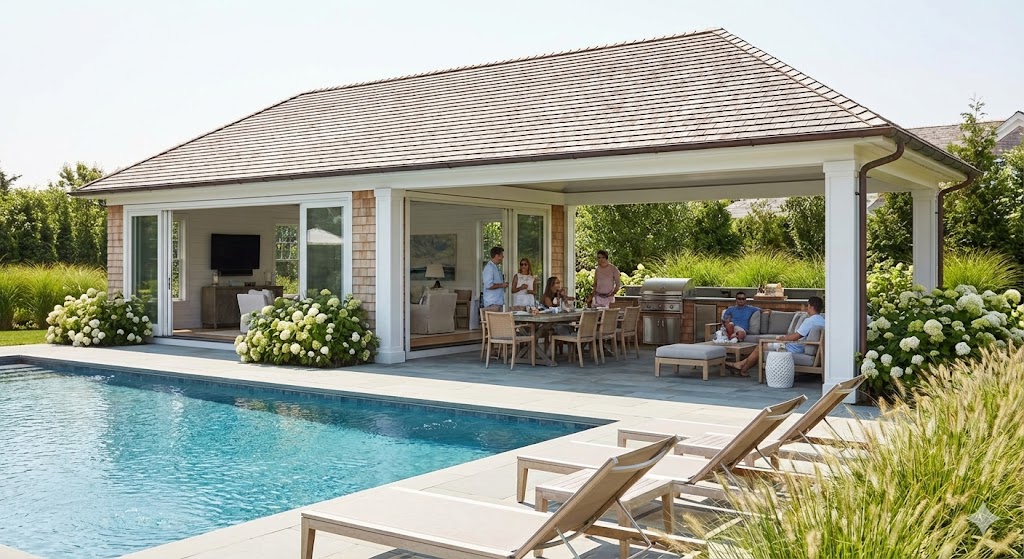
The pool house has evolved from changing room to destination. Today’s Hamptons pool house design creates fully realized living environments that function independently of the main residence. These structures often become families’ most-used spaces during summer months.
Understanding current pool house expectations helps homeowners evaluate existing structures and plan improvements. The gap between outdated pool houses and contemporary standards has widened substantially. Properties with exceptional pool houses command premium values; those with inadequate facilities increasingly disappoint buyers.
The Evolution of Hamptons Pool House Design

Traditional pool houses served minimal purposes. They provided bathroom facilities, perhaps a shower, and storage for pool equipment. Guests changed clothes, used the restroom, and returned to the pool. These structures required little beyond basic function.
Contemporary expectations have transformed completely. Today’s Hamptons pool house design incorporates living rooms, full kitchens, guest suites, and wellness facilities. The best examples function as independent residences suitable for extended habitation.
McKinsey research on luxury amenities identifies outdoor entertainment infrastructure among the fastest-growing priorities for high-net-worth property buyers. Pool houses exemplify this trend.
The transformation reflects changing lifestyle patterns. Families spend entire summer days at pool areas rather than commuting between pool and main house. Pool houses must support all-day occupation with appropriate comfort levels.
Essential Components of Modern Pool Houses

Current standards establish baseline expectations for quality pool house design.
Full bathrooms with showers serve obvious needs. Multiple units accommodate simultaneous use during gatherings. Finishes should match main residence quality rather than accepting institutional alternatives.
Living space provides comfortable repose between swimming sessions. Furnished sitting areas with climate control enable relaxation regardless of weather conditions. Television and audio systems extend entertainment options.
Kitchen or kitchenette facilities reduce trips to the main residence. At minimum, a wet bar with refrigerator and ice serves beverage needs. More complete kitchens enable full meal preparation for poolside dining.
Changing areas separate from bathrooms allow simultaneous use. Lockers or cabinet storage protects guests’ belongings during pool activities. Generous sizing prevents cramped conditions.
Advanced Pool House Features

Beyond baseline expectations, exceptional pool houses incorporate additional capabilities.
Guest suites transform pool houses into independent accommodations. Privacy-conscious visitors appreciate sleeping quarters separated from the main residence. These suites often include private bathrooms and kitchenette facilities.
Fitness facilities bring wellness amenities poolside. Exercise equipment, yoga studios, and massage rooms capitalize on pool house locations for health-focused activities.
Home offices enable productive work with pool proximity. Parents supervising children’s swimming can maintain work connections. Video conferencing backdrops featuring pool settings communicate successfully.
Outdoor kitchen integration connects pool house to surrounding terrace. These installations handle complete meal preparation and often include bars with seating for casual dining.
Wellness spaces increasingly appear in luxury pool houses. Saunas, steam rooms, and spa treatment areas extend pool house utility into health and relaxation territories.
Architectural Considerations
Pool house architecture must relate appropriately to main residence styling while maintaining distinct character.
Style continuity prevents visual discord. Pool houses reflecting main residence architectural vocabulary—roof forms, window proportions, material selections—feel intentional rather than afterthought.
However, pure replication seems redundant. Pool houses benefit from slightly more casual interpretations of primary architectural themes. This differentiation acknowledges their supporting role while maintaining family relationship.
Scale requires careful calibration. Pool houses overwhelmed by main residences disappear visually. Those competing for attention disrupt property hierarchy. Appropriate sizing establishes presence without dominance.
Orientation optimization maximizes solar exposure and view opportunities. Pool houses should face swimming areas with consideration for sun patterns and prevailing breezes.
Interior Design for Pool Houses
Pool house interiors require specific approaches distinct from main residence strategies.
Durability accommodates wet and sandy conditions. Guests arrive from pool in damp swimwear. Flooring, upholstery, and surfaces must tolerate this reality without deterioration.
Easy maintenance serves busy summer schedules. Cleaning crews should refresh pool houses rapidly between uses. Complex materials requiring specialized care create operational burdens.
Despite durability requirements, quality expectations remain high. Performance fabrics now offer aesthetic appeal matching traditional upholstery. Tile and stone flooring provides durability without institutional appearance.
Color palettes often embrace summer lightness. While main residences might feature formal sophistication, pool houses can express playful coastal character appropriately.
Architectural Digest’s annual design survey consistently features pool house interiors reflecting these contemporary approaches. The best examples combine resilience with refined aesthetics.
Pool House Landscape Integration
Pool houses exist within larger landscape contexts requiring coordinated design.
Privacy screening often necessitates landscape treatment. Hedging, fencing, and strategic planting create intimate pool environments without neighboring oversight.
Circulation patterns determine access routes. Guests should move comfortably between pool house, main residence, and parking areas. Path materials and widths affect experience substantially.
Planting near pools requires careful selection. Debris-producing species create maintenance problems. Root-aggressive plants threaten pool structure integrity. Appropriate choices enhance settings without complications.
Outdoor shower provisions extend pool house facilities into landscape. Rinse stations reduce interior traffic while adding practical amenity.
Investment and Value Analysis
Pool house improvements represent significant investments with substantial returns.
New construction costs typically range from $500 to $800 per square foot for quality pool houses with appropriate finishes. A 1,000 square foot pool house might require $500,000-$800,000 investment depending on specifications.
Renovation costs vary based on existing conditions. Upgrading outdated pool houses often delivers excellent value compared to new construction when structural elements remain sound.
Return on investment analysis favors pool house improvements highly. Hamptons real estate analyses consistently identify outdoor amenity quality among top buyer priorities. Properties with exceptional pool houses sell faster at premium prices.
The utilization factor strengthens investment logic. Families actively using pool houses derive immediate lifestyle benefits exceeding financial calculations. The investment pays returns in daily enjoyment beyond eventual resale.
Common Pool House Mistakes
Experience reveals predictable error patterns.
Undersizing constrains future flexibility. Pool houses that feel adequate initially become cramped as families grow or entertaining patterns expand. Building larger than immediately necessary provides future accommodation.
Ignoring mechanical requirements creates operational problems. Pool houses require robust HVAC, plumbing, and electrical systems. Undersized infrastructure struggles with demand spikes during heavy use.
Treating pool houses as afterthoughts shows in quality. When budgets prioritize main residences excessively, pool houses suffer. The daily visibility of quality gaps frustrates owners throughout ownership.
Integrated Design Advantage
At D&J Concepts, our comprehensive approach ensures pool house success through unified design vision.
We design pool houses simultaneously with main residences and landscapes when possible. This coordination prevents the disconnections that plague projects where different firms handle different elements.
Interior design extends naturally from main residence to pool house. Consistent palettes, complementary furnishings, and harmonious materials create estate-wide coherence.
Landscape architecture surrounds pool houses with appropriate settings. The same designers creating garden rooms also design pool house contexts.
Planning Your Pool House Project
Whether building new or renovating existing structures, pool house projects benefit from thorough planning.
Programming defines requirements. How will the pool house actually be used? What activities must it accommodate? Who will use it and in what numbers? Clear answers guide design appropriately.
Site analysis identifies opportunities and constraints. Existing utilities, setback requirements, and view opportunities shape possible approaches.
Budget realism prevents disappointment. Quality pool houses cost substantially. Understanding investment requirements early enables appropriate expectation setting.
For comprehensive pool house design consultation, contact Social Life Magazine for professional connections. Explore related concepts in Outdoor Kitchen Design for Hamptons Entertaining.
David Hornung heads D&J Concepts, Southampton’s full-service design-build studio. The firm’s integrated approach encompasses interior design, landscape architecture, and construction management for the Hamptons’ most discerning properties. Learn more at dandjconcepts.com.
Author

Written by
Recent Posts

Breaking Bad Cast Net Worth. $130 Million Cooked in Five Seasons of Perfect Television

Cailee Spaeny Net Worth — From Springfield, Missouri to A24 and Alien in Three Years Flat

Wagner Moura Net Worth — He Learned Spanish to Play Escobar. Then He Learned English to Take Hollywood.

Robert Eggers Net Worth — He Made a $3.5 Million Film in Puritan English and Hollywood Listened

Brie Larson Net Worth — A $6 Million Indie Film Won Her an Oscar. Marvel Paid Her the Rest.
Categories
- Art
- Articles
- Beauty & Skincare
- Celebrities
- Celebrities|Movies
- Celebrities|The Chronicles
- Chronicles
- Entertainment|Culture
- Event Photos
- Events
- Fashion
- Fashion & Style
- Featured
- Food & Beverage
- Food, Spirits, Wine
- Hamptons
- Hamptons Celebrities
- Hamptons Celebrities|Celebrities|The Chronicles
- Health
- Health & Beauty
- Lifestyle
- Luxury Lifestyle
- Movies|Culture
- Movies|Hamptons Lifestyle
- Press
- Profiles
- Real Estate
- Technology
- The Chronicles
- Travel
- TV
- Uncategorized
- Weddings