
A useful corporate gift should fit the recipient’s routine, not just the company’s branding brief. Tech accessories can be a good choice when they match the devices people actually use and offer a genuine improvement over what they already have. Compatibility, total cost and delivery planning matter more than a long list of features.
Here is how to choose well, and where the common mistakes are.
Start with the recipient, not the catalog
Before picking a product, answer three questions:
- What devices do they use? A team on company-issued iPhones needs something different from a client list with a mix of phones.
- What do they already have? A second charging pad is clutter. A better-designed version of something they use every day is an upgrade.
- Where will they use it? At a desk, on the road or at home changes the right choice more than the price does.
Not every recipient needs a gadget. For some, a well-made notebook or a good bottle is the more thoughtful gift, and that is a perfectly good answer.
Options worth considering
A power bank for people who travel
A 10,000mAh power bank is a practical option for people who travel or spend long days away from outlets. Compare the model’s dimensions, weight and USB-C output rather than the capacity alone, and avoid promising a fixed number of full phone charges, since that depends on the phone. A lighter 5,000mAh model may be the better gift when portability matters more than stored energy.
For anyone flying, power banks travel in carry-on bags, not checked luggage. The watt-hour rating printed on the device is what airline limits refer to. Check the airline’s rules, and remove the power bank if a carry-on is gate-checked.
A magnetic wireless charger for the desk or nightstand
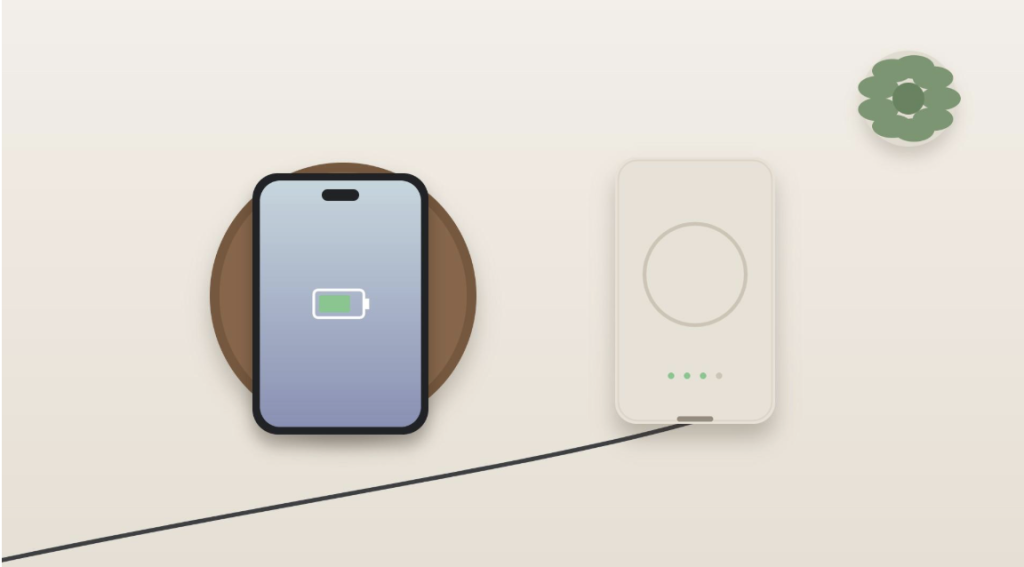
Qi2 chargers use magnetic alignment with compatible devices, so the phone sits in the right spot instead of sliding off a flat pad. Check the recipient’s exact phone model and case rather than assuming every recent iPhone or Android phone supports the same magnetic attachment and charging speed. Some newer phones charge wirelessly but have no built-in magnets, and Qi2 products differ in maximum power, with the result depending on the phone, the charger and the power adapter together.
A stand suits someone who wants to see the screen while the phone charges; a flat pad suits a nightstand or a minimal desk.
A good cable or wall charger
Cables and compact USB-C wall chargers are unglamorous, which is part of their appeal: they get used. A multi-tip cable can be useful for a mixed group of devices. Check both the device tips and the end that plugs into the charger, plus the cable’s supported charging power. For a team on modern USB-C devices, a well-made USB-C-to-USB-C cable paired with a compact charger may be a better fit.
A multi-device charging station for top clients
For leadership teams, key clients or milestone anniversaries, a station that charges a phone, earbuds and a watch together is the premium option. Retail brands such as Belkin, Anker or OtterBox carry more recognition, and many can be ordered with a logo, usually with smaller minimum orders and a higher price per piece. Confirm compatibility with the recipient’s watch and phone before ordering.
Budget by the total, not the unit price
Budgets work better as ranges of product types than as fixed price bands:
- At lower budgets, consider compatible cables and basic charging accessories.
- Mid-range budgets can cover selected power banks or charger-and-cable sets, depending on quantity and decoration.
- Certified magnetic chargers and retail-brand charging stations should be priced by exact model rather than assumed to fit a set band.
The advertised unit price is rarely the cost per person. Custom orders usually add a one-time setup charge for the logo, plus shipping, and sometimes charges for extra print colors or locations; for remote teams, add gift packaging and shipping to individual addresses. Before comparing options, calculate the total rather than the lowest advertised unit price. BrandedChargers’ guide to custom charger order costs shows worked examples that separate the product price, applicable setup and decoration charges, shipping and tax.
Keep the branding discreet
A gift people keep is one they are happy to use in front of others. Choose a logo treatment that suits the approved imprint area and decoration method. A simplified one-color design often works well on small housings; full color may suit a larger flat surface. On premium pieces, a small engraved mark or a branded gift box can be more welcome than a large logo on the product itself.
Review a mockup with the device in use and approve the stated imprint dimensions. A digital proof is a layout check, not a guarantee of the final printed color.
Plan the timeline backward
Custom products need production time before they ship, and production time is not the same as delivery time. December shipping is also slower than usual. Work backward from the date the gifts need to be in hand:
- Set the in-hand date, a few days before the party or the last office day.
- Allow for shipping, with a buffer for holiday delays.
- Allow for production of the specific product, as the supplier states it.
- Allow a few days for artwork and proof approval.
Starting the process in early November gives more room for product selection, artwork, proof approval and delivery planning. The actual order deadline depends on the chosen product, quantity, destination, stock and supplier cutoff, so request a written in-hand date rather than relying on a general calendar rule. Rush production exists on some products, but it works best as a backup plan.
The short version
Match the gift to the devices people use, price it by the total, keep the branding understated and start early. A well-chosen charger or power bank is a small thing, and that is exactly why it works: it fits into someone’s day without asking anything of them.
Author

Written by
Recent Posts
How to Choose Useful Tech Gifts for Employees and Clients in 2026
The Garage Question: Which Car Goes South for the Season?

VandS Clinic Review Treatment: How Seoul Injectable and Laser Options Compare for US Patients
Before Buying a View Home: What a Sloped Lot Means for the Purchase

Powerful Strategies to Stay Ahead in a Fast-Moving Real Estate Market
Categories
- Art
- Articles
- Business of Luxury
- Celebrities
- Culture
- Entertainment
- Events
- Faces of Summer 2026
- Fashion
- Fashion & Style
- Featured
- Finance
- Food, Spirits, Wine
- Hamptons
- Hamptons Celebrities
- Health
- Health & Beauty
- Lifestyle
- Luxury Lifestyle
- Press
- Profiles
- Real Estate
- Technology
- The Chronicles
- Travel
- Uncategorized
- Weddings