
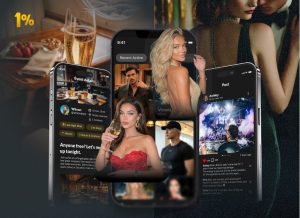
I want to tell you about a Saturday that I have told almost no one about.
Not because it was private — though parts of it were. But because every time I’ve tried to describe it, I can see the moment the other person decides I’m exaggerating. So I’ve mostly kept it to myself, which is its own kind of problem, because it is the truest thing that has happened to me in years, and the reason it happened is sitting on my phone right now in the form of an app most people I know have never heard of.
Let me back up.
The Room I Didn’t Know I Was Missing
I am not someone who needs to be told she’s doing well. I run a brand consultancy that works with clients I’m proud of, I live well, I travel when I want to, and I have a network that has taken fifteen years to build carefully and deliberately. I say this not to establish credentials but to explain why I was not looking for anything when I found The 1%.
A contact — a woman whose judgment I respect without reservation — mentioned it at dinner in the spring. A private social network, she said. Everyone verified. The caliber of people inside was different, she said — not different like another LinkedIn, but different in the way that a room gets different when the door is actually being managed. She showed me the app briefly, the way you show someone something you’re not sure they deserve yet, and then put her phone away. She said: try it. I’ll say no more than that.
I downloaded it that evening more out of loyalty to her instincts than any real expectation.
The first thing The 1% asked for was my face. Not my resume. Not my portfolio. My face, live, matched in real time against a verified photograph by AI that is, I would later learn, genuinely difficult to fool. The message this sent — before I had seen a single profile or read a single post — was the clearest brand statement I have ever encountered from an app: we know who is in here, and we intend to keep it that way.
The Discovery feed I found on the other side looked like Instagram if Instagram had a door policy. Real people, verified, sharing genuine moments from lives that were — I noticed immediately — operating at a register I was not entirely accustomed to seeing in a social feed. A woman photographing the view from a chalet that was clearly not a rental. A founder documenting the closing of something significant with the kind of quiet pride that doesn’t need to name the number. A man posting a single image of a coastline I recognised as Sardinian with no caption at all, because the image required none.
I scrolled for longer than I meant to. Then I completed my profile, listed my professional details, and waited to see what the room would do.
The Message I Almost Didn’t Open
It came four days later. A connection request, followed by a message in the app’s messaging feature — measured, intelligent, the kind of opening that suggests the person writing it has enough going on that they don’t need to perform for you.
He had looked at what I did. He was developing a portfolio of hospitality properties across Southern Europe and needed someone who understood how to build a brand identity that could carry across multiple markets without losing specificity in any of them. He had read my work — the actual work, not the summary of it. He had a specific question about how I’d approached a rebranding project I’d done three years earlier for a hotel group in Portugal.
We exchanged several messages over two days. The conversation was entirely professional and entirely unlike any professional conversation I have had via any other platform, because there was no noise around it. No algorithm surfacing it between advertisements. No mutual connections performing visibility in the margins. Just a direct line between two verified people having a substantive exchange.
On the third day, he created a Meet Now and sent me an invitation.
The location he listed was an address in the city I didn’t immediately recognise.
What “Out of My League” Actually Looks Like
I should tell you that I considered not going. I have a finely calibrated instinct for when something is too good and when it is simply good, and I spent twenty-four hours trying to determine which category this fell into. What settled it, in the end, was the verification. He was exactly who he said he was. The platform had confirmed it before I ever had to.
The address was a private terminal.
A car met me at the entrance. I was shown to an aircraft that I will not describe in detail because I don’t want this to read like a fantasy, except to tell you that the detail I keep returning to is the flowers — white ranunculus in a low arrangement on the table, someone having thought about this specific thing on what I would later understand was a very ordinary Thursday for the people who live at this altitude.
We flew south. I still didn’t know exactly where we were going.
The yacht was anchored off the coast in water so blue it looked edited. We had lunch on the upper deck. He had assembled a small team — his legal counsel, his creative director, a woman who handled his European acquisitions and who I immediately wanted to hire away from him. Over the course of the afternoon, the conversation moved from introductory to substantive to something that felt, by the time the sun was lower, like the beginning of a real collaboration.
At some point between the second course and the dessert he didn’t touch, he said: I’ve been looking for someone who thinks about brands the way you do for eighteen months. I’ve met a lot of people. They all said the right things. You said different things. The right different things.
The contract was prepared by the time dinner was over. I signed it in the saloon with a pen that was heavier than it needed to be, which I found I didn’t mind at all.
We celebrated, as people celebrate at that altitude — quietly, with good wine and better conversation and the specific warmth of an evening that has gone exactly right. His team was extraordinary. The woman who handled acquisitions told me, around midnight, that she had found this network six months earlier and that it had reorganised her professional life in ways she was still accounting for. That almost everyone in his circle who had come in through an introduction in the last year had come through the same door.
A car took me to a hotel he had arranged. In the morning, a car took me back to the terminal. I was home by noon.
What I Know Now That I Didn’t Know Then
That was four months ago. The project is underway. It is the most interesting work I have done in a decade, for a client who operates at a level I had not previously had access to, through a connection that no other platform I have ever used would have produced.
I’ve thought a lot about why The 1% worked when nothing else has. The answer I keep arriving at is the simplest one: every other network optimises for volume. More connections, more reach, more noise. The 1% optimises for exactly one thing — the quality of who is actually in the room. The verification keeps it honest. The structure keeps it intentional. What’s left, when you remove the noise, turns out to be something that feels less like a social network and more like the best professional introduction you’ve ever received, scaled.
The woman at that dinner table who told me to try it — she was right, and she knew she was right, which is why she didn’t oversell it. Some rooms speak for themselves.
This one did.
The door is open. Whether you walk through it is up to you.
Download The 1% and complete your verification: The 1% Elite Social Network — App Store
Discover the community: 1percentapp.com
Author

Written by
Recent Posts
Unlocking the Berkshires

Dalia Forman Design

Alberto Luzzi
How to Pick a Homecoming Dress for Your Body Type and Feel Amazing in It
How to Prepare a Home for Sale When Major Repairs Are Not Affordable
Categories
- Art
- Articles
- Business of Luxury
- Celebrities
- Culture
- Entertainment
- Events
- Faces of Summer 2026
- Fashion
- Fashion & Style
- Featured
- Finance
- Food, Spirits, Wine
- Hamptons
- Hamptons Celebrities
- Health
- Health & Beauty
- Lifestyle
- Luxury Lifestyle
- Press
- Profiles
- Real Estate
- Technology
- The Chronicles
- Travel
- Uncategorized
- Weddings