
A two-hour flight and a business-class ticket can look like an odd match. Why pay a premium when you may spend almost as much time getting through the airport as you do in the air?
This is why a seat-only comparison is inadequate. On a short-haul flight, some of the most useful business-class benefits happen before takeoff or after landing. The better question is: which parts of this trip become easier?
Judge the Whole Journey, Not Just the Flight Time
Imagine a 7:30 a.m. departure. You leave home before dawn, check a suitcase, spend 90 minutes at the airport, fly for two hours, then head straight to a meeting.
While the flight itself may be short, the overall travel day can be quite long.
Priority check-in, fast-track security where available, lounge access, extra baggage, priority boarding, and faster baggage handling can remove several small irritations from the same day.
For business travel, the value may be an hour of quiet work instead of balancing a laptop at a crowded gate. The useful part of the upgrade is often the journey around the seat.
Calculate the Real Upgrade Price
The headline fare difference can mislead because economy passengers often add services later.
Suppose economy costs €140 and business class €280. But if you would buy a €40 checked bag, €20 seat selection, and a €35 lounge visit anyway, your real economy trip costs €235.
| Cost item | Economy | Business |
| Base fare | €140 | €280 |
| Checked bag | €40 | Included |
| Seat selection | €20 | Included |
| Lounge | €35 | Included |
| Relevant total | €235 | €280 |
The effective premium is now €45, not €140. The figures are illustrative, but the method matters: compare business class with the economy trip you would actually buy.
That is why “is business class worth it?” has no universal answer. A traveler with one backpack sees a different equation from someone checking two bags.
Know What “Business Class” Actually Means
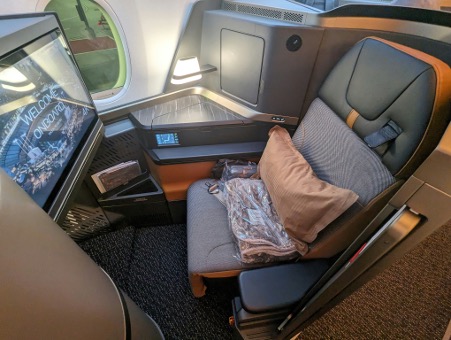
On many European short- and medium-haul flights, business class does not mean a lie-flat seat or even a wider dedicated seat. The product may instead combine an empty adjacent seat with airport services, baggage allowances, catering, and more flexible fare conditions.
Discover Airlines is a useful example. Its current short- and medium-haul offer can include lounge access and priority security where available, priority boarding, meals and drinks, increased baggage allowances, and—where available—a free adjacent seat.
A firsthand experience in Discover Airlines’ business class from Next Level of Travel shows why the details matter. On a Munich–Las Palmas trip, the reviewer reported paying about US$100 more for the upgrade and valued the combination of baggage, lounge access, priority services, food, and extra space.
The lesson is simple: inspect the actual product before paying for the cabin name.
When Does the Upgrade Make Practical Sense?
Business class becomes easier to justify when several benefits solve real problems at once.
It may work well if you have checked luggage and the included allowance replaces fees you would otherwise pay. It can also make sense on a connection-heavy itinerary, where smoother airport processes matter more than on a simple direct trip.
Airport time matters too. Lounge access is nearly useless if you arrive shortly before boarding. With a long connection, it can mean a meal, charging points, a desk, and a quieter place to make a call.
Arrival plans can tip the balance as well. If you are going straight into a meeting, conference, or packed sightseeing day, reducing travel fatigue may be worth more than on a relaxed weekend away.
When Economy Is the Better Buy
Now reverse the scenario: a 75-minute direct flight, one carry-on, no need for flexibility, quick security, and little time at the airport.
If the main difference is a blocked middle seat and a nicer snack, a large premium becomes difficult to defend. The same applies when airline status already gives you lounge access or priority services; you may be paying twice for the same perks.
A common mistake is assuming that “business” guarantees a dramatic cabin upgrade. Check the aircraft, seat layout, baggage rules, lounge eligibility, and fare conditions before booking.
A Small EU Passenger-rights Nuance
Premium fares do not automatically mean higher fixed compensation for disruptions. Under current EU passenger-rights rules, compensation for qualifying cancellations and long delays is largely linked to flight distance rather than cabin class.
What Problem Does the Upgrade Solve?
For a short-haul flight, business class is usually a bundle rather than one spectacular perk. Sometimes that bundle contains several things you would otherwise pay for; sometimes it contains almost nothing you need.
Price the extras, check the seat, think about your airport time, and consider what happens after landing. If the upgrade turns a complicated travel day into a noticeably easier one for a modest effective premium, it can make sense.
That is the practical answer to “Is business class worth it?”. Judge the upgrade by how much real friction it removes from the entire journey.
Sources
- Next Level of Travel: https://www.nextleveloftravel.com/travel-hacks/honest-discover-airlines-business-class-review/
- Discover Airlines: https://www.discover-airlines.com/us/en/discover/travel-classes
- Your Europe: https://europa.eu/youreurope/citizens/travel/passenger-rights/air/index_en.htm
Author

Written by
Recent Posts
Best Folding Tables for Community Halls and Function Centres

From the Hamptons to Mykonos for a September Encore
Is Business Class Worth It on a Short-Haul Flight?
Failure to Disclose Finances in Divorce
Columbus Car Accident Attorney: Protecting Your Rights After a Georgia Crash
Categories
- Art
- Articles
- Business of Luxury
- Celebrities
- Culture
- Entertainment
- Events
- Faces of Summer 2026
- Fashion
- Fashion & Style
- Featured
- Finance
- Food, Spirits, Wine
- Hamptons
- Hamptons Celebrities
- Health
- Health & Beauty
- Lifestyle
- Luxury Lifestyle
- Press
- Profiles
- Real Estate
- Technology
- The Chronicles
- Travel
- Uncategorized
- Weddings