

The coffee goes here. The pad goes here. The notes go here. Every morning on 12 acres in East Hampton, one of the wealthiest comedians alive sits down with a legal pad and does the same thing he did when he was broke. He writes jokes.
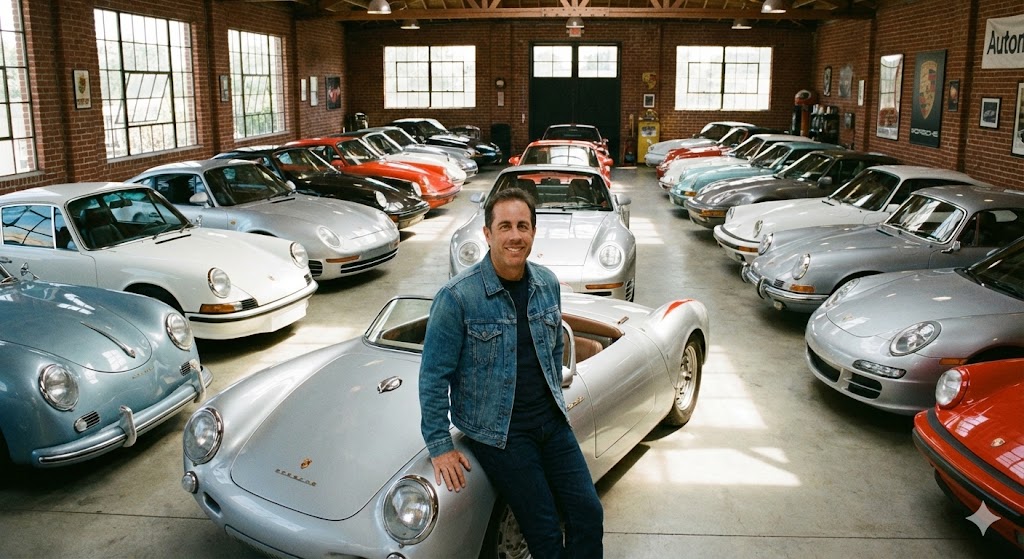
The Jerry Seinfeld East Hampton home is many things at once: a $32 million estate on one of the most expensive roads in America, a 22-car garage housing one of the world’s great Porsche collections, and a baseball diamond a Mets fan built for his kids. It is also, somehow, remarkably ordinary. That tension — between the scale of what he has built and the simplicity of how he lives inside it — is the whole story.
This is what life looks like after a billion dollars. It looks a lot like discipline.
The Further Lane Estate: What $32 Million Bought
In 2000, Jerry Seinfeld paid $32 million for a 12-acre property on Further Lane in Amagansett, purchasing it from Billy Joel. The street name alone signals what kind of address this is. Further Lane runs parallel to the Atlantic in East Hampton, a stretch of real estate where the hedgerows grow thick enough to disappear behind and the neighbors do not introduce themselves.
The property includes a large manor house with its own pool and garden, a separate guest house, a main pool, a barn, and a baseball diamond Seinfeld added shortly after moving in. The diamond is not decorative. East Hampton real estate at this level often reads as performance — a statement of arrival. The baseball diamond reads as a father who grew up watching the Mets and wanted his kids to grow up the same way.
The garage holds 22 cars. On the Upper West Side of Manhattan, Seinfeld keeps a separate $1.4 million custom garage housing over 150 vehicles — at one point making him the largest private collector of vintage Porsches in the world. The Hamptons garage is the edited version. The greatest hits. Each car in that collection represents a specific chapter: a year he was grinding open mics, a year the show was number one, a year after the finale when he had to figure out what came next. The cars are not trophies. They are the way some people keep journals.
The Morning Routine: How a Billionaire Starts the Day
Jerry Seinfeld does not wake up and check his net worth. He wakes up, splashes water on his face, and sits down to write. This has been true since before anyone knew his name, and it remains true on Further Lane.
The routine is almost aggressively unglamorous. His father Kalman kept a box of jokes from World War II — writing things down was survival equipment in the Seinfeld household, not creative expression. That methodology transferred completely. The legal pad. The single focus. The refusal to let the day begin with anything else.
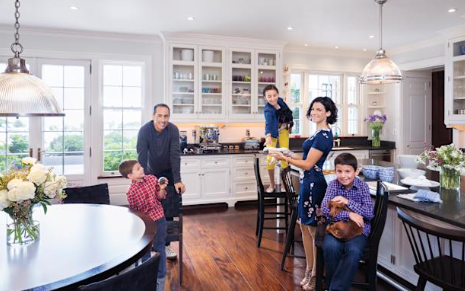
“The writing is such an ordeal,” Seinfeld has said. “That sustains me.” He practices Transcendental Meditation twice daily and works out — weights and HIIT — three times a week each. Then there is the espresso. The Seinfeld kitchen runs on an Elektra machine, and their preferred brew is Black Cat espresso by Intelligentsia. This is a man worth over a billion dollars who has picked a specific coffee and sticks with it. The consistency is not accidental. It is the whole point.
The estate’s kitchen gets serious use. Not because of Jerry — his comfort food is egg noodle mac and cheese, a detail that would fit comfortably in a Season 4 episode — but because of Jessica.
Jerry Seinfeld East Hampton Home: The Jessica Factor
Jessica Seinfeld grew up on Long Island. She did not need to be convinced that the Hamptons were the right place to raise a family. What she brought to Further Lane was something more useful than taste: she brought infrastructure.
As a cookbook author, she has made the East Hampton kitchen a working space — her culinary videos have given audiences glimpses of a pantry that functions the way a professional kitchen would, organized and fully stocked. She has described their decorating philosophy simply: “Jerry and I are the least formal people.” The rooms reflect it. The sunroom functions as party central for summer guests who sit on the floor eating antipasti. The minimalism is not austere. It is just honest.
Meanwhile, Good+ Foundation — which Jessica founded in 2001 after the birth of their first child Sascha — has become a Hamptons institution in its own right. Each summer, the Further Lane estate transforms for the annual Good+ Foundation Summer Dinner, drawing guests including Jimmy Fallon, Sarah Silverman, Gwyneth Paltrow, Lorne Michaels, and Naomi Watts. Chanel has presented. Net-a-Porter has co-hosted. Since its founding, Good+ has donated over $112 million in essential goods to anti-poverty programs nationwide. The estate is not just a home. It is a venue for serious work.
The guest list for those dinners reads like a map of exactly who summers in the Hamptons and why. The Seinfelds are not at the center of that world because they are the flashiest. They are at the center because they have been here long enough, and consistently enough, to become part of the geography itself.
Three Kids, One Long Island, No Instruction Manual
Sascha, Julian, and Shepherd Seinfeld grew up between Manhattan and Further Lane. All three attended Duke University. Sascha, the eldest at 24, is a writer — she contributed to a sketch for Inside Amy Schumer while still an undergraduate. Julian graduated this past spring. Shepherd, the youngest, is currently a sophomore.
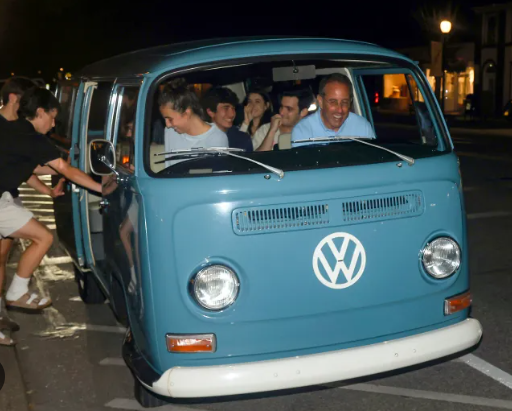
There is something precise about what the Seinfelds passed down and what they did not. The kids are private in a way that is increasingly rare for celebrity children with Instagram-active parents. They show up at the Good+ Foundation dinner. They are photographed once a summer, smiling, and then they disappear back into their actual lives. Jerry has described fatherhood with characteristic flatness: “I love it. I love having a family and kids and all the madness. There is no aspect of it I don’t like. Even when it’s horrible, I love it.”
For context on what was built here: Jerry Seinfeld’s net worth exceeds $1 billion, generated through syndication royalties, touring, and decades of refusing to coast. His parents were both orphans who found each other in New York. His father painted signs and told jokes. His mother lived to 98 and watched her son become the most financially successful comedian in American history. None of them had a template for any of it.
The kids on the baseball diamond in Amagansett — the Mets fan’s kids, playing catch on Long Island — are the end of a very long chain of improvisation. And they all went to Duke.
The Hamptons Chapter: Why He Never Actually Left
There is a geographic irony embedded in the Further Lane purchase that Seinfeld has never seemed particularly eager to explain. The East Hampton estate sits close to the actual location where “The Hamptons” episode of Seinfeld was filmed in 1994 — the one with the infamous shrinkage scene, the one where Kramer steals lobsters from someone’s trap. Life predicting art, or art predicting geography. Either way, the comedian who built a billion-dollar career out of observing ordinary life now lives in the setting of one of his most memorable episodes.
He grew up in Massapequa, which is also Long Island. The progression from Massapequa to Further Lane is not a departure from his origins — it is a straight line. Same island. Better address. Same instinct to notice what everyone else takes for granted and write it down before breakfast.
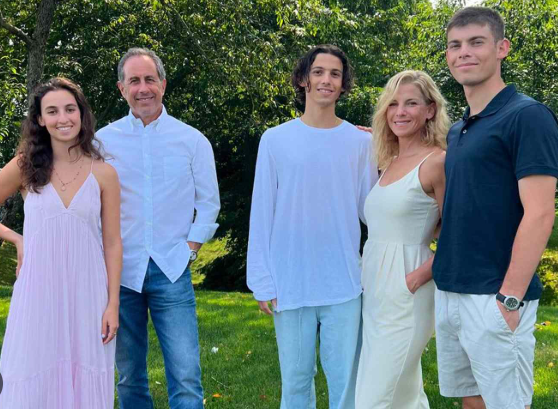
In a review for The East Hampton Star, a neighbor described running into Seinfeld in the Amagansett Square parking lot, the family preparing to drive a rusted Volkswagen van to California on four bald tires. “What a dumb but inspired idea,” the neighbor wrote. That is exactly right. That is also exactly Massapequa. The money changed the real estate. It did not change the person.
The Hamptons have a specific relationship with people like Jerry Seinfeld — not the flashy arrivals or the seasonal renters, but the ones who bought quietly two decades ago and simply stayed. East Hampton restaurants know his order. The staff at the Amagansett coffee shop recognize the car. The neighbors on Further Lane have adjusted to the fact that their neighbor keeps 22 of them.
What the Estate Actually Tells You
The Jerry Seinfeld East Hampton home is not the most architecturally dramatic property in the Hamptons. It is not the newest or the largest or the most photographed. What it is, is consistent. Twenty-five years on the same 12 acres. The same espresso machine. The same legal pad. The same Mets-fan baseball diamond. The same wife who built a $112 million philanthropy operation from the same address where she is also writing cookbooks and hosting summer dinners with Gwyneth Paltrow on the floor eating antipasti.
The people who build things that last — the ones who make a billion dollars telling jokes about nothing, who raise three kids who all go to the same university and keep low profiles, who donate more than $112 million to families in need — do not usually look the way you expect from the outside. The Jerry Seinfeld East Hampton home looks exactly like that. Enormous. Quiet. Running on discipline and Black Cat espresso, every single morning, before anything else begins.
If the estate is a statement, it is this: the work always came first. The 12 acres came later. In that order, specifically.
Social Life Magazine has covered the Hamptons for 23 years. For feature inquiries, brand partnerships, or editorial placements, contact us at sociallifemagazine.com/contact. For tickets and sponsorships at Polo Hamptons, visit polohamptons.com.
Author

Written by
Recent Posts
7 Mindful Meal Prep Tips for Stop Food Waste Day

Rebecca Ferguson Net Worth: The Advantage of Not Being the Lead
What Makes a Dinner Party Truly Unforgettable (Hint: It’s Not the Food)
Tips for Managing Grease and Oil in Everyday Dishwashing

Austin Butler Net Worth: The Method Actor in a Post-Method World
Categories
- Art
- Articles
- Beauty & Skincare
- Celebrities
- Celebrities|Entertainment
- Celebrities|Television
- Celebrities|The Chronicles
- celebrities|the-archive
- Chronicles
- Entertainment|Culture
- Event Photos
- Events
- Fashion
- Fashion & Style
- Featured
- Food & Beverage
- Food, Spirits, Wine
- Hamptons
- Hamptons Celebrities
- Hamptons Celebrities|Celebrities|The Chronicles
- Health
- Health & Beauty
- Lifestyle
- Luxury Lifestyle
- Movies
- Press
- Profiles
- Real Estate
- Technology
- The Chronicles
- Travel
- Uncategorized
- Weddings