
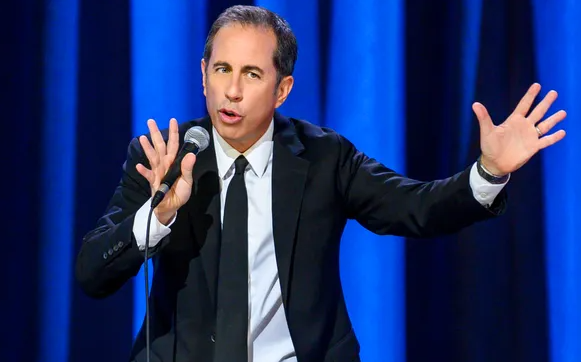
Jerry Seinfeld was three years old when he demanded the entire birthday cake. Not a slice. The whole thing. When his parents refused, he simply refused to eat any cake at all. He sat there, arms crossed, staring at the dessert he’d rather abandon than accept on terms that weren’t his own.
This is the story everyone tells about young Jerry. However, the detail that matters more is what they don’t tell you. Both of his parents grew up as orphans. Neither Kalman nor Betty Seinfeld had parents to teach them how to parent. Consequently, when their strange, stubborn little boy said he wanted to be a comedian, they just shrugged and said, “Okay, good. Do whatever you want.”
Fifty years later, the Jerry Seinfeld Hamptons estate sits on 12 acres in East Hampton, purchased from Billy Joel for $32 million. There’s a baseball diamond he added himself. A 22-car garage. A $14,000 coffee maker. And somewhere inside, a man who still writes jokes on yellow legal pads because his father kept a box of them from World War II.
The Wound: Children of Nobody
Kalman Seinfeld was born in 1918 to Hungarian Jewish immigrants in Brooklyn. His mother Celia died when he was young, and his father remarried. The boy essentially raised himself in what Jerry later called “a broken home.” Meanwhile, Betty Hosni’s story was even harder. Her parents were Syrian Jews from Aleppo who immigrated through Ellis Island around 1910. When the 1918 Spanish Flu pandemic killed her mother, young Betty was placed in foster care and bounced between orphanages.
Two orphans found each other somewhere in New York. They didn’t marry until they were both in their forties, having spent decades figuring out how to be human without anyone showing them.
“They were wild dogs themselves,” Jerry explained in a Closer Weekly interview. “They didn’t fit into any normal box.”
Kalman became a sign painter, running a shop called Signfeld Signs in New York City. During World War II, he served in the Pacific and developed a habit that would shape his son’s entire career. He wrote down every joke he heard and stored them in a box for safekeeping. Humor, for Kalman, was survival equipment.
The Television That Wouldn’t Die
The Seinfelds moved to Massapequa, Long Island, when Jerry was still a toddler. It was a typical suburban existence, except for one thing. Both parents had learned self-reliance the hard way, and they passed that independence to their children with almost unsettling completeness.
“They were loners,” Jerry recalled. “They kind of raised us in a very hands-off way. I said, ‘I want to be a comedian.’ They said, ‘Oh, well, we look forward to hearing about it.'”
Young Jerry became obsessed with television. Not just watching it, but studying it. His mother Betty eventually got so frustrated that she removed the TV from the house entirely. Undeterred, Jerry simply walked next door to watch at the neighbors’ house. Looking back, that wasn’t wasted time. It was graduate school.
He absorbed everything: Abbott and Costello, Jean Shepherd, the rhythms of commercials, the timing of laugh tracks. While other kids watched for entertainment, Jerry was reverse-engineering the machinery of funny. Additionally, he discovered something crucial about himself. He was never actually funny around his parents.
“I was never funny around my parents,” he admitted at The New Yorker Festival. “So when I told them I wanted to be a comedian, they had no idea. But their son is very funny.”
The Chip: Precision as Religion
The birthday cake incident wasn’t stubbornness for its own sake. It was an early manifestation of something that would define Jerry Seinfeld’s entire approach to life and work: an absolute refusal to accept anything less than exactly what he wanted.
“He had a very ordinary childhood, but he was very driven,” his sister Carolyn observed in GQ. “If he wanted a toy, he’d sit at the table crying or arguing or carrying on. He’d obsess about things like that.”
That obsession found its perfect outlet in comedy. At sixteen, Jerry volunteered at Kibbutz Sa’ar in Israel, gaining perspective on what really mattered. He attended SUNY Oswego before transferring to Queens College, where he discovered that making people laugh in theater productions felt like home. Consequently, his path became clear.
In 1976, fresh out of college with a degree in communications and theater, Jerry walked into Catch a Rising Star in New York for his first open mic. The performance was a disaster. He froze completely, managing only to mumble the subjects he’d planned to cover: “The beach… Driving… Your parents…” before walking off stage after ninety seconds.
Remarkably, the audience thought it was intentional. They laughed anyway.
The Yellow Legal Pad Years
What followed was four years of grinding. Catch a Rising Star. The Improv. The Comic Strip. Thirty to fifty dollars a night, performing for whoever would listen. Jerry sold jewelry from a cart outside Bloomingdale’s (positioned on wheels for quick escape from police). He tried selling light bulbs over the phone, which he later joked about: “It was hard finding people sitting home in the dark, going, ‘I can’t hold out much longer!'”
During this period, he developed what would become his signature methodology. Yellow legal pad. Pen. Coffee. Write every single day. Never break the chain.
“I grasped the essential principle of survival in comedy really young,” Seinfeld told The Profile. “It’s similar to calligraphy or samurai. I want to make cricket cages. You know those Japanese cricket cages? Tiny, with the little doors? That’s it for me: solitude and precision, refining a tiny thing for the sake of it.”
His father’s box of jokes from the war had taught him something. Humor could be collected, refined, perfected. Words weren’t just words. They were machinery. Every syllable mattered.
The Rise: A Show About Nothing Built on Everything
In May 1981, Jerry Seinfeld made his debut on The Tonight Show Starring Johnny Carson. He was 27 years old. Johnny loved him, and the trajectory changed forever.
But there was a detour first. In 1980, he landed a recurring role on the sitcom Benson, playing Frankie, a mail delivery boy with comedy routines nobody wanted to hear. The irony wasn’t lost on anyone. Then, without warning, he was fired. He showed up for a read-through and discovered there was no script for him. Nobody had bothered to tell him.
Jerry made a vow: he would never do another sitcom unless he had complete creative control.
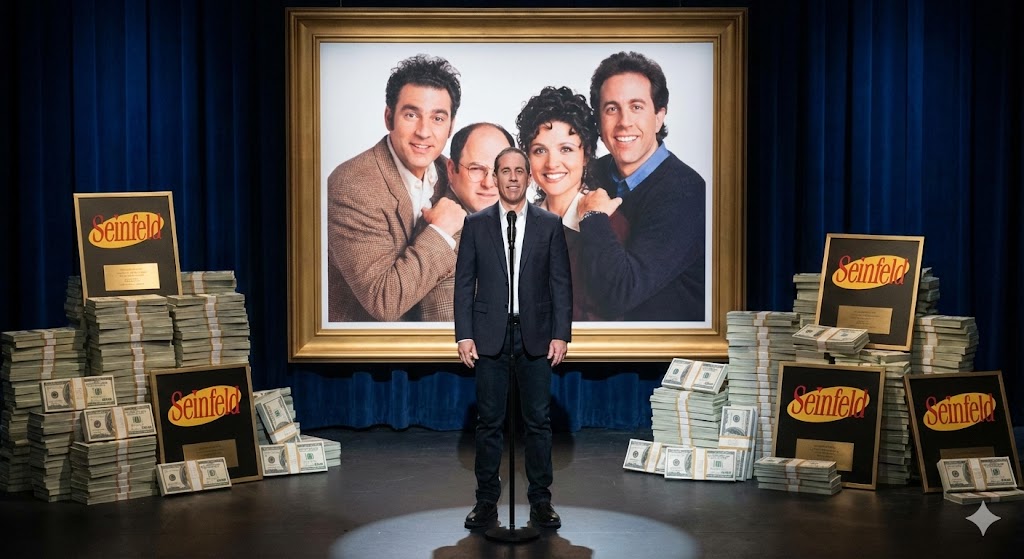
In 1988, that opportunity arrived. NBC invited him to create a show, and he teamed up with fellow comedian Larry David. The Seinfeld Chronicles became Seinfeld, and what followed was television history. A show about nothing. Four friends in Manhattan. No hugging, no learning. By the final season, Jerry was making $1 million per episode. He famously turned down over $100 million to produce one more season.
“I like money, but it’s never been about the money,” he explained. The craft was what mattered. The cricket cage.
The Tell: Still Writing After Billions
The wound of being an orphans’ son manifests in Jerry Seinfeld’s almost pathological self-reliance. He doesn’t need approval. He doesn’t need validation. He certainly doesn’t need anyone to teach him how to be funny. His parents couldn’t, and he turned out fine.

Nevertheless, something drives him to keep working decades after he could have retired. In 2012, fourteen years after Seinfeld ended, a New York Times profile found him still workshopping jokes, still refining single bits for years at a time. He counts syllables. He shaves letters off words if the timing is a split-second too long.
When his father Kalman died in 1985, Jerry was still grinding through the comedy circuit. Seinfeld the show hadn’t happened yet. Kalman never saw his son become the most successful comedian in American history. He never saw the $32 million Hamptons estate or the Porsche collection or the billions in syndication royalties.
But he did pass along his box of jokes. And that methodology. Write it down. Refine it. Keep it safe. Survival equipment.
Jerry’s mother Betty lived until 2014, reaching 98 years old. She spent her final years in Florida, having watched her son transform from the strange little boy who demanded whole birthday cakes into something neither orphan parent could have imagined.
Jerry Seinfeld Hamptons: Billy Joel’s Beach, Perfected
In 2000, Jerry Seinfeld paid $32 million for Billy Joel’s 12-acre East Hampton estate. The property sits on Further Lane in Amagansett, one of the most expensive stretches of real estate in America. There’s a main house. A five-bedroom guest house. Two pools. A 22-car garage for part of his legendary Porsche collection.
And a baseball diamond he installed himself, because Jerry Seinfeld is a lifelong Mets fan who thinks about baseball “all day.”
Consider the journey. His father Kalman painted signs in Brooklyn and stored jokes in a box. His mother Betty bounced between orphanages after the Spanish Flu took her mother. Neither had parents to guide them, so they raised their children with radical autonomy: do whatever you want, and let us know how it goes.
Now their son summers in a mansion purchased from another Long Island icon, on a property that was voted the best celebrity summer home in America. The Jerry Seinfeld Hamptons estate features a $14,000 Elektra espresso machine that gets fired up daily. His wife Jessica, a cookbook author and philanthropist, calls their sunroom “party central.”
Yet for a man worth nearly a billion dollars, there’s something remarkably Massapequa about how Jerry lives. He still writes jokes on yellow legal pads. He still obsesses over single words. He plays catch on his baseball diamond with his three kids. The wild dog independence his parents modeled has become his operating system.
The Massapequa Kid Who Never Left Long Island
Jerry Seinfeld also owns a $32 million duplex overlooking Central Park, complete with a separate $1.4 million garage he built solely to house his car collection. There’s a lakefront home in Burlington, Vermont, where his wife Jessica grew up. Until recently, there was a $14 million ski retreat in Colorado.
But the Hamptons house is different. It’s on Long Island. The same Long Island where he grew up watching television at the neighbors’ house because his mother removed their set. The same Long Island where Kalman painted signs and collected jokes. The same Long Island where two orphans built a family with no instruction manual.
Interestingly, Jerry never really left. He just upgraded the real estate.
The Jerry Seinfeld Hamptons property sits remarkably close to where “The Hamptons” episode of Seinfeld was filmed in 1994, the one with the infamous “shrinkage” scene. Life imitating art, or art predicting life? Either way, the cosmic joke isn’t lost. The comedian who made billions from observational humor about nothing now lives in the actual setting of his most memorable episode.
Still That Kid With the Yellow Legal Pad
At 70, Jerry Seinfeld continues touring, performing stand-up comedy for audiences who’ve been laughing at his material for four decades. He created Comedians in Cars Getting Coffee. He directed and starred in Unfrosted. He still treats each joke like a Japanese cricket cage, refining it until every syllable is perfect.
“I will never stop working,” he’s said repeatedly. The word “retirement” doesn’t compute for someone raised by orphans who taught self-reliance above all else.
His children, Sascha, Julian, and Shepherd, grew up in the Hamptons mansion, playing on that baseball diamond, watching their father obsess over comedy the way Kalman once obsessed over sign painting. The independence continues. The yellow legal pads continue. The chain remains unbroken.
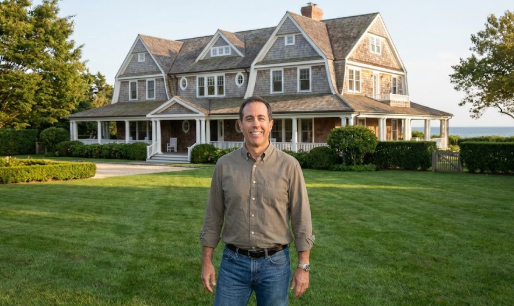
The Jerry Seinfeld Hamptons story isn’t about a comedian who bought a beach house. It’s about two orphans who raised a boy with such complete autonomy that he became unstoppable. Neither Kalman nor Betty knew how to parent because nobody had parented them. So they did the only thing that made sense. They got out of the way.
Maybe that’s the real joke. The parents who didn’t know how to raise a child raised the most successful comedian in history. The orphans’ son built an empire from nothing. And somewhere on 12 acres in East Hampton, there’s still a man writing jokes on yellow legal pads, refusing to accept anything less than the whole birthday cake.
Get the Inside Story
Feature Your Hamptons Brand or Property: Contact Social Life Magazine — We connect luxury brands with the audiences that matter.
Polo Hamptons VIP Experiences & Brand Partnerships: Explore Polo Hamptons — Where icons, tastemakers, and brands converge.
Join the Hamptons Insider List: Get Our Newsletter — Celebrity origin stories, real estate moves, and East End intel before anyone else.
Social Life Magazine Subscription: Subscribe Now — 23 years of Hamptons authority, delivered to your door.
Support Independent Hamptons Coverage: Donate $5 — Keep the real stories coming.
Related Stories
Read more celebrity Hamptons origin stories at Social Life Magazine, including coverage of Billy Joel, Howard Stern, and the Long Island icons who shaped East End culture.
Author

Written by
Recent Posts
Where Can You Find the Best Made-to-Measure Bespoke Suits in NYC
The Financial Habits Every Successful Entrepreneur Swears By
What Happens If You Delay Hemorrhoid Treatment in New York City

James Franco Net Worth — A $30 Million Career Interrupted

Selena Gomez Net Worth — How a Disney Kid Built a $1.3 Billion Empire
Categories
- Art
- Articles
- Beauty & Skincare
- Celebrities
- Celebrities|Movies
- Celebrities|The Chronicles
- Chronicles
- Culture|Television
- Entertainment|Culture
- Event Photos
- Events
- Fashion
- Fashion & Style
- Featured
- Food & Beverage
- Food, Spirits, Wine
- Hamptons
- Hamptons Celebrities
- Hamptons Celebrities|Celebrities|The Chronicles
- Health
- Health & Beauty
- Lifestyle
- Luxury Lifestyle
- Movies
- Movies|Culture
- Movies|Hamptons Lifestyle
- Press
- Profiles
- Real Estate
- Technology
- The Chronicles
- Travel
- Uncategorized
- Weddings