
Jim Carrey’s net worth currently stands at approximately $180 million, down from a peak estimated at $300 million. But the Jim Carrey net worth story isn’t about the accumulation—it’s about what happens when someone who once lived in a van decides they have “enough.” And then un-decides when the real estate market doesn’t cooperate.
“I bought a lot of stuff and I need the money, frankly,” Carrey told the Associated Press in 2024, explaining his return to acting for Sonic the Hedgehog 3 after announcing retirement. The statement shocked Hollywood. This was the first actor to command $20 million per movie, the only star in history to have three films gross $100 million in a single year, admitting financial motivation. But Carrey has always operated outside normal celebrity parameters. His relationship with money—like everything else about him—defies conventional understanding.
How Jim Carrey Made His Fortune
Between 1994 and 2008 alone, Carrey earned approximately $200 million from film salaries and bonuses. His career earnings exceed $300 million from acting. The trajectory was unprecedented: $450,000 for Ace Ventura in 1994, then $7 million for Dumb and Dumber the same year, then $20 million for The Cable Guy in 1996—making him the first actor ever to reach that threshold for a single film.
The $20 million benchmark became his standard. Batman Forever, Liar Liar, How the Grinch Stole Christmas, Bruce Almighty—each commanded the same premium. His smartest deal came with Yes Man in 2008, where he exchanged upfront salary for 36.2% of profits, resulting in a $35 million payday. Films where he starred have grossed over $2.5 billion domestically, averaging $94 million per picture.
Post-peak, the income declined but never disappeared. The Sonic franchise provided $12 million for the third installment. Endorsement deals—Verizon, Samsung, XFINITY—generated millions more. But Carrey’s creative priorities shifted toward painting and spiritual exploration, reducing his film output significantly after 2014. Money accumulated more slowly while lifestyle expenses continued.
The Wound That Built the Empire
James Eugene Carrey was born January 17, 1962, in Newmarket, Ontario, Canada. His childhood collapsed when he was twelve. His father Percy, an accountant and aspiring musician, lost his job. The Carrey family—Jim, his parents, and three siblings—moved into a Volkswagen van. They lived wherever they could park.
To help support the family, teenage Jim worked eight-hour shifts as a janitor and security guard at a tire factory after school. The schedule destroyed his grades. He dropped out at 16 to pursue comedy full-time. His father drove him to Toronto clubs, helped write material, and believed in a talent that hadn’t yet proved itself commercially.
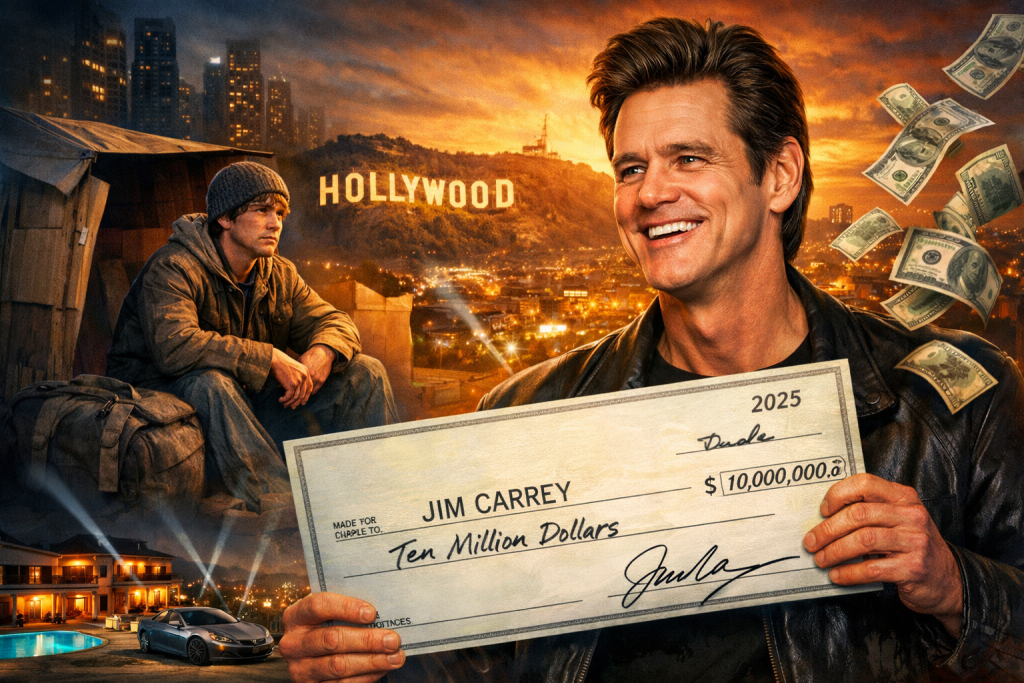
“My parents held my comedy up as something special,” Carrey later told The Hollywood Reporter. “I was what was special about them in a way.” The family’s faith became his fuel. Around 1985, broke and depressed, Carrey drove his beat-up Toyota Camry into the Hollywood Hills. Overlooking Los Angeles, he wrote himself a check for $10 million “for acting services rendered,” post-dated ten years. He kept it in his wallet. When his father died in 1994—the same year Carrey’s fortune materialized—he slipped the fulfilled check into his father’s casket.
Jim Carrey’s Real Estate and the $11 Million Problem
Carrey’s primary residence for three decades was a sprawling compound in Brentwood, Los Angeles. He purchased the first property in 1994 for $3.8 million (equivalent to $6.6 million today), adding the adjacent one-acre lot in 2000 for $1.7 million. The two-acre estate features 13,000 square feet of living space, a guest house, swimming pool, tennis court, and approximately 300 feet of privacy hedging.
In February 2023, Carrey listed the estate for $28.9 million. It didn’t sell. He reduced to $24 million in October 2023. Then $21.9 million. Then $19 million. The property finally sold in 2025 for $17 million—nearly $12 million below asking. The extended sale period and dramatic price reductions fueled speculation about his financial position.
Additional holdings include a New York City apartment and a former Malibu beachfront mansion purchased in 2002 for $9.75 million, later sold in 2013 for $13.4 million. His car collection, while modest by celebrity standards, includes a Mercedes-Benz SLR McLaren valued around $500,000. The assets reflect a comfortable but not extravagant lifestyle—until you consider the $120 million that apparently evaporated between peak and present.
The Philosophical Turn: “I Have Enough”
In 2022, ahead of Sonic the Hedgehog 2’s release, Carrey announced his retirement. “I’m being fairly serious,” he told Access Hollywood. “I really like my quiet life and I really like putting paint on canvas and I really love my spiritual life and I feel like—and this is something you might never hear another celebrity say as long as time exists—I have enough.”
He pivoted to visual art, producing paintings that process his depression, his spiritual searching, and his complicated relationship with fame. He co-authored a novel, “Memoirs and Misinformation,” that blurred autobiography and fiction. He spoke publicly about depression and existential questioning with a vulnerability rare in Hollywood. The comedian who made millions contorting his face seemed genuinely trying to understand the face beneath the mask.
Then the Brentwood mansion wouldn’t sell. And suddenly, two years into retirement, he needed money. “If the angels bring some sort of script that’s written in gold ink,” he’d said, “I might continue down the road.” Apparently Sonic the Hedgehog 3 was written in gold ink. Or at least in sufficient ink to cover whatever gap had opened between his lifestyle and his liquid assets.
What’s Next for Jim Carrey’s Fortune?
Carrey has begun hinting at potential reboots of beloved characters he’d previously declared off-limits. The financial motivation is transparent; the creative justification remains thin. But Carrey has always operated by his own rules. He might return to comedy stardom. He might disappear into art. He might do both simultaneously while questioning the nature of self on podcast interviews.
The Jim Carrey net worth story offers an uncomfortable lesson about wealth and happiness. He achieved every financial goal a homeless kid could imagine, then found the achievement hollow. He declared “enough” with $180 million remaining, then discovered that “enough” depends on lifestyle choices and real estate markets. The check he wrote himself in the Hollywood Hills came true. What he couldn’t script was whether the truth would satisfy.
“For me, art is trying to take a mixture of pain and intelligence and create something that wasn’t there before,” Carrey told Parade. “There’s something beautiful about taking a painful thing and making a painting out of it.” That kid sleeping in the van made his pain into $300 million worth of comedy. Now he’s making his confusion about that success into a different kind of art. The wound keeps evolving. So does the work.
For perspectives on wealth, fulfillment, and the complicated relationship between them, explore Social Life Magazine. Join conversations that go beyond surface success at Polo Hamptons.
Related Reading:
Author

Written by
Recent Posts

Shia LaBeouf Net Worth: How a Fortune Survived the Man Who Keeps Trying to Destroy It
Vin Diesel Net Worth: The $225 Million Fortune a Bouncer Built by Trading a Cameo for a Franchise

Ben Affleck Net Worth: The Fortune Built on a Joint Bank Account, Two Oscars, and the Boiler Room Speech

Giovanni Ribisi Net Worth: The Child Actor Who Never Burned Out and Plays Men You Shouldn’t Trust
Oliver Stone Net Worth: The Soldier Who Made Wall Street to Honor His Father and Exposed Him Instead
Categories
- Art
- Articles
- Beauty & Skincare
- Celebrities
- Celebrities|Movies
- Celebrities|The Chronicles
- Chronicles
- Entertainment|Culture
- Event Photos
- Events
- Fashion
- Fashion & Style
- Featured
- Food & Beverage
- Food, Spirits, Wine
- Hamptons
- Hamptons Celebrities
- Hamptons Celebrities|Celebrities|The Chronicles
- Health
- Health & Beauty
- Lifestyle
- Luxury Lifestyle
- Movies|Culture
- Movies|Hamptons Lifestyle
- Press
- Profiles
- Real Estate
- Technology
- The Chronicles
- Travel
- Uncategorized
- Weddings