
Jon Bon Jovi was seven years old when his mother handed him a guitar. Carol Sharkey Bongiovi had been a Marine, then a Playboy Bunny, then a florist who ran a silk flower business out of their modest Sayreville home. She’d watched the Beatles on Ed Sullivan and decided right then that her son would be famous. However, the guitar cost more than a week’s groceries. Little Johnny threw it down the basement stairs because he liked the sound it made when it crashed more than any chord he’d ever learned.
Fifty years later, that kid from 16 Robinhood Drive owns a $7.6 million historic estate on Lily Pond Lane in East Hampton. Today, he’s worth $450 million and has sold 149 million records. Yet when you understand where he came from, you also understand why he still can’t walk past someone sleeping on a grate without doing something about it.
The Making of Jon Bon Jovi: From Two Marines to Rock Royalty
A Working-Class Catholic Upbringing in New Jersey
John Francis Bongiovi Jr. was born on March 2, 1962, in Perth Amboy, New Jersey. Notably, both his parents were former Marines. His father, John Sr., became a barber after his service. Meanwhile, his mother Carol had worked as one of the first Playboy Bunnies at the New York City club before settling into motherhood and entrepreneurship. Eventually, the family moved to Sayreville, a blue-collar suburb where everyone knew everyone.
The Bongiovi household ran on faith, pasta, and dreams. Later, Carol ran the family’s fan club out of a shop called Country Charm in the Edison Shopping Center. During those years, teenage Jon and his childhood friend Peter Mantas spent summers picking pine cones for her wreath business. “I like to say she was our first boss,” Mantas later recalled.
The Moment Everything Changed
At fifteen, Jon attended a Bruce Springsteen concert. Suddenly, something locked into place. “I was that kid in the crowd,” he later said. “It’s 45 years later and I just got to be me. So the whole thing is just kooky surreal.” As a result, he picked up the guitar again. This time, however, he meant it.
His new teacher, Al Parinello, was demanding but transformative. Years later, Jon carved Parinello’s initials into his acoustic guitar after the mentor died. Ultimately, that kind of loyalty and refusal to forget where the help came from would define him throughout his career.

Jon Bon Jovi Hamptons: The Power Station Years and the Road to Fame
Sweeping Floors Where Legends Recorded
By 1980, Jon was out of high school, working part-time at a women’s shoe store, and hustling for any break. Fortunately, his second cousin Tony Bongiovi co-owned the Power Station Studios in Manhattan, where the Rolling Stones, David Bowie, and Diana Ross recorded. Consequently, Jon got a job sweeping floors and fetching coffee for $50 a week. More importantly, he learned everything he could about the music business.
One day, disco producer Meco was recording a Star Wars Christmas album. Tony suggested the kid sing lead on “R2-D2 We Wish You a Merry Christmas.” Remarkably, it became Jon’s first professional recording at just eighteen years old.
Living at Home While Making Number One Hits
Here’s what most people don’t know: Jon Bon Jovi was still living with his parents at 16 Robinhood Drive when he produced “You Give Love a Bad Name.” Surprisingly, the money wasn’t quick, and the fame didn’t arrive with a trust fund attached. In fact, rock stars like Southside Johnny would come back to the Bongiovi house for pasta after recording sessions.
In 1984, Bon Jovi released their self-titled debut, and “Runaway” cracked the Top 40. Then, two years later, Slippery When Wet sold 30 million copies worldwide. Consequently, “Livin’ on a Prayer” became the working-class anthem of a generation.
Tommy and Gina: Writing Songs for People Like His Parents
The Story Behind the Anthem
The couple in “Livin’ on a Prayer,” Tommy and Gina, weren’t invented from thin air. Instead, co-writer Desmond Child was a taxi driver dating a waitress nicknamed Gina at a diner called “Once Upon A Stove.” Additionally, Jon Bon Jovi knew these people personally because they were his neighbors, his cousins, and the kids he grew up with in Sayreville.
“Tommy and Gina aren’t two specific people,” Jon explained. “They represent a lifestyle that’s working class and real.” Furthermore, in 2002, he admitted the song was partly a response to Reagan-era economics. “Trickle-down economics are really inspirational to writing songs,” he noted with characteristic Jersey wit.
Success Through the Lens of Struggle
The chip on Jon’s shoulder wasn’t about proving anyone wrong. Rather, it was about proving something right. Throughout their marriage, his parents had stayed together and toughed it out through good times and bad. Sadly, Carol Bongiovi died in July 2024 at 83. In response, Jon released a statement: “Our mother was a force to be reckoned with. Her spirit and can-do attitude shaped this family.”
What he got from Carol and John Sr. was permission to believe. “Even if you truly weren’t any good at your craft, if you believed you were, you could work on it,” Jon told The Big Issue. “They truly believed in the John Kennedy mantra of going to the moon. ‘Yeah, of course you can go to the moon. Just go, Johnny.’ And there I went.”

Jon Bon Jovi Hamptons Estate: The E.C. Potter House on Lily Pond Lane
A Piece of East Hampton History
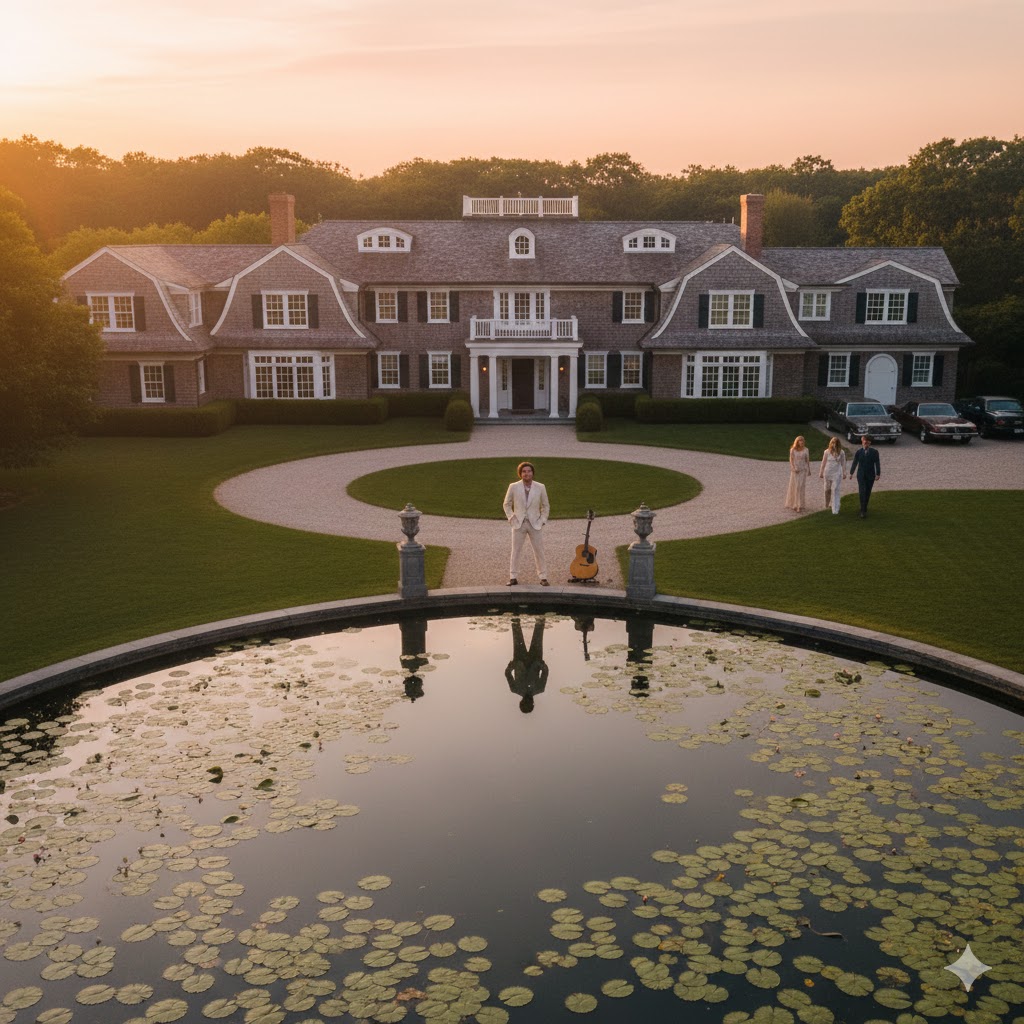
In 2004, Jon and his wife Dorothea paid $7.6 million for the E.C. Potter House on Lily Pond Lane in East Hampton. Originally, the property was designed in 1905 by architect J. Greenleaf Thorp, the same man who built Grey Gardens. Today, the 11-bedroom estate features three stories of classic Shingle Style architecture overlooking Hook Pond.
Consider what this means for a kid who grew up in a modest New Jersey suburb. Notably, Lily Pond Lane is arguably the most prestigious street on the East Coast. Moreover, the house was built by real estate developers who constructed Park Avenue apartment buildings and the Winter Garden Theater. Therefore, Jon Bon Jovi, son of a barber and a former Playboy Bunny, now owns a piece of East Hampton’s architectural heritage.
His Favorite Place on Earth
Jon has called the East Hampton estate “his favorite place on earth to be.” Although his main residence was once an 18,000-square-foot chateau in his native New Jersey, the Hamptons home became the family’s summer sanctuary. Over time, he’s become part of the community by singing in local bars, launching charitable initiatives during COVID, and building a wine brand named after the very place that welcomed him.
Hampton Water: A Father-Son Business Born From Family Values
From Pink Juice to Premium Rosé
Jon’s son Jesse grew up spending summers in East Hampton. After graduating from Notre Dame, he approached his father with an idea: a rosé brand that captured the Hamptons lifestyle. Characteristically, Jon’s response was classic workingman’s wisdom: “Go take that college degree and put it to use. I have a day job. Go figure it out.”
Jesse did exactly that by designing the label, developing the concept, and finding renowned French winemaker Gérard Bertrand. In 2018, Hampton Water Rosé launched to critical acclaim. Since then, the brand has earned four consecutive years of 90-point ratings from Wine Spectator. Currently, it’s one of America’s fastest-growing rosé brands, up 28 percent in 2023.
The Tell: Family First, Always
The wine isn’t just a business venture; it’s proof that Jon Bon Jovi raised his kids the way Carol and John Sr. raised him. Specifically, that means working hard, staying humble, and building something real. Since 1989, Jon and Dorothea have been married after eloping to Las Vegas during a tour stop as high school sweethearts. Despite the private jets and stadium tours, their four children grew up grounded.
JBJ Soul Kitchen: The Wound That Became a Mission
Seeing Someone Sleeping on a Grate
One night, Jon was looking out a hotel window in Philadelphia when he saw a man sleeping on a grate. Immediately, the image hit him like a lightning bolt. “That’s not what our forefathers were thinking when they created this America that they dreamt of,” he said. “I don’t need a scientist to find the cure because I can make a difference.”
In 2006, he founded the Jon Bon Jovi Soul Foundation. Since then, the organization has helped provide support for over 1,000 units of affordable housing in 12 states, serving thousands of people including youth and veterans.
A Restaurant Where Dignity Is on the Menu
In 2011, Jon and Dorothea opened the first JBJ Soul Kitchen in Red Bank, New Jersey. Remarkably, the concept is revolutionary: no prices on the menu. Instead, paying guests make a suggested donation of $30 for a three-course meal. Meanwhile, those who can’t afford to pay are invited to earn their meal through volunteer work.
“The most important ingredient is love,” Dorothea explained. “Dignity and respect grow out of that.” Currently, there are four locations, including one at Rutgers University addressing food insecurity among college students. When COVID hit, the Hamptons locations pivoted to distributing over 238 tons of food over 18 weeks to families on Long Island’s East End.
The Tell: Still That Kid From Sayreville
Why He Can’t Stop Working
Jon Bon Jovi has undergone vocal cord surgery, and his ability to tour again remains uncertain. Nevertheless, he keeps recording, writing, and showing up. “If you’re not going to be great, the guy that’s coming in tomorrow night is going to be better,” he said recently. “You have to win hearts in order to win people’s hard-earned dollar.”
That’s not ambition; that’s survival instinct. Essentially, that’s the kid who watched his parents tough it out through good times and bad, who swept floors at the Power Station hoping for one shot, and who lived at home until “You Give Love a Bad Name” finally paid off.
The Hamptons as Healing
The E.C. Potter House on Lily Pond Lane isn’t just real estate. Instead, it’s proof that the dream Carol Bongiovi had while watching the Beatles on Ed Sullivan wasn’t crazy. Similarly, it’s validation for every kid from a working-class family who believes they can make it. Together, the historic estate, the Hampton Water rosé, and the community roots Jon has put down in East Hampton are all connected to a seven-year-old throwing a guitar down the basement stairs because he didn’t know yet what he would become.
Last summer, Jon was spotted at a local East Hampton spot, just being a regular guy in the Hamptons. Despite being worth $450 million, he’s still married to his high school sweetheart and still funding restaurants where people without money can eat with dignity. Ultimately, he’s still carrying something inside him that no amount of success has fully healed.
Perhaps that’s the point. Maybe Jon Bon Jovi Hamptons isn’t about arrival but rather about never forgetting where you started. It’s about making sure the door you walked through stays open for someone else and about turning a mother’s impossible dream into a legacy that feeds the hungry and houses the homeless.
“‘Yeah, of course you can go to the moon. Just go, Johnny.’ And there I went.”
Get the Inside Story
Feature Your Hamptons Brand or Property: Contact Social Life Magazine — We connect luxury brands with the audiences that matter.
Polo Hamptons VIP Experiences & Brand Partnerships: Explore Polo Hamptons — Where celebrities, tastemakers, and brands converge.
Join the Hamptons Insider List: Get Our Newsletter — Celebrity sightings, real estate moves, and party intel before anyone else.
Social Life Magazine Subscription: Subscribe Now — 23 years of Hamptons authority, delivered to your door.
Support Independent Hamptons Coverage: Donate $5 — Keep the real stories coming.
Related Stories
Search Social Life Magazine for related articles on Michael Bloomberg, Martha Stewart, Madonna, Calvin Klein, Ralph Lauren, for more origin stories like this one.
Search Social Life Magazine for Hamptons stories on East Hampton real estate, Hamptons philanthropy, and celebrity summer homes.
Author

Written by
Recent Posts
Behind the Scenes of Weddings Involving Long-Distance Relationships
Why Karaoke Is the Ultimate Entertainment Choice for a Hen Party
Easy Recipes That Feed A Crowd Without The Stress
The Influence Of Social Media On Interior Style Trends
Where Can You Find the Best Made-to-Measure Bespoke Suits in NYC
Categories
- Art
- Articles
- Beauty & Skincare
- Celebrities
- Celebrities|Movies
- Celebrities|The Chronicles
- Chronicles
- Entertainment|Culture
- Event Photos
- Events
- Fashion
- Fashion & Style
- Featured
- Food & Beverage
- Food, Spirits, Wine
- Hamptons
- Hamptons Celebrities
- Hamptons Celebrities|Celebrities|The Chronicles
- Health
- Health & Beauty
- Lifestyle
- Luxury Lifestyle
- Movies|Culture
- Movies|Hamptons Lifestyle
- Press
- Profiles
- Real Estate
- Technology
- The Chronicles
- Travel
- Uncategorized
- Weddings