
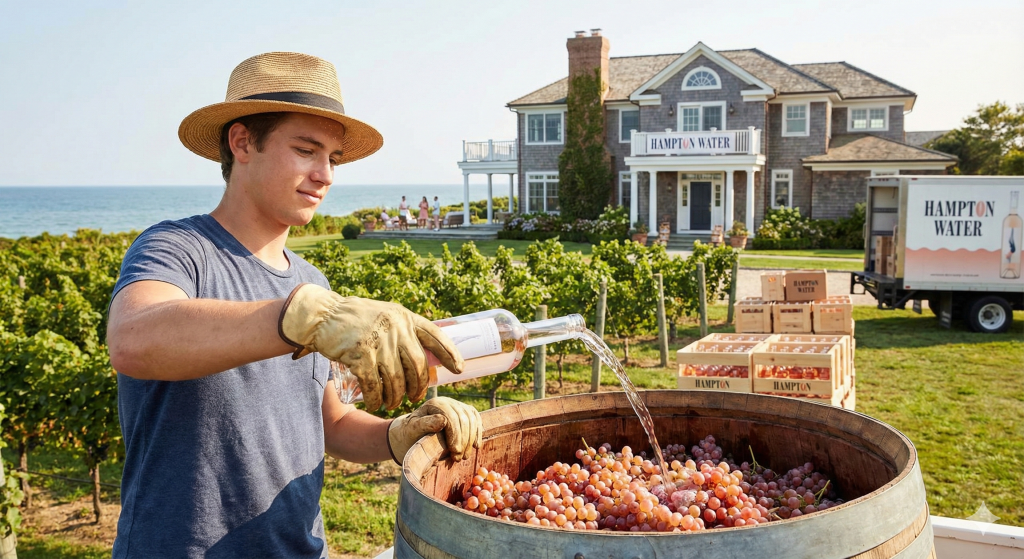
Jon Bon Jovi’s son didn’t want the family name on his business cards. He wanted his own thing. In 2016, Jesse Bongiovi was a Notre Dame senior watching his father pour what the rockstar called “pink juice” on the back deck of their Lily Pond Lane estate. Every summer brought the same ritual: the same glass, the same view of the Atlantic, the same French rosé chilling in the ice bucket.
The Numbers Behind Jon Bon Jovi’s Son’s Wine Venture
Hampton Water sold more than 100,000 cases in 2024. That figure represents a 33% year-over-year increase in a category where most brands are declining. According to Impact Databank, the top French rosé brands collectively dropped 3% last year. Jesse’s brand grew by double digits.
The positioning tells the story. At $19 a bottle, Hampton Water occupies the premium tier—expensive enough to signal taste, accessible enough to buy by the case. Consequently, Nielsen data shows it’s the fastest-growing rosé in that $16-25 price bracket. Wine Spectator awarded it 90 points four consecutive years. Additionally, Wine Enthusiast gave it 91 points and the “Wine and Culture Star Award.”
Perhaps more telling: Hampton Water outsells Brad Pitt’s Château Miraval and the ubiquitous Whispering Angel on Wine.com. In 2021 and 2022, it ranked as the top-performing rosé by bottles sold on the platform—beating nearly 1,000 competing labels.
The Origin Story: Pink Juice on Lily Pond Lane
The Bongiovi family has summered on Lily Pond Lane since 2004, when Jon purchased an 11-bedroom estate built by the developer who gave New York the Winter Garden Theatre. Subsequently, those summers became the foundation of Jesse’s business concept.
“I kept bugging him and bugging him,” Jesse told Wine Enthusiast, describing the campaign to get his father onboard. The pitch was simple: people would love an approachable rosé that captured the Hamptons lifestyle without the Hamptons pretension. Jon eventually agreed. Nevertheless, he insisted on one condition—they would partner with a legitimate winemaker, not simply slap their name on existing inventory.
They found Gérard Bertrand, a French winemaker with 15 estates across the Languedoc region. Bertrand wasn’t a celebrity-adjacent opportunist. Instead, he was a former professional rugby player who inherited his father’s vineyards and built them into an empire spanning 950 hectares. The partnership gave Hampton Water credibility the category rarely sees.
Jesse was 23 when they launched in 2018. His father was already worth an estimated $410 million from four decades of platinum albums and sold-out tours. The son could have coasted. He chose to build.
The Strategy Nobody in Wine Was Using
Traditional wine marketing assumes consumers want education. Hampton Water assumes they want permission. The difference defines the brand.
“You talk to an average 25-year-old person living in New York City and you go, ‘And what kind of notes are you getting on this?'” Jesse explained. “They go, ‘Pink? What are you talking about?'” That intimidation factor kills sales. Therefore, Hampton Water eliminated it entirely.
The brand launched as a social-first company—unusual for wine in 2018. Today, Hampton Water commands nearly 600,000 followers across platforms, with TikTok as the primary channel. The content doesn’t feature vineyard tours or barrel tastings. Instead, viewers see people cradling oversized bottles at beach parties and spotting the rosé on shows like Vanderpump Rules.
Additionally, Hampton Water encourages cocktails. Traditional wine culture treats mixing as sacrilege. Jesse treats it as strategy. The brand’s website features recipes for rosé margaritas, Palomas, and spritzes. “Don’t put ice in it. Don’t make a cocktail with it. That is not how it is done,” Jesse said, mocking the category’s gatekeepers. “We wanted to break that entirely.”
The results suggest consumers agreed. While competitors lecture, Hampton Water invites. While competitors gatekeep, Hampton Water opens doors.
The Hamptons DNA That Couldn’t Be Replicated
Jon Bon Jovi once described the brand’s philosophy this way: “The Hamptons is a place where you can aspire to be, even if you’ve never been there. You could be in a kiddie pool in Cleveland and go, ‘I’m in the Hamptons right now.'”
That insight drives everything. The label features a woman diving into water—no celebrity face, no vineyard imagery. The name evokes a place, not a person. Consequently, the brand transcends its famous founders while leveraging their lifestyle credibility.
The Hamptons connection runs deeper than marketing. Jesse grew up on Lily Pond Lane, where his neighbors included Steven Spielberg and Jerry Seinfeld. He watched how wealth moved through summer rituals. Moreover, he understood that rosé wasn’t just a beverage—it was a status signal that could be democratized.
Local restaurants across the East End now pour Hampton Water as their house rosé. The brand sponsors events throughout the summer season. Furthermore, Jon Bon Jovi launched a food bank during COVID to feed Hamptons families facing food insecurity. The community credibility isn’t manufactured.
Lily Pond Group: The Play Beyond Wine
In September 2025, Jesse announced Lily Pond Group, a lifestyle brand incubator focused on beverage alcohol. The company name references the family’s East Hampton street address—a signal that everything connects back to those summer origins.
Hampton Water serves as proof of concept. The incubator will partner with emerging founders to scale “culturally resonant lifestyle companies” using the playbook Jesse built. According to the launch announcement, LPG provides hands-on support across sales, distribution, marketing, and operations.
The timing is strategic. Celebrity alcohol brands have become a recognized asset class since George Clooney sold Casamigos to Diageo for $1 billion. Ryan Reynolds sold Aviation Gin for $610 million. The Rock’s Teremana tequila reportedly sells 600,000 cases annually. Jesse watched these exits. Now he’s positioning to create them for others—and likely himself.
“We believe keeping this laid-back lifestyle as our north star is one of the many things that sets us apart,” Jesse told industry publication Shanken News Daily. The lifestyle isn’t just branding. It’s the product itself.
What This Means for Heirs Building Their Own Thing
Jesse Bongiovi represents a specific type: the legacy-adjacent entrepreneur who refuses the easy path. He could have managed his father’s business affairs. Instead, he built parallel.
The model matters for anyone navigating family wealth. Jesse used his access—the Lily Pond Lane summers, the celebrity network, the initial capital—without making access the product. Hampton Water succeeds because the wine is good and the marketing is smart, not because Jon Bon Jovi’s face appears on the bottle.
Additionally, the business demonstrates patience. Jesse spent eight years building Hampton Water before launching Lily Pond Group. He earned credibility through execution before scaling ambition. That sequencing separates sustainable ventures from vanity projects.
Hampton Water has become the default vocabulary across the Hamptons dining scene—the rosé you order when you want quality without performance. Emerging entrepreneurs treat it as a case study in category disruption. For Jesse, it’s become the foundation of something larger.
The Investment Angle Smart Money Is Watching
Hampton Water remains privately held. No funding rounds have been announced publicly. The company doesn’t need outside capital—between Jon’s wealth and operating cash flow, the balance sheet is presumably healthy.
Nevertheless, the strategic positioning suggests eventual options. Diageo, Pernod Ricard, and Constellation Brands have all acquired celebrity-backed spirits and wine companies at premium multiples. A brand selling 100,000+ cases with 30%+ annual growth and authentic lifestyle positioning would attract serious interest.
Lily Pond Group adds another dimension. If Jesse can replicate the Hampton Water model across multiple brands, the incubator itself becomes valuable—potentially more valuable than any single brand in the portfolio. He’s building a platform, not just a product.
Industry analysts project Hampton Water could reach 150,000 cases globally by 2025. Jesse has publicly stated a 10-year goal of becoming the number-one selling rosé in America. The math suggests he’s tracking ahead of schedule.
The Verdict: Jon Bon Jovi’s Son Built Something Real
Jon Bon Jovi’s son spent eight years proving that Hampton Water wasn’t a celebrity vanity project. The sales data confirms it. The industry recognition validates it. The institutional interest implies it.
What makes the story notable isn’t the famous father or the East Hampton address. It’s the discipline. Jesse identified a gap, built a team, partnered with legitimate operators, and executed for nearly a decade before claiming victory. That’s not how celebrity brands typically work.
The kid who watched his dad pour pink juice on Lily Pond Lane now runs the fastest-growing premium rosé in America and a brand incubator with real capital behind it. Furthermore, he named the incubator after the street where it started—a reminder that authentic origin stories can’t be manufactured.
Hampton Water proves something counterintuitive: the way to escape your father’s shadow isn’t to run from it. It’s to build something adjacent that eventually stands alone. Jon Bon Jovi’s son figured that out at 23. The rest is execution.
Stay Connected with Social Life Magazine
- Contact Social Life Magazine
- Experience Polo Hamptons
- Subscribe to Our Newsletter
- Print Subscription
- Support Our Journalism ($5)
Featured in Social Life Magazine
Building a Hamptons-connected brand? Learn about feature opportunities in Social Life Magazine.
Related Articles
- Best Restaurants in the Hamptons by Village – Where to pair Hampton Water with exceptional cuisine
- Best of the Hamptons 2026 – The insider’s guide to summer scenes worth your time
Author

Written by
Recent Posts
Cynthia Erivo Net Worth: The Voice That Was Always There
Inside Out 2, Wicked, and the Emotional Blockbuster That Ate 2024
7 Mindful Meal Prep Tips for Stop Food Waste Day
Rebecca Ferguson Net Worth: The Advantage of Not Being the Lead
What Makes a Dinner Party Truly Unforgettable (Hint: It’s Not the Food)
Categories
- Art
- Articles
- Beauty & Skincare
- Celebrities
- Celebrities|Entertainment
- Celebrities|Television
- Celebrities|The Chronicles
- celebrities|the-archive
- Chronicles
- Entertainment|Culture
- Event Photos
- Events
- Fashion
- Fashion & Style
- Featured
- Food & Beverage
- Food, Spirits, Wine
- Hamptons
- Hamptons Celebrities
- Hamptons Celebrities|Celebrities|The Chronicles
- Health
- Health & Beauty
- Lifestyle
- Luxury Lifestyle
- Movies
- Press
- Profiles
- Real Estate
- Technology
- The Chronicles
- Travel
- Uncategorized
- Weddings