
The line is the point.
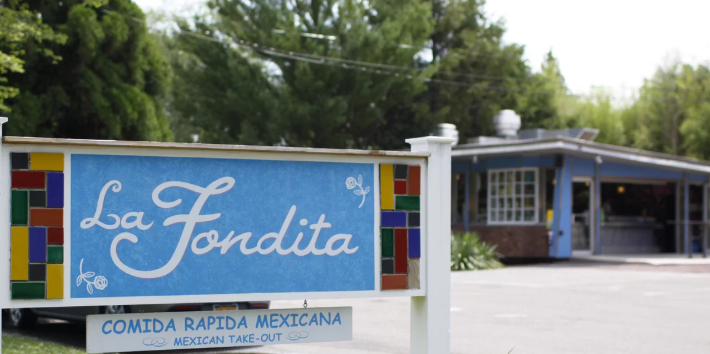
At La Fondita, the walk-up taco window on Montauk Highway in Amagansett, the queue functions as a social experiment. Indeed, any French sociologist would be delighted by what unfolds here. A landscaper in work boots stands behind a woman whose wrist carries more carats than his truck payment. Meanwhile, a hedge fund manager who helicoptered in this morning waits with the same patience as the contractor’s crew breaking for lunch. Summer people mix with year-round people. Billionaires stand beside busboys. Everyone faces the same counter, orders from the same menu, and sits on the same technicolor picnic tables overlooking the same pond.
There are no reservations here. Similarly, there’s no host stand, no velvet rope, and no concierge service to expedite your journey to the front. Instead, there’s just a line, moving at the pace that fresh tacos allow, in front of a walk-up window decorated with papel picado. Naturally, the staff doesn’t care what you drove here in.
La Fondita has been pulling off this trick since 1998. Originally, it opened as the casual sibling to Nick & Toni’s, the wood-fired Italian restaurant that had already spent a decade defining Hamptons dining at its best. While Nick & Toni’s required reservations and rewarded connections, La Fondita asked nothing but your presence and your order. Notably, the name translates to “little kitchen” in Spanish. Furthermore, the concept has remained stubbornly little ever since, even as the restaurant empire it belongs to has grown into one of the most influential on the East End.
The Honest Origin
To understand La Fondita, you first need to understand the people who built Nick & Toni’s. In 1988, Jeff Salaway and Toni Ross opened a Mediterranean restaurant in East Hampton with a radical premise for the time. Essentially, they committed to cooking simple food, using local ingredients, and trusting that quality would find its audience. Salaway, whom friends called “Nick,” had spent time in Italy with Ross. There, he discovered a cuisine not yet common in American restaurants—beet ravioli with poppy-seed sauce, tagliatelle with just lemon and olive oil. In other words, direct and unpretentious cooking that required excellent ingredients and nothing else.
Craig Claiborne’s First Visit
The opening night story has since become East End legend. Craig Claiborne, the retired New York Times food critic, walked in as their first customer and seated himself at his usual table from when the space housed a different restaurant. Consequently, he kept returning, bringing friends, and offering the kind of helpful critique that only someone of his stature could provide. Over time, the restaurant evolved into something essential—the place where Hamptons dining graduated from seafood shacks and country clubs into something genuinely ambitious.
Salaway died in 2001, but not before he and Ross had expanded their vision. Eventually, what became Honest Man Hospitality would include Rowdy Hall, Townline BBQ, and later Coche Comedor. La Fondita was among the first extensions of that vision, opening in 1998 with a simple premise: what if the same people who cared obsessively about farm-to-table Italian cooking applied that philosophy to Mexican street food?
As it turned out, the answer was a taco window that has outlasted trends, recessions, and the relentless upscaling of everything around it.
The Little Kitchen That Could
The physical footprint of La Fondita is almost comically modest. There’s a counter, a kitchen, and some colorful tile. Additionally, picnic tables and Adirondack chairs are arranged on grass that slopes down toward a pond. Above, papel picado—the traditional Mexican paper banners with their intricate cut patterns—hangs from the ceiling. Near the counter sits a display of ripe avocados, fresh limes, and housemade salsas. That’s it.
Notably, no dining room exists here, nor is there a bar program. Likewise, there’s no chef’s table, no tasting menu, and no sommelier waiting to guide you through a wine list. Instead, you simply walk up to the counter, order, and wait for your number. Then you carry your own food to a picnic table and eat. If you want a cocktail, you can order one from Coche Comedor next door and bring it back to the fire pit. Alternatively, for beer, there’s Brent’s General Store nearby.
What’s on the Menu
The menu reads like a greatest hits of Mexican street food, executed with the ingredient sourcing that Nick & Toni’s made famous. Specifically, tacos come with chicken, chorizo, shredded beef, or carnitas, each served on house-made corn tortillas topped with cilantro and onions. Additionally, fish tacos feature whatever’s fresh. On weekends, specials bring tacos al pastor—marinated pork cooked with pineapple—and birria de res, the chile-braised beef served with consommé for dipping.
The burritos are properly stuffed, while burrito bowls satisfy the health-conscious crowd without sacrificing substance. Meanwhile, nachos come in two configurations: con queso for purists, or supremo for those who want the full treatment with meat, refried beans, pico de gallo, and crema. Similarly, tortilla soup arrives with avocado crema and queso fresco. For those seeking virtue alongside their visit, the Ensalada Fondita offers a chopped salad with jicama, radish, and pickled jalapeños.
But ultimately, the tacos are why people come. And keep coming. And tell their friends to come.
The Chef Who Grew Up Eating This
Juan Geronimo, La Fondita’s chef de cuisine, grew up in Acapulco. Consequently, his childhood unfolded in the family kitchen watching his mother and grandmother cook. Moreover, the markets of his hometown, with their stalls of produce and vendors selling street food, formed his culinary education before any professional kitchen did.
Before landing at La Fondita, Geronimo worked in some of the East End’s most notable kitchens. His resume includes Nick & Toni’s and Rowdy Hall—both part of the same restaurant family. However, the dishes he builds at La Fondita are the ones he grew up eating, the foods he calls “foods of celebration.” As a result, daily specials might include chile rellenos, barbacoa, tacos al pastor, mole, or tamales, depending on what inspires him and what ingredients are available.
Joan Reminick of Newsday once wrote of La Fondita: “If you’re craving authentic Mexican food on a beautiful summer day, the search ends here.” Indeed, the assessment holds. What the restaurant offers isn’t fusion or elevated or reimagined. Rather, it’s simply Mexican street food made with care, served in an environment that reminds you why this cuisine works best when nobody’s trying too hard.
The Paradox of Casual Excellence
La Fondita presents a particular challenge to Hamptons hospitality economics. After all, the real estate is valuable. Moreover, the location on Route 27 in the heart of Amagansett could support something considerably more ambitious—and profitable. The customer base includes people for whom price is no object. Therefore, every incentive points toward expansion, upscaling, and the addition of a full bar program and a proper dining room. A reservations system could generate revenue before anyone sits down.
Yet the restaurant has resisted all of it.
The Coche Comedor Solution
When Honest Man Hospitality wanted to build something more elaborate, they did it next door instead. Coche Comedor opened in 2019 in a renovated vintage diner that had previously housed the Honest Diner and later served as headquarters for Art of Eating catering. Today, the new restaurant features a wood-burning grill, a rotisserie program, an extensive tequila list, and proper sit-down service. Intentionally, architects opened up the wall facing La Fondita, thereby creating a visual relationship between the two spaces. As a result, the casual taqueria and its more sophisticated sibling became connected but distinct.
Paradoxically, the existence of Coche Comedor actually protects La Fondita. By building the upscale version next door, Honest Man eliminated the pressure to transform the original. Consequently, La Fondita can remain what it has always been: a walk-up window, a short menu, picnic tables on the grass, and a line that treats everyone the same.
The Democratic Table
One reviewer captured something essential about La Fondita: “In spite of being owned by a large restaurant group, La Fondita feels and tastes like a shack some Mexican family set up to make a living.”
This observation is both accurate and instructive. Admittedly, the restaurant does belong to a large group. Furthermore, the provenance is impeccable—Nick & Toni’s is among the most celebrated restaurants in Hamptons history, and the people behind it have shaped how the East End eats for more than three decades. Nevertheless, none of that matters when you’re standing in line. The pedigree remains invisible. What remains instead is the experience: tacos made fresh, a counter where you order, a picnic table where you eat.
When Access Becomes the Exception
As a destination, the Hamptons has become increasingly stratified, with experiences sorted by price point and access. For instance, the best tables require the right connections. Similarly, beach clubs require memberships, and hotels require rates that filter for a particular clientele. Even the farm stands have tiered into premium and accessible.
La Fondita, however, opts out of this sorting mechanism entirely. Here, the landscaper’s money spends exactly like the hedge fund manager’s. Likewise, the line moves at the same pace for everyone, and tacos taste the same regardless of who’s eating them. In a community increasingly defined by what separates people, this little kitchen on Montauk Highway keeps doing the quiet work of bringing them together.
The Practical Magic
A word about logistics: La Fondita gets crowded. During peak summer hours, the line can try patience. Additionally, parking requires either luck or creativity—the empty diner lot next door helps, but spaces fill quickly. The bathrooms also involve a wait, and picnic tables fill up fast. Nevertheless, none of this is a complaint; it’s simply the reality of a popular place that hasn’t expanded to meet demand.
How to Skip the Line
Fortunately, the regulars know to call ahead. You can phone in your order at (631) 267-8800 and pick it up at your convenience, thereby bypassing the line entirely. Alternatively, ordering in bulk works too—La Fondita caters. In fact, showing up at the beach with a bag of tacos and some cans of beer from Brent’s General Store constitutes a perfectly executed East End picnic.
Currently, hours run Thursday through Monday, 11:30 a.m. to 8 p.m., though weekend hours sometimes extend later. Therefore, check before you go. Although the restaurant operates seasonally, the season has stretched longer as year-round demand has grown.
What to Know Before You Go
Dogs are welcome at the outdoor seating, which is helpful for beach-day visitors. Additionally, portions are sized to traditional Mexican standards, meaning tortillas run about six inches rather than the oversized American versions. As such, order accordingly. The housemade salsas are arranged at a self-serve station with varying heat levels. Notably, the fish tacos earn particular praise for freshness. Moreover, the watermelon agua fresca, when available, justifies the trip on its own.
The Sister Next Door
In 2019, Coche Comedor opened in the renovated vintage diner adjacent to La Fondita. Interestingly, the building had a history of its own. It operated as the Honest Diner decades ago, serving comfort food from a classic railroad-car-style structure. Subsequently, it spent nineteen years as headquarters for Art of Eating catering. The renovation preserved the diner’s exterior character while transforming the interior into something contemporary, with geometric tile floors, dark blue booths, wood-topped tables, and a steel bar.
Two Restaurants, One Campus
The relationship between the two restaurants is deliberate. Specifically, Coche Comedor offers what La Fondita doesn’t: proper seating, a raw bar with local oysters and ceviches, an extensive tequila selection, and rotisserie meats meant for sharing. Architecturally, the designers literally opened up the wall facing La Fondita, thereby creating a visual connection between the casual taqueria and its more ambitious sibling.
For customers, this arrangement means options. For example, you can grab tacos at La Fondita and bring them to the fire pits at Coche Comedor while ordering a margarita from the bar. Conversely, you might start with drinks and ceviche at Coche and drift next door for tacos. Essentially, the two restaurants function as a campus of sorts, offering different experiences at different price points while sharing the same philosophy about ingredients and execution.
Importantly, the arrangement also protects La Fondita from pressure to become something it isn’t. With a proper sit-down restaurant next door handling customers who want service and ambiance and a full bar program, the taco window can remain a taco window. Thus, the expansion happened without changing the original.
The Endurance
La Fondita has been serving tacos on Montauk Highway for more than a quarter-century. In restaurant years, this qualifies as geological time. Since 1998, the East End dining scene has transformed completely. Farm-to-table became a movement. Celebrity chefs discovered the market. Instagram changed how restaurants present themselves. Prices escalated beyond recognition. Throughout all of this, La Fondita has mostly ignored the changes.
Evolution Without Revolution
Over the years, the menu has evolved modestly, with specials rotating seasonally. For instance, the birria arrived more recently, following the trend that made chile-braised beef a national obsession. However, the fundamentals remain: tacos, burritos, quesadillas, and the same emphasis on fresh ingredients and proper execution that defined the place from the beginning.
Importantly, this durability isn’t accidental. Rather, it reflects a particular philosophy about what restaurants can be when they resist the pressure to be more. La Fondita doesn’t need a renovation or a rebrand; nor does it require a celebrity chef residency or a TikTok strategy. Instead, it needs tortillas and meat and vegetables, a counter where people order, and picnic tables where they sit. Everything else is decoration.
In the Hamptons of 2025, where even casual dining often requires advance planning and significant expenditure, this simplicity reads as rebellion. Admittedly, La Fondita isn’t cheap—this is still the East End, and prices reflect that reality. Nevertheless, it’s accessible in ways that transcend the price point. Anyone can walk up. Anyone can order. Anyone can sit at the technicolor picnic tables and eat tacos overlooking the pond while the summer afternoon softens into evening.
Day after day, the line keeps forming and the kitchen keeps cooking. Consistently, the little taco window keeps doing the work of feeding everyone who shows up, regardless of who they are or how they got here.
That’s the point. Indeed, that’s always been the point.
The Larger Meaning
In the taxonomy of Hamptons dining, La Fondita occupies an unusual position. On one hand, it belongs to a sophisticated restaurant group with impeccable credentials. Moreover, it sits on valuable real estate in a prime location. It serves a clientele that includes some of the wealthiest people in America. By every conventional metric, therefore, it should have evolved into something bigger, more expensive, more exclusive.
Instead, it has remained a taco window for twenty-seven years.
The Economics of Equality
This choice reveals something about what hospitality can mean when it isn’t optimized for maximum extraction. Certainly, La Fondita makes money—you don’t survive for nearly three decades in the restaurant business without turning a profit. However, it makes money by serving a lot of people well rather than serving a few people extravagantly. Granted, the margins on a $4.50 taco are not the margins on a $95 dry-aged ribeye. Still, volume compensates, and the simplicity of the operation keeps costs manageable.
More importantly, the format creates something that money cannot buy: the experience of being treated the same as everyone else. In a community increasingly defined by access and exclusivity, La Fondita offers the opposite. Here, no one gets a better table because there are no tables. Similarly, no one jumps the line because the line is the line. Likewise, no one receives special treatment because the treatment is the same for everyone: walk up, order, wait, eat.
Where Worlds Intersect
Interestingly, this democratic quality attracts people specifically because they can’t purchase their way around it. For instance, the hedge fund manager waits because waiting is what happens at La Fondita. Meanwhile, the landscaper doesn’t defer because there’s nothing to defer to. As a result, the picnic tables create their own social mixing, with strangers eating tacos at adjacent spots, unified by nothing except hunger and geography and the decision to show up at a taco window on Montauk Highway on a summer afternoon.
Ultimately, the Hamptons needs places like this. As the East End becomes more expensive and more exclusive, spaces where different worlds intersect grow rarer and more valuable. La Fondita is one of them—not by accident, but by design. After all, the people who built it could have built something else. Instead, they chose this, and they keep choosing it, year after year, season after season, while the landscape around them transforms beyond recognition.
Every day, the line keeps forming and the tacos keep coming. Without fail, the little kitchen keeps doing its work.
The Essentials
Name: La Fondita
Address: 74 Montauk Highway, Amagansett, NY 11930
Phone: (631) 267-8800
Website: lafondita.net
Hours: Thursday through Monday, 11:30 a.m. to 8 p.m. (hours may extend on weekends; check before visiting)
Reservations: Not accepted. Walk-up counter service only. Call-ahead orders available for pickup.
Price Range: Moderate for Hamptons ($$). Tacos around $4.50 each or 5 for $20; burritos and burrito bowls $16-18.
Cards: Credit card preferred
What to Order: Fish tacos, carnitas tacos, tacos al pastor (weekends), birria de res (weekends), tortilla soup, Ensalada Fondita, watermelon agua fresca
Don’t Miss: The self-serve salsa bar, the weekend specials board, ordering from Coche Comedor next door if you want a margarita
Good For: Quick lunch, beach picnic provisions, casual dinner, groups, families with kids, dogs (outdoor seating)
Part Of: Honest Man Hospitality, which also operates Nick & Toni’s, Rowdy Hall, Townline BBQ, and Coche Comedor
Author

Written by
Recent Posts

Robert Eggers Net Worth — He Made a $3.5 Million Film in Puritan English and Hollywood Listened

Brie Larson Net Worth — A $6 Million Indie Film Won Her an Oscar. Marvel Paid Her the Rest.

Jacob Tremblay Net Worth — He Was Nine Years Old and Already Better Than Most Adults in the Room

Toni Collette Net Worth — She Gained 40 Pounds for Her First Role and Never Stopped Transforming
Dept of Smiles: Creating Confident, Healthy Smiles Through Modern Dental Care
Categories
- Art
- Articles
- Beauty & Skincare
- Celebrities
- Celebrities|Movies
- Celebrities|The Chronicles
- Chronicles
- Entertainment|Culture
- Event Photos
- Events
- Fashion
- Fashion & Style
- Featured
- Food & Beverage
- Food, Spirits, Wine
- Hamptons
- Hamptons Celebrities
- Hamptons Celebrities|Celebrities|The Chronicles
- Health
- Health & Beauty
- Lifestyle
- Luxury Lifestyle
- Movies
- Movies|Culture
- Movies|Hamptons Lifestyle
- Press
- Profiles
- Real Estate
- Technology
- The Chronicles
- Travel
- Uncategorized
- Weddings