
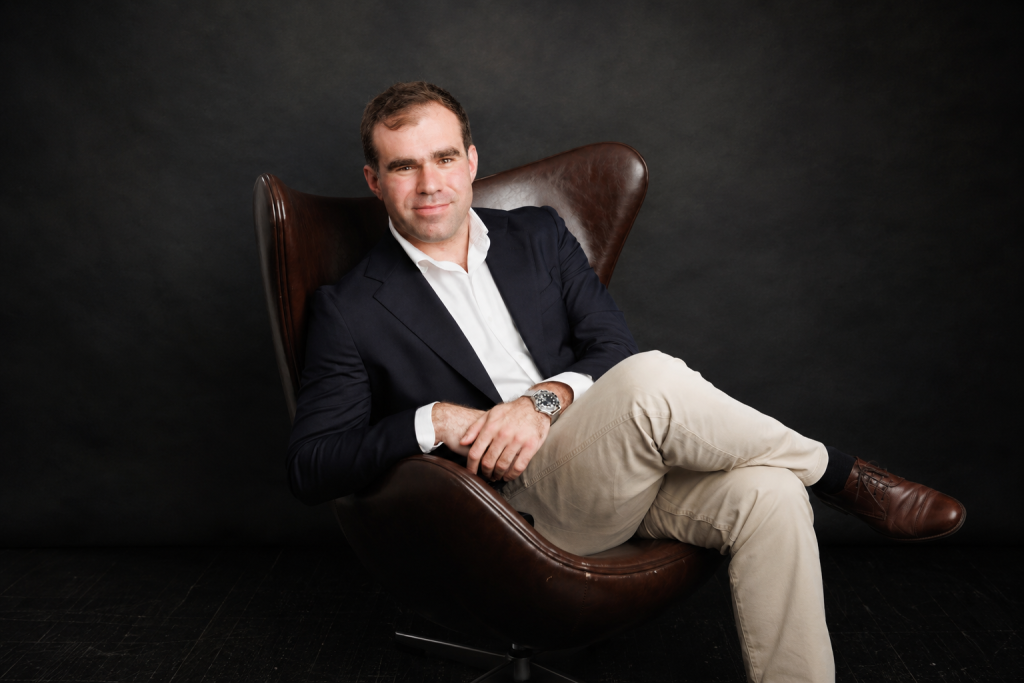
Most founders spend a year chasing one term sheet. Laurence Girard went and found five hundred doctors.
That decision, made in a Cambridge co-working room, is not the whole story. Girard started Fruit Street Health as a summer project at the Harvard Innovation Lab, after meeting physicians who were tired of watching patients die from diseases tied to diet and lifestyle. Type 2 diabetes. Heart disease. The slow ones. Fruit Street exists to help the one in three Americans living with prediabetes avoid the diagnosis entirely, through a prevention program run over video with registered dietitians.
Girard could have raised from a Sand Hill Road firm. Instead, he says, he raised roughly $35 million from hundreds of physician investors who wanted to move public health, one conversation at a time.
Doctors are a famously hard room. They ask about the scientific evidence base before anyone gets near the cap table. Girard sold them anyway, and in doing so built something more durable than money: a standing army of clinicians with skin in the game and a grievance with the system they work inside.
The physician investor thesis
There is a quiet arbitrage sitting in American healthcare, and Girard found it early. Physicians control enormous professional authority but historically owned almost none of the upside in the companies built around their work. They referred, prescribed, advised, and watched other people underwrite the exits.
Girard’s answer was structural. In 2017 he became Managing Director of Hippocrates Ventures, an early-stage fund made up exclusively of physician investors. Then came Healthcare Shares, a larger venture capital fund and venture studio built to formalize the model. Many of the doctors who backed Fruit Street became founding investors in Healthcare Shares itself.
The pitch to those clinicians is not complicated. Because they watch the system fail patients every day at the bedside, they diagnose bad healthcare startups faster than any generalist associate can. A cardiologist knows within four minutes whether a workflow product will actually get used at 6 a.m. on a Tuesday. That is diligence money cannot buy, and Healthcare Shares treats its physician advisory board as the core asset rather than a nice-to-have.
The firm also runs an online community for healthcare entrepreneurship, populated by physicians, founders, executives, attorneys, and technologists. Deal flow, in other words, disguised as a group chat.
What Fruit Street actually built
Fruit Street Health is a public benefit corporation, which matters more than it sounds. The company is a CDC-recognized Distance Learning provider of the National Diabetes Prevention Program Lifestyle Change Program, delivered by telehealth through live group video with registered dietitians. Participants track weight through a wireless scale and a Fitbit, photograph their meals in the Fruit Street app, and can opt into medically tailored meals delivered to the house.
The model is unfashionable in the best way. There is no molecule, no injectable, no billion-dollar compounding pharmacy narrative. Instead there is a year of group accountability aimed at a five to seven percent body weight reduction, one of the most replicated interventions in modern preventive medicine. Participants meet 26 times across the year with a dietitian and a small group of up to 30 people changing their habits in public, together.
Washington noticed
In 2023, the CDC invited Girard into its Lifestyle Change Implementation Research Network, convened through the National Center for Chronic Disease Prevention and Health Promotion to study how these programs get implemented at scale. Fruit Street was also recognized at the White House Conference on Hunger, Nutrition, and Health, where Girard met Senator Cory Booker. More recently he was at CMS headquarters alongside Dr. Mehmet Oz and Robert F. Kennedy Jr., after Fruit Street was selected for the CMS National Health Tech Ecosystem. The company also receives CDC funding through the American Diabetes Association’s Diabetes Prevention Alliance.
Federal invitations are not press releases. They get earned by enrolling thousands of real people and holding the data to prove it.
For anyone tracking the metabolic health trade, the timing is notable. GLP-1 drugs rewrote the category and simultaneously created a downstream problem nobody solved: what happens after the prescription. Behavioral infrastructure is suddenly the scarce resource, and Girard has been building it since 2014.
Credentials stacked like a hedge
Girard collects education the way some founders collect board seats. He earned his bachelor’s degree from Harvard Extension School, then completed both the Program for Leadership Development and the Venture Capital programs at Harvard Business School, each of which confers alumni status. Before that came Venture Capital and Private Equity at Columbia Business School. Then came a Sloan Fellowship at London Business School and a master’s in leadership and strategy.
That last one deserves a footnote. The Sloan program is not a night class. Alfred P. Sloan, then running General Motors, funded the original at MIT in 1930. Stanford added its version in 1957, London Business School in 1968. It is built for people already running things, and the alumni roster includes former United Nations Secretary-General Kofi Annan, former BP chief executive John Browne, and former Hewlett-Packard CEO Carly Fiorina.
Three business schools apparently did not settle it
Girard is currently a JD candidate at UNH Franklin Pierce School of Law through its hybrid program, concentrating in intellectual property and life sciences. He has also been admitted to a fourth, Oxford’s Global Healthcare Leadership master’s program for 2027-28, which he has now deferred twice. Reading that list, the obvious question is why a sitting CEO keeps enrolling in things.
The answer is legible if you know the sector. Healthcare venture is not a product business, it is a regulatory business. Reimbursement rules, IP position, and FDA posture decide outcomes more often than user experience does. A general partner who can read a patent file and a CMS rule without hiring it out runs with less friction than one who cannot.
The bench around him reflects the same instinct. Healthcare Shares Fund I is managed alongside Christopher Meatto, an attorney and financial executive who took his Harvard Law degree fifty years ago, and Dr. Daniel Dow, a board-certified radiologist of two decades. Lawyers and doctors, in other words.
Why the East End should be paying attention
Out here, longevity is the ambient religion. Every Sag Harbor dinner table eventually turns to peptides, continuous glucose monitors, VO2 max, and whoever just came back from a clinic in Switzerland looking suspiciously rested. The Hamptons wellness economy is enormous, and it is almost entirely consumer-facing.
Girard operates one layer beneath that. Prevention at population scale is where the actual dollars sit, because employers and health plans pay for it whether or not anyone posts about it. For family offices already overweight in consumer wellness, a physician-diligenced position in clinical infrastructure is the hedge, not the flyer.
The social overlap is equally real. The East End is thick with department chairs, practice owners, and hospital board members who summer three miles from each other and rarely get pitched as investors rather than donors. Girard’s entire model is built on exactly that person. Nobody has convened them out here yet.
Not just a healthcare executive. The next Ryan Reynolds of soccer?
As if the healthcare load were insufficient, Girard spent the pandemic launching two professional soccer clubs: New Amsterdam FC and Chicago House AC. Both now sit inside a multi-club ownership strategy that extends to Westfield FC, a London side he is working to acquire.
Girard jokes that Ryan Reynolds stole his playbook with Welcome to Wrexham. His version arrives without the Hollywood budget, which he cheerfully calls the poor man’s Wrexham. Rather than one celebrity bankrolling the story, he is assembling doctors, lawyers, founders, and executives who want to own a piece of an English club and watch it try to climb the football pyramid over the next twenty years.
The mechanism is the interesting part. Girard is using the JOBS Act and Regulation D Rule 506(c) to build that ownership group out of accredited investors, which is the same instinct that produced Fruit Street and Healthcare Shares. Find the people who care about the outcome. Let them own it. Skip the gatekeeper entirely.
Where the conversation continues
Social Life Magazine covers the people building the next version of the Hamptons economy, on the lawn and off it. Girard is one of them, and the conversation about physician capital, metabolic health, and where family office money goes next is one we intend to keep hosting.
If you are a founder, an allocator, or a clinician who has quietly been wondering whether your medical judgment is worth equity, you already know which side of that room you want to be standing on.
Editor’s note: this profile is journalism, not an offer or solicitation to buy any security. Nothing here is investment advice. Figures regarding capital raised are as provided by Fruit Street Health.
Author

Written by
Recent Posts

AI for personal finance: where PennyGuard fits

How to Pick a Homecoming Dress for Your Body Type (and Feel Amazing in It)

World Cup Injury Attorney for Vancouver Events
What a 3-Carat Engagement Ring Actually Costs in 2026: The Real Numbers
The Skincare Habits That Make a Real Difference Over Time
Categories
- Art
- Articles
- Business of Luxury
- Celebrities
- Culture
- Entertainment
- Events
- Faces of Summer 2026
- Fashion
- Fashion & Style
- Featured
- Finance
- Food, Spirits, Wine
- Hamptons
- Hamptons Celebrities
- Health
- Health & Beauty
- Lifestyle
- Luxury Lifestyle
- Press
- Profiles
- Real Estate
- Technology
- The Chronicles
- Travel
- Uncategorized
- Weddings