
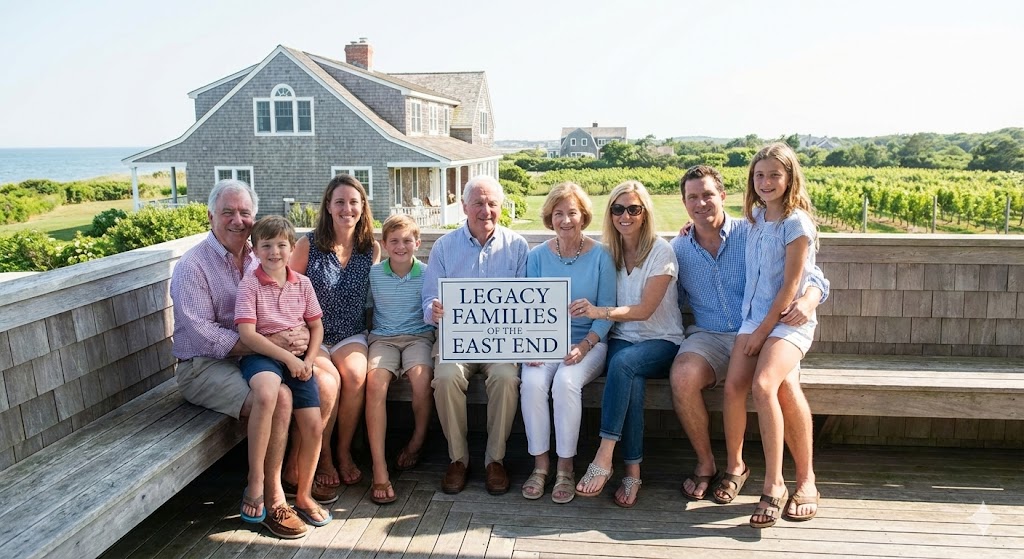
Old Money Profiles | The Families Who Built It | Where the Power Still Lives
Here is a truth about the Hamptons that no real estate listing will tell you: before the hedge fund managers discovered Meadow Lane, before the tech titans landed their helicopters at the Southampton heliport, a handful of families shaped everything you see. Consequently, their names appear carved into village landmarks, whispered in club dining rooms, and attached to land grants older than the nation itself.
This is not gossip. Rather, this is provenance. Understanding who built the East End tells you where the real power still resides, which family connections still open doors, and why certain addresses carry weight that money alone cannot buy. Moreover, the Hamptons did not emerge from the ocean fully formed as a summer playground for Manhattan’s elite. Instead, families built it decision by decision, generation by generation, across four centuries of strategic marriages, calculated land purchases, and the quiet accumulation of social capital.
What follows is the intelligence that separates insiders from outsiders. You will find the founding families whose bloodlines stretch back to 1640, the industrialists who transformed potato fields into estates, the African American community that built its own haven when doors closed elsewhere, and the dynasties whose influence extends so deep that their presence shapes the East End even when their heirs have scattered to the winds.
The Original Settlers: Families of the 1640s
Every story of Hamptons power begins at the same point: 1640. English Puritans from Lynn, Massachusetts, seeking religious freedom, landed at Conscience Point in what would become Southampton. Eight men, one woman, and a boy stepped ashore to establish what remains the oldest English settlement in the State of New York. From this moment, the East End’s social architecture began taking shape.
The Halsey Family: Southampton’s Founders
Thomas Halsey Sr. arrived in 1640 with his wife Elizabeth and four children. By 1648, when the settlement relocated from Old Town Road to what is now Main Street, Halsey had established the homestead that still stands today as the oldest English wood-framed house in New York State on its original site. Notably, the Halsey Homestead at South Main Street functions not merely as a museum. It serves as proof of claim.
Three hundred and eighty years later, descendants of the original Southampton families still trace their lineage through the Halseys and their intermarried kin: the Howells, the Sayres, the Fosters. Furthermore, the Old Southampton Burying Ground holds their remains, with massive brownstones carved with family coats-of-arms marking the graves of those who established a society that would outlast empires.
What Halsey Means Today
Halsey functions as a Southampton street name, a historical society, and a credential. Families who can trace their East End roots to this founding group possess a pedigree that no amount of wealth can purchase. Therefore, when you hear someone casually mention that their family “has been here since the beginning,” they mean 1640. This distinction matters in ways that newcomers rarely understand until they encounter the subtle social barriers it creates.
The Gardiner Family: America’s Oldest Estate
One year before Southampton’s founding, Lion Gardiner purchased a 3,300-acre island from Montaukett chief Wyandanch. The price consisted of a large black dog, some Dutch blankets, and a bit of powder and shot. King Charles I then signed a royal patent granting Gardiner “the right to possess the land forever.” That forever has now stretched to 386 years and counting.
Gardiner’s Island remains the oldest estate in the United States and the only royal grant still intact in the country. It sits between the North and South Forks, encompassing 3,318 acres of private kingdom with 27 miles of coastline, more than 1,000 acres of old-growth forest, and the largest stand of white oak trees in the Northeast. There is no public access. The “No Trespassing” signs are not suggestions.
Pirates, Wars, and Strategic Survival
The island’s history reads like a novel that any publisher would reject as implausible. Captain William Kidd buried $30,000 in treasure there in 1699, giving Mrs. Gardiner a piece of gold cloth and a bag of sugar before sailing to Boston to stand trial for piracy. Authorities later dug up the treasure and used it as evidence in Kidd’s execution. During the Revolutionary War, British forces turned the island into their private hunting preserve. Then, during the War of 1812, the family patriarch faked illness so convincingly that the British abandoned their attempt to arrest him.
Robert David Lion Gardiner, who called himself the “16th Lord of the Manor,” died in 2004. His famous declaration captures the family philosophy: “We have always married into wealth. We’ve covered all our bets. We were on both sides of the Revolution, and both sides of the Civil War. The Gardiner family always came out on top.”
The Island Today
Today, Alexandra Creel Goelet, a Gardiner descendant with a master’s degree in forestry from Yale, owns the island. Annual upkeep runs approximately $2 million. Additionally, a conservation easement with East Hampton Town extends through 2025.
The Gardiner name represents something that transcends mere wealth: unbroken continuity. When Robert Gardiner dismissed the Du Ponts, Rockefellers, and Fords as “nouveaux riches” because “they’re not even a colonial family,” he established the standard by which old money judges itself. Gardiner’s Island is not for sale at any price. That is precisely the point.
The Shinnecock: The Original Landlords
Any honest accounting of East End legacy must begin before 1640. The Shinnecock Nation has inhabited this land for approximately 10,000 years. When the English Puritans arrived, the Shinnecock taught them how to survive, sharing knowledge of whaling, fishing, and farming that made colonial settlement possible. Without this assistance, the European colonists would likely have perished.
Building the Whaling Industry
The commercial whaling industry in the United States began in the 1650s with contracts between Southampton settlers John Ogden and John Cooper and Shinnecock fishermen. Native expertise proved so essential that in 1708, the governor enacted a law stating that “Indians under indenture to whaling companies could not be arrested, molested, or detained” during whaling season.
The Lee family of the Shinnecock Reservation produced generations of master whalemen. Ferdinand Lee achieved the rare title of “Captain,” sailing around the world before wrecking in the Arctic. Moreover, on April 18, 1845, a Shinnecock man named Eleazar became the first Native American to enter Japanese territory when the whaling vessel Manhattan anchored in Tokyo Bay. This occurred eight years before Commodore Perry’s famous visit.
Land Lost and Legacy Preserved
In 1859, a group of New York investors, including Austin Corbin, president of the Long Island Rail Road, conspired to break a 1,000-year lease that Southampton colonial officials and the tribe had signed in 1703. They sent the state Legislature a fraudulent petition. As a result, the tribe lost 3,500 acres, including the land where Shinnecock Hills Golf Club now stands.
Nevertheless, the Shinnecock Indian Reservation remains within Southampton’s geographic boundaries. The nation achieved federal recognition in 2010. Additionally, the annual Shinnecock Powwow, held every Labor Day weekend, draws visitors from across the country as one of the largest gatherings of its kind.
The Shinnecock remind us that all East End fortunes rest on contested ground. Their continued presence challenges any narrative that treats Hamptons history as beginning with the arrival of Europeans. The ongoing land claims, the 2010 federal recognition, and the economic initiatives the nation pursues represent unfinished business that predates every estate, club, and subdivision in the region.
The Gilded Age Industrialists: Building the Summer Colony
The Long Island Rail Road pushed through to the East End in the 1860s. By hook or crook, the railroad companies found ways to get rights-of-way through the remaining Indian land. What followed was America’s Gilded Age, and the tycoons came with it.
Oceanfront estates shot up on land that farmers had considered least workable. The Maidstone Club opened in 1891, creating a hub for high society that remains one of the most exclusive golf clubs in the country. Entry fees today range between $500,000 and $1 million, but that is not the point. Lineage matters more than liquidity. Your great-grandfather’s membership carries more weight than your hedge fund’s performance.
The Ford Family: Fordune and American Industry
The grand event of summer 1940 was the marriage of Henry Ford II, eldest son of Edsel Ford and eldest grandson of Henry Ford himself, to Southampton socialite Anne McDonnell at St. Vincent Ferrer Church in New York. Life magazine called it the joining of “two great U.S. industrial fortunes.”
The McDonnells brought Ford to Southampton. Anne’s family eventually owned 300 acres of oceanfront in Southampton and Water Mill. Interestingly, Squabble Lane got its name because it separated two factions of the family who enjoyed infighting.
Building Fordune
In 1957, Sports Illustrated wrote: “Brought to The Hamptons by his wife’s family, who inhabit a string of estates along the sea, Henry Ford II is building one of the greatest showplaces of the times.” The 16,000-square-foot mansion resembled a French chateau. Workers imported whole paneled rooms, fireplaces, and parquet floors from European estates. The construction cost $2.3 million, equivalent to roughly $25 million today.
After Ford and Anne divorced in 1964, the family sold off sections of the 235-acre Fordune estate. However, the main house and 42 acres remained intact until 2021, when the property sold for $105 million, setting a Hamptons record at the time.
The Fordune enclave, technically in Water Mill but accessed from Wickapogue Road, contains the historic Ford mansion and over fifty large estates. It represents the peak of industrial-age wealth translated into East End real estate. The Ford connection gave Southampton a direct link to the commanding heights of American manufacturing.
The Whitney Family: Elysium on Meadow Lane
Elysium, located at 1116 Meadow Lane in Southampton, stands as a stunning example of Beaux-Arts architecture. The prominent Whitney family originally built this grand estate, which showcases elaborate stonework and lush formal gardens. The Whitney family, well-known for their involvement in thoroughbred horse racing, founded the prestigious Belmont Park racetrack.
The Whitneys represent a certain type of East End family: industrial wealth combined with sporting passion. Their racing interests dovetailed naturally with Southampton’s equestrian culture, the horse shows overlooking Lake Agawam, and the riding clubs that still operate today.
The Devon Colony: Cincinnati’s “Soap Hill”
In 1908, four prominent families from Cincinnati, Ohio, purchased 1,000 acres in northern Amagansett and founded the Devon Colony. William Cooper Procter, grandson of Procter & Gamble founder William Procter, joined Richmond Levering and others in discovering the area during a hunting trip.
The location sits 90 feet above sea level, with Gardiner’s Bay to the north and the ocean to the south. Grand stucco houses rose along Oceanview Lane. Because their wealth came largely from Procter & Gamble, famous for Ivory soap, locals nicknamed the colony “Soap Hill.”
Think badminton on the great lawn, lemonade served by uniformed staff. These historic homes harken back to a time when industrial fortunes funded summer enclaves removed from the Hamptons social competition farther west. Furthermore, the Devon Yacht Club, which the colonists founded alongside their homes, still operates today.
The Bouvier Dynasty: American Aristocracy
The Bouvier family mythologized themselves as descendants of French nobility. This claim was almost certainly invented Gilded Age vanity, but the fiction became so powerful it shaped American history. Their East End presence centered on two estates: Lasata in East Hampton and Grey Gardens in the Georgica section. Both addresses would become synonymous with American aristocracy, ambition, and decline.
Lasata: “Place of Peace”
Lasata, a Native American name meaning “place of peace,” served as the childhood summer home of a future First Lady. Architects built the two-story gray-stucco mansion at 121 Further Lane in 1917, two blocks from the Atlantic Ocean and three blocks from the Maidstone Club. John Vernou Bouvier Jr., known as “the Major,” acquired the 12-acre estate in 1925.
“Each May the various Bouvier households would move out of their Park Avenue apartments for the summer to East Hampton,” wrote historian Sarah Bradford. “Maude would transplant her entire household staff to Lasata.” The grounds included stables for eight horses, a tack room, jumping ring, paddock, extensive vegetable gardens, a grape arbor, and an “Italian garden” edged with boxwood and classical statues.
Jackie Kennedy’s Summers
Young Jacqueline Bouvier learned to ride here, becoming so accomplished that The New York Times noted in 1940 that the “eleven-year-old equestrienne from East Hampton, Long Island, scored a double victory in the horsemanship competition,” calling it “a rare distinction.” At age ten, she wrote a poem titled “Sea Joy”: “When I go down to the sandy shore I can think of nothing I want more than to live by the booming blue sea.”
After her parents divorced in 1940, Jackie’s summers shifted to her stepfather’s farm in Newport. Nevertheless, Lasata never left her. When planning her husband’s funeral after the assassination of President John F. Kennedy, she insisted on decorating St. Patrick’s Cathedral with sprays of summer flowers in white wicker baskets. “I want everything to look like a summer garden,” she said, “like Lasata in August.”
Lasata Today
In 2023, designer Tom Ford purchased Lasata for $52 million. The property has passed through hands including fashion executive Reed Krakoff and film producer David Zander, who commissioned new interiors from designer Pierre Yovanovich and gardens by landscape architect Louis Benech.
Grey Gardens: The Fall of the House of Bouvier
A block from the Atlantic Ocean, at 3 West End Road and Lily Pond Lane, sits Grey Gardens. The house takes its name from the color of the dunes, the concrete garden walls, and the sea mist. Joseph Greenleaf Thorpe designed this 14-room house in 1897, and it would eventually become synonymous with genteel decay.
Edith Ewing Bouvier Beale, known as “Big Edie,” was Jackie Kennedy’s aunt. Her daughter, Edith Bouvier Beale, known as “Little Edie,” was Jackie’s first cousin. Phelan Beale purchased Grey Gardens in 1924 for his wife. After an extended marital separation, he notified her of their divorce by telegram from Mexico around 1946.
Descent into Squalor
What followed was one of American society’s most public collapses. Without adequate income, Big Edie and Little Edie retreated into the house. By the 1960s, thick growth covered the gravel driveway. An abandoned car sat with a key in its ignition. The grand piano had warped into a fossil. Cat hair, cobwebs, and dust coated the entire main level.
In October 1971, police raided Grey Gardens and found it “full of litter, rife with the odor of cats, and in violation of various local ordinances.” The news generated international attention because the inhabitants were relatives of Jacqueline Kennedy Onassis. Consequently, Jackie and her sister Lee Radziwill paid $30,000 to refurbish the property and settle back taxes.
Documentary Fame and Restoration
Documentary filmmakers Albert and David Maysles captured the women’s life in 1975’s “Grey Gardens,” now considered a masterpiece of the documentary genre. Little Edie’s creative outfits, often cobbled together from household items, made her an unlikely fashion icon. The film later spawned a Broadway musical and an HBO movie starring Drew Barrymore and Jessica Lange.
After Big Edie died in 1977, Little Edie sold the mansion to Washington Post executive editor Ben Bradlee and his wife Sally Quinn for $220,000 with one stipulation: they could not tear it down. Quinn later recalled the house was “worse than the movie.” They spent years restoring it. The property ultimately sold for nearly $15.5 million in 2017.
Grey Gardens serves as a cautionary tale about what happens when social capital erodes and no one remains to maintain the infrastructure of gentility. The Bouviers represent both the peak of East End society—Jackie Kennedy’s association with Further Lane and the Maidstone Club—and its most dramatic fall. Little Edie’s famous line from the documentary captures the central tension: “It’s very difficult to keep the line between the past and the present.”
The African American Legacy: Eastville and SANS
Any story of Hamptons legacy that ignores the African American community is incomplete. From the early 1800s until the mid 1900s, the section of historic Sag Harbor known as Eastville served as home to a multi-ethnic population of free Blacks, European immigrants, and Native Americans.
Eastville: Underground Railroad to Whaling Wealth
African Americans arrived in Sag Harbor seeking employment in the profitable whaling business sometime prior to 1840. They joined Montaukett and Shinnecock people who already possessed skilled whaling expertise. Around 1840, Lewis Cuffee, Charles Plato, and William Prime organized the St. David AME Zion Church, which became the center of the Eastville community.
The congregation built the church in 1839 on Eastville Avenue, and historians widely believe it served as a stop on the Underground Railroad. Its founding pastor, Rev. P. Thompson, was a noted Abolitionist and friend of Frederick Douglass. Additionally, the adjacent century-old cemetery holds African Americans and Native Americans, many of whom worked as Sag Harbor whalers.
Whalemen of Distinction
Men of Eastville rose to prominence in the whaling industry. David Waukus Bunn served as First Mate on several vessels. Miles Ashman appears in the New Bedford Whaling Crew List Database. Charles Ashman worked on the ship “Three Brothers” in 1875. These men were skilled professionals who commanded respect in an industry that judged competence over color.
SANS: The Black Hamptons
Sag Harbor Hills, Azurest, and Ninevah Beach Subdivisions, collectively known as SANS, emerged between 1947 and 1952 when African Americans created a place of their own. It functioned primarily as a vacation community, a place where people built second homes.
The vision came from Brooklyn schoolteacher Maude Terry while vacationing at a cottage in Eastville. She fell in love with the woods and secluded beach and imagined a private community for Black families on undeveloped land between Hampton Street and Gardiner’s Bay. Her sister, Amaza Lee Meredith, an architect, drew up plans to subdivide the property.
Building Community Through Self-Reliance
The founders self-financed at a time when policies made it incredibly difficult for Black people to get mortgages. It became a place of rest and relaxation during Jim Crow segregation, when few other places welcomed Black families for this kind of passive recreation. Word spread by word of mouth through New York City’s Black communities.
SANS attracted a who’s who of Black elite: politicians, corporate CEOs, entertainers. Harry Belafonte visited. Lena Horne came. Langston Hughes often visited historian William Pickens, a founder of the NAACP. Edward R. Dudley, the first African American U.S. ambassador and Manhattan Borough President, built a home here. Additionally, Pulitzer Prize-winning novelist Colson Whitehead set his 2009 novel “Sag Harbor” in this community.
“Here you could have a beachfront deeded to your property,” explained Georgette Grier-Key, executive director of the Eastville Community Historical Society. “You could leave your door open and not be afraid of the threat of the Ku Klux Klan, which was very prevalent, even out here on Long Island.”
Preservation Challenges
The community joined the National Register of Historic Places on July 10, 2019. It represents one of only about 2 percent of the 95,000 listings that focus on African American history.
However, SANS now faces mounting development pressure as waterfront property values escalate. Developers have discovered these undervalued homes steps from the beach. Rising taxes have forced out some longtime families. The struggle to preserve SANS is ultimately the struggle to preserve an alternate Hamptons history, one where middle-class Black professionals built their own summer community through collective action and self-reliance.
Meadow Lane Today: Where the Old Money Lives
Southampton’s Meadow Lane has earned the nickname “Billionaires’ Row.” This five-mile strip of oceanfront contains approximately 100 homes, more than half of them brag-worthy mansions. Ken Griffin purchased Calvin Klein’s compound for $84.4 million. Robert Kraft paid $43 million. Daniel Och’s estate anchors the lane.
The Geography of Wealth
The oceanfront roads—Gin Lane and Meadow Lane—rank as the most expensive in the village. Southampton has served as home to members of the Ford, Du Pont, Morgan, Atterbury, Woolworth, and Eisenhower families. Moreover, the village hosts approximately half of the billionaires with residences in the Hamptons.
Supporting Billionaires’ Row is an army of workers rivaling a small city’s workforce. Each estate employs an average of 20 full-time staff: butlers, chefs, gardeners, and “house managers” who earn six-figure salaries. The private staffing industry has become so specialized that agencies maintain Southampton offices just to service this single street.
Private Enclaves Within Enclaves
Private housing associations and private roads dot Southampton Village. The Murray-McDonnell compound, Pheasant’s Close, Olde Towne, and the Fordune enclave represent subcommunities containing dozens of expensive homes. Few are actually gated. Instead, exclusivity is enforced through other means entirely.
The Private Clubs: Where Membership Matters More Than Money
Five private clubs rank as the most elite, prestigious, and difficult to join in the Hamptons: the Bathing Corporation of Southampton, the Meadow Club, the National Golf Links of America, Shinnecock Hills Golf Club, and the Maidstone Club. Of these, the Maidstone is widely considered the most exclusive.
The Maidstone Club: Lineage Over Liquidity
Founded in 1891, the Maidstone Club takes its name from the original name for East Hampton, itself named after Maidstone in England. The club started as a 7-hole course in 1894 and expanded to 18 holes in 1899. Its website remains inaccessible unless you have a membership and password.
Stories about the club’s exclusivity are notorious. In the 1950s, Groucho Marx played as a member guest but then faced rejection for membership. The club did not admit Jews until the late 1970s. Through the 1990s and early 2000s, journalists reported no Black members.
How Membership Works
The club extends membership by invitation only, requiring sponsorship by existing members and vetting by the admissions committee. Prospective members must demonstrate longstanding ties to elite social networks, with strong preference for legacy applicants. Initiation fees range between $500,000 and $1 million, with undisclosed annual dues.
Notable members have included John Steinbeck and E.B. White. Steinbeck wrote parts of “The Winter of Our Discontent” at the club. Furthermore, the East Hampton Historical Society’s annual House & Garden Tour often uses the Maidstone for its kickoff cocktail party.
The Maidstone represents “benevolent paternalism,” a family-oriented exclusivity where lineage and restraint matter more than visible display. Unless you have very well-connected friends or a time machine to establish your family’s East Hampton credentials circa 1891, you might set your sights elsewhere.
The Bottom Line: What This Intelligence Means
The families profiled here did not simply buy their way into the Hamptons. They built it, defended it, and defined the rules by which subsequent arrivals would be judged. Understanding this history is not antiquarian nostalgia. It is strategic intelligence.
Lessons From Legacy
Gardiner’s Island teaches you: The most valuable things are not for sale. Real power comes from assets that cannot be purchased at any price.
The Bouviers teach you: Social capital requires maintenance. Without it, even the most storied families decline into tabloid curiosities.
The Shinnecock teach you: All claims to East End land are contested. The original inhabitants have not forgotten, and their story is not over.
SANS teaches you: Exclusion breeds innovation. When doors close, communities build their own doors.
The Maidstone teaches you: Money cannot buy everything. Some things require time, relationships, and demonstrated commitment to a community’s unwritten codes.
The New Money Question
The new money flooding the Hamptons can purchase oceanfront acreage, build 20,000-square-foot compounds, and hire the staff of a boutique hotel. However, it cannot purchase the credibility that comes from centuries of presence, the relationships that pass between generations, and the institutional knowledge of how East End society actually works.
That is the difference between buying a house and joining a community. The legacy families understood this distinction completely. The question is whether their successors will.
Learn More
For features, advertising, and partnership inquiries: sociallifemagazine.com/contact
For tickets and sponsorships: polohamptons.com
Subscribe to our print edition for the full archive of Hamptons intelligence.
Support independent journalism: $5 helps us continue this work.
Related Articles
- The Hamptons Power Lunch Guide: Where Table Politics Still Matter
- What Things Actually Cost in the Hamptons | 2026 Guide
- The Social Calendar Playbook | Hamptons Events Guide 2025
- Celebrity Net Worth: Hamptons Edition
Author

Written by
Recent Posts

Aaron Paul Net Worth — His Character Was Supposed to Die in Season One. Instead He Made $30 Million.

Bryan Cranston Net Worth. He Played a Sitcom Dad for Seven Years. Then He Became the Most Dangerous Man on Television.
Breaking Bad Cast Net Worth. $130 Million Cooked in Five Seasons of Perfect Television

Cailee Spaeny Net Worth — From Springfield, Missouri to A24 and Alien in Three Years Flat

Wagner Moura Net Worth — He Learned Spanish to Play Escobar. Then He Learned English to Take Hollywood.
Categories
- Art
- Articles
- Beauty & Skincare
- Celebrities
- Celebrities|Movies
- Celebrities|The Chronicles
- Chronicles
- Entertainment|Culture
- Event Photos
- Events
- Fashion
- Fashion & Style
- Featured
- Food & Beverage
- Food, Spirits, Wine
- Hamptons
- Hamptons Celebrities
- Hamptons Celebrities|Celebrities|The Chronicles
- Health
- Health & Beauty
- Lifestyle
- Luxury Lifestyle
- Movies|Culture
- Movies|Hamptons Lifestyle
- Press
- Profiles
- Real Estate
- Technology
- The Chronicles
- Travel
- TV
- Uncategorized
- Weddings