
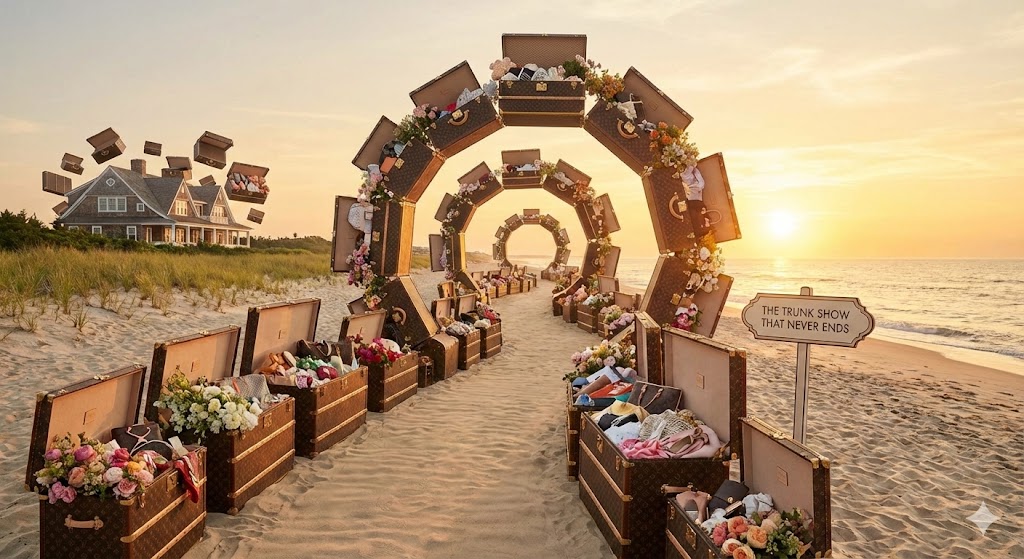
Inside the flagship, a limited-edition Neverfull bears a single word embossed in blue-and-white monogram leather: HAMPTONS. The bag costs $2,030. Furthermore, the word itself costs nothing to print. Yet the word is precisely what you’re paying for. Pierre Bourdieu, the French sociologist who spent his career dissecting how taste functions as social weaponry, would recognize this transaction instantly. You’re not buying canvas and cowhide. You’re purchasing membership in a story that began 170 years ago on a Paris street.
Louis Vuitton Hamptons: The $22 Million Statement
In March 2023, Bernard Arnault—chairman of LVMH and, depending on the day’s stock price, the world’s richest man—purchased 1 Main Street in East Hampton for $22 million. At $4,400 per square foot, this transaction exceeded prime retail rates in Hong Kong, Milan, and Manhattan’s Fifth Avenue. Moreover, it set the record for commercial real estate in Hamptons history.
The question is not why Louis Vuitton chose this location. The question is what being here allows the brand to become. Consequently, understanding this requires examining what sociologists call “symbolic capital”—the prestige and recognition that money alone cannot purchase, but money can certainly amplify.
The building dates to 1917. Designer Elie Tahari owned it previously, having paid $7.5 million in 2006. Cartier occupied the space as a summer pop-up in 2022. However, LVMH wanted permanence, not a seasonal affair. Therefore, the world’s largest luxury conglomerate now owns the Hamptons’ most visible corner outright.
The Genesis: From Orphan Walker to Empire Builder
Louis Vuitton was born in 1821 in Anchay, a small village in eastern France. His mother died when he was ten. His father remarried a woman Louis found intolerable. Consequently, at thirteen, he left home and walked nearly 300 miles to Paris, working odd jobs along the way.
This origin story functions as what Bourdieu termed “institutionalized cultural capital.” The narrative transforms a practical trade—trunk-making—into mythology. Additionally, it positions the brand as self-made, resilient, and fundamentally French. Every Louis Vuitton customer who learns this history participates in its retelling.
In 1837, Vuitton apprenticed under Monsieur Maréchal, a master trunk-maker. He stayed seventeen years, perfecting techniques that would revolutionize travel. Furthermore, by 1853, Empress Eugénie—wife of Napoleon III—appointed him her personal box-maker. This royal endorsement catalyzed everything that followed.
The Innovation That Changed Everything
In 1854, Vuitton opened his first shop at 4 Rue Neuve des Capucines in Paris. His innovation was deceptively simple: flat-topped trunks. Before Vuitton, luggage featured rounded lids designed for water runoff. However, rounded trunks couldn’t stack. Flat-topped trunks could.
This seemingly minor adjustment aligned perfectly with the age of steamships and railways. Travel was democratizing—or at least expanding to the wealthy bourgeoisie. Vuitton’s stackable trunks solved a logistical problem while simultaneously creating a status marker. If you owned Vuitton luggage, you traveled. If you traveled, you mattered.
In 1896, his son Georges introduced the iconic LV monogram canvas. The design—quatrefoils, flowers, and interlocking initials—drew inspiration from Japanese family crests. Moreover, it served a practical purpose: combating counterfeiting. Nevertheless, it also created what Bourdieu would call “embodied cultural capital.” Recognizing that monogram became a test of taste literacy.
The Four Capitals: Decoding What Louis Vuitton Actually Sells
Bourdieu identified four forms of capital that determine social position: economic, cultural, social, and symbolic. Louis Vuitton’s genius lies in converting each form into the others. Consequently, a handbag becomes a portfolio of advantages.
Economic Capital: The Price of Entry
The Neverfull MM retails for approximately $2,030. The Speedy 25 starts around $1,650. However, these “entry-level” pieces merely grant access. True economic differentiation appears in the trunk collection, where custom pieces command six figures. A bespoke wardrobe trunk can exceed $100,000.
Louis Vuitton’s brand valuation reached $129.9 billion in 2024, according to Kantar BrandZ rankings. This figure represents a 4% increase from the previous year. Furthermore, it solidifies Louis Vuitton’s position as the world’s most valuable luxury brand for the eighteenth consecutive year. The parent company, LVMH, reported revenues of €86.2 billion in 2023.
What does this mean for the East Hampton shopper? The economic bar for entry sits high enough to exclude the middle class but low enough to include the aspirational wealthy. A $2,000 bag represents significant expenditure for most Americans. Nevertheless, for the Hamptons’ summer population—where median home prices exceed $2 million—it registers as affordable indulgence.
Cultural Capital: What You Must Know
Bourdieu distinguished between three types of cultural capital. Embodied capital refers to knowledge absorbed into the body—taste, manners, dispositions. Objectified capital means cultural goods themselves—the handbag, the trunk, the monogram stole. Institutionalized capital involves credentials and certifications.
Louis Vuitton demands all three. Additionally, it rewards those who possess them. The casual observer sees a brown bag with letters. The initiated recognize specific models, seasonal variations, and collaboration histories. They know that Takashi Murakami’s multicolor monogram from 2003 differs fundamentally from Virgil Abloh’s 2018 rainbow gradient.
This knowledge gap creates distinction. Furthermore, it explains why Louis Vuitton invests heavily in heritage storytelling. The Asnières workshop, where artisans still craft trunks using nineteenth-century techniques, functions as a pilgrimage site. Visiting it—understanding what happens there—converts economic capital into cultural capital.
Social Capital: Who You Become by Association
Carrying Louis Vuitton signals membership in a network. The brand’s celebrity associations span Rihanna, Angelina Jolie, and multiple royal families. Moreover, creative directors like Nicolas Ghesquière, the late Virgil Abloh, and current menswear head Pharrell Williams extend this network into fashion, music, and art worlds.
In the Hamptons specifically, the social capital equation intensifies. The store’s opening party in May 2023 featured Champagne, caviar-topped blinis, and live music. Guests watched an artisan paint flowers on a monogrammed suitcase, demonstrating the on-site personalization services. This wasn’t shopping. It was convening.
The white Moke shuttle embodies this social function perfectly. When you accept the ride, you advertise your destination to everyone you pass. Consequently, arrival at Louis Vuitton becomes performance, witnessed and therefore validated.
Symbolic Capital: What Ownership Says About You
Symbolic capital represents prestige itself—recognition, honor, reputation. Louis Vuitton’s position at the apex of the luxury hierarchy confers maximum symbolic return. However, the calculus grows complicated in the Hamptons context.
The East End attracts both old money and new. Old money—legacy wealth, family fortunes, multi-generational assets—often practices conspicuous non-consumption. Nevertheless, new money—tech founders, hedge fund managers, entertainment executives—frequently signals success through visible acquisition.
Louis Vuitton navigates this tension strategically. The monogram broadcasts wealth unmistakably. Yet the brand also offers understated options: Epi leather, Taïga leather, pieces without visible branding. Consequently, customers can calibrate their symbolic output. Screaming or whispering—Louis Vuitton accommodates both registers.
Why Louis Vuitton Chose the Hamptons—And What It Reveals
The Hamptons function as what Bourdieu called a “field”—a competitive arena where agents struggle for position. Luxury brands competing for Hamptons real estate participate in this struggle. Furthermore, their location choices reveal strategic positioning.
Louis Vuitton selected the most prominent corner in East Hampton Village. Chanel occupies 28 Newtown Lane. Prada sits at 2 Newtown Lane. Gucci holds space nearby. This clustering intensifies competition while simultaneously validating each participant. Moreover, proximity to competitors signals confidence in one’s own position.
The Store Experience
The East Hampton boutique spans two floors within a landmarked brick building. Interior design evokes seaside aesthetics: blue-and-white tiled floors featuring the monogram flower pattern, petrified wood fixtures by designer Andrianna Shamaris, and a constellation of Zanellato/Bortotto lanterns overhead.
Decorative elements include surfboards, beach chairs, hammocks, and banana palms. The effect simulates a walk on the beach. However, the simulation operates in reverse. You’re not on the beach. You’re in a climate-controlled retail environment contemplating a $3,000 purchase. Nevertheless, the coastal coding softens the transaction, making luxury feel like leisure.
The LV By The Pool collection debuts here annually before global release. Hamptons-exclusive products include a monogrammed pareo stole and fan bearing the word “Hamptons.” These limited editions transform the location itself into cultural capital. Owning the Hamptons fan proves you were there, in the right place at the right time.
Playing the Field: Louis Vuitton vs. the Competition
Within the Hamptons luxury field, brands occupy distinct positions. Hermès represents maximum exclusivity—Birkin waiting lists, by-appointment shopping, studied indifference to customer demand. Chanel channels Parisian heritage with seasonal pop-up theatrics. Nevertheless, Louis Vuitton claims the biggest footprint and the boldest location.
This positioning reflects a calculated bet. Louis Vuitton accepts that some old-money customers consider it too visible, too accessible, too new-money-coded. However, the brand bets that Hamptons demographics skew toward those who earned wealth rather than inherited it. Tech money, finance money, entertainment money—these populations often appreciate visible markers of success.
Furthermore, Louis Vuitton’s ownership structure enables aggressive expansion. As LVMH’s flagship brand, it commands resources unavailable to independent competitors. Bernard Arnault can purchase buildings outright rather than negotiate leases. This permanence sends its own signal: we’re not testing the market. We’re claiming it.
The Quiet Luxury Tension
The “quiet luxury” trend—exemplified by The Row, Loro Piana, and Brunello Cucinelli—positions itself against logo-heavy brands. Additionally, this aesthetic aligns with old-money habitus: wealth that doesn’t need to announce itself.
Louis Vuitton responds by offering both registers. The screaming monogram canvas coexists with whisper-quiet Epi leather in the same store. Consequently, customers can signal according to context. The monogram Neverfull for Saturday farmers market browsing. The plain leather briefcase for Monday investor meetings.
This flexibility represents commercial genius. Rather than ceding the quiet-luxury customer to competitors, Louis Vuitton absorbs them into its own ecosystem. You can be both types of rich person—just buy both bags.
The Investment: Cultural Arbitrage or Conspicuous Consumption?
What does entering Louis Vuitton Hamptons actually mean? The answer depends on your existing capital portfolio.
For those with abundant economic capital but limited cultural capital—the newly wealthy seeking social legitimacy—Louis Vuitton offers a shortcut. The brand’s heritage story, its royal associations, its museum-worthy trunk collection all convey taste without requiring you to develop it organically. You can purchase the cultural capital that old money accumulated over generations.
For those with cultural capital but modest economic means—fashion professionals, artists, cultural workers—Louis Vuitton presents a dilemma. You may recognize the brand’s quality and appreciate its design heritage. However, purchasing signals alignment with values you might critique. Nevertheless, many resolve this tension through ironic consumption or selective acquisition.
For the already-wealthy with established cultural credentials, Louis Vuitton functions as convenience. The bag works. The craftsmanship endures. The purchase requires no justification because nothing needs proving.
Practical Information
Louis Vuitton East Hampton occupies 1 Main Street, on the corner of Main Street and Newtown Lane. Hours run Monday through Saturday from 10 a.m. to 7 p.m., and Sunday from noon to 6 p.m. The complimentary Moke shuttle service operates throughout East Hampton Village.
First-time visitors should expect attentive service calibrated to purchase intent. Sales associates read signals quickly. Browsing is permitted. Moreover, high-traffic periods around holidays and summer weekends may require patience. The second floor offers personalization services and private appointments for significant purchases.
The Final Calculation
Louis Vuitton Hamptons represents a $22 million bet that the East End’s wealthy want what the brand sells: not just products, but participation in a mythology that transforms consumption into identity. The flat-topped trunk that revolutionized travel in 1858 now sits reimagined as a gaming trunk, a mahjong set, a conversation piece for beach houses that cost more than most Americans earn in a lifetime.
Bourdieu warned that taste operates as “social weaponry”—a means of establishing distinction between those who possess legitimate culture and those who merely possess money. Louis Vuitton brilliantly bridges this gap. It sells legitimacy to those with money and exclusivity to those with taste. The store at 1 Main Street serves as embassy for this transaction, a physical space where capital converts into capital, endlessly.
The Moke will take you anywhere in the village. Nevertheless, it will always bring you back here.
Continue Your Luxury Education
- The 8 Hamptons Boutiques Fashion Editors Actually Shop — Discover where industry insiders spend their own money, from Kirna Zabête to The Row.
- Best of the Hamptons 2026: Restaurants, Beaches, and Power Scenes — The complete insider guide to East End destinations worth your time.
Stay Connected with Social Life Magazine
Author

Written by
Recent Posts
High quality leather accessories
The Coconut Acai Base: A Fresh Take on Nutrient-Dense Eating
Be the Nurse Who Makes a Difference: Amplifying Your Impact
5 Benefits Prefab Steel Buildings Offer for Modern Design Flexibility
Why ADHD Is More Than Just Trouble Paying Attention ADHD is often viewed as a simple case of being easily distracted or having too much energy. This narrow view fails to capture how the condition actually works in the brain. It is a complex neurological disorder that impacts how a person manages their time, emotions, and actions. Understanding the depth of these challenges is the first step toward better support and self-compassion.
Categories
- Art
- Articles
- Beauty & Skincare
- Celebrities
- Celebrities|The Chronicles
- Chronicles
- Entertainment|Culture
- Event Photos
- Events
- Fashion
- Fashion & Style
- Featured
- Food & Beverage
- Food, Spirits, Wine
- Hamptons
- Hamptons Celebrities
- Hamptons Celebrities|Celebrities|The Chronicles
- Health
- Health & Beauty
- Lifestyle
- Luxury Lifestyle
- Movies|Hamptons Lifestyle
- Press
- Profiles
- Real Estate
- Technology
- The Chronicles
- Travel
- Uncategorized
- Weddings