
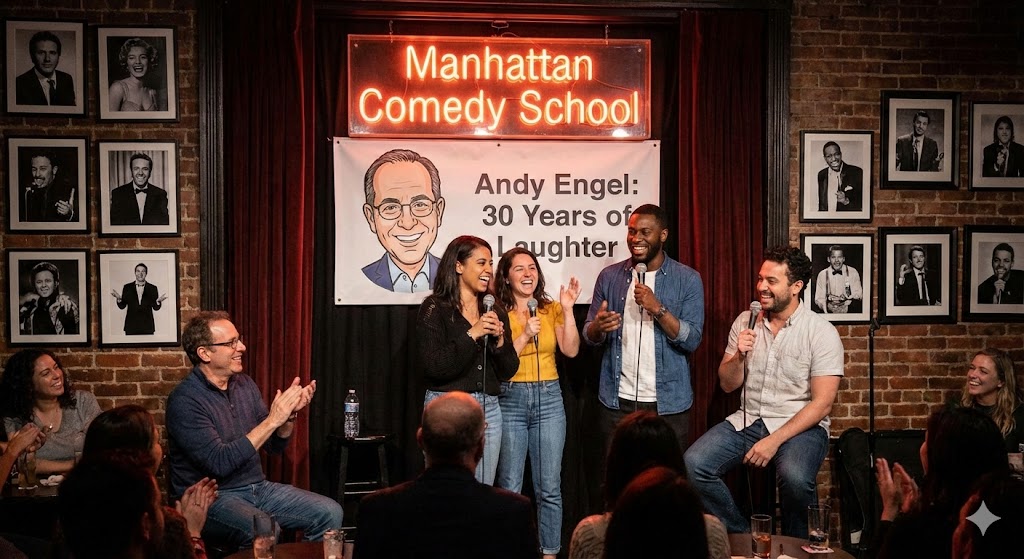
Walk down West 23rd Street in Chelsea on any given Tuesday night, past the historic brick façade of the Hotel Chelsea where Dylan Thomas drank himself to legend and Patti Smith dreamed herself into rock history, and you’ll find a different kind of American mythology being written. Inside Gotham Comedy Club’s 10,000-square-foot Art Deco temple, a nervous accountant from Westchester is discovering she can make 300 strangers laugh at her divorce. This is Andy Engel’s Manhattan Comedy School in action, and remarkably, it has been manufacturing these small miracles for nearly three decades.
The Man Behind the Microphone: Andy Engel’s Origin Story
In 1993, while Giuliani was cleaning up Times Square and the comedy club boom of the ’80s had gone definitively bust, Andrew Engel started producing New Talent Shows at Carolines on Broadway. The timing seemed catastrophically bad, given that economic recession had shuttered clubs across the city. Moreover, the stand-up gold rush was officially over.
Engel didn’t care. Instead, he saw something everyone else missed: the infrastructure was collapsing, but the talent wasn’t going anywhere. Consequently, they just needed a platform.
By 1997, he’d formalized his instincts into the Manhattan Comedy School, eventually moving his operation to Gotham Comedy Club in Chelsea. The formula was deceptively simple: hire working headliners to teach, give students real stage time in front of real crowds, and hand them broadcast-quality video of their performance. Then, most importantly, open every door you can.
The Alchemy of Access
What Engel understood, before anyone was using terms like “social capital” in comedy circles, was that stand-up success isn’t just about being funny. After all, countless funny people die in obscurity at open mics across America. The difference-maker, therefore, is access—and access in New York comedy means knowing the right people at the right clubs who can put you in front of the right industry representatives.
Engel became that access point. His New Talent Shows at Gotham regularly attract drop-ins from Jerry Seinfeld, Dave Chappelle, Chris Rock, Amy Schumer, and Jim Gaffigan. Additionally, industry scouts from Comedy Central, HBO, CAA, William Morris Endeavor, and Late Night with Jimmy Fallon camp out in the audience. For an aspiring comic, consequently, getting on one of Engel’s showcases isn’t just a gig—it’s a lottery ticket.
The Four Capitals of Comedy: A Bourdieu Analysis (with Punchlines)
Pierre Bourdieu never walked into a comedy club, but if he had, he’d have recognized the game immediately. The Manhattan Comedy School operates as a conversion machine, essentially transforming one form of capital into another until students emerge holding something they didn’t have before: legitimacy.
Economic Capital
A six-week stand-up class at MCS runs $450. That’s the price of admission to a system that has produced producers on Adam Sandler’s Netflix specials, writers for Seth Meyers, and headliners who’ve performed for Presidents Obama and Bush. The return on investment can be staggering, although only if you convert the opportunity into something more valuable than the cash you spent.
The economic architecture here is fascinating. Unlike traditional comedy paths that require years of grinding at unpaid open mics, MCS compresses the timeline significantly. Students graduate directly onto Gotham’s 300-seat main stage, and furthermore, they receive professional video that functions as their calling card. The school essentially allows you to purchase proximity to gatekeepers.
Cultural Capital
What must you know to succeed in stand-up? The answer isn’t simply “be funny.” MCS instructors like Karen Bergreen, who’s appeared multiple times on The Jim Gaffigan Show, and Cory Kahaney, who holds the record for Late Late Show appearances, teach the embodied knowledge that separates amateurs from professionals. Specifically, they cover joke structure, timing, persona development, how to read a room, and when to push versus when to pull back.
This is cultural capital in its purest form. The knowledge can’t be downloaded; rather, it has to be absorbed through practice, failure, adjustment, and repetition under the guidance of people who’ve done the work. Brian Koppelman, creator of Showtime’s Billions and writer of Rounders, put it plainly: the school provides “all the tools you need to begin a career in stand-up comedy.”
Social Capital
Here’s where Engel’s operation becomes genuinely remarkable. His New Talent Shows have served as the launchpad for Jim Gaffigan, Ed Helms, Kevin Hart, Greg Giraldo, Demetri Martin, Lisa Lampanelli, Jessica Kirson, Emma Willmann, and Judah Friedlander. That’s not merely a student roster—it’s a Netflix comedy special waiting room.
The network effects, moreover, compound over time. Eddie Ifft credits Engel’s showcase with launching his career, noting that his first development deal came from a tape made at one of those shows. Similarly, Joseph Vecsey, now a producer on Adam Sandler’s Netflix movies and co-producer on Sandler’s 100% Fresh special, traces his trajectory back to Engel’s showcases eight years ago.
This is social capital as infrastructure. Engel has spent 30 years building relationships with bookers, agents, managers, TV producers, and festival programmers. Therefore, when he vouches for a student, that vouching carries weight because his track record is undeniable.
Symbolic Capital
What does graduating from Manhattan Comedy School say about you? First, it signals you’re serious. Additionally, it confirms you’ve been vetted. Most importantly, it announces you’ve performed on the same stage where Seinfeld drops in to work out material, where Comedy Central shoots specials, and where Last Comic Standing held auditions.
The symbolic capital isn’t just about the school, however. It’s equally about the venue. Gotham Comedy Club has been featured in Jerry Seinfeld’s documentary Comedian, served as the setting for Larry David’s Curb Your Enthusiasm pilot, and hosts Comedy Central’s Live at Gotham. When you perform your graduation show on that stage, consequently, you’re borrowing legitimacy from decades of comedy history.
The Pedagogy of Punchlines: How MCS Actually Works
The standard Level 1 Stand-Up class runs six weeks. Students meet once a week, learning the fundamentals from instructors who are actively working the circuit. Karen Bergreen, for instance, has been teaching stand-up for over a decade while maintaining her own national touring career. Meanwhile, Cory Kahaney was named Best Comedian in NYC by Backstage and Best Female Comedian by the Manhattan Association of Cabarets.
The curriculum covers writing, delivery, persona development, and perhaps most crucially, the business side of comedy. Engel himself conducts sessions on how to get an agent, build an industry tape, navigate the festival circuit, and convert stage time into career momentum.
The Women Only Stand-Up class has become particularly notable as well. In an industry with well-documented gender imbalances, MCS has created a space where women can develop material about specifically female experiences without worrying about room dynamics. Currently, Calise Hawkins leads sessions, building on the foundation that Bergreen and Kahaney established.
The Graduation Show
Every class culminates in a performance on Gotham’s main stage. This isn’t some back-room showcase, however. Students perform in front of full audiences, under professional lighting, with broadcast-quality recording capturing every moment. The resulting video, therefore, becomes their comedy resume.
Consider Tom Eschelman, who’d been taking classes with Karen Bergreen. He got passed for a TV spot on Gotham Comedy Live after performing at a New Talent Showcase. That’s the pipeline working exactly as designed: class leads to showcase, which leads to industry attention, which ultimately leads to television.
The Testimonial Parade: What They’re Actually Saying
Roy Wood Jr., now a correspondent on The Daily Show, captured the value proposition perfectly: “After gaining the courage to get on stage, you’ll need the competence to stay there! Don’t think about it twice! Take the class and be on your way!”
Jim Gaffigan, who started on Engel’s New Talent Shows before becoming one of the most successful touring comedians in America, offers a simple endorsement: the school has “helped countless young comedians get started.”
Lewis Black, a man not known for mincing words, put it directly: “So you want to be a comic. Well, get off your ass and do something about it. I can think of no better place to start than the Manhattan Comedy School. The faculty is exceptional—it’s a roster of comics that I truly admire.”
Lisa Lampanelli, queen of the roast, expressed a wish as well: “Man, do I wish I had known about the Manhattan Comedy School when I was getting started! It would have been wonderful to start my standup career with a strong foundation, and that’s exactly what MCS provides.”
Beyond the Stage: Comedy as Professional Development
Here’s where MCS gets interesting for readers who have no intention of pursuing comedy professionally. The school has developed a parallel track for corporate clients, recognizing that stand-up techniques translate directly to business contexts: public speaking, pitching, selling, and commanding a room.
Pete Lengyel, Executive Producer of Super Troopers, took classes and found that the experience improved his business dealings, “particularly where I’m pitching a new TV sitcom or reality show.” Similarly, Andy Engel now speaks at companies like Google and Microsoft, using humor to engage audiences on serious topics.
The underlying insight is that comedy is essentially a form of communication technology. Learning to write and deliver a joke means learning to understand attention, expectation, surprise, and release. Those mechanics, consequently, work whether you’re standing in front of a Gotham audience or presenting quarterly results to a board.
The Geography of Getting Funny
Gotham Comedy Club sits at 208 West 23rd Street, nestled into a 1929 Art Deco building adjacent to the legendary Chelsea Hotel. The location isn’t accidental, of course. Chelsea has been home to artists, writers, and performers for over a century, and the neighborhood’s bones understand creative risk.
The club itself expanded from the original 3,300-square-foot space on West 22nd Street to the current 10,000-square-foot venue in 2005. The main showroom now seats 300. Furthermore, the atmosphere deliberately evokes the 1920s, thereby capturing something theatrical and timeless that makes both performers and audiences feel like they’re participating in tradition.
MCS has also expanded beyond Manhattan in recent years. They now operate in London and Hong Kong, bringing Engel’s model to international markets. Additionally, classes are available both in-person and online, adapting accordingly to how people actually want to learn.
The Verdict: What’s Really Being Sold Here
The Manhattan Comedy School sells transformation. They take people who’ve always wondered if they could be funny on stage and give them the tools, training, and platform to find out. More importantly, however, they provide access to an ecosystem that would otherwise take years to penetrate.
Is it for everyone? Obviously not. Comedy remains brutally competitive, and most people who try stand-up don’t stick with it. Nevertheless, for those serious about pursuing the craft—or even for professionals who want to add comedy skills to their communication toolkit—MCS offers something genuinely valuable: a compressed pathway into one of New York’s most exclusive creative networks.
Andy Engel has spent 30 years building this machine. The results speak for themselves: Kevin Hart, Jim Gaffigan, Ed Helms, and dozens of other headliners who got their start on his stage. Add to that the network of agents, managers, and producers who trust his judgment, plus the thousands of students who’ve found their voice in his classrooms.
If you’re serious about comedy, you probably know about this place already. However, if you’re merely curious, they offer free 90-minute workshops called “You Can Do Stand-Up Comedy” that have been running for over a decade. Thousands have attended, and notably, some of them are now on your television.
The question isn’t whether the Manhattan Comedy School can teach you to be funny. The question, ultimately, is whether you’re ready to find out if you already are.
Continue Your Cultural Education
- The Hamptons Summer Entertainment Guide: Where Culture Meets the Coast
- Inside New York’s Creative Renaissance: The Institutions Shaping Tomorrow’s Talent
Stay Connected with Social Life Magazine
Author

Written by
Recent Posts
Loews Regency New York Hotel Celebrates 63 Years
Jodie Kidd Model Career
Gia Carangi, Supermodel
Anna Nicole Smith, Model
Early 2000s Supermodels Where Are They Now?
Categories
- 2025 Social Life Events
- Access to Digital + Physical Magazine
- Art
- Articles
- Beauty & Skincare
- Beauty & Wellness
- Business Strategy
- Celebrities
- Chronicles
- Design History
- Design History|Design Trends
- Design History|Hamptons
- Design Process
- Design Process|Luxury Living
- Design Trends
- Design Trends|Hamptons
- Event Photos
- Events
- Family
- Fashion
- Fashion & Style
- Featured
- Food & Beverage
- Food, Spirits, Wine
- Hamptons
- Hamptons Celebrities
- Hamptons Design
- Hamptons Design|Design Process
- Hamptons Design|Luxury Living
- Hamptons|Luxury Living
- Health
- Health & Beauty
- Home & Design
- Home & Living
- Lifestyle
- Luxury Home Design|Design Process
- Luxury Home Design|Design Trends
- Luxury Home Design|Hamptons Design
- Luxury Home Design|Interior Design
- Luxury Lifestyle
- Luxury Living
- Luxury Living|Design Process
- Luxury Living|Hamptons
- Luxury Living|Hamptons Design
- Press
- Profiles
- Real Estate
- Technology
- The Chronicles
- Travel
- Trending
- Uncategorized
- Weddings
- Wellness