
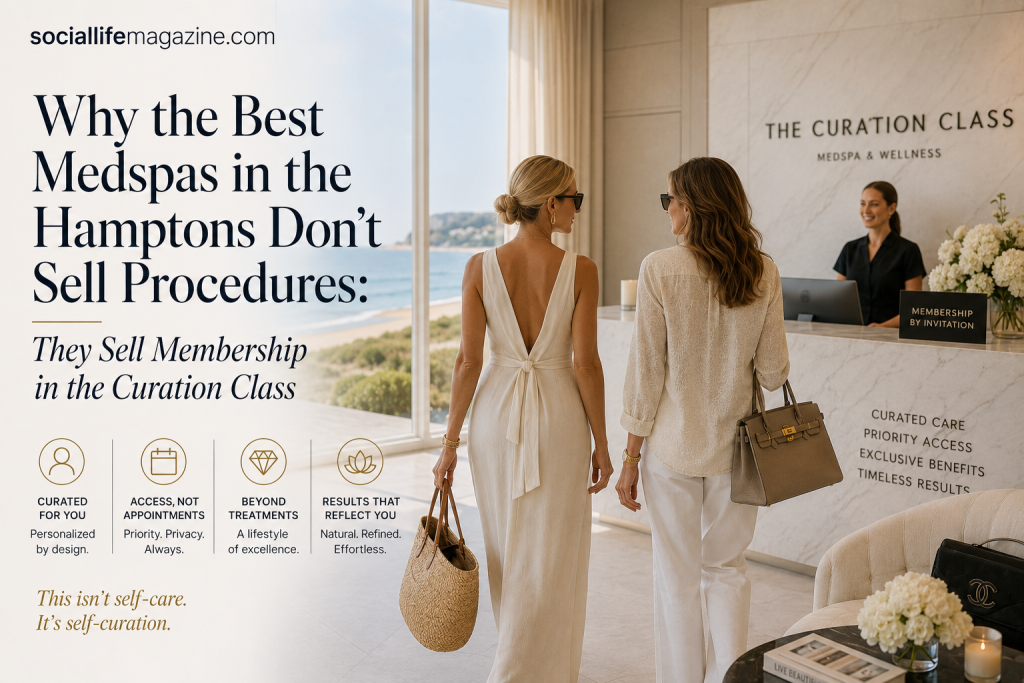
There is a medspa in Southampton that does not advertise its prices. Even so, it does not list its treatment menu on the homepage. Its website has exactly three things: a phone number, a waiting list form, and one photograph. That photograph communicates something that has no clinical name. Understanding medspa marketing in the Hamptons starts here, with this practice, and with why it is fully booked every summer while its competitors run Groupon specials.
The practice’s clients drive out from Manhattan. Some of them fly. None of them found it through a Google ad.
A few miles east, a competing practice runs before-and-after galleries, Groupon promotions in the off-season, and paid search campaigns targeting “best Botox Hamptons.” Still, it has a five-star Google rating, a clean website, and a steady supply of first-time patients who do not come back.
The difference between these two practices is not clinical skill. Both have trained injectors. Both use the same FDA-approved products. The difference is that one practice understands what it is actually selling and the other is running a medical practice that happens to be located near money.
The practice that wins understands a principle Paglia identified decades before aesthetic medicine existed. The female status drive is fundamentally a curation drive. The woman booking a filler appointment at a Southampton medspa is purchasing something else entirely. She is buying continued membership in the taste class that defines what beauty looks like this season on the East End. The treatment itself is almost beside the point. The social credential is the product.
For the foundational framework behind this argument, see The Gender Capital of Luxury.
The Curation Drive in Aesthetic Medicine
Paglia’s argument, developed across “Sexual Personae” and three decades of cultural criticism, is that female status capital operates through refinement, selection, and the gatekeeping of aesthetic standards. The woman with the most refined taste is not just expressing preference. She is setting the standard that others orient toward.
In aesthetic medicine, this dynamic plays out in the treatment room and well outside it. The decision to book a procedure at a specific Hamptons practice is a curation decision. It is a choice about which aesthetic authority to affiliate with and which social world that affiliation signals membership in. The best injector in Southampton is not the one with the most Instagram followers. She is the one whose clientele constitutes the curation class that other women in this market are trying to enter.
This is why word-of-mouth dominates the high end of the Hamptons aesthetic medicine market. Referrals in this vertical go beyond clinical endorsements. When a woman whose taste is respected tells another woman where she gets her work done, she is extending a form of social capital that no advertising budget can manufacture.
The referral economy at the top of this market is powerful. Practices that actively court it, through their physical environment and their editorial presence in publications the curation class reads, consistently outperform practices that spend the same budget on paid acquisition. The mechanism is not complicated. But most practices are not designed around it.
Why Results Language Misses the Point
Walk through the digital advertising landscape for Hamptons-area medspas and the same creative patterns repeat endlessly. Before-and-after photography. Procedure explainers. Limited-time offers. Clinical language about collagen stimulation, treatment depth, and recovery windows. These are, without exception, the wrong signals for the wrong audience.
The woman with serious purchasing power in the Hamptons aesthetic medicine market has already decided she wants the procedure. She made that decision before she opened her laptop. What she is still deciding is which practice she trusts to maintain her membership in the curation class, and whether the practice’s public presence confirms that it operates at her level.
Clinical results language tells her nothing useful. She assumes the clinical results are good. What she is reading for are subtler signals: the aesthetic quality of the practice’s photography, the caliber of the editorial coverage it receives, the tone of the language it uses about itself and its clients. A practice that leads with Groupon pricing tells the curation-drive buyer that it is not her room. A practice that leads with editorial features in Social Life Magazine tells her it might be.
Still, the mistake is understandable. Results language converts volume buyers, and volume buyers are real revenue. But in the Hamptons market specifically, the volume buyer and the high-value repeat client are almost never the same person. A practice that optimizes for volume acquisition at the expense of curation positioning trades short-term conversion for long-term client quality. Eventually, it owns a practice full of first-time patients and an empty waiting list.
The Social Proof Architecture of a Winning Practice
The medspa that wins at the top of the Hamptons market has built a social proof architecture that operates entirely within the curation capital system. Every element of its public presence communicates one thing: the people who belong here already belong here, and if you do not know who they are, you probably do not belong here either.
This sounds exclusionary because it is. Exclusion is the mechanism. Curation capital is worthless if everyone has access to it. The practice’s waiting list is not an operational inconvenience. It is the product. The fact that you cannot get an appointment until August signals exactly what it is meant to signal.
The social proof architecture of a winning Hamptons practice has four components working simultaneously. First, its physical space is designed at the level of the taste class it serves. The waiting room is not a medical waiting room. It is an aesthetic experience that communicates the practice’s curation authority before the patient sees the injector. Its editorial presence is in the publications the curation class actually reads. Third, its client photography shows women whose personal style communicates the taste level of the clientele. Fourth, its social media presence, if it maintains one, operates on restraint. Scarcity of content is a luxury signal. Volume of content is a volume practice signal.
Each component reinforces the others. Together they build the social credential that converts the high-value buyer that clinical advertising cannot reach.
The Male Capital Angle
Aesthetic medicine in the Hamptons is not exclusively a female capital market. But the male side of the market requires entirely different positioning, and most practices that serve male patients apply the wrong marketing voice to it.
Paglia’s argument about male status capital is that it runs through conquest, through the public performance of competitive fitness, dominance, and biological vitality. The male patient booking a body contouring consultation or a facial rejuvenation treatment is not making a wellness decision. He is making a conquest capital investment. He is reclaiming the biological signals of competitive fitness that the accumulation of wealth has sometimes outpaced.
The practice that markets male aesthetic treatments with wellness language, with self-care framing and sensitivity messaging, misses this patient entirely. He does not want to be told he deserves to feel good about himself. He wants to be told that this investment will make him more competitive in the social arenas where he operates. Performance language. Optimization language. The same register that works for private aviation and sports medicine.
In the Hamptons context, the male patient is often a finance executive who has spent his career in conquest capital arenas. The practice that understands his status drive and speaks to it directly earns his loyalty the same way the right wealth management firm does. Not by being warm. By being correct.
Positioning Against NYC Competition
The most underrated challenge for Hamptons medspa operators is not competition from other East End practices. It is competition from the Manhattan practices their clients use eleven months a year.
The NYC aesthetic medicine market ranks among the most sophisticated in the world. The practices that Hamptons summer residents use in Manhattan have spent decades building social proof architectures, editorial reputations, and curation class credentials that a Southampton medspa cannot replicate on volume alone. The question for the Hamptons practice is not how to beat established Manhattan providers on clinical outcomes or brand recognition. It is how to position around the specific social dynamics of the summer market in a way that no Manhattan practice can access.
The answer is geography and seasonality. The Manhattan practice is excellent but it is in Manhattan. That Hamptons practice positions itself as the aesthetic authority for the summer social field. Its name circulates through the Bridgehampton Polo Club crowd and the Southampton Hospital Gala circuit. No Fifth Avenue address can replicate that positioning.
Editorial presence is the fastest path to that positioning. A feature in Social Life Magazine places the practice inside the social field it is trying to own. It reaches 25,000 print readers per issue across five summer editions distributed from Westhampton to Montauk. It reaches 82,000 email subscribers who are planning their Hamptons summers from apartments on the Upper East Side before Memorial Day. And it positions the practice as a participant in the curation class conversation rather than as a medical service provider advertising into it.
The Editorial Play
There is a reason the best practices in the Hamptons aesthetic medicine market consistently appear in Social Life Magazine while the practices running paid search campaigns do not. The two marketing strategies are targeting different purchase decisions by different buyers using entirely different social mechanisms.
Paid search captures the intent-driven buyer who has already decided on the procedure and is shopping for a provider. This buyer is real and she generates revenue. But she is not the buyer who builds a practice’s long-term positioning in the Hamptons market. She is not the buyer who refers three friends before Labor Day.
The editorial buyer, the reader who encounters a practice through a Social Life Magazine feature and decides to make contact, is operating from a different decision architecture entirely. She is not comparison-shopping. She is responding to a curation signal from a publication she already trusts as a cultural authority in the market she operates in. When that feature positions the practice correctly, with the right voice and the right contextual framing, it extends the magazine’s curation authority to the practice directly.
That transfer of authority is, in the Hamptons aesthetic medicine market, the most valuable thing a practice can acquire. It cannot be bought through Google. It can be earned through editorial placement in the right publication at the right moment in the summer calendar. The 2026 season opens July 18. See also how curation capital operates in the luxury fashion vertical and the hotels and resorts vertical.
Where The Conversation Continues
Social Life Magazine reaches the Hamptons luxury audience across five summer issues and 25,000 print copies per issue. Year-round digital distribution and 82,000 email subscribers extend that reach into the high-net-worth population that drives the East End aesthetic medicine market.
Editorial features, advertising partnerships, and sponsored content are available for the 2026 season. Space is limited and filling fast.
Author

Written by
Recent Posts

Victoria Justice Kicks Off Halloween Early with Love Zombie Bash in Hollywood

Planning an Arizona Road Trip? Practical Details to Handle Before You Leave

Short Homecoming Dresses That Feel Polished, Not Overdone
Men’s Health After 40: Important Changes to Pay Attention To
What You Need to Know About Spray Tanning
Categories
- Art
- Articles
- Business of Luxury
- Celebrities
- Culture
- Entertainment
- Events
- Faces of Summer 2026
- Fashion
- Fashion & Style
- Featured
- Finance
- Food, Spirits, Wine
- Hamptons
- Hamptons Celebrities
- Health
- Health & Beauty
- Lifestyle
- Luxury Lifestyle
- Press
- Profiles
- Real Estate
- Technology
- The Chronicles
- Travel
- Uncategorized
- Weddings