
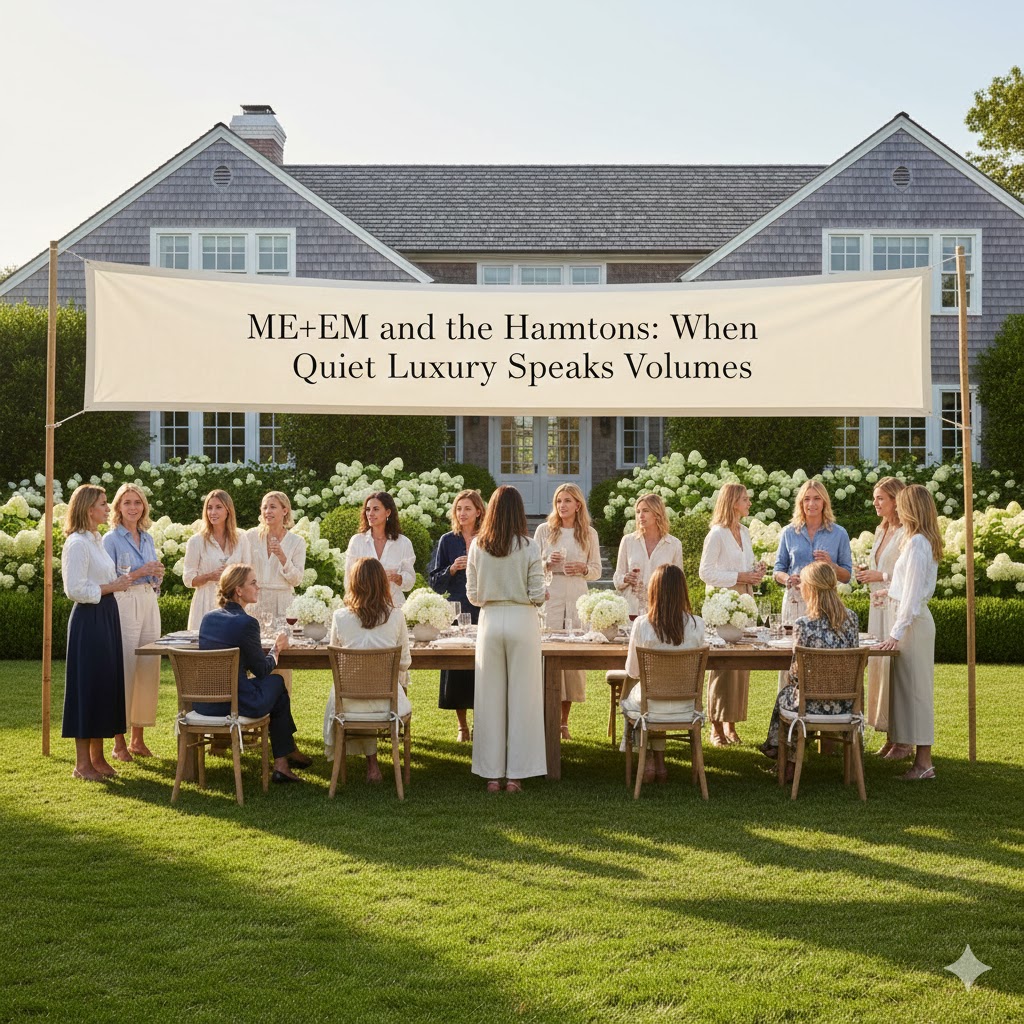
The woman examining the silk trouser display at 7 Newtown Lane does not reach immediately. Instead, there is a protocol here, though not the kind enforced by velvet ropes or imperious sales associates. She is calculating something more subtle: the fabric weight, the construction details, the invisible stitching that separates clothes designed for real life from those designed merely for photographs.
This is the ME+EM Hamptons boutique, a 600-square-foot space that opened in summer 2024 and promptly became one of East Hampton’s most quietly significant retail statements. Furthermore, what makes this British import remarkable is not what it sells, but rather what it refuses to sell you.
Pierre Bourdieu, the French sociologist who spent his career dissecting how taste functions as class warfare, would recognize this storefront instantly. After all, he understood that true distinction operates through absence. Consequently, the brands that matter most to those who matter most are often the ones that never shout.
From Pyjama Room to Palace Favourite: The ME+EM Genesis
The origin story begins, as many lasting fortunes do, with frustration. Clare Hornby had spent fifteen years in advertising, including a stint at HHCL, the agency behind the legendary “You’ve Been Tango’d” campaign. As a result, she understood consumer psychology deeply. Moreover, she understood her own wardrobe failures intimately.
“When I went into advertising I couldn’t afford designer clothes full price but didn’t like the quality of high street,” Hornby has explained. “I just knew there was a gap to be filled between high quality and price.”
In 2007, Hornby and her friend Emma Howarth brainstormed on holiday in Majorca. Subsequently, the result was Pyjama Room, a loungewear company that launched into the teeth of the 2008 financial crisis. By Hornby’s own admission, it was “too narrow a concept.” Nevertheless, the insight contained within it was profound: women wanted comfort without compromise, and they wanted to look pulled together without the performance.
The Rebirth as ME+EM
The company rebranded as ME+EM in 2009, and the name was deliberate. “Me” was Hornby while “Em” was Emma. However, the plus sign contained multitudes, suggesting addition, collaboration, and the idea that clothes should enhance rather than overwhelm. Accordingly, the brand would become synonymous with what Hornby calls “fashion Lego,” pieces designed to combine endlessly.
Today, ME+EM reports revenues exceeding £120 million annually. In addition, Highland Europe led a £55 million investment round in 2022, valuing the company at £130 million. Yet more telling than the numbers is the customer list itself. For instance, the Princess of Wales owns multiple pieces. Similarly, Victoria Starmer walked into 10 Downing Street the day after the 2024 election wearing Labour red ME+EM, thereby triggering a 300% spike in website traffic.
The Mythology Machine
What ME+EM emphasizes in its founding narrative reveals as much as what it downplays. Specifically, the brand leads with Hornby’s advertising background, positioning her as someone who decoded consumer desire before creating products to satisfy it. This is certainly true. However, it is also strategic.
Less prominent in the official story is the fact that Hornby mortgaged her house to fund the initial launch. Additionally, her husband Johnny persuaded her to continue when she was ready to abandon the venture entirely. These details humanize the founder. Yet they also introduce risk, vulnerability, and the possibility of failure. Consequently, the mythology machine prefers to present ME+EM as inevitable rather than hard-won.
ME+EM’s Four Capitals: Decoding the Hidden Currency
Bourdieu argued that capital comes in multiple forms, each convertible to the others under the right circumstances. Therefore, understanding how ME+EM Hamptons operates requires examining each form in turn.
Economic Capital: The Price Architecture
ME+EM occupies a deliberate position in the market hierarchy. Entry points begin around $150 for essential tops, while the signature trousers that built the brand’s reputation range from $295 to $385. Meanwhile, silk dresses cluster around $495 to $790, and the most elaborate pieces rarely exceed $1,200.
This pricing is surgical in its precision. It sits below traditional luxury houses, where comparable construction might command $800 to $2,000 for trousers alone. At the same time, it floats well above contemporary labels where $150 represents an upper limit. Indeed, fashion educator Andrea Cheong has noted that ME+EM could “easily charge what Joseph does” given the construction quality.
The direct-to-consumer model makes this positioning possible. By eliminating wholesale markup and avoiding grand flagship expenses, ME+EM claims to deliver luxury construction at contemporary prices. Nevertheless, the question Bourdieu would ask is whether customers are actually paying for the absence of markup, or merely for the story about that absence.
Cultural Capital: What You Must Know
To properly consume ME+EM requires a specific kind of knowledge. First, you must understand that “quiet luxury” represents the apex of current taste hierarchies. Additionally, you must recognize that visible logos now signal new money desperation rather than arrival. Furthermore, you must appreciate construction details that never photograph well but feel exceptional against skin.
The brand’s “3F” philosophy provides the essential vocabulary: Flattering, Functional, Forever. Each term performs important work. “Flattering” acknowledges that women’s bodies vary and matter. “Functional” positions fashion as tool rather than costume. “Forever” rejects the fast-fashion cycle that educated consumers increasingly recognize as environmentally and aesthetically bankrupt.
How Insiders Signal Knowledge
This cultural capital is embodied in how regular customers discuss the brand. For example, they mention the way trousers have double belt loops for versatility. They also note that blouse sleeves contain hidden elastic for pushing up during tasks. In addition, they reference the “above the desk” dressing philosophy optimized for video calls. Ultimately, this knowledge marks the insider and separates her from casual shoppers.
Social Capital: Network Access and Signaling
ME+EM’s social capital operates through association with specific archetypes. Most notably, the Princess of Wales wearing the brand’s Breton stripes establishes a particular aesthetic territory. This is not the glamour of evening gowns and tiaras. Rather, this is the competence of a working royal managing three children, public duties, and a cancer diagnosis with visible grace.
Similarly, Claudia Winkleman wearing ME+EM blouses to present “The Traitors” and “Strictly Come Dancing” extends this positioning. Here is a woman whose intelligence and humor take precedence over conventional beauty, and whose style serves her personality rather than demanding attention for itself. Likewise, Nicole Kidman, Katie Holmes, Cat Deeley, and Daisy Edgar-Jones contribute additional data points to this constellation.
The social club effect here is subtle but undeniably real. Wearing ME+EM signals membership in a tribe of accomplished women who understand quality, reject ostentation, and prioritize function without sacrificing elegance. It is a tribe with no formal initiation but with strict unspoken standards nonetheless.
Symbolic Capital: What Ownership Declares
The symbolic value of ME+EM lies precisely in what it refuses to symbolize. There is no visible logo anywhere. There is no heritage mythology involving nineteenth-century craftsmen or royal warrants. Moreover, there is no waiting list, no artificial scarcity, no “investment piece” language designed to disguise consumption as financial prudence.
Instead, ME+EM symbolizes a rejection of these games entirely. Ownership declares that you have moved beyond needing validation through logos. It signals that you understand the difference between price and value. Consequently, it announces that you dress for your own satisfaction rather than the approval of strangers who might recognize luxury signifiers.
This is, of course, its own form of status game. The rejection of obvious status markers has become, for a certain educated elite, the ultimate status marker itself. Bourdieu would smile at this paradox.
Why ME+EM Chose the Hamptons: Strategic Positioning Revealed
The ME+EM Hamptons location at 7 Newtown Lane opened in May 2024 as part of a three-store American expansion. Madison Avenue came first, thereby establishing Upper East Side credibility. Soho’s Mercer Street followed shortly after, capturing downtown creative energy. East Hampton completed the triangle, reaching the summer retreat of the exact demographic ME+EM serves.
The Anti-Flagship Philosophy
The 600-square-foot space exemplifies the brand’s anti-flagship philosophy. While Gucci refreshes its East Hampton outpost with ocean-inspired floors and Louis Vuitton operates from a building Bernard Arnault personally purchased for $22 million, ME+EM occupies a modest storefront with warm lighting and a bespoke English oak table instead.
Design details signal the target customer with precision. Pinch Anders lighting creates soft ambiance throughout. Pet-friendly amenities include ceramic water dishes by Tina Vaia and dog beds from London-based Mungo and Maud. As a result, the message is clear: this is a space for women who bring their dogs to errands, who value community over ceremony, and who shop with efficiency and taste.
The store’s location on Newtown Lane places it adjacent to Prada, STAUD, and Kirna Zabête. This positioning is deliberate and strategic. ME+EM does not compete with global houses on their terms. Rather, it offers an alternative for women who find traditional luxury exhausting or irrelevant to their lives.
The Hamptons as Competitive Field
Bourdieu understood markets as “fields” where participants struggle for position using available capital. The Hamptons luxury field has specific rules that govern success. Proximity to the beach matters considerably. Access to parking helps tremendously. Association with the “right” neighbors confers legitimacy instantly.
ME+EM enters this field with a differentiated strategy. Where LVMH brands compete on heritage and spectacle, ME+EM competes on relevance and practicality instead. For instance, the store debuts the brand’s first swimwear collection, designed for women who actually swim rather than those who merely pose near water.
The habitus of the ME+EM Hamptons shopper is distinct from the habitus of the Cartier customer or the Gucci devotee. She is likely a professional woman, possibly with children, and definitely with multiple demands on her time. Furthermore, she has disposable income but resents the performance required by traditional luxury. Above all, she wants to look put together, not costumed.
Playing the Field: ME+EM and the Competition
Understanding ME+EM’s position requires mapping the Hamptons contemporary luxury landscape carefully. The Row’s Amagansett boutique, opened in 2024 to replace the beloved Tiina the Store, represents one extreme of this spectrum. Mary-Kate and Ashley Olsen’s label pushes minimalism toward austerity, with cashmere sweaters commanding $1,200 and above.
Meanwhile, Zimmermann, Veronica Beard, and STAUD compete at various price points with different aesthetics. Zimmermann offers romantic femininity. Veronica Beard provides polished American sportswear. STAUD delivers California cool with Hamptons seasonal presence.
Unique Market Territory
ME+EM occupies unique territory in this competitive landscape. It offers The Row’s quality philosophy at significantly lower prices. Additionally, it provides Veronica Beard’s professional utility with British understatement rather than American confidence. Moreover, it delivers seasonless versatility in a market dominated by resort-specific inventory.
The brand’s direct-to-consumer model creates structural advantages as well. No wholesale margin means more can be invested in construction while maintaining competitive pricing. Furthermore, monthly capsule releases replace seasonal collections, thereby reducing markdown pressure and keeping inventory fresh throughout the year.
Old Money, New Money, and the ME+EM Solution
The eternal tension in Hamptons fashion is the divide between old money restraint and new money display. Traditional luxury houses have built empires helping new money signal legitimate taste through recognizable products. As examples, the Birkin bag, the Cartier Love bracelet, and the Gucci loafer all serve this function.
ME+EM offers something different entirely. It helps new money dress like old money without requiring the cultural knowledge that old money accumulates over generations. The clothes are appropriate for everything from beach club lunches to charity galas without being remarkable at either occasion. Importantly, this is precisely the point.
Simultaneously, ME+EM appeals to old money customers tired of being targeted by brands that assume wealthy women want to look wealthy. The aesthetic is polished without being precious, expensive without being ostentatious, and designed without being designed-looking.
The ME+EM Investment: Cultural Arbitrage or Smart Consumption?
The ME+EM Hamptons boutique at 7 Newtown Lane operates with the same hours as surrounding retailers. The experience is notably low-pressure. Staff are helpful without hovering over customers. There is no ritual of presentation and no ceremony of purchase. You examine clothes, you try them on, and you buy or you don’t.
The Anti-Ritual as Ritual
This anti-ritual is itself a ritual, of course. It signals that you are too sophisticated to require flattery, too busy to tolerate delay, and too confident to need validation from sales associates. Paradoxically, the absence of performance becomes its own performance.
For visitors seeking practical guidance, consider the following. The signature trousers justify the brand’s reputation entirely. The silk blouses layer beautifully with existing wardrobes. The knitwear holds up remarkably well to repeated wear. However, less successful are trend-driven pieces that dilute the core proposition. Therefore, stick to the classics.
What ME+EM Really Sells
Bourdieu might ask what ME+EM is really selling beneath the surface. The answer is complex and multilayered. Partly, it sells well-constructed clothing at competitive prices. Partly, it sells membership in a tribe of busy, accomplished women who value substance over spectacle. However, mostly it sells the resolution of a specific anxiety: the fear that caring about how you look conflicts with being taken seriously.
The brand’s promise is that you can have both desires satisfied. You can dress with intention without dressing for attention. You can invest in quality without performing wealth. This promise, wrapped in British restraint and delivered to Newtown Lane, has clearly found its audience.
The future of ME+EM Hamptons seems assured for now. Clare Hornby has mentioned potential expansion to Boston, Greenwich, Dallas, Austin, and Chicago. The American market, with its appetite for British understatement and its population of professional women seeking alternatives to traditional luxury, appears highly receptive.
Whether this expansion will maintain the brand’s character remains to be seen, however. Growth has diluted many direct-to-consumer darlings over time. For now, though, the intimate East Hampton boutique offers something increasingly rare in luxury retail. It offers a shopping experience that respects your intelligence, your time, and your desire to look like yourself, only better.
Continue Your Luxury Education
Explore more insider perspectives on Hamptons fashion and lifestyle:
- Best Hamptons Fashion Boutiques You Must Visit — Our comprehensive guide to the East End stores where fashion editors actually shop, from The Row’s whispered minimalism to Kirna Zabête’s curated boldness.
- 10 Luxury Fashion Trends Defining Hamptons Style in 2025 — From quiet luxury to sport-luxury fusion, discover the movements shaping how the discerning dress this season.
Stay Connected with Social Life Magazine
Author

Written by
Recent Posts
The Family Brand Is the New Admissions Strategy
Tips For Selecting Drawer Dividers That Match Demanding Shop Conditions
From Hamptons Weekends to Cross-Country Escapes: Making Luxury Travel Easier with Reliable Auto Transport
Navigating Sexual Assault Law in Ontario: A Guide to Justice and Recovery
Judicial Standards and Protecting the Vulnerable
Categories
- 2025 Social Life Events
- Access to Digital + Physical Magazine
- Art
- Articles
- Beauty & Skincare
- Beauty & Wellness
- Business Strategy
- Celebrities
- Chronicles
- Design History
- Design History|Design Trends
- Design History|Hamptons
- Design Process
- Design Process|Luxury Living
- Design Trends
- Design Trends|Hamptons
- Event Photos
- Events
- Family
- Fashion
- Fashion & Style
- Featured
- Food & Beverage
- Food, Spirits, Wine
- Hamptons
- Hamptons Celebrities
- Hamptons Design
- Hamptons Design|Design Process
- Hamptons Design|Luxury Living
- Hamptons|Luxury Living
- Health
- Health & Beauty
- Home & Design
- Home & Living
- Lifestyle
- Luxury Home Design|Design Process
- Luxury Home Design|Design Trends
- Luxury Home Design|Hamptons Design
- Luxury Home Design|Interior Design
- Luxury Lifestyle
- Luxury Living
- Luxury Living|Design Process
- Luxury Living|Hamptons
- Luxury Living|Hamptons Design
- Press
- Profiles
- Real Estate
- Technology
- The Chronicles
- Travel
- Trending
- Uncategorized
- Weddings
- Wellness