
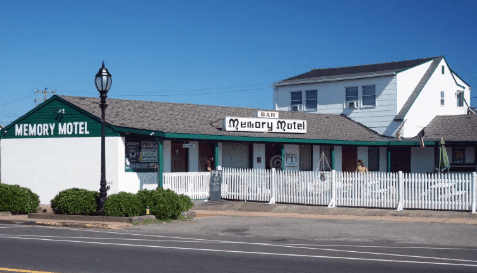
The bar closes at 4 AM. That’s the first thing you need to know about Memory Motel Montauk. It’s 3:15, the drinks are served in plastic cups without fruit (don’t ask for a lime), and somewhere between the pool table and the piano, you’re standing exactly where Mick Jagger once stood, scribbling lyrics about a woman named Hannah who would haunt him across seven minutes of vinyl and fifty years of speculation.
The Spring of 1975: When Memory Motel Montauk Became Legendary
In the spring of 1975, Montauk was still a sleepy fishing village where middle-class families vacationed and surfers chased waves at Ditch Plains. Nobody wanted to venture past Amagansett. Subsequently, Andy Warhol saw opportunity in that isolation when he purchased Eothen, a 20-acre oceanfront compound, with filmmaker Paul Morrissey in 1971 for $225,000.
The name Eothen comes from ancient Greek, meaning “from the east” or “from the dawn.” The compound consisted of five white clapboard cottages built in the 1930s for the Church family—heirs to the Arm & Hammer baking soda fortune—who used it as a seasonal fishing camp. Under Warhol’s ownership, it became something else entirely: a refuge for celebrities seeking escape from Manhattan’s glare.
When the Rolling Stones needed somewhere to rehearse for their Tour of the Americas ’75, they rented Eothen for a paltry $5,000. Mick Jagger, Keith Richards, Charlie Watts, Bill Wyman, and newest member Ronnie Wood set up in the main hall’s stone floors, bashing songs into road-worthiness usually after midnight. Additionally, collaborators Billy Preston and touring percussionist Ollie Brown joined them. The “World’s Greatest Rock and Roll Band” had invaded the End.
The problem was entertainment. Eothen offered privacy and ocean views, but the band needed somewhere to unwind. Memory Motel Montauk was the only establishment in town with both a piano and a pool table. Moreover, the owners weren’t exactly Stones fans—they reportedly hated the band—but that didn’t stop Jagger and company from showing up night after night, drinking heavily, shooting pool, occasionally brawling, and playing that piano until sunrise.
Memory Motel Montauk: The Song That Immortalized a Dive Bar
The track that emerged from those bleary nights is unlike anything else in the Stones’ catalog. At seven minutes and eight seconds, the piano-driven ballad trades the band’s usual swagger for vulnerability. Jagger began writing the lyrics at Memory Motel Montauk before finishing them on the road, and the song’s geography reflects that journey—references to leaving for Baton Rouge, where the Stones played warm-up shows at Louisiana State University, anchor the narrative in specific places and departures.
The opening lines paint a picture of a brief encounter with a woman who left an indelible mark. The mysterious “Hannah” had hazel eyes, a slightly curved nose, and drove a green-blue pickup truck. She took Jagger’s guitar and sang him a song that stuck in his brain. Then she headed back to Boston, where she was singing in a bar.
The identity of Hannah has fueled speculation for fifty years. Carly Simon remains the primary suspect—her physical features match the description, she and Jagger were romantically linked during this period, and some theorize that her hit about a vain man was actually written after a one-night stand at the motel. Nevertheless, Jann Wenner, founder of Rolling Stone magazine, has insisted the song is about photographer Annie Leibovitz, who was covering the Stones and allegedly involved with Jagger at the time. Others suggest the name “Hannah” is simply “Annie” rearranged.
Jagger has only offered this cryptic clarification: “The girl in Memory Motel is actually a real, independent American girl.” The truth remains buried somewhere between the dive bar and the dawn.
Andy Warhol’s Montauk: The Scene Behind the Song
Understanding Memory Motel Montauk requires understanding the broader ecosystem that Warhol created at Eothen. The compound became what Bob Colacello, former editor of Warhol’s Interview magazine, called “the Factory answer to Hyannisport.” The guest list reads like a who’s-who of 1970s celebrity culture.
Lee Radziwill was the first to rent the main house in summer 1972. She brought her sister Jackie Kennedy Onassis along with their children—Caroline, John Jr., Tina, and Anthony. Filmmaker Jonas Mekas was hired to teach the Kennedy children photography and filmmaking, capturing footage later included in the 2017 documentary “That Summer.” For Warhol’s 44th birthday, Radziwill gifted him a flagpole that still stands on the property.
The Jaggers had already discovered Eothen by 1972, staying with Radziwill during the Stones’ American Tour. Mick would unwind with Grand Marnier at the local Shagwong Tavern, while Bianca—disregarding her designer clothing—went into the kitchen to shuck clams herself. One evening at Gosman’s, Jagger tripped and smashed his right hand through a window. Photographer Annie Leibovitz shot his stitched-up wrist in a local emergency room.
Other visitors to Eothen included John Lennon, Yoko Ono, Elizabeth Taylor, Liza Minnelli, Halston, Catherine Deneuve, Truman Capote (commuting from nearby Sagaponack), Dick Cavett (their neighbor), photographer Peter Beard, and Keith Haring. The compound operated on discretion—famous guests could relax knowing their privacy was protected by a mile-long dirt road and Warhol’s understanding that celebrities needed somewhere to simply exist.
As Warhol himself noted: “Mick Jagger really put Montauk on the map. All the motels were overflowing with groupies. When Mick went into town everything stopped. Surfers chased him from White’s Drug Store to White’s Liquor Store.”
The Building at 692 Montauk Highway: A History of Secrets
Memory Motel Montauk predates its rock-and-roll association by decades. The long, low-slung structure was built in the mid-1920s by a sea captain in memory of his son, who perished at sea. A memorial headstone remains embedded in the foundation on the building’s west side, and a map on the stage wall outlines all the captain’s journeys.
The motel’s history between its construction and the Stones’ arrival remains murky. According to local lore—unsubstantiated but persistent—the establishment operated as a bordello during World War II, servicing sailors stationed in Montauk. Whether this rumor holds any truth or simply adds mystique to an already atmospheric venue is impossible to confirm. Nevertheless, the stories contribute to the sense that this building has witnessed more than most structures on the East End.
Former owner Arthur Schneider confirmed to music historians that the motel was indeed the only place in Montauk with both a piano and pool table during the 1970s, explaining why the Stones made it their regular haunt despite the owners’ reported distaste for their famous patrons. The establishment simply had what the band needed.
Memory Motel Montauk Today: Late-Night Institution
The Memory Motel has evolved considerably since its Warhol-era heyday. Brian Kenny, founder of Montauk Ventures LLC, now helms the property, transforming it into one of Montauk’s most successful hospitality establishments. The 13 motel rooms sell out during peak season. Furthermore, the bar has become the peninsula’s definitive last-call destination—the place you go at 3 AM when the night doesn’t feel complete because not enough questionable decisions have been made yet.
The venue hosts live music and DJs every Friday, Saturday, and Sunday throughout summer. HBO’s “Girls” filmed in one of the rooms. Kristian Nairn (Hodor from “Game of Thrones”) DJ’d there the week his character met his demise. Leonardo DiCaprio reportedly wears the Memory Motel t-shirt regularly. Bill Clinton, Blake Griffin, Chad Smith from Red Hot Chili Peppers, Rebecca Romijn, and Busta Rhymes have all passed through.
“We’ve had the full gamut of stars stopping by,” Kenny told Grazia. The celebrity magnetism continues, suggesting that whatever energy the Stones deposited in 1975 hasn’t dissipated.
The bar operates on specific principles that veterans understand. Drinks come in plastic cups after 9 PM. Don’t ask for fruit in your cocktail. The vibe channels rowdy beachside dive bar energy without the pretension that infects some Montauk establishments. Thursday features trivia. Industry workers pack Memory Mondays. Weekends draw crowds seeking that particular 3 AM alchemy where strangers become friends and the night extends past reasonable limits.
The NYC Pop-Up: Memory Motel Montauk Goes Manhattan
In fall 2023, Memory Motel partnered with Common Ground—the NYC and East Hampton party destination—for a 69-day pop-up bar in Manhattan’s East Village. Located at 103 Third Avenue, the two-level space was designed to replicate the Montauk original, complete with a mural of the iconic facade on the building’s exterior.
The opening night featured a particularly fitting DJ: Alexandra Richards, daughter of Keith Richards and model Patti Hansen. Richards, who has also spun at the Surf Lodge in Montauk, delivered a set spanning Beyoncé, Talking Heads, the White Stripes, and the Bee Gees—a multi-generational dance party that her father would presumably appreciate.
Due to overwhelming success, the pop-up extended through St. Patrick’s Day. The menu featured burgers, nachos, wings, and “Weenieville” hot dogs—straightforward bar food designed to fuel rather than impress. The approach reflected Kenny’s philosophy: “People are excited and ready to have high energy fun without having to spend stupid money on bottle service they don’t have.”
The pop-up demonstrated that Memory Motel Montauk had evolved from dive bar into genuine brand—one capable of translating its specific energy across 116 miles to a Manhattan audience craving Montauk’s particular brand of unpretentious revelry during winter months.
The Shagwong Connection: Montauk’s Other Rock-and-Roll Haunt
No discussion of Memory Motel Montauk is complete without acknowledging its companion establishment in 1970s Stones mythology. Shagwong Tavern, the divey fishermen’s bar where Jagger drank Grand Marnier and Bianca shucked clams, played an equally important role in the band’s Montauk experience.
During the Stones’ five-week residency, word spread through New York rock radio about their presence, spurring obsessed fans to make the three-hour pilgrimage east. Security details had to be established at Eothen. Nevertheless, the band continued appearing at local haunts, creating the legend that persists today.
Shagwong attracted its own celebrity following over the years—Robert De Niro, Elizabeth Taylor, Paul Simon among them. Today, it continues operating as what Montauk insiders describe as “once a fishermen’s club, now a pop-up dancefloor with classic grit.” The establishment represents the same resistance to gentrification that makes Memory Motel Montauk endure.
Why Memory Motel Montauk Matters
The cultural significance of Memory Motel Montauk extends beyond rock nostalgia. The establishment represents something increasingly rare in the Hamptons: authenticity that hasn’t been polished into extinction.
Montauk itself operates on different rules than Southampton or East Hampton. As we’ve noted in our guide to Montauk restaurants, the peninsula “strips everything down to its essential truth. Wind. Salt. Waves that don’t care about your net worth.” Memory Motel embodies that ethos. It’s not trying to be a scene. It simply is one.
The Rolling Stones chose Montauk in 1975 precisely because it wasn’t the Hamptons as commonly understood. They needed somewhere to work without constant surveillance, to drink without judgment, to be musicians rather than celebrities. Memory Motel provided that space. Fifty years later, it still does—for anyone willing to stay until 4 AM and embrace whatever revelations emerge between the pool table and the piano.
James Patterson and Peter de Jonge included a scene set at the Memory Motel in their 2002 thriller “The Beach House,” demonstrating how the establishment had penetrated popular culture. Moreover, Kenny is currently developing a Memory Motel series, with portions planned as a scripted cartoon format. The legend continues expanding.
Visiting Memory Motel Montauk: What to Expect
Memory Motel Montauk operates at 692 Montauk Highway, roughly six miles before you reach the lighthouse at land’s end. The bar opens late evening and runs until 4 AM on weekends—this is explicitly a nightlife destination rather than a dinner spot.
Expect plastic cups after 9 PM. Expect no fruit in your drinks. Expect crowds on weekends, particularly during summer months when Montauk’s population swells with visitors seeking beach days followed by late nights. The motel’s 13 rooms book out during peak season, so accommodation reservations require advance planning.
The bar attracts a diverse crowd—tourists aware of the Stones connection, locals seeking a late-night spot, industry workers on Monday nights, and the occasional celebrity passing through. Live music and DJ sets happen throughout summer weekends. The atmosphere tends toward energetic rather than chill, rowdy rather than refined.
For those building a complete Montauk experience, Memory Motel represents the after-midnight chapter. Start with sunset cocktails at Montauket or the Crow’s Nest. Dinner at Gurney’s Scarpetta Beach or Navy Beach. Then, when other establishments close, make your way to the Memory.
The Enduring Mystery of Hannah
Perhaps what makes Memory Motel Montauk so compelling is the central mystery the song never resolves. Who was Hannah? The question has generated fifty years of speculation without definitive answer.
Carly Simon’s physical features match the description—the curved nose, the hazel eyes (though some sources claim hers are blue), the musical ability, the independence. Her complicated relationship with Jagger, including his background vocals on her enigmatic hit about vanity, suggests entanglement. However, Simon has never confirmed or denied the connection.
Annie Leibovitz presents equally compelling evidence. She was the official tour photographer, present during the Montauk rehearsals, and by some accounts intimately involved with Jagger. The name “Hannah” can be read as a scrambled “Annie.” She later wrote in her memoir about being in love with Mick during this period.
Jagger’s only clarification—that Hannah was “a real, independent American girl”—confirms she existed while refusing to identify her. Keith Richards’ repeated refrain throughout the song that “she got a mind of her own and she use it well” reinforces the portrait of a woman who wasn’t simply passing through the frontman’s life.
The mystery enhances rather than diminishes the song’s power. Memory Motel Montauk becomes not just a physical location but a metaphor for those encounters that mark us permanently despite their brevity—the people who pass through our lives and leave impressions we carry decades later.
Memory Motel Montauk: A Conclusion at Last Call
It’s nearly 4 AM. The lights haven’t come up yet at Memory Motel Montauk, but they will soon. Outside, the Atlantic continues its eternal conversation with the shore. Inside, people who were strangers five hours ago are exchanging numbers, making plans, living out some version of the narrative Jagger captured in 1976.
The Stones left Montauk that spring and embarked on one of the most successful tours in rock history. Andy Warhol continued hosting celebrities at Eothen until his death in 1987, when his estate donated fifteen acres to the Nature Conservancy, creating the Andy Warhol Preserve. The compound itself has traded hands multiple times, most recently listed for $85 million.
But Memory Motel Montauk remains. The building that a sea captain constructed in memory of his lost son, that may or may not have housed a wartime bordello, that definitely hosted the Rolling Stones during five weeks of legendary mayhem, continues serving drinks in plastic cups to anyone who shows up looking for whatever magic happens at the end of Long Island after midnight.
Some bars are just bars. Memory Motel Montauk is a monument to the encounters that change us, the nights that become stories, and the truth that sometimes the best memories emerge from the loneliest places.
Last call.
Stay Connected with Social Life Magazine
- Contact Social Life Magazine
- Experience Polo Hamptons
- Subscribe to Our Newsletter
- Print Subscription
- Support Our Journalism ($5)
Related Articles
- Insider’s Guide to Montauk: Discover Hidden Gems – The complete guide to the Hamptons village that doesn’t act like one.
- Best of the Hamptons 2026 – Restaurants, beaches, and power scenes worth your time.
Author

Written by
Recent Posts
5 Most Trusted Psychiatry Providers in LA for Family Therapy
When Should You Replace Your Furnace? Top Signs Explained
Innotox 50 Units: A Modern Botulinum Toxin for Facial Aesthetics
Why E-commerce SEO Services are Essential for Online Retail Success
When You Should Choose A Denim Jumpsuit Instead
Categories
- 2025 Social Life Events
- Access to Digital + Physical Magazine
- Art
- Articles
- Beauty & Skincare
- Beauty & Wellness
- Business Strategy
- Celebrities
- Chronicles
- Design History
- Design History|Hamptons
- Design Process
- Design Trends
- Event Photos
- Events
- Family
- Fashion
- Fashion & Style
- Featured
- Food & Beverage
- Food, Spirits, Wine
- Hamptons
- Hamptons Celebrities
- Hamptons Design
- Health
- Health & Beauty
- Home & Design
- Home & Living
- Lifestyle
- Luxury Home Design|Design Process
- Luxury Home Design|Design Trends
- Luxury Home Design|Hamptons Design
- Luxury Home Design|Interior Design
- Luxury Lifestyle
- Luxury Living|Design Process
- Luxury Living|Hamptons
- Luxury Living|Hamptons Design
- Press
- Profiles
- Real Estate
- Technology
- The Chronicles
- Travel
- Trending
- Uncategorized
- Weddings
- Wellness