
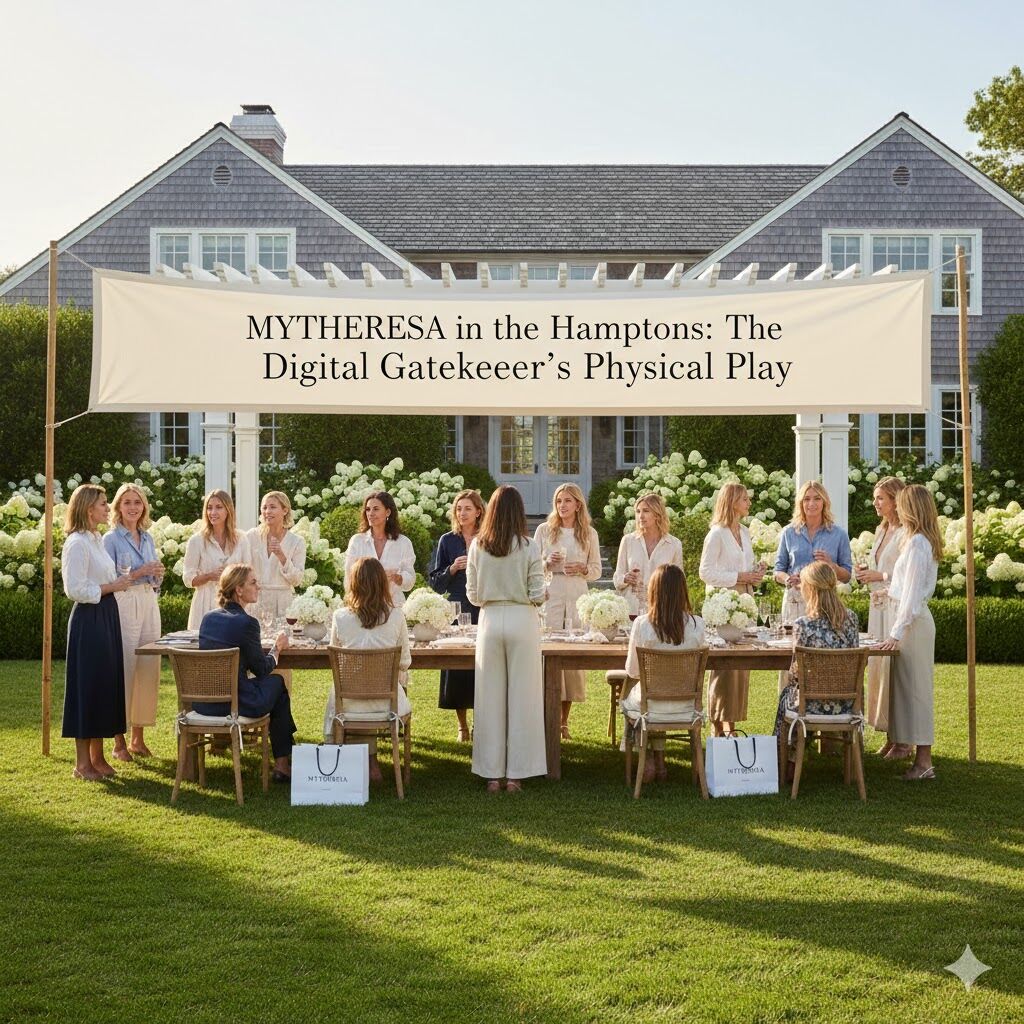
The building at 9 Railroad Avenue in East Hampton started life as an auto body shop. Now it hosts $50,000 emerald necklaces and cashmere sweaters that cost more than the mechanics who once worked here earned in a month. The transformation isn’t irony. It’s strategy.
When Mytheresa Hamptons visitors step off the LIRR and cross the street to find a purple-and-yellow storefront staffed by personal shoppers trained in the art of “surprise and delight,” they’re witnessing something more sophisticated than retail. They’re participating in a carefully orchestrated conversion of digital convenience into physical belonging. The question isn’t whether Mytheresa sells beautiful things. The question is what those beautiful things are actually buying.
The Mytheresa Genesis: From Munich Boutique to Digital Empire
The story begins in 1987, when Susanne and Christoph Botschen opened Theresa, a multi-brand boutique in Munich’s city center. They met at fashion school and built something rare: a marriage and a business that both thrived on shared obsession. “You have to be obsessed with fashion,” Susanne would later explain, and obsession became their competitive advantage.
Munich’s luxury clientele in the late 1980s favored conservative elegance. The Botschens pushed grunge aesthetics and avant-garde designers when their peers played it safe. This contrarian instinct attracted brands like Gucci, Prada, and Saint Laurent, who recognized that authentic curation beats safe inventory every time. By the time competitors figured this out, Theresa had locked in relationships that would take decades to replicate.
The Mythology Machine
Christoph’s strategic mind produced what Susanne called “the best idea he ever had besides marrying me.” In 2006, two years before Zalando existed, the couple launched Mytheresa.com. The timing was deliberate. Digital luxury remained an oxymoron to most industry observers. The Botschens bet that wealthy women would eventually want convenience without compromise.
The mythology emphasizes founder vision and brand relationships. What it downplays is the institutional backing that scaled the dream. Acton Capital Partners invested in 2010. Neiman Marcus acquired the platform in 2014 for roughly €150 million. After Neiman’s bankruptcy carved Mytheresa free in 2020, the company debuted on the NYSE in January 2021, raising $407 million. The founding romance never leaves the story, but the financial engineering made the empire possible.
Today, following the April 2025 acquisition of YOOX Net-A-Porter from Richemont, Mytheresa operates as LuxExperience B.V., a €2.7 billion revenue group targeting €4 billion by 2030. The Munich boutique remains open. It functions less as a store than as a shrine to origin mythology.
Mytheresa’s Four Capitals: Decoding Luxury’s Hidden Currency
Pierre Bourdieu argued that economic capital alone cannot explain social stratification. Cultural, social, and symbolic capitals operate alongside money to determine who belongs where. Mytheresa’s business model weaponizes all four.
Economic Capital
Entry begins around $200 for accessories. The sweet spot hovers near $800, Mytheresa’s average order value that sets it apart from aspirational-focused competitors. Top customers spend upwards of $40,000 annually, and this cohort generates nearly 40% of gross merchandise value. The price architecture filters out browsers without explicitly excluding them. You can look. Whether you can buy repeatedly determines whether Mytheresa invests in knowing you.
Investment positioning remains secondary to velocity. Unlike auction houses pushing “collectible” narratives, Mytheresa emphasizes wardrobe building. The implicit promise: buy consistently at full price, and your rewards compound through access rather than appreciation. This model generated €916 million in fiscal 2025 revenue while competitors hemorrhaged market share.
Cultural Capital
Mytheresa demands specific knowledge from its best customers. You must understand why The Row commands $1,200 for a cashmere sweater when cheaper alternatives exist. You should recognize that Brunello Cucinelli represents quiet wealth while logo-heavy alternatives signal something else entirely. The platform’s curation presumes this literacy without explaining it.
The edit of roughly 250 brands excludes obvious choices. Hermès, Chanel, and Louis Vuitton maintain their own distribution, leaving Mytheresa to showcase brands that benefit from context: Bottega Veneta, Loro Piana, Loewe. Customers prove their sophistication by recognizing value in labels that don’t announce themselves. This shared recognition creates community among strangers.
Social Capital
“Money-can’t-buy experiences” define Mytheresa’s loyalty architecture. Top customers receive invitations to multi-day events in Capri hosted by Dolce & Gabbana, yachting trips with Valentino in Nice, and visits to Brunello Cucinelli’s compound in Solomeo. These gatherings accomplish what algorithms cannot: they transform transactions into relationships and customers into advocates.
The Hamptons pop-up extends this logic geographically. Over 6,000 guests visited the 2024 installation. Martha Stewart attended opening night. Candace Bushnell browsed. The guest list becomes its own credential. Showing up signals that you belong among people who get invited to places that require invitations.
Symbolic Capital
Mytheresa solves the new money problem without acknowledging it exists. Old wealth customers appreciate the curation that keeps them distinct from aspirational shoppers flooding other platforms. New wealth customers access legitimate taste without enduring the education that traditionally accompanied it. Both cohorts benefit, and neither must confront the transaction explicitly.
The brand’s Net Promoter Score of 86% exceeds industry norms because it delivers this alchemy consistently. Customers feel understood rather than sold to. The distinction matters enormously to people spending five figures annually on clothing.
Why Mytheresa Chose the Hamptons—And What It Reveals
The Mytheresa Hamptons strategy emerged from observation rather than assumption. Heather Kaminetsky, President of North America, noticed something during physical activations: digital relationships deepened faster when bodies occupied the same space. “When we’re physically able to engage with people in any environment—whether it’s a dinner or with our product—creating moments with people has enabled us to grow this business,” she explained. “It’s all about connections.”
The location at 9 Railroad Avenue carries deliberate symbolism. Positioned directly across from East Hampton’s LIRR station, the pop-up captures arrivals before competitors can intercept them. The train remains social signifier rather than mere transportation. Wealthy New Yorkers who could helicopter or drive often choose the Jitney or LIRR for the communal performance of summer migration. Mytheresa meets them at the threshold.
Store design evolved annually to sustain interest. The 2023 “Summer Body Shop” transformed automotive relics into luxury display cases—tires became shelving, muffler rails held clothing. The 2024 “Railroad Racetrack” added Porsche sponsorship and fine jewelry, including emerald necklaces worth more than some customers’ summer rentals. The VIP lounge at the rear functions as deal room and decompression chamber, where personal shoppers build relationships that outlast the season.
Partnership with Flamingo Estate adds lifestyle credibility that pure fashion retail cannot generate. Richard Christiansen’s Los Angeles brand brings apothecary products, pantry goods, and the “Inconvenience Store” concept—a curated selection of things you didn’t know you needed until proximity created desire. The collaboration signals that Mytheresa understands how wealthy people actually live, not just what they wear.
Playing the Field: Mytheresa vs. the Competition
The luxury e-commerce landscape shifted violently between 2023 and 2025. Matches collapsed into administration before Frasers Group shuttered it entirely. Farfetch sold to Coupang in distress. Net-A-Porter and YOOX searched for buyers until Mytheresa acquired them. Against this carnage, Mytheresa’s survival looks like victory. Against Bourdieu’s framework, it looks like strategic positioning.
Net-A-Porter pioneered luxury e-commerce in 2000 but never resolved the tension between editorial authority and commercial necessity. Mr Porter carved out menswear but lacked the scale to sustain independent operations. Farfetch’s marketplace model connected boutiques globally while diluting the curation that justified premium pricing. Each competitor solved one problem while creating others.
Mytheresa maintained narrower focus. Fewer brands, deeper relationships, better margins. While competitors chased aspirational customers with promotional intensity, Mytheresa courted “wardrobe-building” shoppers who buy consistently at full price. This discipline yielded 43.4% gross margins when industry averages struggled below 40%.
The Hamptons presence reinforces differentiation physically. Net-A-Porter lacks comparable activation. Farfetch’s marketplace model prevents the kind of brand-controlled experiences Mytheresa produces. Local competitors like Fivestory and Blue & Cream serve different price points. Within the specific intersection of digital-native luxury retail and Hamptons physical presence, Mytheresa operates without direct competition.
The Mytheresa Investment: Cultural Arbitrage or Conspicuous Consumption?
Visitors to Mytheresa Hamptons will find the pop-up operating Thursday through Sunday at 9 Railroad Avenue in East Hampton. Expect personal shoppers who remember your preferences, product exclusives from Khaite, Valentino, and Toteme, and an atmosphere that feels more social club than store. The VIP lounge welcomes appointments for fine jewelry viewing. Flamingo Estate products provide gifts that signal taste without screaming price.
The ideal customer arrives already fluent in luxury codes. They recognize that Brunello Cucinelli’s pricing reflects Solomeo’s artisan culture rather than mere margin extraction. They understand why The Row’s minimalism commands premiums that maximalist competitors cannot justify. They appreciate curation as service rather than limitation. For this customer, Mytheresa delivers precisely what it promises: access to beautiful things surrounded by people who understand their value.
Bourdieu might observe that Mytheresa performs a clever misrecognition. Economic exchange masquerades as cultural community. Commercial relationships feel like social belonging. The platform sells products while appearing to offer membership. Whether this represents sophisticated service or sophisticated manipulation depends on how much you trust the distinction between the two.
What remains undeniable: in a summer landscape crowded with competitors fighting for attention, Mytheresa secured the spot directly across from the train station. The location says everything. When wealthy New Yorkers arrive in East Hampton, the first thing they see is an invitation to belong.
Continue Your Luxury Education
For deeper exploration of Hamptons retail culture, discover our guide to the best Hamptons fashion boutiques that fashion editors actually shop. Learn how luxury fashion trends are reshaping East End style for the 2025 season.
Stay Connected with Social Life Magazine
Author

Written by
Recent Posts
Experiences You Can Only Enjoy on a Sailing Vacation in Italy
How Do THC Gummies Work?
Can I Bring CBD Gummies on a Plane
How Long Do Delta-9 Gummies Last?
Natural Stress Relief Practices, Exercises & Products for More Calm
Categories
- 2025 Social Life Events
- Access to Digital + Physical Magazine
- Art
- Articles
- Beauty & Skincare
- Beauty & Wellness
- Business Strategy
- Celebrities
- Chronicles
- Design History
- Design History|Design Trends
- Design History|Hamptons
- Design Process
- Design Process|Luxury Living
- Design Trends
- Design Trends|Hamptons
- Event Photos
- Events
- Family
- Fashion
- Fashion & Style
- Featured
- Food & Beverage
- Food, Spirits, Wine
- Hamptons
- Hamptons Celebrities
- Hamptons Design
- Hamptons Design|Design Process
- Hamptons Design|Luxury Living
- Hamptons|Luxury Living
- Health
- Health & Beauty
- Home & Design
- Home & Living
- Lifestyle
- Luxury Home Design|Design Process
- Luxury Home Design|Design Trends
- Luxury Home Design|Hamptons Design
- Luxury Home Design|Interior Design
- Luxury Lifestyle
- Luxury Living
- Luxury Living|Design Process
- Luxury Living|Hamptons
- Luxury Living|Hamptons Design
- Press
- Profiles
- Real Estate
- Technology
- The Chronicles
- Travel
- Trending
- Uncategorized
- Weddings
- Wellness