
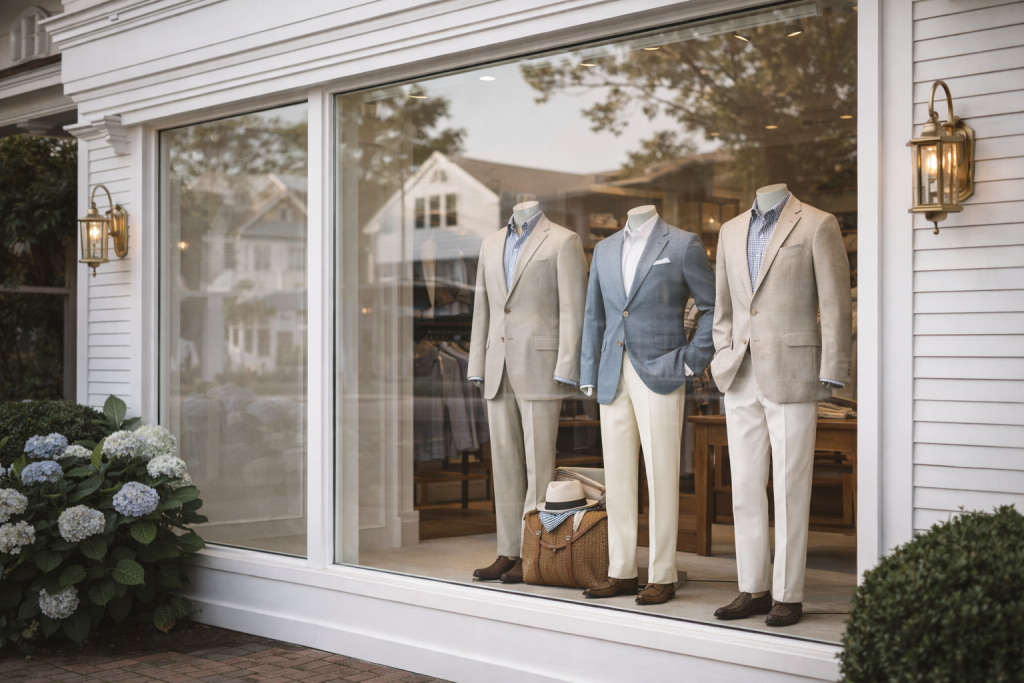
This guide catalogs every brand that genuinely signals old money membership, from American preppy institutions to British heritage makers to European quiet luxury houses. For the complete philosophy behind these choices, see our Old Money Playbook: How Generational Wealth Actually Works.
What Makes a Brand “Old Money”
The Recognition Principle
Authentic old money brands share specific characteristics that separate them from merely expensive labels. Heritage matters. Most legitimate old money brands have operated for decades or centuries, developing reputations that money alone cannot purchase. Brooks Brothers has dressed American presidents since 1818. Barbour has outfitted British royalty since 1894. This longevity creates institutional memory that new luxury houses cannot replicate.
Quality over marketing defines the category. Old money brands typically spend less on advertising than their flashier competitors. Their reputation spreads through word of mouth, inherited wardrobes, and institutional relationships with schools, clubs, and families. The marketing budget goes into materials and construction instead.
Subtlety separates old money brands from nouveau riche favorites. If the average person on the street identifies something as expensive, it’s probably too obvious for old money circles. The recognition should come from those who share the same reference points. Everyone else should see nothing unusual at all.
The Insider Test
A simple framework distinguishes genuine old money brands from pretenders. Ask three questions. First, would this brand be recognized at a Hamptons polo match by those who’ve attended for twenty years? Second, would the same item go unnoticed on a Manhattan subway? Third, does quality justify the price across decades of use rather than seasons of fashion?
Brands that pass all three tests belong on this list. Those that fail any single criterion serve different purposes, however expensive they might be.
American Heritage Brands
Brooks Brothers
Founded 1818. The cornerstone of American old money style. Brooks Brothers invented the ready-made suit, introduced the button-down collar after observing polo players, and has dressed forty American presidents. The brand experienced corporate turbulence including 2020 bankruptcy and subsequent acquisition, but core products remain foundational.
Essential pieces include oxford cloth button-down shirts, navy blazers, and traditional fit suits. The Golden Fleece line represents their premium tier. Quality has fluctuated with ownership changes, but specific products maintain their place in old money wardrobes.
Entry point: $80 (dress shirts). Core pieces: $300-$800. Investment items: $1,500+ (Golden Fleece).
J. Press
Founded 1902. The more refined alternative to Brooks Brothers with stronger Ivy League connections. Locations near Yale and Harvard aren’t coincidental. The brand’s sack-cut suits and sports coats remain unchanged because the customers don’t want change.
J. Press represents perhaps the purest expression of American prep. Their collaborations with Murray’s Toggery Shop produced collections that sold out immediately. The brand maintains American manufacturing for core items and eschews fashion-forward experimentation entirely.
Entry point: $95 (ties). Core pieces: $400-$900. Investment items: $1,800+ (made-to-order).
Murray’s Toggery Shop
Founded 1945. The tiny Nantucket institution that invented Nantucket Reds. The distinctive faded salmon-pink pants were named at a 1962 party for the New York Yacht Club. Lisa Birnbach’s Official Preppy Handbook canonized them in 1980 as “de rigueur at country and yacht club affairs.”
The pigment-dyeing process guarantees the fabric fades gracefully over time. Authenticity matters here. Murray’s holds the trademark on Nantucket Reds. Imitations exist but lack the cultural legitimacy of the original. Fourth-generation family ownership maintains quality standards.
Entry point: $45 (accessories). Core pieces: $98-$198 (Reds pants/shorts). Investment items: $295+ (collaborations).
L.L. Bean
Founded 1912. The Bean Boot is non-negotiable for New England old money. Not as a fashion statement but as actual functional footwear for actual weather. The Norwegian sweaters and chamois shirts matter too. The lifetime guarantee reflects old money values of durability over disposability.
L.L. Bean represents practical Yankee heritage. The brand serves people who actually use their outdoor gear rather than those who photograph themselves in it. Mud on your Bean Boots indicates appropriate use.
Entry point: $50 (chamois shirts). Core pieces: $150-$300. Investment items: $500+ (premium outerwear).
Bills Khakis
Founded 1990. Relatively young by old money standards but essential for understanding American prep. The brand produces American-made khakis in the proper shade. Not bright, not dark. The specific tan of worn cotton that’s impossible to fake.
Entry point: $165 (khakis). Core pieces: $165-$250.
Alden
Founded 1884. The premier American shoemaker. Their cordovan leather penny loafers and tassel loafers define old money footwear. Massachusetts manufacturing continues. The wait times for certain models reflect demand that outstrips production capacity.
Alden shoes improve with age. Proper care and regular resoling extend lifespan indefinitely. The patina that develops cannot be purchased new.
Entry point: $450 (calfskin). Core pieces: $700-$900 (shell cordovan).
Ralph Lauren
Founded 1967. Complicated status. Ralph Lauren democratized American prep, making the aesthetic accessible beyond its original enclaves. The brand ranges from accessible mall-tier (Polo) to genuine investment pieces (Purple Label, Double RL).
Old money opinion splits on Ralph Lauren. Some consider it imitation rather than authentic heritage. Others recognize Purple Label quality as genuinely competitive with European houses. The distinction depends on specific product lines rather than the brand overall.
Entry point: $150 (Polo). Core pieces: $500-$1,500 (Collection). Investment items: $2,500+ (Purple Label).
Vineyard Vines
Founded 1998. Controversial inclusion. The brand represents accessible prep but lacks the heritage of older institutions. Visible logos and bright colors violate traditional old money discretion. However, the brand appears at Hamptons gatherings frequently enough to warrant mention.
Consider Vineyard Vines “casual old money adjacent” rather than core wardrobe. Acceptable for beach days, questionable for club dinners.
Entry point: $50 (accessories). Core pieces: $125-$200.
British Heritage Brands
Barbour
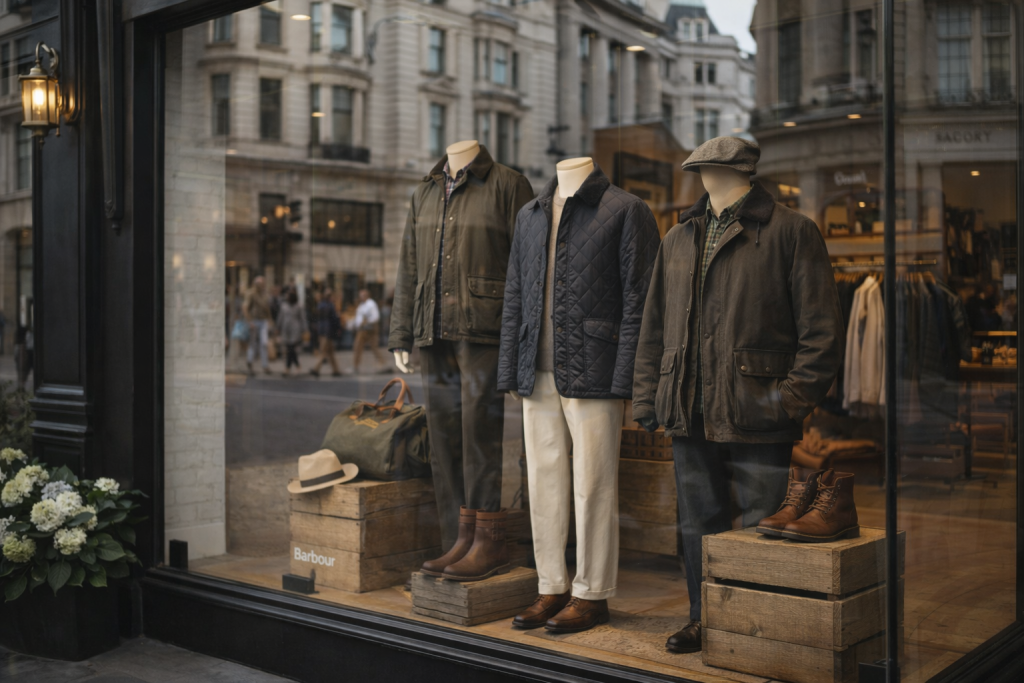
Founded in 1894. Waxed cotton jackets were worn by British royalty and American old money alike. The Beaufort and Bedale models are correct choices. Rewaxing them every few years extends life indefinitely. The jacket should show appropriate wear. A pristine Barbour suggests a recent purchase.
Barbour represents functional British country wear adopted by American anglophiles. The brand’s royal warrants confirm institutional legitimacy. Three generations of the same family have worn the same styles.
Entry point: $200 (accessories). Core pieces: $400-$550 (classic jackets). Investment items: $800+ (heritage line).
Church’s
Founded in 1873. Northampton-made shoes represent the quiet alternative to flashier English shoemakers. Simple designs, exceptional construction, improved by decades of wear. Church’s occupies the sweet spot between accessible dress shoes and bespoke alternatives.
The brand has LVMH ownership now, which purists debate. Core products maintain quality. The brand’s father-to-son inheritance tradition continues regardless of corporate structure.
Entry point: $500 (loafers). Core pieces: $600-$900.
Crockett & Jones
Founded in 1879. Another Northampton shoemaker, family-owned across five generations. Goodyear-welted construction allows indefinite resoling. The brand has dressed James Bond in recent films, raising profile without sacrificing quality standards.
Entry point: $550 (loafers). Core pieces: $650-$850.
Turnbull & Asser
Founded in 1885. Jermyn Street shirtmakers. Their bespoke program represents the gold standard for dress shirts. Ready-to-wear maintains similar quality standards. Prince Charles and numerous British prime ministers have worn their shirts.
Entry point: $285 (ready-to-wear). Core pieces: $450-$600. Investment items: $500+ (bespoke).
Johnstons of Elgin
Founded 1797. Scottish cashmere since before American independence. Their sweaters and scarves appear in old money closets because quality justifies price across decades of use. The brand supplies materials to other luxury houses, suggesting quality that exceeds even their own retail products.
Entry point: $200 (scarves). Core pieces: $400-$800 (sweaters).
Holland & Holland
Founded 1835. London gunmakers whose clothing line extends the brand into lifestyle. The field jackets and country wear represent British sporting heritage. Prices reflect exclusivity. The brand serves people who actually shoot rather than those who merely dress for it.
Entry point: $400 (accessories). Core pieces: $1,500-$4,000.
Hunter
Founded 1856. Wellington boots associated with British country estates, equestrian life, and rainy New England prep school campuses. The original tall boot remains the standard. Avoid fashion collaborations that dilute the heritage.
Entry point: $160 (original tall). Core pieces: $160-$250.
Burberry
Founded 1856. Complicated status similar to Ralph Lauren. The trench coat represents genuine heritage. The check pattern became over-licensed and lost exclusivity before the brand pulled back distribution. Current positioning attempts to reclaim heritage credibility.
Old money selects Burberry carefully. The classic trench in khaki qualifies. Check-heavy accessories do not. The brand illustrates how visibility can undermine exclusivity.
Entry point: $500 (scarves). Core pieces: $2,200+ (classic trench).
European Quiet Luxury
Loro Piana
Founded 1924. The benchmark for quiet luxury. Italian cashmere and vicuña without visible branding. Silicon Valley billionaires wear Loro Piana base layers precisely because no one recognizes them. Gwyneth Paltrow’s courtroom wardrobe featured the brand prominently.
The brand specializes in materials of extraordinary quality. Baby cashmere from the neck and belly regions of Mongolian goats. Vicuña that costs more per ounce than gold. Storm System outerwear that functions as well as it looks. The satisfaction comes from touching the fabric, not from being seen wearing it.
LVMH acquired Loro Piana in 2013 for €2 billion, validating its position at the apex of quiet luxury. The acquisition hasn’t diluted quality standards.
Entry point: $500 (accessories). Core pieces: $1,500-$4,000 (sweaters, shirts). Investment items: $8,000+ (outerwear, vicuña).
Brunello Cucinelli
Founded 1978. Italian cashmere with a philosophy. Founder Brunello Cucinelli purchased a castle in Solomeo as company headquarters. Handmade garments by Italian craftsmen. The brand represents conscious luxury with ethical production.
Brunello Cucinelli cashmere differs from Loro Piana in character. Less soft initially but more durable and resistant to pilling. The aesthetic skews slightly more relaxed. The signature monili beading provides subtle identification for those who recognize it.
Entry point: $500 (t-shirts). Core pieces: $1,200-$3,500 (sweaters, jackets). Investment items: $5,000+ (outerwear, suiting).
The Row
Founded 2006. Modern addition to old money brands. Mary-Kate and Ashley Olsen created a label that embodies contemporary quiet luxury. Clean lines, exceptional materials, minimal branding. The Row proves that heritage isn’t the only path to old money acceptance.
The brand’s extreme minimalism and premium pricing position it as investment-grade contemporary. A basic t-shirt might cost $500 because the fabric and construction justify it across years of wear.
Entry point: $350 (accessories). Core pieces: $1,500-$4,000. Investment items: $5,000+ (outerwear, leather).
Hermès
Founded 1837. The ultimate test case for old money brands. Hermès possesses unquestionable heritage and quality. The Birkin and Kelly bags define luxury aspiration globally. Yet this very visibility creates tension with old money discretion.
Old money approaches Hermès selectively. Scarves, yes. Leather goods in subtle colors, possibly. Prominent bags that announce themselves, rarely. The brand is undeniably excellent. The question is whether excellence serves display or function.
Entry point: $200 (twillies). Core pieces: $500-$1,500 (scarves, ties). Investment items: $10,000+ (bags, leather).
Charvet
Founded 1838. The Parisian shirtmaker where old money places orders for custom pieces. Their tie selection in particular signals to those who recognize it. Charvet represents French refinement applied to wardrobe basics.
Entry point: $250 (ties). Core pieces: $500-$800 (shirts). Investment items: $600+ (bespoke).
Kiton
Founded 1968. Often called the Hermès of suiting. Neapolitan tailoring at its apex. Kiton suits cost $7,000 to $50,000 because the construction justifies it. Each suit requires approximately 25 hours of handwork. Production is limited to about 22,000 garments annually.
Entry point: $500 (ties). Core pieces: $2,500-$4,500 (jackets). Investment items: $7,000+ (suits).
Zegna
Founded 1910. Italian suiting and materials. Zegna operates as both a brand and a fabric supplier to other luxury houses. Their control over the entire production chain from sheep to suit ensures quality standards.
Entry point: $300 (accessories). Core pieces: $1,500-$3,500 (suiting). Investment items: $5,000+ (Couture line).
Max Mara
Founded 1951. The camel coat authority. The 101801 model, essentially unchanged since 1981, defines investment outerwear for women. Italian manufacturing with quality that justifies decade-long ownership.
Entry point: $400 (accessories). Core pieces: $1,500-$2,500 (coats). Investment items: $3,500+ (101801 Icon).
Totême
Founded 2014. Swedish minimalism that aligns with old money principles despite youth. Clean lines, quality materials, restrained branding. Totême represents Scandinavian interpretation of quiet luxury.
Entry point: $200 (accessories). Core pieces: $500-$1,200.
Watches and Jewelry
Patek Philippe
Founded 1839. The pinnacle of old money timepieces. Their advertising slogan captures the philosophy: “You never actually own a Patek Philippe. You merely look after it for the next generation.” Watches are inherited rather than purchased.
Entry point: $20,000 (Calatrava). Core pieces: $30,000-$100,000. Investment items: $200,000+ (complications).
Cartier
Founded 1847. The Tank watch designed in 1917 remains the definitive old money dress watch. Simple, elegant, instantly recognizable to those who know watches, invisible to those who don’t. Jewelry follows similar principles. Avoid logo-heavy pieces.
Entry point: $3,000 (Tank Must). Core pieces: $7,000-$15,000 (Tank Française, Santos). Investment items: $30,000+ (precious metals).
Vacheron Constantin
Founded 1755. The oldest continuously operating watch manufacture. Even more discreet than Patek Philippe. Recognition requires genuine horological knowledge. The brand serves collectors who’ve moved beyond mainstream prestige names.
Entry point: $15,000 (Patrimony). Core pieces: $25,000-$80,000.
A. Lange & Söhne
Founded 1845. German precision watchmaking. The brand attracts collectors who appreciate mechanical excellence over brand recognition. Lange watches signal connoisseurship rather than wealth display.
Entry point: $25,000 (Saxonia). Core pieces: $40,000-$150,000.
Building an Old Money Brands Wardrobe
The Foundation Strategy
Acquiring old money style doesn’t require purchasing everything at once. The approach should mirror old money philosophy: invest in quality that compounds over time rather than acquiring quantity quickly.
Start with basics from accessible heritage brands. Brooks Brothers oxford shirts. Alden loafers. L.L. Bean boots for weather. These pieces establish foundation at reasonable investment levels. As budget allows, upgrade individual categories rather than expanding horizontally.
The Investment Calculation
Old money math differs from conventional shopping. A $3,000 Loro Piana jacket worn 200 times over five years costs $15 per wear. If resold for $1,500, true cost drops to $7.50 per wear. A $300 fast-fashion alternative worn 20 times before disposal costs $15 per wear with zero recovery.
The calculation favors quality consistently. But it requires patience and confidence that trends won’t tempt you toward disposable alternatives.
The Maintenance Requirement
Old money brands require maintenance that fast fashion doesn’t. Rewax your Barbour. Resole your Aldens. Store cashmere properly with cedar. Have sweaters professionally cleaned. The pieces reward care with decades of service.
This maintenance mindset separates authentic old money style from costume wearing. The goal isn’t looking like you have money. It’s treating quality possessions with respect they deserve.
What to Avoid
Certain brands disqualify themselves from old money status regardless of price. Any brand where logos dominate the aesthetic, chasing quarterly fashion cycles, or prioritizing recognition over quality. Any brand whose primary appeal is being seen wearing it.
The new money vs old money distinction applies to brands as clearly as to individuals. Brands serving new money need visibility. Brands serving old money need quality. The priorities differ fundamentally.
Where Old Money Actually Shops
The Hamptons Circuit
Southampton and East Hampton host boutiques stocking genuine old money brands. These aren’t the flashiest stores on Main Street. They’re the ones that have occupied the same locations for decades, serving the same families across generations.
The complete guide to Hamptons living details these shopping destinations. The consistent pattern: old money shops where staff recognize regular customers, maintain relationships across years, and stock merchandise that doesn’t change dramatically season to season.
The City Institutions
J. Press on Madison Avenue. Brooks Brothers’ flagship. Bergdorf Goodman’s curated selection. These Manhattan institutions continue serving old-money customers despite broader retail disruption. The experience differs from mass luxury retail. Staff knowledge matters. Relationship building matters. Transaction speed doesn’t.
The Resale Ecosystem
Old money wardrobes include inherited and secondhand pieces. Consignment stores in wealthy zip codes offer previous-generation quality at fraction of retail. The RealReal and Vestiaire Collective provide authenticated luxury resale online.
Shopping secondhand aligns perfectly with old money values. Quality pieces deserve second lives. Acquisition source matters less than item quality. A 1990s Barbour from consignment carries more authenticity than a new fast-fashion imitation.
Connect With Social Life Magazine
Get Featured: Contact Social Life Magazine for advertising, features, and brand partnership opportunities.
Polo Hamptons 2026: See these brands in context at Polo Hamptons. Tickets, cabanas, and sponsorship opportunities available.
Stay Connected: Subscribe to our email list for exclusive event invitations and insider access.
Print Subscription: Get Social Life Magazine delivered—the Hamptons’ luxury lifestyle authority since 2000.
Support Independent Journalism: Donate $5 to support our coverage.
Related Reading
The Old Money Playbook: How Generational Wealth Actually Works
Author

Written by
Recent Posts
Must-Have Items for Your Wedding Gift Registry
What Mental Health Challenges Can Look Like Over Time
Quiet Luxury: The Rise of the Smart Motorized Pergola
Sleek Cosmetic Upgrades That Refresh Your Natural Beauty
Durable Vinyl Poster Printing in NYC That Turns Heads and Drives Results
Categories
- Art
- Articles
- Beauty & Skincare
- Celebrities
- Celebrities|Movies
- Celebrities|The Chronicles
- Chronicles
- Entertainment|Culture
- Event Photos
- Events
- Fashion
- Fashion & Style
- Featured
- Food & Beverage
- Food, Spirits, Wine
- Hamptons
- Hamptons Celebrities
- Hamptons Celebrities|Celebrities|The Chronicles
- Health
- Health & Beauty
- Lifestyle
- Luxury Lifestyle
- Movies|Culture
- Movies|Hamptons Lifestyle
- Press
- Profiles
- Real Estate
- Technology
- The Chronicles
- Travel
- Uncategorized
- Weddings